Accelerate your Business Journey with Continuous Testing in DevOps

In the current pandemic scenario, the need for digital solutions in all business sectors has increased immensely and is predicted to accelerate further. Many new industrial foundation concepts like Agile Testing, Cloud Testing, or outsourced independent software testing services have been regressively adopted by business experts to retain a position in the digitally competitive environment. Continuous Testing in DevOps is another digital priority that includes early and regular testing from the start of development to deployment end to track issues at all stages and resolve them on a prior basis for the best quality practices.

Adopting into a Quality Approach!

To manage costs and business trends in the market, businesses have to outdo their current quality approach by implementing effective quality agile and DevOps practices for automation testing. Quality Assurance providers should understand the importance of independent software testing at all stages. Automation testing is a key build-up in continuous testing which enhances testing flexibility with increased frequency and continuity in DevOps QA testing processes through continuous testing tools. Continuous delivery with Automated Testing helps in combating many QA challenges and lets IT decision-makers work excellently with consistent quality delivery to business clients. Continuous Testing which processes in the starting journey of the Software Development Life Cycle helps to track down defects at an early stage and is a great step towards Continuous Integration best practices. The software testing company should be considered about adopting agile testing with Continuous Testing in DevOps to assure consistency in quality testing at all development stages.

Can Testing Capabilities be increased with Continuous Testing with DevOps?

Continuous Testing with DevOps acts as a key differentiator and is vital for software development businesses to meet up instant and increasing customer demands related to high speed and quality development without bugs and need for improvements. It is an important task now to integrate Continuous Testing with DevOps Testing along with core fundamentals – Continuous Integration and Continuous Delivery. Test Automation through Continuous Testing adds to the testing capabilities of the CI/CD pipeline built by the DevOps team for quicker, bug-free, and flexible development of the business software.

How Business Goals can be Achieved Utilizing CI?

Continuous Integration with Continuous Testing, the Continuous Deployment best practices can improve your business profits to another level as it introduces multiple benefits to both developers and testers which help them to achieve the business goals in the right time duration while keeping in consideration the flexibility and quality aspects.

Cut Down Code Review Downtime

The quicker feedbacks induced by Continuous Testing are transferred between the Testing and Development team continuously which cut short the downtime for code review as all the development and test requirements are already met which results in the best DevOps testing strategy.

Maintain Testing Consistency

Continuous Integrations and modern software testing services help in bringing testing consistency to the software development project. It creates a robust system and subsystem connection with the sustained environment for quality and regular testing with minimum fails.

Improved Development Transparency

The value added to all stages in the development comes with the early and continuous testing from the start which enhances visibility to both testers and developers at the right time. The whole team is aware of detected and possible issues in the stages which they work upon to fix before moving to the next level which secures the time and increases testing transparency.

Offers Faster Market Releases

Businesses are harnessing the advantage of Continuous Integration and Testing by utilizing the opportunity or speedier and frequent market releases. This has been made possible with the concept of agile and frequent testing at the earliest stage of the SDLC.

Enhanced Test Coverage & Capabilities

With the introduction of Test Automation and early detection of defects via Continuous Testing, testers are now able to cover all potential aspects of failures in the DevOps Test Automation. It results in robust, secure, and bug-free product development for any business.

Minimizes Application Bound Risks

As Continuous Testing offers a quick turnaround at an early stage only with frequent rounds without any loopholes bugs or errors, it minimizes the development and design risks related to sudden change in code structure or design parameters modification. It is because the developers are early informed about the suspected issue which saves both time and cost for businesses

How to Adopt Continuous Testing?

The adoption of new digital age testing practices like Continuous Testing is not an easy task and includes consideration of multiple aspects as mentioned below:

Virtualized Environments: 

Working on virtual testing environments is beneficial to maintain regular and frequent testing tasks without loss of resources.

Requirements Analysis: 

While using the Continuous Testing approach, every stakeholder related to the project should be involved to run a smooth testing journey with clear requirements knowledge.

Test Data Management: 

Synthetic data generation for testing without risking the information is needed to maintain speed and transparency.

Testing Types: 

In Continuous Testing, API testing is required to manage the testing pyramid. Other crucial testing includes Security Testing, Performance, and Load Testing.

Test Automation Tools: 

It is vital to choose the correct and effective Continuous Testing tools based on the type of development, market trend, cost considerations, performance, security, etc.

Acceptance Criteria: 

Multiple acceptance criteria based on user stories can be utilized to create tests to satisfy all requirements one by one.

Automation Generation: 

Running Automated Testing via generated acceptance-level tests at the start of the development sprint allows developers to receive immediate feedback on which they can work upon for improvements.

Feedbacks Communication: 

The real-time and automated feedback loops are helpful to check the product reality and quality level all the time.

Explore It Now!

Many businesses are looking forward to adopting modern testing approaches like Continuous Testing and are also ready to outsource software testing services or outsource software testing company for digital help. Get in touch with us directly with your project requirements to get instant services with consultations from testing experts.
Its Deadline for Legacy System – Start New journey with Legacy System Modernization!

As technology advances, the need to modernize legacy systems becomes more crucial. Most companies that need digital transformation have at least one legacy system that needs to be modernized. If you fail to modernize your legacy system, you lose the ability to leverage new technologies and keep pace with the competition in the market. Now, it’s time for every organization should understand the importance of digital transformation in business.

In many companies, software exists that was built decades ago and has been modified over the years. This legacy software is often expensive to maintain and difficult to upgrade. It can also provide limited functionality. Modernizing this legacy code allows the legacy modernization company to improve business processes and become more competitive in the marketplace.

Legacy Technology – End of Life

Inefficient digital transformation legacy systems can slow down digital transformation initiatives and prevent organizations from keeping pace with competitors. Here is what legacy system indicates the end of its life:

  • The application imparts only to the manual settings.
  • Only one type of data alone is accepted and has many risks factors.
  • The solution provided has low productive capacity.
  • Outdated software abstains, to incorporate with other systems.
  • Maintenance is overpriced and complicated in this case.

Replacing legacy systems and understanding the importance of digital transformation in business will provide a unique solution to legacy system modernization.

Why do you Need a Legacy System Modernization?

New technology and innovations got developed every day and the pressure is on to deliver more at less cost and in less time with digital and business transformation, it can be difficult for businesses to keep up with the pace. Businesses using legacy systems face many problems including outdated coding languages, limited software platform options, and inadequate staff skills. Have you faced legacy system issues? Here are the indicators that you should get alert to get a change with legacy app modernization:

  • Time consuming performance and task.
  • Taking plenty of time for maintenance.
  • Investment your penny to maintain the system.
  • Tedious on manual operations.
  • Bug raising as the system gets updated.
  • Losing the security level.
  • Data breach.
  • Low speed and performance.
  • Low features for migrating.
  • Problems in integrating and support.

Click to know about the right practices, risks to overcome, how to step and transform from legacy system modernization for your business

Benefits of legacy system modernization

Using a legacy system is always feels like standing on the tip of the iceberg. With the help of legacy system modernization, you can be able to provide the customers with relevant information about your company and what you do for them.

Some key benefits you gain with legacy system modernization are:

Better Customer Service

A well-designed business and digital transformation provide up-to-date information on each customer interaction so that customer care agents can provide better service by being able to access the right information at the right time. This can lead to increased customer retention and increased sales.

Business Growth 

A legacy system modernization solution can help you create new products and services based on the business intelligence derived from the data in your legacy applications, so you can grow your business without increasing costs.

Faster Innovation 

A legacy system modern digital business helps you leverage existing investments in technology so you can innovate faster, deliver value sooner, and reduce risk.

More Efficient Operations 

By modernizing your legacy system to a new system with a custom solution, you can streamline business processes and eliminate unnecessary steps across multiple systems with digital transformation software development. As a result, employees are more productive, and operations are more efficient.

Reduced Maintenance Costs

A custom legacy software modernization solution enables you to consolidate redundant applications into a single system. It eventually saves your overall legacy system maintenance cost.

Less tension, more happy clients

With smooth UI and user-centric experience, the customer gets satisfied, and employee performance also gets recognized. Ultimately this helps the organization with an increase in revenue.

All set for future-ready business

Replacing the legacy system with Modern technologies elevates the business higher. It helps the business owner evolve and expand the business, to the higher niche. Upgrading with the latest technologies helps the internal culture be innovative and agile.

The future is based on a risk-free environment for any business. Since the legacy system, is not configured to understand the risks factors. It is easy for hackers to hack any, type of data.

Cybersecurity is foreseeing as the future. Business owners using the latest infrastructure must be calculative on risks. Hire a legacy software modernization company to safeguard your data and ensure the organization’s security.

Unlock Big data with better performance and reliability

Outdated infrastructure is always a Barrie gate from accessing the company data quickly. Optimizing the database needs to be successful for an organization with big data opportunities.

The end-users always expect the project, completed on time. To achieve the outcome, the organization needs to be up to date. Introducing AI, cloud, cybersecurity, and automation with the help of DevOps helps the process on track and pushes to deliver it quickly.

The Best Option for Legacy System Modernization

Most systems in use today were created decades ago when we had a very different world. The technology landscape has changed dramatically since then, and the systems we’re using today simply can’t keep up with the demands of modern e-commerce. We live in a mobile world. We interact with our customers on social media platforms. And our customers expect to shop wherever they choose.

The good news is that there’s no shortage of options for innovating your legacy system. You can make it nimbler and more responsive by relying on APIs, or you can add features you couldn’t have dreamed of when your store was first built. Or you can replace it altogether with a modern platform designed specifically for e-commerce with legacy modernization services.

We can help you!!

Check out the best benefits of Legacy System Modernization to your business models at CG-VAK Software & Exports Ltd. Here, with a single email query, you can connect with our business experts directly for IT and digital transformation services.

HubSpot Vs WordPress: Which is the smart choice for your business?

Are you aware of the fact that over 70 million websites in the world are built using a CMS? It is common knowledge that an efficient and easy-to-use CMS gives a website its spine and drive, its cohesion and contour, and a huge chunk of its personality. A CMS made up of a content management application (CMA), and content delivery application (CDA), does all the technical work in the background, allowing the end-user to focus on the front end of the site.

Content Management System and some popular CMS!

CMS allows a person with limited technical knowledge or coding expertise to create, manage, modify, personalize, optimize, and publish content on a website.

There are dozens of CMSs available in the market. The most popular ones are WordPress, HubSpot CMS, Joomla, Drupal, Magento (for e-commerce sites), Ghost, Sitecore, Squarespace, and Wix among others. Now it’s a hectic moment to choose the best one for your business website. No worries! we provide a clear explanation for you to choose a perfect one for your website.

What is the Best CMS Platform?

There is no one answer to this question. There could be a favorite, but then it would be hard to argue that one CMS will do the job to perfection in almost 100% of situations.

What though can be done is to compare them based on numbers and data and try to figure out which CMS can do the job most of the time, if not all the time.

There’s must be a reason though, as to why WordPress and HubSpot CMS enjoy overwhelming popularity —a fact attested by their overwhelming market dominance.

WordPress launched in 2003 is a free and open-source leading content management system written in PHP programming language. Ideal for small businesses and freelancers, WordPress powers over 60 million websites in the world. WordPress easily lets you build a WordPress site with its Gutenberg editor and then customize it with plenty of plugins and themes available in the WordPress directory, and available on third-party sites.

HubSpot content management system launched in 2006 is a CMS ideal for any-sized business. It is important to note that HubSpot at its core is a marketing company, which means it is a one-stop destination for all your online marketing needs. HubSpot CMS is one of the software solutions offered by the company which provides a high level of flexibility and ease of use to help create and optimize personalized content and measure a website’s performance over time.

To sum it up, HubSpot boasts touts itself as an inbound marketing enabler intended to help the business grow with its comprehensive suite of online marketing products.

HubSpot CMS Vs. WordPress

Let’s make a comparison between the two popular CMSs on a few important parameters to comprehend which is going to be the best fit for your website

  • Website Performance
  • Ease Of Maintenance
  • Security
  • SEO & Analytics

Performance of the website 

Websites that fail to load within a couple of seconds are likely to suffer from a high bounce rate. In today’s crowded virtual world, speed matters a lot. HubSpot scores ahead of WordPress on this parameter as it automatically manages speed optimization. In the case of WordPress, you need to install this plugin. Also, HubSpot has its built-in page performance tracker. If you are using WordPress, you need to download the software from a WordPress plugin.

In short, if you want everything done for you, HubSpot is a better option. On the other hand, if you wish to involve yourself more in pages optimization, WordPress is just what the doctor ordered.

Ease of maintenance 

Like any other thing, websites require regular maintenance and updates for smooth running. To keep the website optimized and relevant, features such as security, privacy, software updates, etc need consistent upkeep. HubSpot makes it easy as all these features are built-in into the software.

In the case of WordPress, for most of these tasks, plugins from a third party are required. HubSpot sites as such are less susceptible to crashes.

Security 

HubSpot has an in-house team for taking care of security issues such as threat monitoring, activity logging, SSL protection and intrusion detection to mention a few.

In the case of WordPress, all these features are generally incorporated through third-party plugins, which in turn could enhance risk factors.

SEO & Analytics 

To drive online traffic, websites need to rank higher in SERP. HubSpot offers in-built features that make it rather easy to make optimization changes. In the case of WordPress, you again must rely on third-party plugins. The sheer popularity of WordPress has led to the springing up of firms involved in the business of building SEO add-ons for WordPress. One prime example of it is Yoast.

HubSpot seo tool offers its traffic and contacts analytics tool; to do the same in WordPress you need a CRM tool. Hence you can find a new digital content marketing strategy. With HubSpot analytics software tool, you can build everything you need right from landing pages to call to action.

Spotlighting the comparison of HubSpot CMS Vs WordPress

AspectHubSpot CMSWordPress
SecurityIn-house security managementMore plug-ins and software requirements increase vulnerabilities
On-page SEOIn-built features. Ideal for beginnersMore customizability. Better for keeping a tab on SEO goals
BloggingLimited blog customization features.Host of tools to customize the look and feel of a blog
DesignLacks design customization and sophisticationSophisticated and customized designs that can be purchased from professional developers and designers
SupportExcellent support provided by the in-house teamThird-party integrations mean support may not be up to HubSpot standards
PricingPricing model more aggressiveA lot of free plugins keep costs down
AnalyticsEasy to graspMore functionality, but more knowledge required

HubSpot CMS or WordPress: Which is better to opt for?

WordPress by far is the undisputed leader when it comes to a CMS. WordPress controls over 60 million websites – that means over 40% of all websites use WordPress. In sharp contrast, less than 1% of all websites are built on HubSpot.

However, it in no way implies that HubSpot is inferior to WordPress. It is just that they are meant to serve different purposes. WordPress is more ideal for bloggers and small businesses. However, if you are a B2B business with your in-house digital and marketing team, you are better off with HubSpot. It has an extensive range of in-built features that make scaling and lead generation a breeze.

Also, some marketers find it more comfortable to work with streamlined features available in HubSpot. And then some marketers prefer the customizability options provided by WordPress.

To conclude, there are certain features in WordPress found wanting in HubSpot, and the opposite is also true. In the end, when we speak about HubSpot CMS and WordPress, currently HubSpot CMS is the decision preferred over WordPress for website development.

We help you with WordPress and HubSpot Development Services

Building a website that possesses excellent lead-generating capability, as well as an exceptional digital marketing strategy is not an easy task by any stretch of the imagination. It always helps to bring an outside ally to shoulder the load and grow your brand. Along with the platform you have to choose a best CMS development company for your project. Our CMS developers at CG-VAK help you get astounding websites for your business. Talk to us today about CMS web design and CMS development.

Kick Start your Software Development process with Behavior Driven Development

Behavior Driven Development (BDD) is an agile software development process that makes use of continuous real-world examples through which we define the behavior expectations from the system. The main objective of BDD methodology is to encourage communication amongst the stakeholders of the project so that there is a clear understanding of the problem and its desired solution.

By inspiring developers to pay attention only on the desired performances of an app or program, BDD plays an important part in trimming down the excess, the bloat, unnecessary codes, and redundant features—all the factors that shift focus from the real problem to be solved. This methodology is an extension of test-driven development (TDD) as it is written in a shared language that streamlines communication between developers, non-technical people, and stakeholders.

A typical BDD project initiates with a conversation between the developers, managers, and customer; this communication helps in the evolution of the framework regarding how a product is envisioned to work. What is expected from the project is now set as a goal for the developers. The project is set to be delivered to the customer after all the behavior tests are aced and the product meet its desired requirements.

What specialize in BDD compared to other development techniques?

In BDD, software acceptance testing, or end-user testing (test to check if the product serves the purpose of the end user) serve as the starting point for software design., They assist in the establishment of a clear channel of communication between stakeholders and the development team.

The major problem in development of software is to ensure that all the stakeholders are perfectly aware of what exactly is happening. Here, BDD makes its presence strongly felt as it serves as a powerful communication tool that brings all the stakeholders on a single platform to ensure that everyone is aware of what is needed.  This in turns promotes greater clarity and cooperation between both technical and nontechnical people involved in the project.

The primary objective of behavior-driven development approach as such is to ensure that everyone in the team can read and write acceptance tests.  Of course, it is the code written by developers that automates the tests, but BDD ensures that everyone can comprehend its essence.

Few distinguishing features of BDD in comparisons to other development techniques are enumerated as following:

Strong Collaboration: 

No development skills are required for creating tests, which means product owners, developers, and testers are aware of how the project is progressing.

Shorter Learning Curve: 

Since BDD is explained using ubiquitous language, it becomes easier to grasp for all the stakeholders involved.

High Visibility:  

Since it is a non-technical process, it can resonate with a larger audience.

Rapid Iterations: 

With BDD, it is easy to make improvements as the response time for responding to users’ feedback is curtailed.

Less Wastage: 

BDD helps in clear communication of what is required, which in turn results in better understanding and subsequently less rework.

Focus on User Needs:  

Happy customers are good for businesses and the BDD methodology is all about focusing on end users need.

Meets Business Objectives: 

With BDD, each development is linked to the actual business objectives.

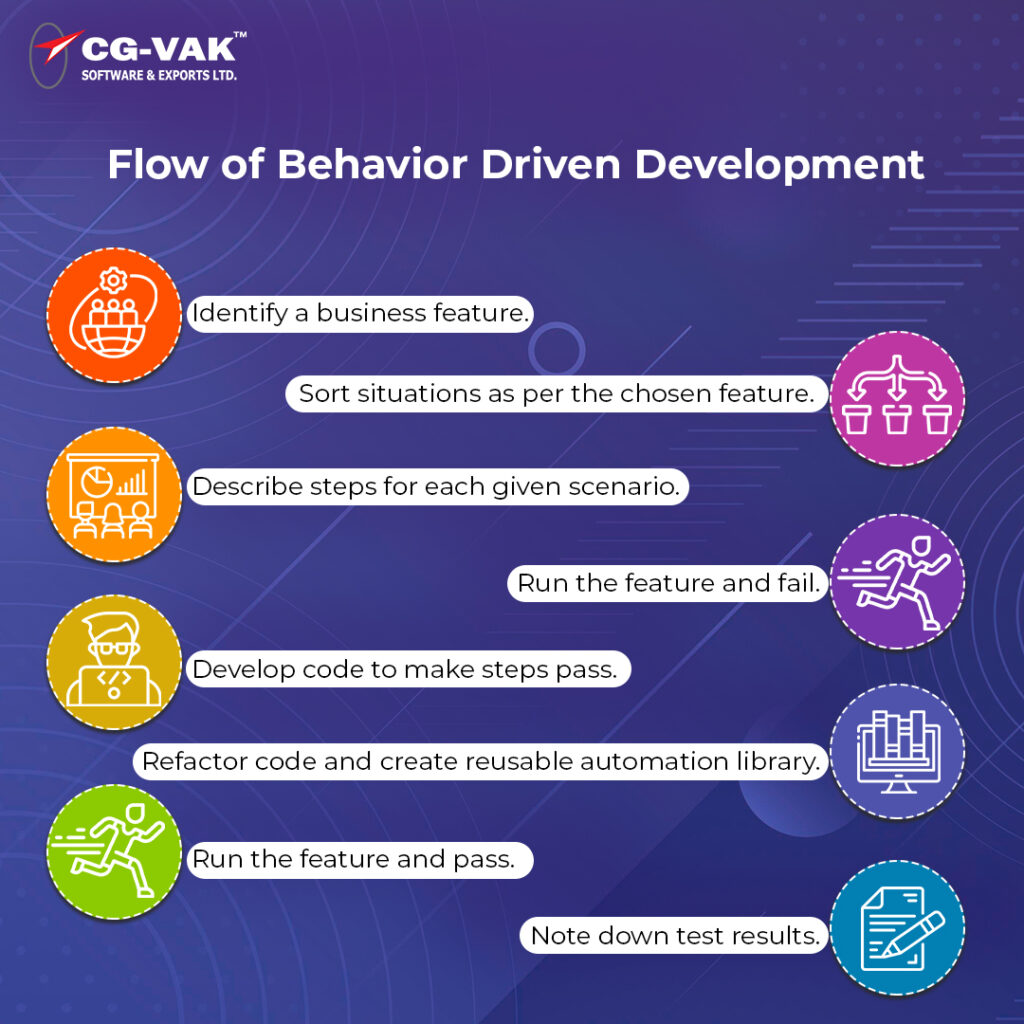
Flow of BDD:

BDD is an evolved version of Test-Driven Development, as it makes use of the ideas and general techniques of TDD. In addition, BDD combines it with ideas from domain-driven design and object-oriented analysis, which in turn provides analysts and developers with the shared processes and specialized tools for BDD to facilitate collaboration on software development. In short, it shows how software development should be a seamless integration of business interests and technical insight.

The first step of BDD involves creation of a goal. This goal is translated into features and stories. In order to ensure that the behavior is understood by all the stakeholders involved, it is written in a language that all can understand.

A Given context:  Preconditions

When the event occurs: Actions

Then an outcome: Results

Sample Feature File

Scenario: Withdrawing cash from an ATM

Given: The user inserts the card in the machine

When: User need to enter pin and other details

Then: The cash successfully dispersed

This is the outcome of BDD. Whatever tests is written must adhere to the Given-When-Then, which in turn makes the entire software testing process easy.

Features of BDD

  • Inculcating a focus-shift from “tests” to “behavior”
  • A collective effort between developers, non-technical people, QA team, and stakeholders.
  • Ubiquitous language that is easy to comprehend
  • Driven by Business Value
  • Goes one over Test Driven Development (TDD) using a natural language easy for non-technical people to understand.

The ‘Given-When-Then’ formula

One way to go about writing the BDD test cases for a user story is through the application of the template:

The Given context + When an action is carried out + Then this should be the observable consequence

Take for instance:

Given the User wishes to book a ticket

When they click the submit button

Then proper message should be displayed for further action

The proposed template is created using tools like JBehave, RSpec or Cucumber. Cucumber Open, which is a Java framework for BDD is the world’s leading tool for BDD. It facilitates writing tests in a language that can be understood by both technical and non-technical person. The language that Cucumber recognizes is known as Gherkin.

A real-world example for BDD:

Given a barbie doll costs $15

When we sell Tina the doll

Then the amount the customer should pay is $15

That is,

A context is Given

When an event occurs

Then it shall result in an outcome

Benefits of BDD framework for your business

Promotes collaboration:  

BDD uses a language everyone can understand. This in turn promotes collaboration and allows everyone to active engage during the software development.

High visibility:

Since BDD utilizes a language everyone can understand, all the stakeholders are aware of how the project is progressing.

The software design lays emphasis on business values and needs:  

Clients can easily communicate their priorities, which in turn help developers offer a more tailored product with minimal wastage of resources.

Lower costs:

Clear communication eliminates misconceptions and misunderstanding, which significantly reduces the overall cost of the project

Facing difficulties in project? Utilize BDD process

Behavior-driven development (BDD) is a set of best practices that enables organizations to develop software centered around real-world problems with real-world users. Earlier, a lot of superficiality crept into the project as the focus was on technical solutions. This has changed as BDD focuses on the actual end-users who would be using the software.

If you are facing difficulties in software development because of incomplete or misaligned information, which is resulting in frustrations from end users, please give us a call. Outsource your software development requirements and our BDD experts would be glad to give you a hand.

Renovating eCommerce Retail Industry with Augmented Reality

In the modern world of shopping, eCommerce development company and the retail industry are facing the biggest challenge with the soaring cost of returns. More than 50 percent of these online retailers are under the pressure of free returns expected by above 80 percent of customers.  With this rising demand, eCommerce retails are stuck at risk of quite low margins. As per the recent study, the UK is facing a cost of around 60 billion Euros per year. All these repercussions require a serious solution like implementing Augmented Reality into eCommerce industry to sustain in the market as well as meet the demands of the customers.

What is Augmented Reality?

Augmented Reality is the technology that helps in improving the real-world environment using computer-generated perpetual data involving visual, auditory, haptic, sensory modalities, and more. It brings a real-world perspective to the user by mixing 3D models virtual objects using a live camera feed.

AR in retail market is the most successful experiment for online retail companies as it is intended to offer a real-time shopping experience via virtual reality in retail without any need for visiting the retail shop.

What Challenges Retailers Face? Why Should They Choose AR? 

As mentioned before, eCommerce retailers are struggling for good conversion rates and facing a crisis of low margins with induced pressure of free returns by today’s woke customers. With the market competition of multiple eCommerce online retailers and direct encounters to big technical giants, there is a dire need to increase conversion rates with engaging platforms.

The online customers who are getting smarter with passing days are now more interested in the “try before you buy” concept where they like to have the complete information and the personal product experience as they used to have in the onsite shopping. To meet these customer demands and for high conversion rates, big tech and eCommerce giants like Lenskart, IKEA, Lakme, Amazon, etc. are continuously implementing Augmented Reality retail app for providing the best real-time consumer experience before they make any purpose.

There are many reasons why online retailers should go for including Augmented Reality in online shopping.

Reduction in Product Return

With the inclusion of Augmented Reality eCommerce app such as Lenskart’s virtual Augmented Reality experience for customers by eCommerce retailers, there is a significant amount of reduction in product return by customers as they are already familiar with the usages of the product, look and feel, and could choose the correct product as per their requirements.

Trying Option before Buying 

Augmented Reality solutions offer online customers a chance to know exactly about their desired products as they used to do while visiting shops personally. It delivers an amazing shopping experience with the provision of trying on products digitally such as eye lenses, clothing, makeup, etc.

Increasing Brand Presence and Awareness

With retail Augmented Reality app development, retailers are enhancing brand presence with direct customer engagement with the detailed product description and instant feedback with complete transparency. Customers are also getting completely aware of the Augmented Reality eCommerce brands.

Breaking Language Barrier 

The Google Translate AR mode allows customers to view and read their eCommerce application in their chosen language which improves the customer experience. Customers can switch to around 40 languages to view the site content easily.

Enhanced Conversion Rate 

Online shopping with Augmented Reality and real-time product description, Augmented Reality online shopping ramps up the conversion rate where customers make a purchase only when they try it out online.

High Rate of Investments 

Virtual Reality shopping online made customers well aware of the brand value by in-person digital experience and in return helps in providing the high ROI.

Customized Shopping Experience 

eCommerce sites that offer AR shopping experience to consumers support customized experience can make the selection of products as to how it will look in a real-time environment. For example – clothing colors, wearable, etc.

Extra-ordinary Customer Engagement 

Customers prefer those brands that can provide them the shopping experience they like to have without moving to the onsite. The revolutionary Augmented Reality strategy is capable to enhance customer engagement rapidly.

Best Mode in Social Distancing Times 

In the Covid-19 situations, where social distancing is necessary, retailers including Augmented Reality apps are growing faster as consumers are more concerned to visit offline shops and they prefer the exact shopping experience offline.

Amalgamation of Onsite & Online Shopping Experience

The best part of renovating the eCommerce retail industry with Augmented Reality as it offers a combination of both digital and offline shopping experiences which helps in building customer engagement better.

Click here to know the power of AI in eCommerce and How AI Drives eCommerce and Boost your Business

How Augmented Reality makes Customers Happy while Shopping? 

Augmented Reality products are helping customers to enjoy shopping online like never before. Customers are now completely engaged in the product trial online to select the best-suited one for their usage.

Let us understand through some real examples how customers are enjoying Augmented Reality shopping.

“Virtual Try-On” Facility by Lakme & Sugar

The top cosmetic brands included AR technology into their online websites to provide them real-time makeup experience with different lipsticks shades and other makeups which is quite helpful in making the quick decision.

IKEA Place Application

It was launched in 2017 and since then offers customers to experience and visualize different products into their existing space with integrated AR solutions.

Amazon Salon

The recently launched Amazon Salon provides hair coloring experience to online customers giving them an accurate idea of how each hair color would look on them which is again satisfying for customers before making any purchase.

Virtual AR Experience by Lenskart

Lenskart is the big brand for eye wears and it has also utilized the power of AR by offering customers the virtual eyeglasses trial experience to ease down the correct fit, color, and look as required for the purchase.

Win your Market with Augmented Reality, how to Integrate AR in eCommerce? 

The future of Augmented Reality is bright. There are many innovative ways to integrate AR into eCommerce which can boost up the conversion rates, ROI, and margins. eCommerce retailers can introduce avatars and digital twins in the metaverse, create digital real-estate stores, increase try-on on multiple product categories, use AR for marketing and promotion, etc.

But, to utilize the best of Augmented Reality technology in eCommerce, market experts are required, and outsourcing the services is always a good approach. The online retailers interested in AR app development can get advanced services at CG-VAK Software & Exports Limited. Here, digital experts are available for fine consulting, eCommerce development services, and Augmented Reality services.

Augmented Reality is a boon for eCommerce retailers who are now intended to integrate AR and virtual experiences for better conversion rates, margins as well as reduced product return rates. So, investing in the outsourcing IT Company which provides the best Augmented Reality services is required to sustain the competition.

Developing Progressive Web Apps with ReactJS – Is it a Worthy Option for Business?

Globally, more than 40% of IT enterprises and programmers in the last year are using React web framework for developing multi-purpose progressive web applications for different business functionalities.

Modern-day businesses prefer the concept of Progressive Web App Development as such applications integrate the benefits of both web and native applications. The exclusive benefits of Progressive Web Application include speed, cost-efficiency, simple design, offline operations, push notifications, engagement, reliability, etc. React PWA example with top brands like Google, Starbucks, Twitter, Flipkart that are already investing in React Progressive Web App for high conversion rates, customer engagement, and building up their brands. Most organizations develop progressive web app with ReactJS as it is a widely used web framework that facilitates flexibility, speed, scalability, component-driven approach, and more to developers and programmers.

Click here to know why many businesses prefer PWA applications over usual mobile applications.

Building Progressive Web Apps with ReactJS

Building Progressive Web Apps require certain conditional elements like secure network via HTTPS for developing trusted sites for web applications, manifest (JSON) file for application look and feel with controls like icons, designs, URLs, etc., and scripts or service workers to control network requests and caching via web browsers for quick web page access and better customer experience.

To build React Progressive Web App, React UI library available as the open-source project is utilized along with JavaScript webpack. This combination enables programmers to develop highly scalable, large, hot reloading supported user interfaces for web apps.

How to Build PWA Apps with ReactJS?

Building a React Web App with ReactJS framework allows developers to make modifications during the runtime and helps them to enhance the UI designs and functionality to another level. Let us have a close look at the basic procedure to develop web application using ReactJS:

Setting Up a Simple PWA: Use the installed CreateReactApp tool to build the simple PWA or run the below command if not installed already.

npm i create-react-app –g

Registering a Service Worker:

The configuration of the auto-generated Service Worker file is required for the offline operability of the React PWA. The index.js file for the new project contains the unregistered Service Worker by default. To register it, the programmer requires to modify the call from unregister() to register().

Web App Manifest Configuration:

The manifest.js file available in the public folder contains the metadata which controls the application appearance during its launch. It is found at the following location:

<link rel=”manifest” href=”%PUBLIC_URL%/manifest.json” />

Loading Build Folder into Browser: 

Run this command to build the project.

npm run build

Next, install the http-server and load the build folder into the browser. Then, add ‘start’ in the scripts of the manifest.json file.

Testing React PWA:

For testing react PWA, it should be run in the production mode. The command for the same is

npm run build

npx server build

Utilize the Lighthouse tool from Chrome DevTools to access and test your created react PWA for secure network, page loading, mobile-friendly UI, loading on offline connections, etc.

The PWA React development process is simplified with packaged files and ready-to-use scripts in Progressive Web App store, and advanced tools which minimize efforts.

 What Should You Focus Before Developing PWA Apps?

Before attempting to develop PWA apps with any technology or framework like ReactJS, there are some considerations or focuses which should be considered for a directional and successful approach for React Progressive Web App development:

  • Having a secure network connection such as https is needed.
  • Page loading performance should be improved than before.
  • Mobile-friendly design for progressive mobile app development for a large-scale customer base.
  • PWA user interface should be engaging and go with the brand presence.
  • Web page access in slow internet or offline network should be considered.
  • Using JS libraries intelligently to utilize the strong aspects for PWAs.
  • The progressive site access for customer engagement and easiness is necessary.
  • Cost considerations with reliable software packages and standard tools available in the market.

In addition, programmers can integrate more points as per their business project scalability and requirements before going for a PWA development.

Advantages of PWAs with ReactJS

As mentioned before ReactJS adds more power to Progressive Web Apps with its open-source UI library and scripts. The interested company or individual programmer should be aware of all the benefits of building an open-source React Progressive Web App as mentioned here:

Cutting your Costs to Minimal

For building Progressive Web App using React.js, minimal management, fewer resources are required which overpowers the benefits of React Native app development. Also, PWAs are simpler to develop with easy push updates and real-time working unlike native apps filling app stores.

No Reliance on Network Connections

React Progressive Web Application fully supports flaky internet connections or even for offline networks which increases its demand in the eCommerce market. The eCommerce PWA with React is highly accessible at times of low networks and works progressively without interruptions.

Apps on Hot Reloading 

For developers and programmers, developing eCommerce PWA using React is highly advantageous as it supports Hot Reloading which allows changes in runtime without any effect on other aspects at all.

Top Level Customer Engagement 

With the inclusion of a rich library, React PWA is built customized user-interface creations based on the customers’ preferences and demands. So, customer engagement is not at all an issue.

Fast Page Loading and Accessibility

Customers are highly satisfied with the quick web page loading in React Web Application, and it improves customer retention on the page, unlike native apps page accessibility where the customer drops the plan to purchase owing to the slow page response.

Efficient Support to Mobiles

eCommerce PWAs are mostly accessed in mobiles and the use of ReactJS framework to build these apps adds to the integrity and efficient support to mobile UI with good scalability.

There are more advantages linked to PWA with ReactJS which helps a Progressive Web App Development Company to build efficient and progressive web applications.

Would you like to Build PWA Apps with ReactJS?

If you are already interested in the concept of building PWA Apps with ReactJS to elevate your brand/business or are inspired by this article, we recommend you try the professional progressive web app development services. Contact CG-VAK for outstanding consulting and support for building the best Progressive Web Apps with different technologies and frameworks.

Ending Note

Progressive Web App is the future of business branding and commercialization. It is progressive on the trials of replacing the native applications which require installation and device storage with internet dependency. Still, there is a lot to improve with underlying PWA challenges like no cross-platform support, in the development phase, not being publishable to Apple Store, etc.

Scala Vs Java: Which one you should opt for? Will it be the right choice?

In today’s world, software development is at a rapid pace, and the ability to perform faster while empowered with more capability and with easier integration is the primary focus of all developers and business stakeholders. The most popular websites, such as Twitter, LinkedIn, or eBay, are currently using Scala as one of their prime programming languages

Scala programming language is well known as an alternative to Python, particularly in big data projects. It was created in 2003 by German computer scientist Martin Odersky to address some of the shortcomings of the popular Java language.

Scala is a high demanded language for big data that runs on top of the JVM (Java Virtual Machine), also known as JVM language for app developers, which is designed to express programming patterns in a type-safe manner and offers highly detailed, yet concise code.

In 2015, its usage was 0.2%, but in March 2019, this increased to 1.3%, and 1.6% in March 2020. This growth is a bit more than the popular languages, like JavaScript or Python. Scala is also among the top 20 most popular programming languages, according to the 2019 Developer Survey conducted by the Stack Overflow website.

Scala programming follows a top-down approach. The individual programs are broken down into multiple chunks and each program can be executed in parallel, so the process gets a speed-up and efficiency is improved significantly. Scala development supports .NET Framework and JRE (Java Runtime Environment).

Scala Vs Java: Key differences

The two programming languages differ based on multiple factors as mentioned below:

Programming Language

Scala: Statically typed programming language

Java: A network-centric, programming language.

Concurrency

Scala: Uses an actor model for supporting modern concurrency

Java: Uses the conventional thread-based model for concurrency.

Type of Variables

Scala: Variables are by default immutable types.

Java: Variables are by default mutable types.

Lazy Evaluation

Scala: Supports lazy evaluation.

Java: Doesn’t support lazy evaluation.

Static Members

Scala: Doesn’t contain static members.

Java: Contains static members.

Operator Overloading

Scala: Supports overloading.

Java: Doesn’t support overloading.

Backward Compatibility

Scala: Doesn’t offer

Java: Offers

Readability

Scala: Less readability due to nested code

Java: More readability

Frameworks

Scala: Play, Lift

Java: Spring, Grails, etc.

How Scala is better than Java in its features? 

 The popularity and learning of Scala programming are rapidly on the rise, although some of the developers have admitted that Scala is hard to understand in comparison to Java, the learning you will get after this language is worth the investment.

There is no doubt that Scala includes some of the more complex features such as Tuples, Functions, Macros, etc. but they are built ultimately to increase the efficiency of the developers by writing easier and better codes. It is a type-safe JVM language that comprises both OOPs and functional programming.

Scala programming has a more complex structure than Java programming, but writing a single line of code is much better than writing 20 simpler Java codes.

We can say that Java is too verbose.

Hello World in Java:

Public  class HelloJava {

public static void main(String[] args) {

System.out.println(“Hello World!”);

}

}

Hello World in Scala:

object HelloScala {

def main(args: Array[String]): Unit = {

println(“Hello World!”)

}

}

Hence, Scala is less verbose than Java in the above simple example.

Let’s take another example of creating a simple list of Strings:

Java:

List<String> list = new ArrayList<String>();

list.add(“1”);

list.add(“2”);

list.add(“3”);

Scala:

val list = List(“1”, “2”, “3”)

Note: Javascript runtimes through Scala is popular for building robust, front-end web applications.

Dynamic vs. Static

Many new languages have emerged over the past few years and integrated into app development services, most of the dynamic. Scala, on the other hand, is statically-typed.

In a dynamic language, you can’t be sure that your code is sufficiently robust and bug-free until you run it. This can lead to potentially serious defects in the code that are never realized until the code is in production.

Contrast between Scala vs Java

AspectsScalaJava
ArchitectureDesigned and developed to be both object and functional-oriented language.Not as a strong functional programming language. It was developed as an object-oriented language, although in recent days, it is supporting some functional programming features.
SimplicitySimpler, more compact, and concise.Larger chunks of code.
FrameworksSupported frameworks- Lift, Play.Supports Grails, Spring, etc.
Concurrency modelmodel for supporting modern concurrency.Conventional thread-based model
Lazy evaluationSupports.Does not support.
Compiling processCompilation of source code into byte code is slow.Compilation of source code into byte code is very fast.
Static membersDoes not contain static members.Contains static members.
ReadabilityLess readable due to its nested code.More readable.
Operator overloadingSupports.Does not support.
InterfacesTraits. These act like Java 8 interfaces.Java 8 interfaces.
Calling methodEvery operation on the entities is performed using method calls.There is no calling method. Operators are treated differently.
Type of variablesImmutable type.Mutable type.
TreatsAny method or function present is treated as a variable.Treats functions as an object.
Bug-free codesNo assurance.Complete assurance of lesser defects.
Multiple inheritances supportSupports; using classes and not abstract classes.Does not support multiple inheritances by using classes; support by interfaces.
Backward compatibilityDoes not support.Supports.
Static keywordDoes not containContains.
Code styleCompact formLong-form.
URL rewritingNeededNot needed.

Advantages of Scala vs. Java

Check out some of the crucial benefits of Scala over Java here:

Handling of Functional Programming Features

Functional programming lets you solve the complexity problem differently. Scala is designed and developed to support it by default, while Java is not a strong functional programming language.

Concise and Compact Codes

Scala has a compact form that is easier to understand, write, compile, and debug, but in Java applications, there is a long-line form of code with complexity.

Concurrency

Parallelizing tasks are easier in Scala due to the actor model of concurrency, which is modern and more efficiently used for Android app development software services, but in Java, a conventional thread-based model is followed.

Third-party Libraries

In Scala, there are a lot of third-party libraries, while most libraries are from Java.

Java does not have such third-party libraries and also does not support Scala libraries.

Which is better to opt for: Scala Vs Java?

Java is a dynamic and mature programming language, whereas Scala language is a modern-age programming language.

Both Java and Scala can be used for building a wide range of applications. But it should be noted that each programming language has its weaknesses and strengths. So developers need to keep in mind the particular requirements of their project when comparing the two programming languages. Contact the most reputed CG-VAK, an offshore and onshore company for valuable software development services to take complete advantage of the best JVM language – Scala for business development.

Get a move to Enterprise Data warehouse management and enhance your business

The computing world nowadays is growing exponentially with the introduction of big data, machine learning, data analytics, etc.

During these transformations in business intelligence BI and data warehousing, the modern data warehouse has proven to be a reliable and continuous technique for managing integrated data.

A data warehouse is a system that is used for data analysis and reporting which is the core of business intelligence (BI) as all the analytical sources depend on the data warehouse platform. It is a central repository where current, as well as older data, are taken from a variety of sources and are stored in one place.

These reports are helpful for the organizations in understanding or predicting the patterns in their sales and forecasting which helps in formulating market strategies accordingly.

Hence companies nowadays are opting for data warehouse solutions to scale their business capabilities such as Microsoft azure data warehouse.

This Microsoft cloud data warehouse as a service has been proved as one of the most effective and dependable data solutions in recent times.

Data warehouses are located generally on-premises after purchasing the server rooms, some hardware, and specialized people to run it. All kinds of businesses, irrespective of their size, are migrating to the cloud.

A cloud-based data warehouse such as the Azure data warehouse service enables to access of almost unlimited computing power and storage space from the laptop.

Recently organizations are using a Confluent, a streaming data service platform with confluent Kafka cloud, for real-time streams.

One of its surveys shows customers increase speed to market by up to 75%, and reduce total cost of ownership by 60% with Confluent Cloud.

According to the survey, only 21% of companies are planning to stick with a single cloud provider. A hybrid option having on-premises and cloud data warehouses is the business intelligence data warehouse strategy for 57% of companies, while 22% are opting for a multi-cloud data warehousing approach.

Major reasons to get migrated to cloud data warehouse

Some of the reasons to get migrated to the cloud data warehouse and reap the full benefits of the cloud data warehouse are summarised as:

Cost Efficiency

With on-premises data warehouses, scaling the size of your data warehouse or improving would simply mean procuring new hardware, server rooms, and specialized staff to look upon which is quite expensive.

With most cloud DWH such as data warehouse in AWS, you pay only for what you use without any risk of purchasing new hardware components.

Scalability and Elasticity

Cloud data warehouses are elastic which means that you can add or remove computing resources according to your will.

Businesses with cyclical demand get more benefits from this DWH. When demand is high, businesses can add storage.

When demand drops, it’s easy to reduce storage which saves money too.

With cloud-to-cloud migrations, switching between one cloud computing providers to another can occur easily.

Speed and Performance

Running too many queries in a database at one time can quickly reach computing capacity on an on-premises data warehouse.

On the other hand, the cloud data warehouse can handle large numbers of transactions simultaneously.

That means if the analytics teams want to connect with CRM, ERP, and marketing data simultaneously, they can transfer data without sacrificing speed or performance.

This has resulted in building a data warehouse with the most advanced technology so that complex integration can be faster & easier.

Reduced Database Management

Cloud data providers like AWS data warehouse have a high level of reliability and in case of any failure in the data warehouse platform

process; they update and manage the issues on their own.

This is the advantage over an on-premises data warehouse platform where there is some failure; it is your responsibility to fix it.

Disaster Recovery

In a traditional on-premises data warehouse, for data recovery, there is a requirement to invest in “backup” datacenter, which is an additional cost.

Cloud data solutions offer automatic backups, duplicates, and snapshots which makes disaster recovery simpler and cheaper.

Steps to follow while opting cloud data warehouse

The process of migration to a cloud varies from industry to industry based on data volume, compliance requirements, company size, and other factors.

Based on the several cloud migration use cases, some useful guidelines are described below.

  • Choosing right architecture

There are two types of architectures for cloud data warehousing systems.

  1. Cluster-based architectures
  2. Serverless architecture

Cluster-based architecture is a pool of shared computing resources that are referred to as Nodes. Each node in the cluster consists of RAM, CPU, and storage space.

The number of clusters in cluster-based architecture determines the price and hence the total cost incurred is easily predictable.

In Serverless architecture, the hardware allocation is taken care of by the managed service provider. The queries are executed at a given time once you pay for storage. The price is not easily predictable.

  • Create a solid data model and data flow blueprint

The data modelling and data flow blueprint and other critical factors must be taken into consideration while migrating to the cloud.

The data model must always be focused on minimizing the data stored while maximizing the value derived out of it without any compromise.

  • Choose ELT over ETL

There are two types of the sequence of the integration process:

  • ETL: Extract, Transform, and Load
  • ELT: Extract, Load, and Transform

In sequence ELT, firstly data is loaded into the data warehouse and then transformed to the appropriate format. The transformation also happens within the data warehouse, and hence, there is no requirement for a staging environment.

But in ETL, the staging environment is a mandatory requirement since the data transformation occurs outside of the data warehouse before loading it.

The best practice is to choose ELT and ETL in a hybrid model according to the compliance requirements.

  • Go agile

The agile methodology is the best for cloud migration projects, especially if the data volume is too high, and there are skilled resource limitations.

This also helps in quickly adaptation to any changes coming during the project.

  • Don’t overlook user adoption

Equipping the users with proper knowledge and training in cloud warehouse is very essential.

For example, in a serverless model, a wrongly executed query (use of large space) could even cost $1,000. Thus, it is important to assist users to query the data appropriately so that huge spending can be avoided on a single query.

Explore some technologies/tools in warehouse.

Conclusion

Due to the efficiency of the data warehouse as a service and cloud in the system, several cloud data warehouse providers such as AWSMicrosoft AzureGoogle CloudSnowflake, and Databricks, are grabbing the market share currently.

But still, there is a need to handle the larger computation that can run complex data warehouse analytics efficiently. This has paved the way for a modern data warehouse with improved infrastructure such as real-time data warehouse. Due to data warehouse modernization, applications based on predictive analytics are being developed without disrupting the system that products and business intelligence rely on. Get the best expert advice and assistance for modernized data warehouse solutions for your business acceleration at CG-VAK.

Move to Q-Commerce and Get your Product Quickly

The eCommerce Industry made a remarkable surge in the ongoing Covid era and has become a new normal for many consumers in the world. Online retailers are now involved in adopting powerful AI and Machine Learning algorithms to grow customer engagement and meet their specific demands which mostly include quick delivery of items and services. Here enters the role of Q-Commerce or Quick-Commerce which inclines on the goal of quickest delivery to its customers as compared to delivery of eCommerce business. It is introduced to ramp up the delivery of eCommerce business and compensate for the immediate customer requirements. The market revenue or Q-Commerce growth estimate is from $25 billion in 2020 to $75 billion in the next five years. Many big brands like Blink It, Gorillas, Buyk, Gopuff, Frazo, etc. are now known as smart Q-Commerce retailers.

The Secret behind Q-Commerce

Q-Commerce, unlike the traditional e-Commerce business model, offers goods and services delivery within minutes or hours. And the secret behind this quick delivery of items is in the presence of micro Q-Commerce stores or small warehouses nearby the delivery place or area. The setup of these micro-stores is based on the quantity of Q-Commerce retailer’s apps or its users in a particular area who are placing orders frequently. Q-Commerce start-ups also partner with nearby grocers or retailers to store and offer the delivery of the ordered items from their place. So, all arrangements are planned and stores are set up in advance to provide

Delivery Model of Q-Commerce

Just like multiple eCommerce delivery models, the Q-Commerce delivery model is divided into two categories:

  • Q-Commerce Apps
  • Q-Commerce Online Platforms

Q-Commerce Apps

It follows the Contractors or Company employees model where the apps retailers own goods inventory like micro warehouse or fulfillment center from where mostly a two-wheeler delivery feet is responsible to deliver the goods on or before the time. An example includes Buyk, Gorillas, Gopuff, etc.

Q-Commerce Online Platforms

This is the second delivery model for Q-Commerce companies where they operate from online platforms like Drizly, Uber Eats, Instacart, etc. and move goods from the existing stores to the customer. In this model, a four-wheeler delivery feet is supported mostly.

Both Q-Commerce models are intended for quick online delivery to the customers. And customers have their own choice to order from a Q-Commerce app or online platform as per their convenience.

As acknowledged by the demands of the consumers, Q-Commerce models are the best fit for the densely populated urban population currently.

How Q-Commerce does Help the Future of eCommerce?

The Q-Commerce operating model is definitely a future business technology for the eCommerce development company.

More urban consumers are getting engaged now. But, due to increasing demands, shift to favorite brands, risk of low conversion rates, and increasing market competition, Q-Commerce companies need to focus on certain growth points to accelerate the traditional e-Commerce business worldwide.

Inventory Management

Q-Commerce inventory should always be available at micro-stores or fulfillment centers and likewise optimized beforehand to avoid the risk of shortage or wrong impression on customers for late or no delivery at all. The advance planning of demand and supply along with the swift maintenance of safety stocks cater to demand predictions including market risks should be organized. This task is most crucial to retain the customers and grow more with full trust build-up.

Automation of Supply Chain

With the focus on smart and quick delivery, Q-Commerce retailers should follow automation in all stages of supply chain management. This will keep up the demands in control along with accuracy and efficiency improvement in Supply Chain constraints such as storage space, unloading capacity, minimum order quantities, packaging configurations, and more.

Rider Scheduling & Route Optimization

To cater to the need of riders in busy market businesses, using a supply chain planning platform to plan rider scheduling would be beneficial. The daily rider scheduling can be properly managed through the offered order forecasting data.
Also, Q-Commerce retailers can invest in planning software with a flexible and agile model which is capable to make quick alterations and generate new route optimizations as per the demand and supply constraints in the market.

Benefits of Implementing Q-Commerce

The Q-Commerce implementation offers multiple benefits to online or an eCommerce retailer as it has a lot to provide to the customer engagement and business growth. Some of the remarkable advantages associated with investing in the Q-Commerce delivery model are mentioned below:

Fastest Delivery Time:

QCommerce offers lightning speed delivery from 15 minutes to an hour which fulfills the customer requirements at the time easily.
Enhances Customer Loyalty: With the trust build-up through assured and timely delivery, customer engagement and conversion rates rise up fast in this delivery model.

Maximum Time Operability: 

The Quick Commerce operating model offers almost 24*7 deliveries and completes urgent customer requirements at odd times as well.

Customer Satisfaction:

Customers placing an order received orders within time and save time for other activities as they don’t have to wait for the delivery all day long enhances a sense of satisfaction for them.

Launch New Products: 

This product delivery model offers a chance of launching new products to inquisitive customers and then make it a brand quickly.

Emergency Delivery: 

The customers who require essential products like medicines delivery at odd times avail the benefits of Q-Commerce technology and retailing.

Market Fulfillment Store: 

It offers an opportunity to partner with existing stores to complete orders from online platforms and establish another business concurrently.

Contrast b/w Retail Models

Different types of retailers adopt different retail business technology and retail models to operate their businesses. Let us have a quick comparison between three retail models known as Q-Commerce Model, Brick Model, and eCommerce business models based on certain comparison factors:

Factor of Comparison Q-Commerce Model eCommerce Model Brick Model 
Delivery Time Less than in an hour In 2-5 days Self-dependency 
Delivery ModeTwo-wheelers Delivery transports like trucks, cars, etc. Personal vehicle 
Inventory Storage Local stores & Micro Fulfillment Centers Big warehouses Superstores 
Products Selection Small (highly rotational) Main products availability Broad products selection 
Prime Consideration Delivery speed Discounts & Offers Discounts & Offers 
Households Requirement 1 person household 3-4 persons households 3-4 persons households 

Start your eCommerce Journey with CG-VAK

Besides multiple benefits from Q-Commerce technology, there are interlinked challenges like small order handling, customers cost acquisitions, inventory optimization, customer scaling, etc. which can be overcome or tackled with proper planning and automation of inventory, resources, and delivery model and supply chain.
Join the expertise at CG-VAK, to complete your dream of a successful eCommerce business setup and move to Q-Commerce technology in retail business quickly. Contact us with more queries related to eCommerce platforms and eCommerce software development services.

Top Agile Trends/Transformations That Businesses Should Adopt From 2022

Agile, which started in 2001, is now all the rage. But what is it? In a nutshell, it is about delivering a product in pieces–or “sprints,” as they’re called in the biz—through cross-functional teams that are constantly responsive to customer feedback. Each sprint starts with a planning phase then moves into execution followed by a review phase where the team reflects on what they accomplished and how they can improve for the next cycle. There are a lot of moving parts to this methodology, and its fundamentals will only continue to adapt as time goes on. It is also clear that companies that use agile methodologies gain a competitive edge over others.

In an agile environment, organizations use short cycles of planning called sprints to build products collaboratively in short iterations.

Why Being Agile Matters

The business landscape is changing. There are many new and revitalized challenges such as the emergence of new technology, COVID-19, and a shift in how customers engage with businesses. Businesses that adapt to this changing landscape will be in a better position to succeed in the future. However, for that to happen agile transformation journey must start now.

Additionally, agile businesses can adapt to the changing landscape because they are designed to work at speed. That means they can react quickly and easily when changes happen, whether it’s improving customer experiences or entering new markets. Agility gives businesses a competitive advantage, as well as peace of mind about the future.

Key Benefits of Agile Trends

In a fast-moving and ever-changing world, small and medium-sized businesses need to be agile to succeed. Having an agile team helps companies achieve goals more effectively by helping them to collaborate and communicate better, become more efficient and accurate, and improve idea flow and troubleshooting. Agile methodologies provide inherent advantages over traditional methodologies:

#1. Fast innovation:

Agile is good at fostering innovation. Because of the work being done in sprints and due to streamlined cross-team collaboration, teams can experiment a lot more throughout the process, even when projects don’t last very long.

#2. Speed resolution:

In the Agile approach to project management, different teams work on their respective parts of a project simultaneously. The teams have frequent meetings where issues are resolved and working materials are shared.

#3. Increased transparency:

Agile is a framework that allows all stakeholders to have continuous visibility of the project. It allows them to see the progress and give their feedback at any stage. This leads to better results and more satisfied clients, who will then be more willing to hire you again for future projects–or even recommend your services to others!

#4. Faster communication:

Agile also makes communication easier between team members because it breaks down barriers between them by always allowing them all access to information instead of just considering one person’s opinion (i.e., an expert) when deciding how things should be done.

Top Agile Trends for you!

Here are the following 4 key agile trends in 2022 that can have a transformational impact on business.

1. Leveraging Cloud Computing for Enhanced Agility

Cloud computing has been a major trend for the last few years, but now agile teams are also looking at cloud-based solutions to gain a competitive edge and utilize new ways of thinking, testing, and deploying. Those organizations that are using cloud-based agile systems are finding that they are achieving enhanced product quality, faster response to market, agility, less cost, more client satisfaction, and similar other benefits. Therefore, we will see more involvement of cloud technology in the agile methodologies with every passing year.

2. DevOps Practices Will Be A Must-Have To Be Successful In The Landscape

DevOps and agile transformation is the new norm, and business needs to adopt this cultural shift that emphasizes constant communication, collaboration and integration. This requires a tremendous level of trust between teams as they work together and hold each other accountable for their actions.

DevOps practices also include automation, continuous delivery, testing and continuous improvement for software development. Software engineers can achieve these goals by incorporating new technologies such as containers (Docker), Kubernetes orchestrations tools, and persistent volumes in the cloud or in-house data centers.

3. Artificial And Agile Trends Are Merging

The combination of agile methodology and artificial intelligence is a common topic of discussion within organizations. Both agile and AI seek to accomplish the same goal: to get high-quality work done in less time and to reap profits as you go. Therefore, they’ll make a great couple.AI and machine learning are already changing how we make decisions. It’s only a matter of time before they start to help us build and deliver products in an agile way. For example, AI could be used to send you daily reports about your projects or potential risks. Once AI has expanded its data storage capabilities, we’ll be able to feed specific information and receive insights on how to improve productivity. This means measuring progress, tracking results, and retaining feedback will happen in one click.

4. Agile Is Expanding Beyond Software Development

The basic principles of agile are not just confined to software development projects; they’re equally useful in other areas as well—like finance and marketing. They are using Agile practices like managing priorities via an iterative approach and becoming more open to changes. In short, we will see more rapid involvement of Agile practices in many other areas in 2022 and in upcoming years.

Where Should Enterprises Focus Now

With the rise of the digital economy, businesses are realizing that they need to be able to quickly adapt and pivot as needed—and that means going agile. Therefore, many organizations are setting up an Agile Centre of Excellence (Agile CoE), a consulting body made up of coaches, senior leaders, and change agents who advocate for their people’s learning needs and govern transformation across teams. Business leaders should focus on inculcating those aspects of agile methodologies that directly impact their functioning and productivity.

The Agile CoE has been a hot topic in business lately, but most organizations are just getting started with scaling agile across departments and teams. Companies are also building up Agile Governance Teams (AGTs). These are the areas business leaders should pay attention to.

Conclusion

Agile is arguably the most popular approach to managing projects in the IT industry, but it has found a new popularity in other fields thanks to its incremental and iterative nature. Additionally, because of the COVID-19 shake-up, agile has become the only rational way of doing work even in traditional organizations. With more people taking their exposure to the next level, agile is all set to reshape workplaces and operating models. For that, We at CG-VAK helps you to get in the flow of agile software development process.