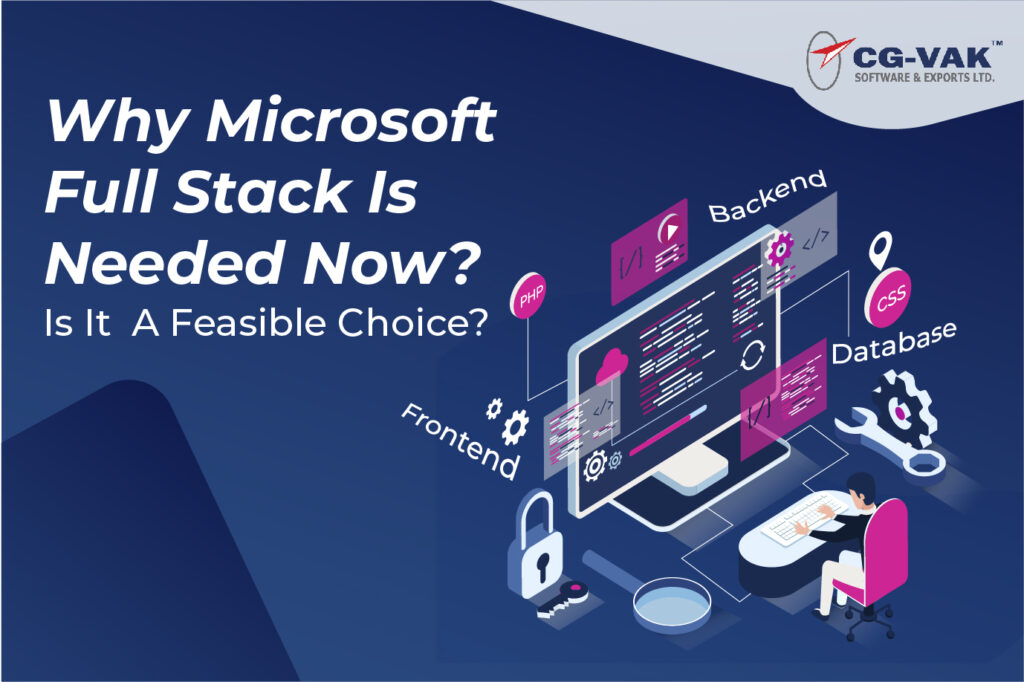
Why Microsoft Full Stack Is Needed Now? Is It Being a Feasible Choice?

The world of programming is so fluid that the importance of various development tools also fluctuates with the rise and fall in the demand of various technologies. What was a popular choice for backend web development, frontend development a couple of years ago, is not the most preferred choice now, thanks to changing preferences that’s the hallmark of a modern-day technology era. There was a time Developers were happy with going with Microsoft software stack for their development projects ten years ago.

It was an 800-pound Gorilla in the field. Because ASP.NET, .NET, and SQL Server worked so well together, companies were happy to choose a complete Microsoft stack for their development projects.

However, many in the field feel Microsoft Full-stack relevance has gone down because of the shift to the mobile and increasing popularity of Android and iOS. To an extent, there might be some semblance of truth, Microsoft Full-stack still holds a lot of relevance, and it has the power to become a viable choice as a complete development framework.

What is Microsoft Full-stack?

Full-stack .NET developers have a lot of skills that allow them to handle a large number of tasks. They can easily work on both the frontend and backend aspects of projects. Because of the versatility of .NET, the industry looks to hire a full stack developer. It is convenient to have one person who performs the frontend and backend work needed.

The full-stack Microsoft development kit allows developers to build client-server applications with ease, whether frontend or backend. The ASP.NET frontend connects to the Microsoft .NET middle-tier, which connects to the SQL Server backend.

Though it has slightly gone out of the mainstream, it has shown resilience and hunger to stay relevant. And it’s succeeding with the rise in the popularity of cloud-based applications powered with Microsoft Azure platform.

The Microsoft Full-Stack .NET framework continues to evolve, bringing new updates and new frontiers with libraries. With the release in 2015, the framework has only become stronger.

Why is it so important focusing on backend, frontend?

Having a seamless combination of both frontend and backend technologies stitched together in a natural flow is crucial to the optimum function of any application. Most people view the frontend as aesthetics part, and the backend with the database is blinkered, and to an extent, an incomplete view. UI/UX is not just about aesthetics; it’s about usability.

In the digital era, it’s even more crucial to know how the entire technology stack performs in delivering a great end-user experience. Right from the browser through backend application services and infrastructure, each stack component has to work in a coordinated fashion to ensure optimum performance.

Frontend Development Holds the Key While traditional performance testing focuses on server-side applications, an estimated 80 percent of page load time occurs in the browser.

Microsoft Full-Stack Front-End Development with ASP.NET Core, Angular development, and bootstrap can be a key to fast, responsive web development. Microsoft full-stack software development framework with Angular, Bootstrap, Xamarin, Jasmine, and similar frameworks, with a bit of jQuery Mobile, packs a punch for powerful web development.

Powerful Backend Packs the Punch 

The choice of a database is of critical importance in web development, and that’s where ASP.Net syncs well. You can use any popular databases with ASP.NET, including Microsoft SQL Server, MySQL, MariaDB, Postgres, MongoDB and CouchDB. When developing web applications, the type of database you use is an important decision. While Microsoft SQL Server needs expensive software licenses for complex development and deployments, the free Express version of Microsoft SQL Server is suitable for most websites. That’s a huge advantage you get.

Still .Net is in presence!! And How it happens?

The following eight reasons make .Net still in presence and a huge sound choice for development:

  1. Reliable, Robust and Mature  

Built 10-years-ago, the .NET framework is quite a mature framework that has been around for more than ten years. It creates an ecosystem for software development and allows programmers to write code of high quality and performance with robust security features.

Microsoft designed the .NET Framework to enable quick and easy development of applications for Windows, with an easy-to-use development environment and a powerful class library. Developers love it because it is a comprehensive, robust, and reliable development platform used by millions of developers worldwide. In short, its battle-tested for years.

  1.  Easy Code Management  

.Net manages your code, which is essential for various reasons, such as reducing bugs and building more flexible applications. Additionally, it handles tasks, such as allocating and recovering memory, creating and destroying threads and processes, and managing the access permissions of running codes.

Since .Net is fully integrated into Visual Basic, it allows you to extend your applications in new ways.

For developers used to working on VB, having memory management, thread and process creation is handled dramatically using ASP.Net, which eliminates the probability of chance for memory leaks and other common bugs. And it has cross-platform capabilities, which is a big plus.

  1. Forget the Old, Enjoy New Capabilities

Like any other language framework, ASP.Net has evolved with time, especially after the development of Microsoft Azure to cater to the needs of cloud-based SaaS applications development.

Whether frontend application or backend development, you can trust it. ASP.NET is a Microsoft framework built on top of the .NET framework, featuring robust infrastructure for authentication, bundling and routing. It is often deployed with the MVC pattern and can be easily integrated with 3rd party JavaScript frameworks.

  1. Powered with Web API

Web API, part of .NET Framework 4.5, offers a simple way to create HTTP services without extra complexity typically associated with WCF. It is easier to use than WCF, but this simplicity also comes at the cost of fewer customization options.

With a complete range of configuration options and hooks, it allows you to intercept, route message, use peer-to-peer and queuing. Therefore, it is preferred for app development.

  1. All-Powerful SQL Server

The .NET Framework is powered with Microsoft SQL Server, meaning you can embed .NET code as stored procedures or functions without compromising the performance. And last but not the least, SQL Server excels at keeping and managing data and its accompanying components, however, what sets it apart is how well it integrates with other Microsoft products.

  1. It’s More Modern   

It’s an entirely object-oriented language designed to eliminate any in-built consistencies, is usually the hallmark of VB and C++. These languages were built to allow developers to build an n-tier architecture, breaking the code up into different components. Now this can be easily achieved by .Net making the life of developers easy.

  1. Thriving Community and Support

When choosing a backend development platform, look for an extensive online community that can help you with any issues. Make sure that you also have access to a person who can help with whatever you need, and that’s where ASP.Net reigns supreme. It’s always better to have a range of options, such as community forums and vibrant technical support in the field of tech development. The online ecosystem for Microsoft products is, without a doubt, one of the largest, which makes it a natural choice.

  1. Strong Focus on Basics

Despite a lot of noise, Microsoft never deviates from the basics. The mobile trend has changed the tech landscape drastically, and it means that choosing Microsoft Silverlight as a frontend for an application is no longer a viable option.

Nowadays, JavaScript frameworks dominate the frontend space. Despite this, it’s still supported by Microsoft through 2021. That makes Microsoft unique as it sticks to its guns, which is good because we have to make technology choices without knowing the future.

Final Thoughts

ASP.Net development is an excellent choice for most organizations when it comes to web application development since it makes developers more productive, reduces bugs, speeds up application development, and simplifies deployment. Although some IT managers are sceptical of its steep learning curve, its impact on productivity is difficult to deny.
A deep dive on DevSecOps with Azure benefits.

This blog interprets the high-level synopsis of DevSecOps. The main thing nowadays organizations are demanding is security that can integrate into your Azure DevOps pipeline. Already available on the release pipelines. Imagine, without sacrificing any speed, an organization needs to know the techniques that can accomplish production-grade deployment in Azure. Using Azure, you can Secure your cloud infrastructure with some best practices. Like; first and best Securing the parameters, utilizing immutable servers, gold-hardened images using Azure marketplace, and administrating severe drift through containers.

Rather than checking for security & safety, CG-vak helps the organization build a security decision with a better development lifecycle. If; the application is strengthened, with the first-rated surety from the beginning. You can be able to, typically avoid the issues when they arise. Let us dive into the blog and understand how DevSecOps benefited from Azure.

Initially, many of them wondered what DevSecOps? Let us find out the scope by evaluating every step of the process. 

Significance of DevSecOps.

Security is the kings’ throne for every organization. Every step of the process needed to be calculative and estimated. The bonus of securing the application gives the continuous process that confines with:

  • Designing a layered architecture with security.
  • infrastructure is secured.
  • Validation of the security is solid to avoid malware attacks.

The Major focus of DevSecOps is. An organization that developing the product has to make sure right from the beginning. i.e., Coding is secured. The way to achieve this is by ensuring the security that is entitled; in each stage of the pipeline. To put in other words, rather than securing the pipeline with security at the time of deployment. Consider security as the Major element from the initial stage of a development cycle. This strategy is well known as ‘Shift-Left’ of security. To achieve this method of security by ensuring your pipeline for every stage.

DevSecOps braced by the Azure. DevSecOps helps to integrate security. Inside the DevOps process, and make developers understand the application is harmless and ready for launch. Understanding the security needs and selecting the apt tools for the CI/CD process is essential. Requirements of the project estimate through the part of the architectural diagram helps to resolve the security issues.

Knowing Azure policy and security center heaves the way for your organization.

Azure has a colossal number of solidifying capabilities. But, colossal for one business alone causes friction and has no value.  Usually, clouds tend as easy using for any organization over colossal as their default setting for the deployment. Here is where the Policy of Azure comes in. By understanding it allows to regulate the default or configuration and prevent such violations against the company policy. The Azure policy would always protect while deployed. DCS stands for Desired State Configuration. DCS helps to specify the degree to which an organization’s resources and services are colossal.

While designing the topology of subscriptions in the Azure tenant, an organization should consider the Azure policy enforcement environment. Different classifications of policies can be; added/applied through subscription, resource group, and management levels.

While understanding the policies, the DevOps team get matured with the security bearings. The Azure team will consolidate the Azure security center and   Advisor into their DevOps for the process. Azure security center augments data sources and glides events into it. Azure offers immense help for the larger organization to build governance strategy as well.

The best approach for DevSecOps in Azure:

DevOps skill development: 

  • Knowing; what kind of things that the attackers are looking to approach. So, the developers help to create software that helps to free from any harm.
  • Admins play the role; Where they have to understand the trouble and adequately know what kind of action is the solution.
  • When everyone understands their role, there will be a handful of mistakes and a couple of breaches.

Explaining the security requirements

  • The organization creates standards based on protecting its assets. The requirements always fall into the standard list of issues, like the top 10 open web applicationsecurity projects.
  • The necessity, always fitting to be explicated. Through the designing process.
  • Security is required to fulfill all the functionality. From logins to every update, should always establish with a risk evaluation.

Defining Metrics

  • It is valuable to measure security improvement constantly because each factor should impart to the overall security score.
  • The data and metrics have to be legit rather than being modified according to the situation.
  • Tracking the bug and clearing the security issues should be part of the process. The standard should be constantly informed; of all the severity levels by establishing attention to them.
  • Prioritizing every bug will solve the problem. Ensure and give importance to the riskier bugs that will channelize and help to fix them quickly.

Threat Model

  • For an organization, threat modeling is considered; as the advanced ability of Strong security requirements. The potential threats or structural discomfort be identified and safeguarded.
  • Creating an application overview regularly; will help to exploit the weakness. Where exactly, the bug will attack.
  • Threat modeling helps in many ways by understanding through the attacker’s perspective. Since it knows the overview of the attacks, it goes after them so Easily.

Advantages of Tools

  • Automating the DevOps process using tools will help the organization to meet the security well-built efficiently.  The process built with the help of testing all test cases pass before the release improves the security.
  • Go for the wrong tool that will cripple your organization. Good tools for DevSecOps pipelines are easy enough to find. Security experts are not needed daily.
  • Organizations, hiring qualified developers and administrators. Who can perform what they are saying? It gives more advantages if it is configurable because the process will not get delayed. After all, the problem is not even real.

Conclusion

Security is the necessary thing. That needed to be integrated into the DevOps team to address the problems faster. The techniques that are listed here are DevSecOps techniques that are related to any online software application. Azure demonstrates verities of tools that help in the process. Some of the tools are:

  • Microsoft security risk detection
  • Microsoft threat modeling tool
  • Security code analysis extension
  • Security code scan

Enhance your security by fulfilling your security requirements with the help of this blog. Robust to your security CG-VAK fulfils all your security calamities with the necessary features that scrub all the web traffic. CG-VAK understands the security solution and runs them natively on Azure, secure and reliable.

Discovering pliability through maneuvering Agile software development

Almost every company started creating products to satisfy the demand of the customer. Every organization should see the plausible reason here. All the companies need to be irrepressible to the chaotic market circumstances and other constraints. Shortly, the company started to grow to a higher position. The business needs to be automated and give the upper hand by modernizing the process. Typically, many organizations need is a result-oriented and customer-focused approach to software development. While you have the advantage of attaining continuous improvement using the powerful arsenal in your organization, why not use it? First, let’s understand the Agile software development process; that accommodates the elements by increasing the quality with these cutting-edge technologies.

Agile methodology is considered reliable, flexible, and fast. The latest stats by VersionOne shows us; 97% of the organization enactment the agile software development process. So, let us understand the benefits and prime focus through; building by agile development practices and elements of the agile approach to software development.

Indispensable benefits of agile software development

There are several numbers of Agile methodology steps used for software development. The beauty is, the development team can choose diverse approaches to build a short development cycle. Bringing; the customer earlier to the project for a better understanding. These are the part of the project management using agile. The development team; will achieve through progressive development because they form their self-organizing teams who are adaptive to any changes.

Several approaches followed for the successful agile product development using different agile methodology tools. Let us explore the benefits of using agile development methodology.

On-time delivery:

  • Usually, the agile team uses scrum as a positive approach to any project delivery. In general, the software development team, schedule time for the period of sprints is 1-4 weeks.
  • To ensure some clients need the projects in a short period. That’s where CG-vak proposes clients about, benefit of agile project management and agile development process. How iterative to develop the software by working consistently and delivering it at the right time.
  • By continues improvement. Design and the testing; QA process in agile will be approached concurrently. So, this helps the process run without any hassle and deliver it on time.
  • In the agile methodology process, experts prioritize the essential requirements first while running the overall delivery in the pipeline. So, this accelerates the entire product development cycle that pushes on-time delivery to the market.

Anticipated costs:

  • Agile methodology principles; are formulated to save costs. Generally, the costings are estimated; by the requirement of the project and how hard it is. The system helps developers to predict the budget of the product precisely.
  • Agile software development methodology is simple. It won’t waste any unwanted resources or time. In the agile development process, only needed resources are a developer who knows to run sprints, unit testing, QA process in agile, and MVP to validate marketing fit.
  • Benefits of agile project management helps to save the majority of the costs to the organization. Those are given; to the project manager and the middle man.
  • If any sprints need to be run through agile development process in future previous documents will be perfectly helpful for better planning. These will also help to save the utmost costs for the organization.

Explicitness in business:

  • All the teams are well built and perfectly aligned. Project management using agile software does not give any hassles to the project holder or the developer. It proficiently provides regular feedback, so if there are any changes in the project. It will be ensured; at the beginning itself.
  • Transparency is a question for every organization. While using Agile; Owners can explicitly know all the updates, status, and daily reports. That helps them to conclude a similar action as a result.
  • It helps the developers and testers to take a breath from any project constraints. As well, it helps to run the show seamlessly without any last-minute changes.

Workforce productivity:

  • The efforts and team performance are always Important in any aspect of the project development. Here, there is a toll you can ensure their commitments towards the project. Each resource is always focused on one task. So, this will automatically make them more productive.
  • There will be no hierarchies in the projects developers, testers, designers, everyone. Working on the project, explicitly do what is best and execute it. The agile team automatically adds 25% productiveness to the project.
  • Since there are no hierarchies, the information and goals do not push them to fall into the structure. Therefore, the software team set their goal and work-focused to complete the process accordingly.

Improved quality by unceasing efforts:

  • The fact is. Most of the organizations that are still following traditional software development in their project; will follow the same old way of software testing at the end of the project.
  • The effort you’re putting at the end of the project will always; have the impact of piling up the works that can resolve quickly; Agile helps break down the project with effective and ultra-quality development and testing without any hassle.
  • The effect of working in a cross-functional team is the developers work with the tester. So, this helps them to deliver the product on time, with expected product quality. Though, this amazes the customer instantly.

Measures to reduce risks:

  • Throughout the development cycle, risk management initiatives provide progressive development to the organization. The risks are calculated and delivered by the scrum team. So, it is helpful to embrace it with the counter plan
  • The QA process in agile and development team are continuously involved in the iteration process. So, that will help to monitor the risks and correct them in the initial stage itself.
  • High risks are prioritized and analyzed simultaneously; and mapped out at the process of execution.

Trust on the performance in return with better ROI:

  • The above proficiency and performances give you the answer to the question. It does not work as a traditional approach; the agile software team. Makes sure to release the software quicker than expected.
  • Probably, you get the software working at the first sprint or, the product will be ready to market after a few iterations.
  • In the fast-moving markets, customer expectations are beyond us. Agile process in software development provides and changes the features after the release of the product based on customer feedback.

What factor gives agile software development to improve product quality?

The agile software development team is a structure. No organization can recent 100% for agile methodology tools. Without any doubt, it helps to deliver the project on time. All the data and documents are available readily without any errors. The product is delivered; to the project owners. Building an agile approach to the software development team will leap you to the perfect solution. Build a solid team. Some tips may help you for better understanding.

Don’t rush to be sloppy:

An organization needs to create space to trust the employers of each other. Because; the team members are going to work together with sufficient space and time for each other. Since that will improve the teamwork in the projects undoubtedly initially, there will be many failings that happen. The team should be well-organized and mature to handle without any miscommunications. Though, this can only be possible by engaging with all experts and adapting to work hard. In the agile methodology process, the first principle is to fail to learn to work together. Don’t wait for the grand success that will not make any improvements. Stay focused on the minute details and start to improve the fundamentals of the team; progress will start improving gradually.

Teamwork that never fails:

The beauty of the agile methodology principles is simple. Do your duties right and take the responsibilities and improvise from your mistakes. That helps put the teams in the success at the end of the projects. Remember how to interact with other departments; at the end of the day, everyone is working for the same goal to find a better solution. Since you work together, this reduces the risks and improves the quality without any difficulties. Understanding. The struggles that went; throughout the project and recognizing that efforts between everyone. That helps to be motivated persistently. It may be positive or negative feedback. Try to improvise next time adequately. These all emphasise the overall agile development process.

Never see change as adversity, but as an opportunity:

Most organizations are always focused; on the positive results of the project. In that case, agile gives you excellent results to overcome any product development. There will be a constant change; that always be expected till we complete the final product. There are salient ways to handle a project successfully. Understanding the reoccurring development and maintaining the status of the project; without any hassle. The team needs to re-evaluate the changes and adjust to the process according to the changes. Every change embrace nothing but the final output of the project. By utilizing the opportunity, the team can overcome any quires.

Conclusion

The business value is increased; by proving the benefits of agile methodology process. Combining; experts who are well versed. With cutting-edge technologies and agile web development will able to transform the organization into a successful chapter.

Consider Agile approach to software development for your project success. From the above information, you can understand how Significant agile development practices are for your organization. CG-VAK understands the business value and time and prioritizes it. Mainly, we focus on customer satisfaction. Agile is widely known for its awesomeness. But maintenance and collaborations weigh up the agile process. Always consider the feedback given by the customers. Improvise the final result and maximize the ROI for your business.

Optimize your business by knowing the ascendancy of incremental test automation!

In a development cycle, usually, the tester performs Different testing at different development stages. At this phase of the process, we need to understand that; incremental testing can add more value; commonly used in the software field. In a testing phase, the integration testing; is performed after the unit test. This module helps the organization in detail about incremental testing? What are the features, advantages, and disadvantages involved while approaching incremental testing?

To put it in simpler words; While running the unit test. Each module; tested individually. The solution to the organization is to ensure a smooth and secure interface between the modules; make a required application, each module added logically. This approach helps to ensure that; all modules are combined incrementally. All the modules; were tested as a group instead of testing in the end. Without any hinder, this helps in the successful integration and assists the data to flow between the modules.

Ultimatum you will face in test automation

The existence of; right automation tool for the test automation is not simple to select. Without selecting it, the organization fails to operate without the hassle and achieve unique requirements like open-source and licensing. Any organization considering setting up the high-quality testing automation unit means. A massive amount of money needed to; be invested beforehand itself. Every organization’s challenge is to set up a better technology infrastructure, but this may lead to the awry testing guideline. Due to the bad; technological infrastructure, the organization RIO will be negatively impacted, and there will be a lack in achieving many goals.

The organization; that is rushing the goals and want to reach the target instantly will never see the big picture of test automation here. At least the important part of the testing that is automated will not resolve any of your problems. The end goal is always not to automate everything approach. As industrial and technical experts, we need to know this will lead us to the misaligned ROI. Considering all this, increasing the cost will help us with the solution that involves in maintenance and development of the test modules; by increasing the cost of AI-driven test automation, we can achieve and adapt to the incremental approach; this helps in ascending the value through test automation.

Why? an organization cannot neglect incremental test automation?

The ideal approach involved in incremental automation is dividing the applications separately into different components before testing them as individual modules. As we all know, how salient is Agile methodology. Instead of combining the testing process involving Agile methodology helps in testing, integrating, and testing the integration before adding it to another module. Alluringly, all the requirements are approached here by an increase in the test frequency, and the organization is equipped ascendingly with the on-demand niche. Using incremental test automation, you can:

  • Corroborate test modules/components as this keep driving to work together post-integration.
  • Manage to find the bugs and defects at the early stage of the development process itself.
  • Plays end-to-end performance testing and is considered cost-effective.
  • As the defects and bugs found early-stage itself. Developers have more time to understand and resolve any defects or bugs.
  • Delightedly, it authorizes DevOps or Agile for continuous testing and release since this helps to get quick feedback and helps to achieve the on-time to the market.
  • Gives more preferences to the end-users, not to the technology.
  • Provides faster results with a rapid feedback cycle.
  • Mitigates the testing, integration, and maintenance as this neutralizes the costly resources.

Diverse methodologies exist that can wide-open your organization using incremental testing:

There are several methodologies you can harness using incremental testing:

Top-down integration: 

Here in this module, the testing takes place from top to bottom. Considering the architectural design meantime, follows and controls the flow. The stubs help to close the void effortlessly by replacing the non-existent components or system.

Bottom-up integration: 

In this module, the testing takes place from bottom to top. In this type of integration, the control flow occurs in the upward direction. The drivers help smoothly to substitute the unavailable components or system.

Functional integration: 

In this type of module, the integration & testing; Occur on the status of functions, functionalities, or specified functional documents.

Pros and Cons of incremental testing:

The ascendancy of incremental testing:

  • While working on the software life cycle, the software will be precipitated smoothly.
  • Incremental testing is pliable and economical to modify any needs and terms of references.
  • The changes can be done from beginning to end during the whole SDLC process.
  • This is considered cost-efficient compared to others.
  • Instant feedback can also play a salient role while building the application.
  • Defects and bugs are identified in the early stage itself.

The decadency of incremental testing:

  • Without good planning and designing many hassles will be faced.
  • During the entire software lifecycle, the endurances might be faced by the system architect. As such requirements are collected beforehand itself.
  • While iteration phase will be inflexible and does not allow to overlap.
  • If the bugs or defects are found in one unit, it requires correction in all the units. Which ingest a lot of time.
  • The stubs and drivers are already developed and need constant updates, so the process consumes extra time.

Conclusion

Considering incremental test automation can economically lower the overall cost of quality. As the incremental testing comes under the integration testing, the application is integrated incrementally and testing performance will be unique. The three methodologies give us hassle-free integration testing. The customer has to choose accordingly depending on the structure of the application for software testing. CG-VAK provides continuous delivery to your need.

Serverless Architecture in the Next Stage of Business Transformation for Scalable Performance

Still, in its early stage, Serverless Architecture represents a completely new paradigm. It offers an excellent drive to complete IT transformation with the introduction of a next-generation cloud. This transformation with Serverless architectures like Azure Serverless thrives with cost-effective and streamlined solutions, processes, and end results. Let us have a meaningful discussion over this concept of Serverless architecture, its benefits to IT businesses, and how it is a driving factor in the digital transformation of businesses with highly scalable cloud solutions and better customer experiences.

Serverless Architecture Approach: What, Why, and How?

Serverless, as the name itself suggests, it is basically a cloud-based development approach adopted by developers where they work only on business-oriented coding and are not involved with issues related to physical servers or infrastructures. In the Serverless Architecture approach, an event-driven function model is utilized to determine the scopes of business requirements. Also, it is an automated, highly scalable architecture to offer required computing strength at any time.

The need for a Serverless Architecture approach has gone popular with the inclusion of cost-effective measures where resources are scalable and cost only for usage. For example – In Serverless cloud computing, it is possible to reduce the server usage or scale it down when not really required, or can instantly ramp up the computing bandwidth at the time of requirement. In total, it is quite convenient and flexible to work with Serverless applications and architecture.

How Serverless Architecture/Computing Works?

Serverless Architecture use cases include IT organizations looking for a smooth and efficient cloud migration, or which works on cloud applications that require additional functional efficiency, scalability, etc. The Serverless approach complements Edge computing with great support to high-latency, big-data processing tasks within cloud computing solutions.

But what is the actual strategy adopted in this type of architecture of cloud computing or development?

With Serverless Architecture, developers need not bother about all the servers or infrastructure supporting codes. This task is for the Serverless cloud providers who are responsible for the management of entire backend services which include virtual machine management, hardware allocation, host patching, server uptime maintenance, capacity provisioning, test environments on servers, etc. All these services integrated with DevOps to keep their applications running and updated all the time are effectively managed by the Serverless cloud service providers. Likewise, it defines a unique, flexible, and scalable architecture approach for the IT development world and offers multiple advantages of cloud computing.

Pros of Implementing Serverless Architecture for Business

After going through the basic understanding of Serverless Architecture, its use cases, working criteria, and all, it is time to learn some fine benefits of Serverless computing to businesses. We have sorted out some exclusive points of benefits of cloud computing to businesses with a Serverless approach.

Easy deployment & continuous delivery

With Serverless Architecture, it is easy to set up as well as deploy distributed systems when compared with the server-based one. Also, as the complete process is automated in the Serverless application development, the code change is automatically deployed which ranks it up for the continuous delivery requirement in businesses.

Infrastructure cost-effective 

The Serverless Architecture follows the pay-as-you-go model which highly impacts the infrastructure expenses and makes it a cost-effective affair. It is considered the ultimate way for businesses to cut costs of infrastructure by switching to Serverless architectures.

Virtual desktop or machines

Using Serverless computing, data processing in Virtual machines or Virtual Assistants like chatbots is really fast which is beneficial when prompt responses are required. The FaaS model of Serverless Architecture provides the desired computing power especially in cases where application user strength increases suddenly.

Impeccable Scalability

Unlike on-server applications, Serverless application is much efficient for startups and enterprises as it delivers automatic resources or computing power when requests increase. It is highly preferred because of its almost nil scalability limitations in applications.

Real-time updates to the application 

One of the advantages of Serverless cloud computing is that within the Serverless environment, cloud providers offer functions that aids in uploading the application updates regularly with the provision of adding new features, patching issues, and more to it.

Boosts productivity

To keep up with fast-changing digital development and software trends, Serverless computing in the cloud is amazingly supporting minimal processes and individuals towards the development of the application while the other contributors are involved in the vital tasks of DevOps.

Ability to reuse compared to other infrastructure 

Any new project such as Serverless application/Serverless web development is easy with this new concept as it utilizes reusable elements like HTTP request functions, layer across Lambda functions, testable coding, encapsulation, etc. in the process which enhances the reusability in comparison to other infrastructures.

Easy pivoting and right targeting

Right customer identification and targeting are always crucial for a business, and with infinite scaling, efficient containers utilization, high product flexibility, etc. as Serverless functions, it is very convenient and direct to reach the targeted new audiences without impacting the existing ones.

Difference b/w other Platforms and Serverless

Serverless Architecture, with the event-driven function model, is popularly recognized as the Function-as-a-Service model which stands out and differs from other cloud computing platforms such as – Platform-as-a-Service and Backend-as-a-Service. Let us get a brief understanding of the exact difference between these platforms and the Serverless approach.

Backend-as-a-Service v/s Function-as-a-Service (Serverless)

Backend-as-a-Service, also known as BaaS is a cloud computing model, which follows the procedure where the cloud provider or vendor delivers backend services and developers are involved in enhancing and maintaining front-end services and solutions including infrastructures and servers.

The Serverless cloud computing model includes event-driven triggers and edge computing alignment with processes for quick, efficient, and highly scalable processing which all is unavailable with the Baas approach.

Platform-as-a-Service v/s Function-as-a-Service (Serverless)

In the Platform-as-a-Service or PaaS model or approach, developers are handling all essential tools for application running and development.

Where the Serverless approach offers developers to focus their abilities on coding only for solving related business issues and problems rather than managing software infrastructures required for the development, the Paas approach is less flexible, runs at a slower speed, and is not really a fan of edge computing in the cloud.

The above comparisons between the Function-as-a-Service model with Platform-as-a-Service and Backend-as-a-Service are in itself a reason why many organizations are leaning towards the Serverless Architecture approach. The best example is the recent survey in 2020, which states that 80% of Amazon Web Services container users have adopted the Lambda or Serverless service for AWS, and thus now implemented the AWS Serverless application model.

But, right away with many benefits of cloud computing with serverless approach, there are some challenges linked with this new concept like switching Serverless providers, security concerns, scaling unpredictability, limited debugging tools, etc. As this concept of Serverless Architecture is in its phase of development and betterment, we can hope these limitations of today are not there in the coming years of digital transformation.

Ready to Implement or Optimize Serverless?

Are you looking for a scalable, streamlined, and cost-effective cloud computing or development approach for your fresh startup or already running a business with a traditional computing approach? If the answer is yes, then it is evident that you are ready to implement or optimize Serverless in your business to gain all its benefits.

CG-VAK, a reputed onshore/offshore IT solutions and services provider extends its expert consulting and software development services to all businesses that are impressed by the Serverless architecture and ready to build a Serverless web application or more. Feel free to contact us with your requirements and queries.

Final Thoughts

Serverless Architecture is the need for the time where competition and matching levels with new trends and skills are required. Advantages of Serverless computing like the high range of scalability, low-cost expenses along high-level customer experience are what all businesses look forward to. It fits right for today’s IT business needs and seems promising for the near future.

It’s Time to Migrate from Winforms to .NET 5.0, Let’s get Modernized with New Versions!

Heard it right! 2 years back, the software giant, Microsoft has announced the release of .NET 5.0 that was going to replace the .NET framework and be the next version to .NET Core 3. It is a unique, unified platform that supports all .NET applications. Being in the run for almost two decades, .NET has delivered services to desktop applications, web applications, mobile applications, microservices APIs, etc. After .NET Framework and its multiple version in series, .NET Core was introduced with amazing feature options including light-weight, modular architecture, open-source, etc. And now, after the .NET Core, its updated next version is .NET 5.0 which got released in November 2020 includes all the competitive requirements in the current time.

Major Frameworks in One Coverage – .NET 5.0 

The .NET 5.0 version got multiple major Microsoft frameworks under its roof and supports main .NET technologies. Desktop development with .NET 5.0 is possible with full support to WPF, Windows Forms, and UWP.  Additionally, leveraging ASP.NET development services is easy along with cloud development with .NET 5.0 (Azure cloud development). The advanced version also shows compatibility with Xamarin for mobile development with .NET, Unity for Gaming, etc. Advanced tools like Visual Studio, Visual Studio for Mac, Visual Studio Code, Command Line Interface, and more are all part of the unified .NET 5.0 version which we are going to discuss in the next section.

Get into a Unified Version With .NET 5.0 

As already mentioned, .NET 5.0 is a unified version as all major frameworks and technologies are available with a single platform and a unified set of Base Class Libraries (BCL). It has made it convenient for Windows desktop development, Android app development, iOS app development, and other .NET development services that can be integrated into a single project. Also, the cross-implementation compatibility in .NET 5.0 ensures that each library will work with every runtime implementation. Due to all these major supports and compatibilities, .NET 5.0 is also known as ONE.NET. The ultimate reason for a unified attribute in this release is performance improvement which can be attained with an enhanced Just-In-Time compiler, enhanced startup times, quicker algorithms, single-file applications, etc. We would learn more about newly added features to the .NET 5.0 release as we move further in this blog.

Feature Updates on .NET 5.0 and New Goals

The main agenda of introducing .NET 5.0 is for the performance improvement requirement which it has outperformed with new updates in its earlier .NET Core version. Let us go through some crucial feature updates on .NET 5.0 and have a slight overview of each.

APIs Optimization

To improve performance and consistency, some APIs like Use of regular expressions, HTML 1.1, HTTP/2 implementations, and operation on strings are optimized.

Language Updates

Here are mentioned some updates for runtime and language with .NET 5.0.

  • Jupyter notebooks now integrate more options for interactions and analysis, thanks to F#5
  • Increase in number of Visual Basic project types like Windows Forms, Class Library applications, WPF, Console applications along with the provision of porting Visual Basic .NET framework applications
  • C#9 includes new features, record type that makes code concise along with convenient immutable data structures

Entity Framework Core Updates

The updates in the Entity Framework Core 5.0 include better SQL queries generation and support; more options for the database model that is described in code.

ASP.NET Core Updates

ASP.NET Core has fewer changes like –

  • With the HPack header compression, Kestrel delivers better performance for HTTP/2
  • The application can be bound to new endpoints without the need to restart when the configuration changes for ASP.NET development services
  • Code can be run before or after Hub methods using SignalR Hub filters

ARM64 Updates

Some crucial updates in the ARM64 support for .NET 5.0 are mentioned below.

  • ARM64 hardware intrinsic and specialized instruction sets are supported
  • Algorithms are tailored or customized to the ARM4 architecture
  • Just-In-Time compilers are optimized for ARM4

Cloud-Native Support

For cloud-native technologies, .NET 5.0 includes improvements for container workload as mentioned here.

  • Better overall performance in containerized environments
  • Image size reduction and wider images selection for single-page native application development
  • Support to orchestration APIs (OpenTelemetry)

After the release of .NET 5.0, a new version (.NET 6.0 or .NET framework latest version) with Long Time Support, fully unified, cross-platform, Xamarin, extended Blazer support, and most crucial feature highlights has been recently released. The next two year projected plans (2022 and 2023) are for new versions, .NET 7.0 and .NET 8.0 with more supports and performance-driven attributes.

Advantages You Get opting .NET 5.0 

If you are choosing .NET 5.0 as the destination to migrate from your existing framework or WinForms to .NET 5.0 development then you might have known some of the advantages of this unified platform. We are going to discuss some key features and advantages of opting for .NET 5.0 as the software framework for business applications requirements.

Faster Performance Improvements 

Faster improvements with the tiered compilations method introduced quick initial compilations which is beneficial at the time of additional improvements as this time recompilation is performed with better quality.

Get New Target Frameworks 

Target frameworks for .NET 5.0 are the successors to .NET standards frameworks. When an operating system is targeted with a complete set of .NET 5.0 APIs, additional APIs are also available.

Single File Applications

With Linux support, the application output display is improved by adding extra files to the single distributable file from which files can be extracted individually on the application access.

Microservices Support

This framework supports Microsoft Azure App Service and Azure Service Fabric with Ruby and Java technology support for microservices implementations.

Container Development

.NET 5.0 framework offers lightweight and modular containerized images for deployment and development.

Integrated Development Environment 

With Visual Studio Code that runs on all operating systems including macOS and Linux, it is possible to develop applications with any chosen OS at a time utilizing third-party debugging facilities.

Apart from the above-mentioned advantages, the Microsoft .NET solution (.NET 5.0) is becoming the all-time favorite for developers as it as a Microsoft cross-platform solution supports side-by-side installation, all key features of .NET Core, Xamarin, and .NET Framework, small project files, and more.

Which Existing Frameworks Support for Migration?

The support lifecycle of the .NET framework depends upon the Operating System and for Windows Server 2019; it is supported through the year 2029.

Note: For projects with low change frequency, the .NET framework is apt as low maintenance is required and not often unless any big business changes happen. Also, Legacy technology migration has ended in August 2021.

For WPF, WinForms, and MVC Projects

These projects tend to perform better under the .NET framework as these have .NET equivalents to the framework. The transition process like WinForms to .NET 5.0 can be one-click and performed using technical documents keeping all efforts involved in the process in close analysis and even performing testing once the transition process is completed.

For WebForms Projects

WebForms projects support migration to the .NET framework though there is no urgent need for the upgrade as the Microsoft documentation is available now and the transition is at the client’s request. Also, WebForms development does not require or benefit from the new features in the framework and the transition costs also matters.

Do You Have Any Idea of Migrating? We Help You!

Many businesses have already adopted the .NET 5.0 for app development and utilizing its convenient benefits. If you are looking forward to this new technology and need a helping hand for the implementation to grow your business, contact our technology experts at CG-VAK, the ultimate resource for expert offshore .NET development services.

Here is Angular 13: Jumpstart your Business like a Pro with Angular New Version

Angular 13, the latest Angular version, a TypeScript-based web framework, has been finally launched in November 2021. The upgrade included several improvements to the already successful software. Angular has introduced a new compilation and rendering pipeline Ivy in its version 9. But, the old compiler and runtime View Engine are still available. So if you are looking to migrate to Angular web development, you need to know the latest Angular framework.

To know about breaking changes that happened on Angular 12 compared to angular 11 click the link.

Also, it is to be noted that Angular has been using Ivy as its compilation engine and renderer for a long time to provide better performance and support for techniques such as server-side rendering.  Let’s have a look at the top features of Angular 13 to see what’s new in this latest version!

Hey, It’s 100% Ivy Now

The Angular latest version 13 removes the Angular Package Format (APF), View Engine-specific metadata, and older output formats. The removal of these elements makes the code more streamlined and able to better support future changes. The new package manager should reduce maintenance costs and the complexity of the codebase. Ivy compiles individual components independently of each other, which improves development times. The use of the ngcc (Angular compatibility compiler) is no longer necessary to build Angular libraries with the latest version of APF. This will offer faster execution times.

The Angular and Ivy frameworks both enable the creation of modular single-page applications. However, Angular relies on a more static approach to defining modules, whereas Ivy’s modules are more amenable to change as needed.

14 Exclusive Features of New Angular 13: 

Angular 13 is a very advanced web development framework. Here is a closer look at its new updates and core changes.

More Ergonomic APIs

AngularJS 13 loads faster thanks to ergonomic code-splitting APIs and granular code breakdown at a component level. Angular 13 splits files into smaller chunks and keeps only the parts of the app that are required for a given view. This makes it easier for users to download just the essential parts of your app, which reduces load times.

Also, the introduction of ESBuild—a JavaScript bundler that works with terser to optimize scripts and supports CSS sourcemaps—improves performance.

 No More Support for IE11

To take advantage of native web APIs and modern browser features, such as those that implement web animations and CSS variables, the Angular team has removed Internet Explorer 11 support.

Angular.js offers a lighter and fast-loading program, along with a more user-friendly experience because of the lack of Internet Explorer-specific code and differential loading. This change in the way Angular implements its dependency injection might affect authorities or institutions that still use IE 11 and have not yet switched to Microsoft Edge or other modern browsers.

Improved Debugging and Test Times

In the latest Angular development framework, the TestBed is the primary unit tests API for Angular applications and libraries.

The new version of TestBed, released on January 21, offers an improved API for creating and tearing down a test environment. It also allows you to learn the structure of your environment as you create new tests, leading to faster, memory-efficient.

It allows developers to increase test speed and decrease memory usage, by allowing the framework to learn the DOM automatically after each test run.

Changes to the Angular Package Format(APF)

Angular Package Format (APF) specifies the format and structure of the Angular Framework packages. It’s a great approach for front-end developers to have a predictable way to store and share third-party libraries built by the community.

  • Generates Ivy partial compilation output.
  • It doesn’t produce UMD bundles.
  • It creates ES2020 output.
  • It uses the package exports using the sub-path pattern feature from Node.js

Accessibility (A11y)

In the new version, all Angular Material Design Components (MDC) have been checked for better Accessibility. Angular 13 has overhauled many user interface components, including inputs such as checkboxes and radio buttons, so now they have bigger touch areas, and other items have better high contrast modes. In an effort to improve the accessibility of its UI components, the team assessed and updated all Material Design Components. Radio buttons and checkboxes now have larger touch targets, and other elements feature higher contrast modes.

Augmented Inline Support for Adobe Fonts

In the latest Angular framework, inline support for Adobe fonts is enabled by default. These fonts can accelerate the FCP (First Contentful Paint) and make your apps more functional. You don’t need to change anything in your code; just run ng update.

Improvement in Localization–H3

AngularJS 13 $localize provides a consistent API that can be used to produce an effective way for in-built internationalization (i18n) and tag messages for translation in code and templates. AngularJS $localize() is a method for internationalizing an application. Developers use it to aid in-built internationalization and translate message tags for display.

Dynamic Component Creation

One update to AngularJS’s API—enabled by Ivy—is a cleaner, more lightweight way to dynamically create a component. Mark demonstrates how, before and after Ivy’s introduction to the framework, instances of ViewContainerRef.createComponent no longer require an instantiated factory to new up a component

TestBed Teardown Now a Default Option

Angular JS TestBed configurations that allow for a better teardown of test modules and environments are now enabled by default. This feature was added in v12 and can be disabled or configured per module.

Angular CLI Upgrade

Angular CLI is one of the fundamental pieces of the AngularJS package. Few developers can handle the complex modern web development ecosystem in its entirety, and Angular CLI safeguards them from most of it.  The latest version of Angular now supports a persistent build cache by default, which causes up to 68% enhancement in development speed. You can enable or disable this feature in current Angular apps. Angular v13 now supports a persistent build cache via the –build-cache flag. You can enable or disable this feature on existing apps with this new update

Other Critical updates

  • js v12.20 and later are no longer supported with Angular packages, because older versions of Node.js use the package exports feature with subpath patterns.
  • The reactive programming library RxJS v7 is supported.
  • The built-in validators min, max, and minLength can be turned off or on.
  • A change has been proposed for Angular.js to address a bug in which the default URL serializer would drop everything afterward, including a question mark in query parameters, resulting in incorrect parsing for navigation to /path?q=hello?&other.

Final thoughts

On a final note, the new version of the Angular 13 framework offers exciting new features. If you’re not dependent on Internet Explorer 11, then you can upgrade to Angular 13 more easily by running ng update in your project. There is a possibility in the future to make NgModules (an Angular feature) on GitHub an optional feature. Such a change would allow developers to create independent components and implement alternative APIs for declaring compilation areas. Why waiting? update angular to latest version now!

Xamarin Toolkits with New .NET MAUI- Replacing with New Alternatives

The brand new sensation in the Xamarin app development field with the Xamarin forms alternative in the form of the new .NET MAUI which was announced in 2020 by Microsoft is the popular topic of discussion among software developers and experts. It is a good time to say bid to the almost seven years old Microsoft Xamarin forms for the Xamarin mobile application development as the new toolkit with better Microsoft cross-platform app development advantages is in the market. These advanced features focus on improving speed and performance in mobile app development or desktop app development.

Microsoft .NET with Xamarin Toolkit – .NET MAUI 

.NET MAUI or Multi-Platform App UI is a cross-platform UI kit, also considered as the evolution of Xamarin forms. It shows high compatibility with multiple Operating systems including Linux, Windows, macOS, Tizen, etc., and also supports Android as well as iOS app development. MAUI cross-platform activities got high performance and extensible rebuilds of UI controls from scratch and wide-range support from mobile to desktop scenarios. Xamarin toolkit is completely replaced by .NET MAUI which is a single framework for mobile app development services on different platforms and devices.

Some essential prerequisites are needed to be incorporated for the .NET app development as mentioned in the below-given points:

  • Ability to select multiple files from the device.
  • Sensors availability and enablement on devices.
  • Device information on which the application is running.
  • Built-in text-to-speech recognition engines.
  • Copy and paste facility to the system clipboard for running applications.

.NET MAUI offers the developers to work with a single code and use it on multiple platforms by their integration into a single API. Xamarin to MAUI transfer has got much in its offerings like hot reload, cross-platform graphics library, single project development, and more which we are going to discuss in detail in the next section.

Features and Advantages of .NET MAUI Compared to Xamarin

.NET MAUI includes multiple added advantages when compared to Microsoft Xamarin which leads to performance, flexibility, and speed enhancements in native app development, cross-platform app development, mobile app development, and more. Let us have a quick discussion over the top MAUI Xamarin features and advantages altogether.

Single Project Development

Unlike Microsoft Xamarin Forms, .NET MAUI lets developers work with a single project and handles different issues associated with multiple projects easily.

Advantages

  • Handling multiple platforms and devices
  • Organizing images, fonts, and platform-related codes from a single location
  • Adding different dependencies
  • Shows compatibility to .NET CLI toolchain for building, developing, running, as well as publishing .NET applications
  • Easy deployments with a single click to simulators, desktops, and emulators.

Slim Renderers Pattern 

In the replacement of customer renderers which were available with Xamarin Forms, .NET MAUI provides the latest new slim renderer pattern to use in the application development.

Advantages

  • Helps in developing the customized, light-weight mobile and desktop applications
  • Delivers a brand new, easier, and efficient development experience
  • Loosely coupled structure with no dependencies like Xamarin Forms on Xamarin application

Full Hot Reload Support

Xamarin Forms included some exceptions for both XAML hot reload and .NET hot reload categories whereas .NET MAUI is the powerful toolkit that contains no such exceptions and supports all available hot reload packages for the development purpose.

Advantages

  • .NET MAUI shows complete support for .NET Hot Reload and XAML Hot Reload packages
  • Allows live editing in the .NET MAUI applications while it is running
  • Helps in cutting off the rebuild time of MAUI applications
  • In-future support for iOS, macOS, Android, and integration of Live Visual Tree along with XAML Hot Reload.

Libraries Unification

This is another remarkable feature that comes up with .NET MAUI. Here, different critical libraries are unified such as Xamarin.Essentials library merge into .NET MAUI for inclusive benefits.

Advantages

  • Ease of using regular services like application, storage, authentication, security, etc.
  • Convenient for utilizing other devices capabilities like sensors, images, contacts, videos, etc.

New Development Patterns 

.NET MAUI supports two additional development patterns apart from Xamarin Forms MVVM or model-view-viewmodel and RxUI or ReactiveUI patterns. The modern development patterns are called Blazor development pattern and MUV or model-update-view pattern. Both new patterns come with new features and ease of application development.

Advantages

Blazor

  • Most adaptive programming models for the development of web applications
  • BlazorWebView allows hosting a Blazor web application into the .NET MAUI application directly
  • Uses native platform functionality and user interface controls which can be added to the XAML pageand pointed to the developed application

MVU

  • Offers a unified pattern to develop cross-platform native front ends via a single code base only
  • Lets coders write app UI logics and codes in C#

Splash Screen View 

.NET MAUI integrates a Splash Screen feature especially for all mobile platforms to provide an exclusive first screen experience to the application viewers.

Advantages

  • Offers to display the first screen of the mobile application quickly with the static splash screen
  • Stores splash screen views for all mobile platforms at a single storage location

All these new features and benefits of the newest app development toolkit or .NET MAUI bring great hope for the development market with quick and efficient app development without much rebuild requirements. But that is not it, the future of application development with .NET MAUI is bright with all new proposals, indications, and forecasts made in the present.

Future for Xamarin Cross-platform App Development with .NET MAUI 

With .NET.MAUI, the game of Xamarin mobile app development will become strong in front of Xamarin alternative like React, Native, etc. cross-platform app development market. It got the capacity to accelerate the Microsoft brand name popularity in developing highly efficient, quickest cross-platform development for multiple platforms including mobile, websites, and desktop applications smoothly. A simple migration path for Xamarin Forms to MAUI without the need of rewriting codes is an exceptional way to integrate the best possible features from the new toolkit. A single interface and project file will be apt with .NET MAUI to work for the application development on any specific platform or cross-platform devices. It will be possible to implement complex, cross-platform experiences by modeling the same APIs of the Android, iOS, and macOS platforms.

The new .NET MAUI Community Toolkit is replacing the Xamarin Community Toolkit with two NuGet packages, CommunityToolkit.Maui and CommunityToolkit.Maui.Markup is all set up for the revolution and the secured future of web application development as well. And, the inclusive cross-platform graphics library with a standard API for different platforms will help developers to reuse their 2D drawing code to mix and match graphics implementations in a single project which is just brilliant. Rich libraries, .NET Hot Reload compatibilities along modern development patterns are new assets that add to the pride of Microsoft cross-platform mobile app development. So, the continuous development of the .NET, .NET MUI toolkit this time is a sure shot hit in the coming future, no doubts.

Conclusion

A number of unique advantages and new features integrated with .NET MUI definitely work for performance enhancement and extensive integrations in cross-platform and native app development. This open-source framework for Windows and all mobile platforms uses a single project to handle multiple requirements and resources on different platforms quite easily. Get more knowledge about the .NET MAUI framework and assistance in the different types of cross-platform app developments from our experts.

Boost Customer Experience with AI Recommendations Now!

The use of Artificial Intelligence for business has increased superiorly in the past few years. As it can efficiently analyze and conclude the customer experience, the top AI solutions are implemented in the online retail sector. It is also forecasted that more than 95 percent of customer experiences are via channels integrating retail AI solutions. The importance of the online retail sector has become immensely high since the Covid-19 emergence and is still on a hike for retail companies using AI.

How AI Can Help You in Transforming/Boosting Customer Experience?

Customers find AI and shopping a perfect match for their benefits in securing time and money. Their main agenda is to get the required quality-proven item without much research and in a sorted amount. Here, retail AI technology can be utilized to enhance the customer experience via customized filter options, chatbots for customer support, quick suggestions based on frequent customer searches, and more. Consumers should get a chance to eliminate mundane tasks and focus on more complex ones with Artificial Intelligence in retail. Let us understand the different ways AI helps in the transformation or boost-up of the customer experience.

Customizable Search for Items to Save Extra Time

Consumers always spend excessive time just searching for the right product. But, thanks to AI technology, now the personalized search is helping the customers by assisting them in various possible ways including perfect recommendations based on applied filters and recent searches. Many big eCommerce firms like Amazon have built AI assistants for the best recommendations, and even conduct voice-activated payments for the chosen products. This secures time, money and ensures an intelligent shopping experience.

Ease in Payments with Integrated AI technology

Today, AI in retail banking is famous as while customers check out the products from the shopping cart with an integrated camera, also known as Smart Carts where customer’s recognition is taken by the click and order is tallied so that the easy payment is made the UPI. In another way, for some places like Amazon Go shops, customers need to pick up their purchased products and walk out, and based on some fed criteria, the payment is automatically deducted from his account.

Unproblematic Returns for Customers

By predicting the right customer behavior through the AI analysis of shopping cart additions, checkouts times, frequent searches, the retailer could easily work to decrease the costly returns on products purchases or conversion rates.

AI-Assisted Automated Customer Support Services

For any omnichannel retail business, AI offers 24*7 customer support services through the medium of chatbots, virtual assistants, SMS, emails, social platform messaging, etc. It enhances customer experience via Artificial Intelligence shopping as they have all-time availability of support assistance from multiple platforms. The implementation of AI for shopping saves extra costs for sorting out support mediums for different channels and customers can quickly resolve their purchase-related queries through this.

AI in Retail Industry Improving Customer Experience

Retailers are harvesting AI technology to another level for their sales benefits by enhancing the customer experience. As per the studies, the apparel and footwear sector holds the highest percentage of AI technology used in its business to gain more customers through their correct insights and feedbacks. Let us contemplate some of the finest ways where AI in the retail industry is assisting in improving the customer experience.

Facilitating a more convenient shopping experience:

Through improved product recommendations and quicker checkouts, customers are content in themselves to have made the correct purchase and invested in the same.

Tackling customer queries & issues intelligently:

There are many AI-assisted support chatbots, messaging apps, or electronic assistants which deliver far better services than manual supports to resolve customer queries.

Acknowledging customer preferences in advance:

The integrated Machine Learning and AI algorithms help retail AI companies to identify the best possible customer insights based on the provided data, conversion rates, shopping cart actions, etc. In this way, the preferences can be identified in ecommercefirm and made available in front of the customer to ensure sales at all times.

Assisting in improving sales and revenues:

The use of Artificial Intelligence in shopping helps in finding out the lacking points or determining the root causes for issues in the existing sales process via the real-time customer behavior towards the purchase of the retail product.

The training for AI use and analysis among the sales teams is vital to improve business sales, spot and fix the problem cause right at the point.

Start Your Year with Implementing AI

With Artificial Intelligence store owing to smart integrations for better customer experience. As the new year 2022 has just begun, many business enthusiasts should have already prepared to expand their businesses by finding more ways to power their stores with the most advanced AI technology.

But, some freshers or new to the retail market who are willing to start a new venture this year, should focus on leveraging the AI technology potential to the best. As customer experience is the most crucial and strategic point for sales and profits, assistance from third-party AI service providers can be availed to avoid misinformation and confusion at the start.

Start the New Year with Artificial Intelligence retail solutions integrations to your business and get the expert assistance at CG-VAK. This resource includes a veteran and intelligent team of IT experts who assist both onshore and offshore clients with the best consultancy, services, and solutions related to Machine Learning, Artificial Intelligence, and other software technologies. Mail us with your project requirements on the website contact page to get a quick revert on the same.

Final Thoughts

AI retail companies are flourishing and keep on integrating smart add-ons for securing future competition. For new ventures, implementing AI in the complete system is necessary to stay up in the business from the start. Many AI usages in improving customer experience are discussed along with the role of AI technology in retail for better customer experience.

New year, right! Reenergize with the latest IT outsourcing trends in a wide range.

Huff 2021 is over with lots of upturns, many new trends, and new services are introduced for the business owner to; succeed. After overlaying 2021. 2022 is going to be a Tech stack for all IT companies. All the organizations have understood this after many lockdowns. The structure of this system is never going to be the same as before. On this verge, 2022 has diversified tech stacks with lots of trends. As a result of work from home and pandemic situations, many organizations are already concerned about Data leakage and the effectiveness of remote working. So, this helps many businesses with the latest idea. Because of these collision latest trends like AI is the solution for IT development.

On this verge, many furtherances took place in this virtual world. But some technologies have only created an impact; Globally, organizations have started integrating with the new technologies tech stack has started providing covenant quality-of-service to industry 4.0 and many IT companies.

Most IT companies are ready to outsource their service especially, in India; Stability, efficient, and cost-effective services; are given by Indian outsourcing companies.; Claim towards custom software development and its outsourcing trends are significantly increasing; Global outsourcing is in demand; has several ascendencies which help many organizations to achieve very decent profits.

CG-vak has created a list of IT outsourcing trends so organizations can outsource without any hassle; let us dive into it right away.

Announcing; the latest IT outsourcing trends that administrate in 2022.

Harness Cloud Computing:

How does it work?

  • Right now, globally, employees are working peacefully. It is possible because of cloud technologies. The employees can deliver the IT projects and services without any hassle.
  • Using cloud computing, many organizations like CG-vak started outsourcing the storage space and governance of the data. Which immensely appears as efficient and cost-effective in this digital world.

Why Cloud computing?

  • Based on the research from Yahoo finance. The global cloud computing market size; is expected to grow from USD 445.3 billion in 2021 to USD 947.3 billion by 2026, at a Compound Annual Growth Rate (CAGR) of 16.3%
  • So, this allures the outsourcing IT firms since the business owners are looking forward to moving their business operations to the cloud.

The amelioration of Blockchain service:

How does it work?

  • The financial service provider; already started considering Blockchain as a big player. Since in this pandemic, many people work from home. Organizations are afraid of data leakage and security breach.
  • Preceding, Blockchain will prove to software development firms, where developers start creating decentralized computers to store the business data safe and sound.
  • Every organization is out of threat if it has strong security. So, they can solely outsource their data through cloud storage or IT functions.
  • The Blockchain has decentralized nature. So, the value from the data acquired like BI- Business Intelligence.

Why Blockchain?

  • The world’s largest market research store, Research and Markets, provides us with the stats. The global blockchain market; is projected to witness a significant CAGR of 71.46 % during the forecast period to reach a total market size of US$4.401 billion by 2022, increasing from US$0.297 billion in 2017.
  • From this business, owners Realize the capability of the Blockchain and outsource it; to the best outsourcing IT company in India.

Machine Learning is the center of attention:

How does it work?

  • Technically, using ML computers can learn anything by itself without programming it. Whereby, if an organization use (ML) they can reduce cost and technical errors. Because everything done by a machine and resources also can focus more on other important; tasks.
  • Machine learning can advance IT operations; that helps the business owners to show the alluring quality of work. The problems are solved; instantly which, gives the upper hand.

Why Machine Learning?

  • According to the report presented; by MarketsAndMarkets. The machine learning market; is expected to grow from USD 1.03 Billion in 2016 to USD 8.81 Billion by 2022, at a Compound Annual Growth Rate (CAGR) of 44.1% during the forecast period.
  • ML provides a significant; solution that is adapted; by any organization. To amplify the customer experience outsourcing it to the right India outsourcing company will provide you with a better ROI and competitive business operations.

Leaping to Cybersecurity:

How does it work?

  • As technologies; are getting furtherance day by day. Many organizations are worried about their data leakage and security to continue their business process without; any hindrance. The more we work on cloud technologies, the more Cybersecurity professional will endure.
  • These continuous lockdowns have pushed the business owner to work from home. From the attackers, they need to save the data without any hassle. Outsourcing; it with the best IT outsourcing company. Will provide them with hassle-free business operations.

Why Cybersecurity?

  • Experts from MarketWatch have expected the global cybersecurity market to grow from USD 137.85 billion in 2017 to USD 231.94 billion by 2022, at a Compound Annual Growth Rate (CAGR) of 11.0%.
  • So, this shows the importance of Cybersecurity. To protect from; attackers and avoid data theft hire an in-demand Cybersecurity outsourcing company.

Immersed priority on Artificial Intelligence:

How does it work?

  • The power of AI is unlimited. By using this software. Human tasks; can be completed without any hassle. AI is getting popular globally because it can complete the task; efficiently without any errors, and business processes also run without any hindrance.
  • Business owners have already started assimilating AI with their products or service to run the process hassle-free. Many companies; already embrace offline applications like chatbots and integrated online applications like Personal assistance; digitally.

Why Artificial Intelligence?

  • As per Gartner, globally. The AI software revenue spike up to $62.5 in the year 2022. At the predicted (CAGR) of 21.3% from 2021.
  • Many business owners have started to show an impulsive; interest in using AI. Around 48% of the CIOs are already deployed or planned to deploy AI in 2022 within the next 11 months. So, why wait. Hire an IT outsourcing company and start the process.

(IoT) Internet of Things creates new possibilities:

How does it work?

The Internet of Things; is enormously used and considered the biggest; tech trend in the coming years. IoT devices; are used in house appliances, cars, and even our clothing which are all connected to the internet.

Since the market for IoT grows, business owners; are already seeing new opportunities using it in their business. Most IT companies; facing troubles in the management of IoT ecosystems like security breaches and data analytics. Now they can choose the right outsourcing partner to overcome this hassle.

Why IoT?

According to Yahoo Finance, Global IoT Data Management Market 2022-2026, the analyst has been monitoring the IoT data management market and is poised to grow by $ 94.79 bn during 2022-2026, decelerating at a CAGR of 13.

IoT grows as the biggest; technology and is popular; for any IT requirements and other businesses. It offers services from system integration to application development for business operations.

Concluding

2022 will also continue with the effect of the pandemic, which causes employees to work from home. Any business; should be significantly operated without any hassle. With these new technologies, the companies are hoping to do business digitally and virtually; for the time being. Of course, the need for cloud, security, privacy, and automation is already in demand. Using these trends, organizations; can push their business forward; by partnering with the best IT outsourcing company like CG-vak.