Blog

Mobile Apps to Boost Sales Team Productivity – Know How

The sales team is one of the most vital parts of any organization. They are responsible for a lot of things, such as fetch revenue for the business, increase brand value, establish sustaining a relationship with clients, and be the first point of contact between the internal management and customer. A business cannot prosper if the marketing and sales team lacks productivity loses interest. Therefore, developing businesses and start-ups need to adapt and implement business utility and productivity apps into their sales and marketing models.

Identifying the Problem Early is Necessary

Most often, it is found that in order to balance both primary duties, such as bring in more clients, and secondary obligations, such as communication and administration, the sales team ends up not accomplishing their goals, which leaves them with unfulfilled targets and poor time management strategies. Organizations today must need some kind of reinforcement models that will help their sales force to eliminate redundant tasks and improve their performances.

Mobile applications bring so many unexplored opportunities for the sales team to make more sales, improve efficiency, and increase selling time for each sale personnel.

How Mobile Applications Can Benefit the Sales Field

Access to accurate and immediate information, experiencing and inculcating seamless communication, and projecting a dynamic and clearer picture of products and services to potential clients can be enhanced and tailored to suit organization requirements through mobile applications. By implementing automation in sales, the time, effort, and skill wasted on manual work, such as data entry that leads to data error, can also be reduced.

Here is how we can increase the selling time of salespersons, and more importantly, improve the quality of their work:

  • Mobile applications enable sales personnel to have access to comprehensive information about their work, their to-do activities of the day, and the information needed to function at the tip of their fingertips.
  • Customized mobile applications provide marketing executives with information on the retailer, manufacturer, or distribution dug out from the company’s integrated CRM. Automation also lets representatives track their own as well as external resources’activities, such as distance, time, travel, delivery, and transportation.
  • Quick and comprehensive access to data allows the sales force to have greater knowledge about the client, in terms of history, payment status, customer ratings, projects implemented, products ordered and so on. With complete information, executives can prepare themselves better for pitching their products and services to prospects.
  • Automation of sales force enables the marketing team to feed details and client information digitally and retrieve them from the cloud when and as needed. Mobile applications and the availability of information as ERP data remove traditional approach to data storage and sharing.
  • Automation of the workflow process of the sales team through mobile app solution leads to cent percent accuracy in project/service/product delivery time. Reps will be able to send workflow processes to clients for their approval before the project is started.
  • ERP system allows the sales team to store data to process when required. This promotes on-time delivery, better customer engagement, improved status updates back and forth, and proactive post-delivery service.
  • When it comes to client interaction, mobile applications can be extremely useful with regards to making an interactive sales presentation, building and sending proposals, and connecting with clients at a personal level. Sales reps can design their presentation with interactive apps instead of using the traditional PPT models and make each meeting more engaging.
    When it comes to making proposals, it is important that executives are alert and attentive in noting down requirements and ideas. Customized mobile applications and tools can help them to create proposals on the go, which in return help them to close deals faster and increase efficiency in offering competitive prices.
  • Sales reps can use their smartphones in more numbers of ways than they could imagine. Integrating a CRM system to smartphone boosts work clarity and quality. You could also eliminate carrying laptops everywhere if you have everything functional in a smartphone.
  • More innovative ways are coming this year, number one being wearable technology. They will have a huge impact and sales representatives will be able to customize more apps using the technology.

We conclude by stating: with the advent of smart technology, you just need one mobile application to change the dynamics of the sales force. From keeping clients informed and boosting sales, to improved loyalty and trust, one can leverage mobile apps as a powerful marketing tool. The cost of mobile app development is very small compared to the payoffs you would receive in the future. A mobile can work as a promotional channel, business catalog, product/service information page, online shop, client base and a doorway for new opportunities and collaborations.

If you are looking for a Mobile app development company to boost your sales team productivity we can help you achieve enterprise mobility through a streamlined approach. 

Business benefits of Microservice Architecture

What should an enterprise do if its dated architecture slowly starts affecting the business negatively? What if you are failing to provide your users what they are wanting? What is the best way to redesign a business value?

Successful companies do not aim to increase the software delivery speed for its own sake. They do it for they are obligated by their business growth and speed.

If you are unable to scale your business and give best to your customer, re-platform to a microservices architecture to build a system that is elastic enough to scale out to handle the peak without negatively affecting the user experience.

After reading this article, you will gain considerable knowledge of microservice best practices and their benefits. You will learn this by reading through the experiences of the world’s best innovative enterprises, Amazon, Walmart, and Spotify.

Why Microservices Architecture is Working Worldwide?

A large suite of application is built as a suite of modular service. All of them are small, independent versioned and customer-centric services that have specific business goals, where standard protocols with well-defined interfaces are used for communication between each individual service.

Since each microservice is independently deployed and scaled, they allow firms module boundary, which implies that different services can be written in different programming languages and can be managed by different development teams.

Microservices platforms are considered ideal for businesses that have the need to enable support for a range of platforms and devices, such as the Internet of Things, wearables, web, mobile, or when the company is not sure what kind of devices it will require to support cloud in future.

Benefits of building microservices architecture are tremendous because its functionalities bring the right balance between delivery speed, the safety of systems, and organizations’ growth in terms of functional scope and scale.

As more companies are recognizing (due to an increasingly digital economy) that software development needs to be a core business competency and fast delivery of the solution is essential to defeating the competition, microservice architecture is gaining precedence over other architectural patterns.

Strategic Importance of Blockchain

Since its inception, the technology has been widely associated with finance because of its connection to cryptocurrencies, which made most industries to view Blockchain as a technology reserved only for the fin-tech industry. However, if we explore, we will find that the solicitation of this electronic ledger is much vast than cryptocurrencies.

It is a building block for many industries presently, since it acts as a legitimate ledger data structure. Apart from bitcoins and transaction records, blockchain has many more functionalities, most prominently allowing digital data distribution instead of data copying.

There are no centralized databases in a blockchain. It ensures that no one individual or party in the system has the power to modify or tamper with the data. It also removes the need for a third party or central authority to authenticate or process peer-peer transactions and hence increases transparency.

Blockchain technology has been hailed as revolutionary and can dramatically lower cost, increase speed, and present transparency of all transactions. Take, for instance, a typical stock purchase or bank wire transaction. The transaction can be executed in minutes but the settlement — the ownership transfer of the stock or funds — takes a few business days. This is because the parties have no access to each other ledgers and therefore cannot automatically verify that the assets are in fact owned and can be transferred. A number of intermediaries (i.e. banks, escrow, credit card companies) act as guarantors of assets as the transaction is verified and the ledgers are individually updated. On the other hand, blockchain transactions reside on a public ledger and are not controlled by a central authority. Decentralizing control removes the need for intermediaries and middle-men. As a result, these transactions can be executed and settled between both parties in minutes with verification that is transparent, public, and validated by the network itself. Whether an emergency or just a normal transaction, this is particularly advantageous where the transfer and receipt of funds are required immediately. While this is just one example, these benefits will collectively alter existing business processes, disrupt industries, and create new business models; similarly, as the Internet did during the digital revolution.

Advantages of Microservices for Businesses

The desire for speed (coupled with safety) is a desire for immediate change, which ultimately takes us to microservices.

When it comes to ‘Speed’, microservices architecture provides the following benefits to businesses:

  • The agility of small services allows businesses to deliver products, services, and features quickly.
  • Composability allows developers to reduce the development time of the solutions and additionally provides supplementary benefit through reusability over time.

Independent deployment of components offers flexible options for prototyping and piloting and addition of new features in production. It reduces the need to require teams to rewrite the whole application of new features.

  • Polyglotism quickens technology introduction and increases solution options by authorizing the use of the right tool for the right task.
  • The comprehensiveness of system streamlines planning boosts accuracy and increases the speed of adaptability of new resources.
  • Organizational alignment of services reduces team ramp-up time and lets the team build complex products continuously.

When it comes to ‘Safety’, microservices architecture has the following advantages over other architectural models:

  • Efficiency in the software development system reduces the cost of infrastructure and the risk capacity related to service outages.
  • Independent manageability reduces the need for scheduled downtime.

Smaller codebases make maintenance easier and faster saving a lot of development time and increasing productivity.

  • Easy replacement of components reduces technical debts that eventually leads to unreliable environments and dated structure. Unparalleled independent runtime scalability leads to software growth as and when the business grows.
  • Improved testing allows for the implementation of risk mitigation.

Microservices architecture deployment case studies of the world’s leading Enterprises

Walmart, Canada, Revitalizes a Failing Architecture

Kevin Webber helped to re-architect Walmart’s online business after the retail giant failed to provide its customers on Black Fridays for two continuous years. Walmart, Canada could not handle the six million page views per minute, which made them incapable of providing positive user experience further.

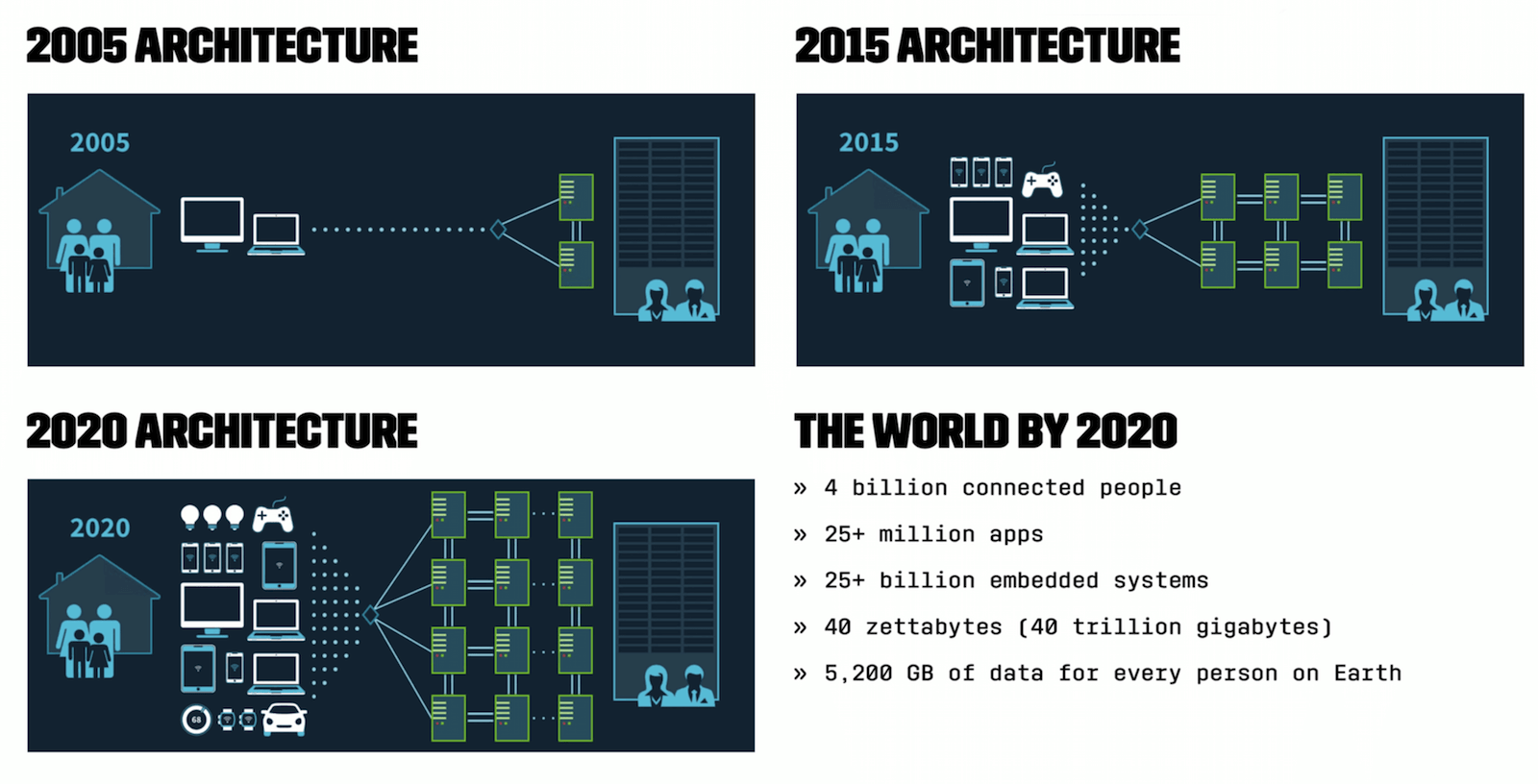
The old architecture of Walmart was based on a 2005 architecture, designed around monoliths, laptops, and desktops. Since they were unable to scale for six million views per minute, in 2012, Spotify had to renew their age-old legacy system and prepare for the 2020 world – a network connection having 4 billion people, 25+ million apps, and 5.2 GB of data for each user. Their aim was a 100% availability achieved with reasonable costs.

And so, they chose to migrate to microservice. They experienced the following changes almost instantly:

  • Conversions boosted by 20% just within 24 hours.
  • Mobile app orders were up by 98% on the same day.
  • The company experienced superb sales on Black Friday or Boxing Day (Canada). It has seen no downtime since re-platforming to microservice.
  • But what was most significant was the operational savings. Since they moved onto commodity hardware (affordable virtual x86 servers) from expensive hardware, they saved 40% of the computing power and 20% to 50% of the overall cost.

Kevin Webber remarked upon this migration, “Building microservice architecture is really the key to staying in front of the demands of the market. It’s not just a sort of re-platforming for the sake of technology. It’s about the overall market in general, about what users expect and what business expects to stay competitive.”

Amazon Incorporated Two-Pizza Teams

Amazon.com, the phenomenal retail website, was running on a massive architectural monolith until 2001. Rob Bingham, senior AWS product manager shared the story of how Amazon from there migrated to the microservices platform by approaching the DevOps philosophy.

“A lot of startups and enterprise projects start out this way (Amazon’s was a multiple tiered, and each had many components in them that were coupled together very tightly) They take a monolith first approach, because it’s very quick, but over time, as that project matures and has more developers on it, as it grows and the codebase gets larger, and the architecture gets more complex, that monolith is going to add overhead to your process, and the software development lifecycle is going to slow down.” – Rob

The development team faced many challenges due to the monolith architecture, including:

  • Large number of developers working aimlessly on one big monolith website
  • Continuous need to deal with coordinating changes with overheads that were also on the same project.
  • They had to make sure any new change (bug fixes or new feature addition) did not affect something else on the big project.
  • Convince everyone else on the big project to upgrade at the same time, if one particular team wanted to update a shared library.
  • Coordinating even small issues like quick fixing a customer issue needed a massive wait period for processes needed to be changed and circulated.

All of these led to something called Merge Week or Merge Friday. However, this large merged version also did not solve the problem and it still added a lot of overhead to the delivery pipeline. Building new code databases, rerunning test cases, and deploying the whole application to full production fleet was crazy and frustrating for software engineers. And we are talking Amazon here, the world’s largest online retail platform.

So, Amazon decided to go for the BIG Organizational and Architectural Change – They teased their monolithic application apart and made it into Service Oriented Architecture. They created highly decoupled architecture, where each service could iterate independently without the need for coordination between those services as long as they followed the standard web service interface.

They also implemented changes in their organizational structure and operations and broke down their central, hierarchical product development team into small ‘Two-Pizza teams’ – teams that were small enough to feed two pizzas.

“We went through the code and pulled out functional units that served a single purpose and wrapped those with a web service interface. We then established a rule, that from now on, they can only talk to each other through their web service APIs.

Back then it didn’t have a name, but now we call it as a microservice architecture.” – Rob

Each of these teams was given new powers and controls, such as:

  • Full ownership of one to four microservices, including customer control, defining their own feature roadmap, designing features, and implementing, testing, deploying and operating the new features.
  • If anything went wrong in a particular service lifecycle, the two-pizza team appointed for that microservice has to take full accountability to fix it and change it, even if it was in the middle of the night.
  • Since organizational teams were properly aligned, engineering teams were energized and motivated to make sure their end-to-end cycle worked properly.

After building microservices architecture, Amazon experienced the following changes:

  • Dramatic improvement in the front-end development lifecycle.
  • Decision making improved by 100%.
  • New features were launched perfectly and quickly.
  • Zero coordination issues.
  • Now the company makes 50 million developments a year.

Spotify Reached Flawless User Experience

Spotify serves 75 million users per month. An average session lasts 23 minutes. Spotify runs extremely complicated business roles behind the scene. Their competitors are Apple and Google.

A global enterprise, such as Spotify, that has an unparalleled brand name and two most inventive competitors, must move fast and innovate constantly. And this requires a highly scalable and stable architecture, remembers the VP Engineering at Spotify, Kevin Goldsmith.

“If you’re worried about scaling to hundreds of millions of users, you build your system in a way that you scale components independently. The problem is, if you want to build a new feature in this kind of (monolithic) world, then the client team have to ask the core team: please get us an API and let us do this. The core team asks the server team: please implement this on the server side so we can do whatever we need to do. And after that, the server team has to ask the infrastructure team for a new database. It is a lot of asking.” – Kevin Goldsmith.

Since Spotify has 90 teams, 600 software engineers, and 5 development offices operating in two continents working on the same product, they built an autonomous microservices architecture with full-stack teams to minimize the level of dependencies.

Now each of their microservices with full-stack teams consists of its own back-end developers, front-end developers, UI designers, testers, and product owners. Since the teams are autonomous, their goals and mission do not interfere or overlap with other teams’ objectives.

Although the company faces a couple of challenges with microservices, such as difficulty in monitoring thousands of instances running simultaneously and increased latency, microservices architecture have clear advantages for enterprises which Spotify have fully experienced:

  • Bottlenecks can be easily identified, tracked, removed or fixed within a microservice, which is complicated in huge monolith applications.
  • Testing a smaller surface is easier. Developers can test services locally without having to deploy them to a test environment.
  • Since applications are smaller, they deploy quickly and easily.
  • Monitoring services is easy in most instances, especially when rectifying a bottleneck.
  • In order to stop the addition of multiple versions to the same binary, the need to add support for multiple versions in the same instances is removed. Therefore, versioning can be done independently.
  • Microservices will never experience large failures, for their failures will be as small and easily manageable as they are.

Spotify has built its microservices architecture system with the thought that their services can fail all the time. Therefore, building microservices architecture has allowed the enterprise to face downtime of a large number of services without the users even realizing it.

In the end, this is what Kevin Goldsmith had to say about embracing microservices for business value development – We’ve been doing microservices at Spotify for years. We do it on a pretty large scale. We do it with thousands and thousands of running instances. We have been incredibly happy with it because we have scaled stuff up. We can rewrite our services at will – which we do, rather than continue to refactor them or to add more and more technical data over time. We just rewrite them when we get to a scaling inflection point. We do this kind of stuff all the time because it’s really easy with this kind of architecture, and it’s working incredibly well for us. So if you are trying to convince somebody at your company, point to Spotify, point to Netflix, point to other companies and say: This is really working for them, they’re super happy with it.”

There is no one right way to use microservices architecture for every company. Organizational changes, cultural challenges, process changes, customers, operations, and existing infra need to be considered. Companies need tools to fund the visibility of their microservice infrastructure. The balance of speed and safety at scale is the primary key to understand the value of microservices in business.

Want to enable the security and flexibility of Microservice Architecture for your business applications? Book a free consultation with our team now.

Top 6 Trending PHP Frameworks That Will Dominate The Market

PHP, also known as the Hypertext Preprocessor, is considered to the best open-source server-side scripting language for developing web applications. PHP has vast storage of modern tools and solutions that allow developers to build state-of-the-art websites, enterprise web applications and lot many other things. PHP solutions save time, streamlines backend operations, and lets developers re-use codes, making their job effortless.

Listed below are the top 6 trending PHP frameworks. Go through each one of them and we are sure you will find few appropriate for your needs.

Why PHP Frameworks

Although there are other frameworks, such as Python and Ruby, that are equally robust, most developers prefer PHP frameworks because it helps to tick the right boxes for different types of web application development projects.

It is a dynamic and smart choice because of the following factors:

Speed: 

Web apps developed by PHP frameworks are responsive and have fast loading time.

Cross-Platform Integration: 

PHP coding can be used in both Website and Mobile app development projects. Additionally, in mobile app development, it can stably integrate with all operating systems.

Stable: 

Since PHP frameworks are being deployed for a number of years now, developers have discovered and fixed many new bugs over the years, which has made this programming language even more stable and advanced.

CMS Support: 

PHP frameworks also support CMS, and widely used for CMS development. Content Management System is must today in successful application development for enhanced digital data experience.

Diverse: 

Most PHP frameworks use object-relational mapping to work with different databases. Developers need not have to punch in complicated SOL codes because of this functionality.

Must-Have PHP Frameworks

Software development tools must evolve to adhere to the latest technology trends. With software development shift, new frameworks emerge to meet the newer requirements. Therefore, due to its abundant resources, a PHP framework will be the first choice for a server-side programming language as well. However, the choices may vary depending upon the developer’s experience, scale, and type of project, and development timeframe etc.

Laravel

Laravel follows the model-view-controller (MVC) architectural pattern that makes it one of the most widely used PHP frameworks. Taylor Otwell developed this open-source framework in 2011, which is essentially based on Symphony.

One can easily learn the nuances of Laravel web framework and continuously upgrade their knowledge with the help of the enormous information documented for each framework released.

The framework is known for its impeccable use in rapid web application development. You can do a whole array of common tasks, such as cashing, authentication, RESTful routing, user management etc, using Laravel’s super-performing templating engine that invariably makes work of software developer easy and efficient.

Exclusive Features of Lavarel Include:

  • Improves performance by running tasks in the background asynchronously. The process is shortly known as Refined Syntax.
  • Perfect and stable integration with Amazon Web Services (AWS).
  • Well-built templating engine.

Symfony

No one can beat the record that Symfony has created over the years. It still holds a position on the chartbuster list of best PHP frameworks even after so many years. If we recall the best features of this PHP MVC framework, then they would be:

  • Reusable components
  • Built-in testing functionality
  • Reusable codes

Depending on the project requirements, developers can use some or all of Symfony’s components. Symfony is an ideal option for solutions that rely on modularity. It is essentially deployed to develop huge enterprise-scale software development projects. What’s more? You will always be benefited with the latest technical documentation about the framework, for Symfony is continually backed-up by a tremendous community of expert developers and engineers.

However, the only con that we can find is that the learning curve is rather steep. So, you may need both time and effort to grasp the whole concept of Symfony and its several functionalities.

Zend Framework

Any large-scale project can be easily developed using the Zend Framework. Developers across the world rely on the features and functionalities of this framework over others for enterprise-scale project development. Today most web application development follow the agile methodology, and this framework was specially built to support agile technology, allowing software engineers to create cutting-edge products to big companies in half time and at a reduced cost.

The benefits that Zend Framework gives to the developers is hard to beat. They include:

  • A commendable architecture that lets developers pay attention to only those components that they choose.
  • Lot of re-usable codes.
  • It has great extension capabilities. For instance, it can integrate with external libraries seamlessly.
  • It is scalable.
  • It comes with instant debugging tools online.
  • Has drag and drop editor and cryptographic coding tools, and the list is never-ending.

Its superpower and unique functionalities make it one of the anticipated PHP frameworks. However, since it is vast and contains several dynamic features, it could be one of the most difficult to learn PHP frameworks.

CakePHP

An old and most reliable PHP framework, CakePHP has been on the top six lists for the past several years in a row. A huge community of software engineers supports it and takes diligent efforts to improve the framework further in terms of consistency and efficiency.

Launched in the year 2000, CakePHP is known for fast builds and proper class validation and therefore it is highly preferred for developing state-of-the-art, smart, beautiful and feature-rich websites. And, the demand for it  will be higher than before.

Some of the unique features of CakePHP include:

  • Build on CRUD Framework (Create, Read, Update, and Delete).
  • Upbeat security functionality, such as SQL injection prevention, cross-site scripting protection, cross-site request forgery, and data input validation.
  • Backed by a sophisticated community of expert engineers that offer free and premium support.

CodeIgniter

CodeIgniter is simple, reliable, scalable, and tried and tested web app development framework that has been on continuous improvement since 2005. It operates perfectly on most of the hosting platforms and needs zero configuration from the users. Did we just miss to say that it is also well built and efficient?

One of the greatest reasons why this Framework is selected over other PHP frameworks is its speed. CodeIgniter works faster with database tasks. However, CodeIgniter is not based upon the MVC architecture, even though it falls under the Models-Views-Controller Category. While Controller is obligatory in this Framework, Models and Views are optional.

Also, amateurs can learn the features and functionalities of CodeIgniter quicker than most other PHP frameworks, including Zend.

Yii2

One of the quirky frameworks is what we will call Yii2 as. It is as simple as its name, “Yes It Is”. This is version 2, which has the features of the old one but improvises in its loading time. In fact, it is deemed as that framework that outshines all other frameworks in load time.

Yii2 is an object-oriented programming language that is integrated with Ajax and JQuery. It works on the principle of, “Don’t Repeat Yourself”, which avoids the use of the same software patterns recurrently. With this unique principle as a super-power, Yii2 is the first choice for developing large-scale web development projects.

It also supports the class-code generator, which enables it to boost rapid prototyping and object-oriented programming.

The aforementioned PHP frameworks are ranked in random order. Each one has its own pros and unique usability. Therefore, your Framework choice must be based upon the project, the amount of time you have, and your preferences. If your developers have time to learn a new option, then choose a framework that best fits your project requirement. For instance, if you need an absolutely classy website, use CakePHP and if you are assigned with enterprise-scale projects, go with either Symfony or Zend.

CG-VAK has the right expertise and perfect infrastructure that enables development support for projects on each framework mentioned above. We offer project development in fixed price model and retainer model. Contact us for more information and for free of cost consultation today.

Why Should You Outsource Software Development to India and why to CG- VAK?

Most of our customers frequently ask us, ‘why should we outsource software development?’

The basic answer is simple and logical- Companies outsource software development requirements primarily to cut costs. But today, it is not only about cutting costs but also about reaping the benefits of strategic outsourcing software development projects such as accessing skilled expertise, reducing overhead, having a choice of flexible staffing, and increasing efficiency, reducing turnaround time, and eventually generating more profit.

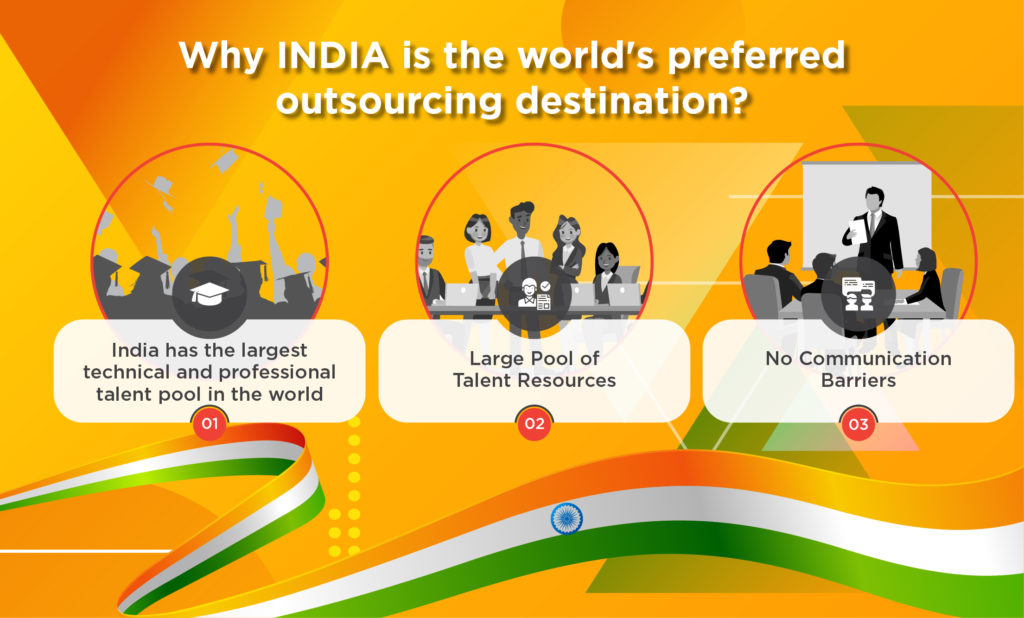
Why India is the world’s preferred software development outsourcing destination?

In a recent survey, 80% of European and US outsourcing firms ranked India as their number one outsourcing destination. The National Association of Software & Service Companies (NASSCOM) also reported that almost half of all Fortune 500 companies choose to outsource software development to Indian It outsourcing companies. Even though many other countries (including China, Mexico, Ireland and the Philippines) have emerged as major competitors, India has managed to outmaneuver all others and emerge as the top outsourcing destination.

Here are the advantages of software development outsourcing:

Large Pool of Talent Resources

India has a population of over 1.2 billion people and every year approximately 3.1 million students hold a degree of graduation from Indian universities in different fields. The talented workforce enables India to deliver quality services in various sectors.

No Communication Barriers

With India, you will not face any language or communication barriers as India is one of the largest English-speaking nations in the world. In India, the Education system is mainly in English and thus, Indian people are fluent in the English language and it encourages outsourcers to choose India as their outsourcing destination.

Time saving

Time becomes very crucial in business. According to statistics, India is the most preferred location for software development outsourcing due to the time zone of their working. Thus, it enables flexibility in working for outsourcing projects and can deliver the given project successfully in a fixed time.

Professional touch

By outsourcing your software development requirements, you can have an immediate access to some of the talented and expert professionals with a high-class work quality.

Before you choose your right offshore software development company for your business needs, do spend a little amount of you time to opt best software development outsourcing company. Check out their services, testimonials, software development outsourcing models, pricing and more. It could help you much better in finding a right destination. And, now let’s have a glance on CGVAK as your IT software outsourcing company.

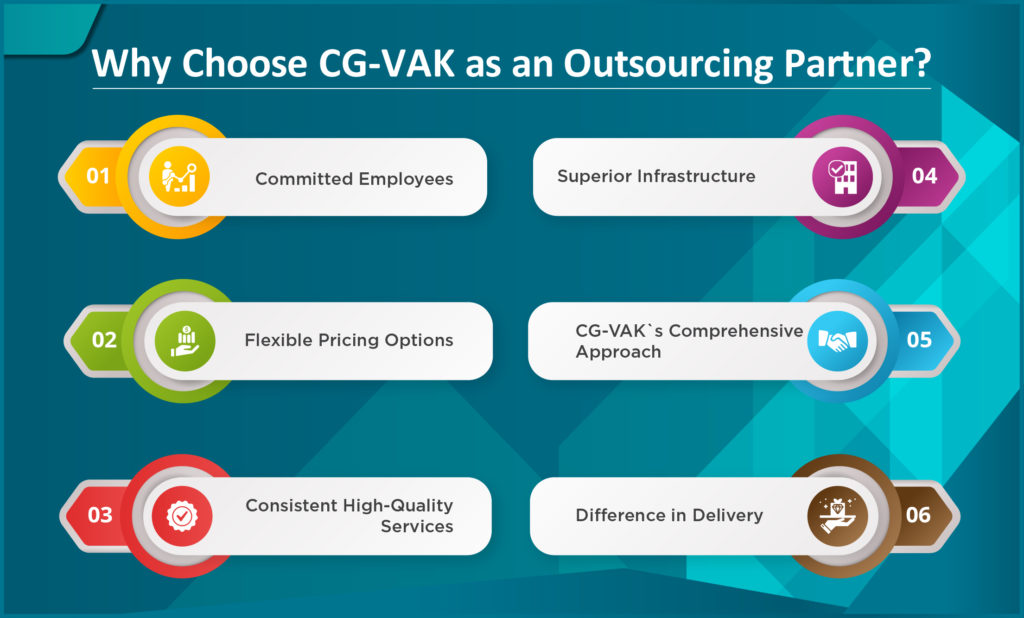
Why Choose CG-VAK as your Software Development Outsourcing Partner?

CG-VAK is a successful software development outsourcing partner to several offshore clients in the United States, the United Kingdom, Europe and Africa for the past 2 decades. We focus on building fast and effective software development solutions with just the kind of optimization one would need. Our team builds high-performance software platforms for our clients that help them accelerate operations, reduce cost overheads, minimize go-to-market time, and maximize customer experience

CG-VAK take the hassle out of your day to day software development needs so you can focus on running your business.

Below is the list of reasons why CG-VAK stand out of the crowd in the offshore outsourcing market.

Committed Employees

In CG-VAK, you get a committed workforce to work on your ongoing projects. Most of the companies in India work 8 hours a day and 5 days a week. In addition to that our team stay back during critical phases of the project and run the extra mile to ensure success of the project. Also, our team can work extended hours to meet short project deadlines.

Flexible Pricing Options

A range of flexible pricing options CG-VAK a top outsourcing provider for global outsourcers. CG-VAK bill their clients per hour or on fixed pricing (based on defined scope) so that they can choose the best suited option. By hiring resources from CG-VAK for your projects, you can save more than 65% on your operational expenses and increase company profits.

Consistent High-Quality Services

Flexible cost is not the only reason which makes CG-VAK one of the top software development outsourcing companies in India, the consistent high-quality services provided CG-VAK is one of the ultimate reasons for being a successful player in the offshore software development outsourcing market for the past 2 decades. When you choose CG-VAK as your strategic outsourcing partner, you gain significant cost savings, quicker turnaround time and experience optimum quality at all times.

Superior Infrastructure

CG-VAK offer their clients best solutions utilizing latest equipment’s or software. Moreover, CG-VAK high-speed internet bandwidth to maintain constant support and communication for their clients. Most importantly CG-VAK ensures 24/7 Power back-up using multiple UPS and Generators.

CG-VAK`s Comprehensive Approach

CG-VAK`s comprehensive approach has enabled it to emerge as a trusted and dependable partner. It has progressively shouldered technical responsibilities to ensure astute product and Custom Software development. We have been delivering cutting-edge solutions to business challenges by setting up a simple yet robust architecture. Transforming to adapt to the changing environment is our key characteristic that is driven by high energy and intense passion.

Building a product or a custom solution that is self-sufficient is a challenging task. One of the most successful ways to create such a product or a custom solution is to partner with a seasoned offshore product / custom service provider that suits well with your budget and understands your project requirements. CG-VAK has a rich history of serving small to large scale enterprises from across the globe. The company shares the same energy and enthusiasm in building the product / custom solution as its client’s; and ensures delivery of a quality, timely cutting-edge solution.

Difference in Delivery:

CG-VAK follows proven agile methodologies such as Scrum and Extreme programming to maintain agility in the way the project runs as well as enhance the scope of development of the product/solution to the best of possibilities. This process ensures the better understanding of the scope of work in order to deliver the product/solution within the planned deadline.

Minimum project size-At least 4 sprints with 2 weeks duration each

CG-VAK is a leading Outsourced Product Development & Custom Software Development company that provides end-to-end services to global ISVs and enterprises.

In the global competition, it is essential for businesses to focus on their core competencies and outsource non-core activities in order to gain strategic advantage and a competitive edge.

With proven technical expertise and a rich experience in Outsourced Product Development & Custom Software Development, CG-VAK has been recognized as a leading Outsourced Product Development & Custom Software Development partner for global enterprises.

From small to mid-sized to large companies, we have helped enterprises in digital transformation, building robust enterprise solutions, business process re-engineering, in order to deliver product excellence and customer satisfaction.

Our team of expert developers perform an in-depth analysis of client needs and adopt agile development processes to deliver:

  • Technical expertise
  • Reduced development costs
  • Additional skilled resources
  • Focus on new competencies
  • Full-fledged PDLC
  • Co-development
  • Faster time-to-market

If you are looking to outsource software development to India, Yes! Your search has ended up to a right place for all your software development needs. 

Blockchain – an Unconventional way to Deliver Values and Promote Growth

Blockchain was the buzzword in 2017 -18 when debates centered around latest technology trends. Although it is not new terminology, blockchain and its other variants of distributed ledger technology do create a potential impact on businesses, which a lot of industries are slowly starting to realize. In 2019, Blockchain will be debuting in many industries and it may also become an integral part of people’s lives.

Enterprise blockchain is the use of technology within the business, which has the potential to monopolize the real-world projects in the short-term. World’s most powerful and inventive specialists like IBM, Oracle, and Amazon are running on blockchain related administration and by 2026 end, the global blockchain technology market is predicted to reach up to USD 16.82 billion. In near future, blockchain technology will give us a new approach to mobile app development, making it more secure and accessible while simultaneously providing aid in data sharing, simplification of revenue cycle reconciliation, and supply chains.

What is Blockchain?

Blockchain, in simple terms, is a global public immutable ledger or database that is managed by a cluster of computers and not by a single entity. In fact, it is democratic in nature. Since the data shared is in immutable format, the data information is open for anyone and everyone to access. Therefore, anything built on Blockchain technology is transparent and everyone involved in it is accountable for its actions.

The data stored is called ‘Block’, and each of these block stores detailed information about every transaction, which enables companies to prove the security of their documents. It is an ingenious way of transferring information from one point to another in an automated and secure manner.

Each of these blocks is secured and bound to each other through cryptographic principles that are commonly known as ‘Chains’.

Strategic Importance of Blockchain

Since its inception, the technology has been widely associated with finance because of its connection to cryptocurrencies, which made most industries to view Blockchain as a technology reserved only for the fin-tech industry. However, if we explore, we will find that the solicitation of this electronic ledger is much vast than cryptocurrencies.

It is a building block for many industries presently, since it acts as a legitimate ledger data structure. Apart from bitcoins and transaction records, blockchain has many more functionalities, most prominently allowing digital data distribution instead of data copying.

There are no centralized databases in a blockchain. It ensures that no one individual or party in the system has the power to modify or tamper with the data. It also removes the need for a third party or central authority to authenticate or process peer-peer transactions and hence increases transparency.

Blockchain technology has been hailed as revolutionary and can dramatically lower cost, increase speed, and present transparency of all transactions. Take, for instance, a typical stock purchase or bank wire transaction. The transaction can be executed in minutes but the settlement — the ownership transfer of the stock or funds — takes a few business days. This is because the parties have no access to each other ledgers and therefore cannot automatically verify that the assets are in fact owned and can be transferred. A number of intermediaries (i.e. banks, escrow, credit card companies) act as guarantors of assets as the transaction is verified and the ledgers are individually updated. On the other hand, blockchain transactions reside on a public ledger and are not controlled by a central authority. Decentralizing control removes the need for intermediaries and middle-men. As a result, these transactions can be executed and settled between both parties in minutes with verification that is transparent, public, and validated by the network itself. Whether an emergency or just a normal transaction, this is particularly advantageous where the transfer and receipt of funds are required immediately. While this is just one example, these benefits will collectively alter existing business processes, disrupt industries, and create new business models; similarly, as the Internet did during the digital revolution.

Blockchain in Mobile Apps

Mobile apps based on blockchain technology prove to be an indispensable asset to all industries – it provides ways to reduce cyber-crime, improve liquidity, and free up investments to help improve businesses steer their operations.

Whether it is digital currency or smart contracts, blockchain has the ability to enhance supply chain management and provide streamlined quality control, by creating, negotiating, and verifying digitally abridged contracts.

It doesn’t matter which industry you are from – whether your company is a legal one running on the governing laws and regulations of the country or whether you are from the manufacturing industry – blockchain technology will improve product tracking, boost productivity, refine efficiency, and increase transparency with government officials. In fact, it allows accessing of personal information across all the industries with authentication.

However, you must invest in a global mobile app development company to best leverage blockchain for your app development. This is because talented blockchain technology developers are scarce. So, you must invest in a company that has the right blend of expert, infrastructure, and pricing.

The Impacts of Block Chain on various industries

Blockchain can be used in various aspects of the business Different industries, with shared business processes, including healthcare services, financial services, retail, and manufacturing must entail blockchain technology to rise above the competition and grow beyond boundaries in 2019 and forward.

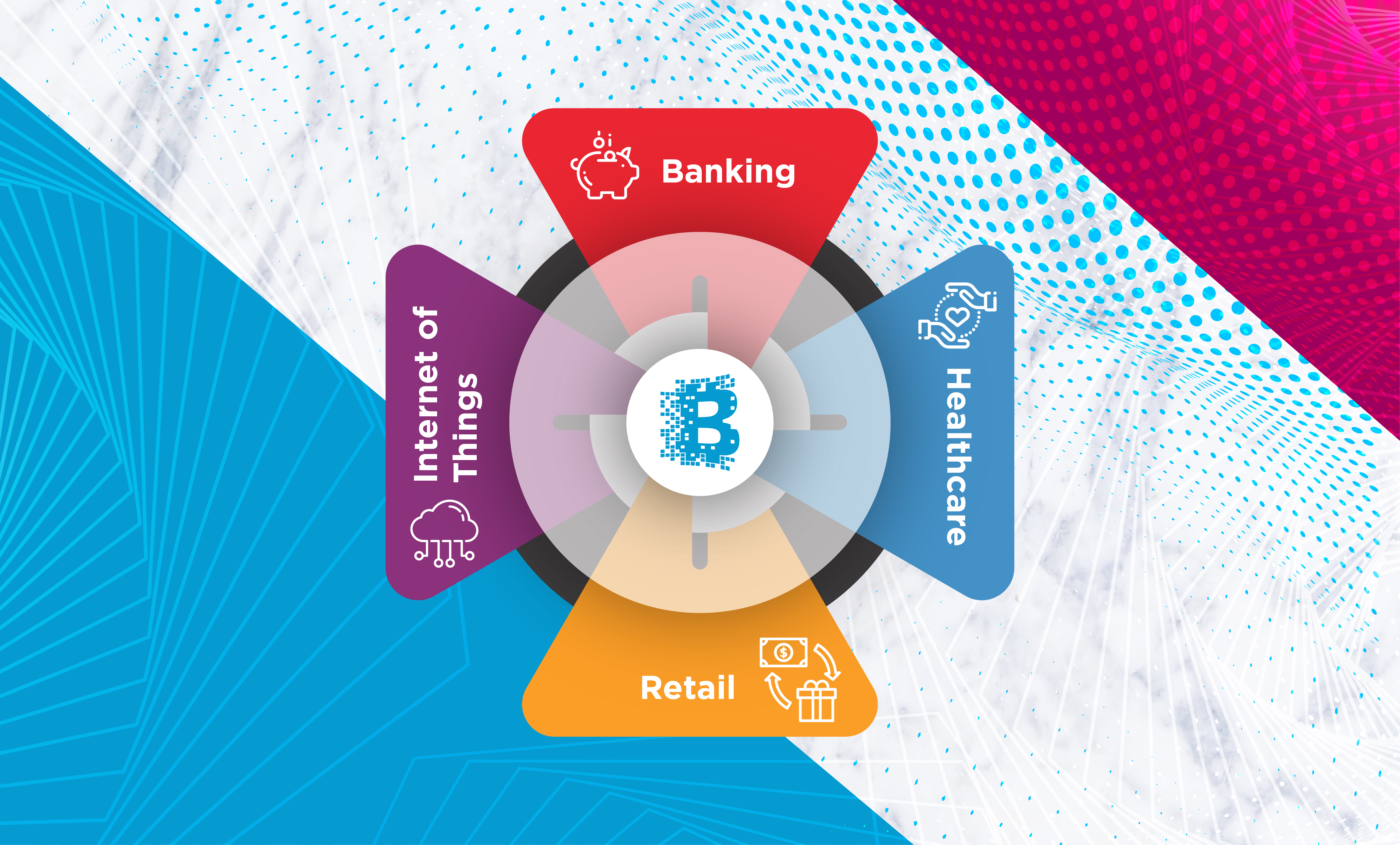
Industries that are recognizing Blockchain’s influence and structural integrity include:

Banking

The financial service ecosystem is structured and quite complex. With Blockchain backing the crucial elements, banks and other financial service providing companies can install enhanced accuracy and information sharing by turning to a digitized and tamper-proof ledger. Some of the immediate effects of blockchain on the financial and banking sectors are:

  • Reduction of fraudulent activities and combat cybercrimes
  • Creation of smart contracts to execute transactions
  • Simplification of the KYC process verification and bringing down compliance department administrative cost
  • Reduction of operational errors and frauds of trading platforms
  • Fortification of security and lower costs for processing payments

Healthcare

Data security across various platforms is an impending and challenging task that most healthcare facilities face. With blockchain at the tail, healthcare providers, patients, and third-parties can share access to their network without compromising on security. Examples include data storage and verification platform for comprehensive data security.

Retail

Trust is the most valuable asset in the retail world. Customer trust can be enhanced through blockchain. For instance, blockchain can attach the trust to sellers than to the site itself (taking Amazon for example). Startups can develop decentralized utilities to connect buyers and sellers without bringing in intermediary and incurring more charges. With utilities, customers can buy products using available cryptocurrencies and sellers get paid through Bitcoin, while all the data gets distributed across the global network ledger instead of getting stored in a centralized database.

Internet of Things (IoT)

IoT is a recent development in the technical realm and many companies are banking on its features, functionalities, and platforms to regulate growth. Currently, the IoT ecosystem relies on the server/client paradigm. However, with more IoT rising, millions of devices will want to interact among themselves or their users, which will cause more issues to surface.

Blockchain explores possibilities to resolve these problems by considering importing core concept of peer to peer messaging. Blockchain will allow gamut of IoT network devices to share the same network without the need for supplementary resources. In the future, blockchain will denote IoT with decentralized and autonomous networks.

Remember, if your business falls under one of the aforementioned industries, know that Blockchain will indefinitely transform the face of your business. You just need to harness the power of blockchain’s innovative ways.

What CG-VAK Blockchain Expertise has to Offer

You now know how Blockchain is changing businesses and how rapidly enterprises are harnessing their powers. Developing and deploying blockchain solution could be tricky unless a team who excels in it develops it for you and supports you. CG VAK’s expertise in Blockchain fits in the business realm in a number of ways by filling the gaps to resolve enterprise problems:

  • Decentralize compliances and communication in permission and cook-proof system.
  • Help protect data from manipulation through immutable ledgers, so that data once recorded cannot be changed, which is the number one reason for cybercrimes. What’s more? If ever your data is being attempted to modify by a hacker, the data ledger hash will change instantly, which will give time for miners to detect the hacker.
  • Improve interoperability between systems by establishing a connection between ledgers using various new-launched inter-ledgers.
  • Help keep the throughput time low, especially in enterprise blockchain functions.
  • Help companies predict and lower operational cost. We develop apps that work on cost-effective platforms on a stable and predictable transaction cost.

You can only be deemed as a true winner in 2019 and forward if you deploy blockchain driven enterprise solutions and services. For that, you need a blockchain driven software and expertise. All you have to do is contact http://www.cgvakindia.com/contact-us/ the blockchain experts of CG-VAK and discover how we can help you simplify your goals and build a Blockchain Enterprise system.

Microsoft Silverlight to Angular Migration – It is time to say goodbye to the legacy technology

User experience is the biggest objective that companies strive to focus on at present. With the addition of new technologies and devices, user experience has been improving significantly. This indicates that the old, legacy technologies that were once the pioneer front-end technologies are now falling short in fulfilling the objective. Hence, it is high time that we bid adieu to one such best technology for web development that we have been working for a very long time – Microsoft Silverlight. This also means it is time to prep ourselves to migrate from Silverlight to Angular – a robust, current, and highly sustainable technology for web development.

If you are looking for Silverlight to Angular migration service you can book a free call or get quotes.

Microsoft Silverlight End of Life

Microsoft has announced the end of support date for Silverlight to be October 5, 2021. Silverlight has been good, reliable, simple, and supportive. However, it has a simple to understand the concept, which has made coding easy and provides a separated view and a clean view model. Basically, it is a proprietary web plug-in based delivery mechanism, while now developers are looking for unified open source based frameworks.

“The commercial media industry is undergoing a major transition as content providers move away from proprietary web plug-in based delivery mechanisms (such as Flash or Silverlight), and replace them with unified plug-in free video players that are based on HTML5 specifications and commercial media encoding capabilities” – Microsoft in a blog post.

The vulnerabilities in media plugins often becoming victims of cyber-attacks (that happened to Silverlight in 2014) could be one of the reasons why it is coming to an end. Therefore, Microsoft insists that web developers soon switch to something new and big, something like Angular JS. The technology’s advancing the market at a rapid speed is one of the major explanations why most web development companies are considering Silverlight to Angular migration.

Why Silverlight to Angular Migration

Developers are seriously getting over Microsoft’s Silverlight and the like, such as Apache Flex. Coding community sites have frequently informed about the technologies that have seen an amazing upsurge and saddening decline in the last 9 years.

To find the results, they used tags (labels or keywords) that were submitted with questions posted on the community site to relate questions with particular topics. Julia Silge, a renowned data scientist, reviewed, in a blog post provided to The Register, the tags that showed the highest percentage year over year since 2010. They were Angular, the TypeScript-based framework for web applications and Apple’s Swift, a programming language. The tag angularjs-directive, which refers to Angular’s system for HTML extension is another technology that also saw a significant, but less dramatic change in the last 5 years.

On the other hand, Silverlight, Microsoft deprecated framework, saw dwindling interest in the developer’s community.

Therefore, it becomes imperative for us to suggest to think about Silverlight to AngularJS migration, especially now when Angular is catching the heat of fame quite well. Angular is feasible and vast in features – two key reasons why developers are not thinking twice to adopt the framework.

Why Angular –Advantages and Features of Angular

‘What are the key benefits Angular and TypeScript can offer development teams’ – a great question that technology managers and directors ask.

It is always important to learn about Angular or any technology before jumping to something new blindly.

So, in reality, Angular can offer development teams (both technical and non-technical) many benefits, features, and functionalities in terms of application maintenance, developer productivity, the longevity of the framework, pace of technology, and managing change requests.

And, as for the question ‘Why Angular’, here is the answer in pointers. We are sure by the end of it, you will understand why you should adopt it in all spheres of web development:

  1. Angular is an open-source web app development framework.
  2. It is managed and maintained by Google and a large community of coders.
  3. It is backed up by Visual Studio .NET IDE and IntelliJ IDE.
  4. It provides extended features, such as routing, dependency injection, animations, and more.
  5. It allows developers to accomplish a particular thing using several approaches by providing different tasks and development styles.
  6. It allows developers Massively Parallel development.
  7. In Angular, the page DOM is directly aligned instead of being added to the inner of an HTML code. This makes the system faster.
  8. With Angular, dependencies are easily handled.
  9. Most of the issues faced during the development of single-page applications are addressed by Angular. Since Angular is built on TypeScript (a superset of JavaScript), it brings in a lot of benefits, especially catching errors early.
  10. There is an overall consistency when using Angular for web app development – the overall structure of a component always looks the same.
  11. Angular services are consistent; it lets you choose between factories, services, providers, values, and constants when you have the code that is required to be reused throughout an application.
  12. With great consistency, you get the benefit from productivity. General guidelines and code structure lets your developers write second and the subsequent components by referring the first one.
  13. You can easily organize codes into ‘buckets’ – whether it’s the components, services, pipes, or directives, everything you create can be organized into one or more buckets.

There are certainly more benefits that we can show you than what we have discussed here. While most benefits are subjective, maintainability, early debugging, productivity and consistency will definitely reign at the top of the list for many companies.

Angular is one of the most popular front-end tools in today’s job market for it has an incredible journey to stardom.

Benefits of Migrating from Silverlight to Angular

Today companies across the world are continually hiring Angular developers to migrate their websites from Silverlight to Angular. The best way to make most of your investment from AngularJS migration is by hiring an outsourced website migration service provided by a suitable and knowledgeable team of developers to make it accessible as an open source solution. An open source solution provides expansive options across various browsers and platforms for a host or browsers regularly support it.

This reason coupled with low migration cost and long-term value proposition are keys to the question of why top companies are migrating to Angular rather than upgrading their existing Silverlight websites.

Migrating to Angular will not only give you newer development options but also vast opportunities for integration. Migration of Silverlight to AngularJS comes with lots of other benefits too:

– Angular is a modern web platform as compared to Silverlight, which is often paired with Kendo UI and built with corresponding APIs.

This not only offers smarter forms but also gives you feature-rich user experience with added benefits of responsive web design that supports multiple devices, such as mobile phones and tablets – something Silverlight was inefficient at.

– If your application is built as a desktop app with Silverlight but you realize that it is best suited as a mobile application, with Angular development team, you can build a cross-platform mobile application. This gives you an option to uplift your existing data services with a brand new mobile application or build a state-of-the-art modern data layer that utilizes your existing database.

– Many Silverlight apps are just meant to be Windows applications. This greatly limits your horizons when compared to cross-platform mobile apps. With Angular development team, you will be able to eliminate this limitation and provide different solutions.

– Some of the other standard benefits of Angular migration are:

  • Thread-like form operations
  • APIs with geolocation support
  • Provision of client-side database
  • Options for embedding videos and audios
  • Better responsive design solutions
  • Customizable by focusing on web app needs

Angular Migration: Best Alternative to Silverlight

Silverlight is great, but since it is ending, the best alternative to it is Angular. Angular provides us with two-way binding supports, which also enable the design pattern MVVM. MVVM pattern provides us with 3 options, including #view, #view model, and #model. With Angular directives, you can also create one-way and two-way support binding.

There are many significant differences between Angular and Silverlight, which eventually make Angular a better and promising choice for web application development, and hence, this arises the need for website migration.

An ideal reason for businesses to consider website migration from Silverlight to Angular is the incomparable love for the framework by the developers’ community for several reasons, including:

  1. Data Binding – two-way data binding is an important feature when working on the display of real-time data.
  2. Testing – Angular effectively changes the complete development lifecycle by using a different approach for testing, Karma.js framework.
  3. Simple Injection and Routing (Perfect for an MVC framework).
  4. MVV
  5. Extensive Google support makes Angular trustable and effective framework.
  6. Most suitable for dynamic and responsive websites, something that is in demand currently.
  7. The framework comes with the Module System for Testing and Development.

Top organizations across the world have adopted Angular framework successfully, including Netflix, Freelancer, PayPal, Upwork, YouTube, Lego, and the Guardian. Every day many businesses are hiring competitive AngluarJS developers for Silverlight website migration. Website migration becomes inevitable as technologies change. You cannot prolong it for too long. Therefore, grab the opportunity today when it is just the beginning so that qualified teams of developers attend you.

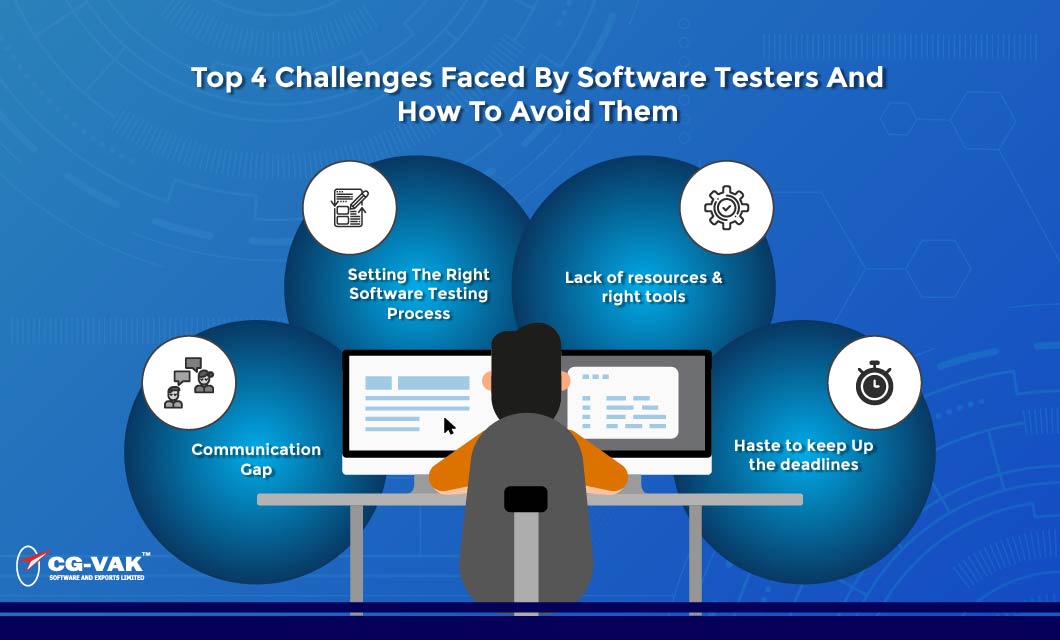
Top 4 Challenges Faced By Software Testers And How To Avoid Them

Software testing plays a crucial role in any successful software development process. Software testers are your last line of defense before the product hits the market. However, Software testers face a lot of challenges in their crucial role. In this article let’s see the top 4 challenges faced by Software testers and the right solutions to make life easier for them.

Top 4 challenges faced by Software testers:

  1. Communication Gap
  2. Setting The Right Software Testing Process
  3. Lack of resources & right tools
  4. Haste to keep Up the deadlines

#1. Communication Gap:

Ask any experienced tester, this is one of the greatest difficulty (or challenge) to testers. In most projects, the software that finally comes out of production and the originally planned functions (& features) are not the same. Changes do happen on the go, and unless a streamlined testing process is implemented, these changes are not properly informed to the QA teams.
This leaves a huge gap between the developers and the QA team, sometimes this gap never gets fixed, resulting in a lot of bugs despite a highly qualified Testing team on board.
Take Away: The right approach is to ensure a QA member is involved in any discussion regarding changes, upgrades or new features for the project that’s not mentioned in the initial product architecture.

#2. Setting The Right Software Testing Process:

Establishing a perfectly working software testing process is more difficult than it sounds. Having said that, a company’s software testing process should ensure that the entire team (Developers, PMs, QAs as well as the Client) is strictly aligned. The challenge here is to bring the entire team together especially when they are working on different time zones and locations.
Take Away: Needless to say, it’s always better to ensure the team works in the same location (Branch) and time zone. In case if it’s not possible, you can at least ensure the team interacts on calls (conferencing or Skype) regularly to keep them on the same page.

#3. Lack of resources & right tools:

Often QA teams find themselves lacking enough resources or the right tool for the given job. Lacking specialists to handle various types of software testing requirements is another issue. Put together these two issues will reduce product quality and increase the time taken by your QA team.
With the right tools, your QA team can get the job done faster and with more accuracy. Furthermore, acquiring the right skills is also important to achieve better results, having a specialist on handing Mobile or Cloud application, for instance, can help you deliver greater quality to your customers.
Take Away: Enabling your QA team will the right tools and recruiting specialty testers into your QA team is certainly worth it. It will both enhance your testing process and reduce the delivery time.

#4. Haste to keep Up the deadlines:

Unrealistic deadlines will often result in less time being allotted for the QA process. Any delays caused during production is often compensated by reducing the time allotted to the QAs. Alternatively, short deadlines result in some of the QA suggestions being ignored. Either way, this will affect your software testers & their process and consequently the product quality.
Take Away: Ensure your QA team is included from the start of the project discussions to ensure the QA process is streamlined to your delivery time. It is important to test your product step by step as it is developed to ensure bugs, and issues are fixed on time.

By helping you deliver higher quality products software testers help you save 1000s of dollars spent on client retention programs. Remember better quality directly results in client satisfaction and encourages referrals from your existing clients. So makes sure to optimize your software testing process or choose a streamlined Independent software testing company to improve your quality delivery

Choosing A Custom Software Development Company

Most businesses in the modern age, much like yours, understand the importance that efficient software holds in the smooth functioning of their company. The software the companies use has a direct part to play in the level of success that the company attains in the long-run. It is true because the software is responsible for most of the grunt work that the companies face. “Professionals in this industry have accorded agile development methodology the most satisfactory software development method.”

They handle complex tasks all on their own, like smoothening business processes, optimizing workflows, responding to situations as they emerge in real-time. Close deals, handle the paperwork quickly, and offer constant and quality service to their customers and clients. Software constitutes the most important part of the company’s mainframe network, both in the cloud and in the company’s internal servers.

Several businesses and companies underestimate the effort required to create software that takes perfect care of their needs. Companies often make the deadly mistake of trusting custom software development companies instead of the best software development company.

Often, companies hand out their requirements to software development companies that already have their hands full with internal work. They are not capable of creating software that handles some company’s needs according to the personalized requirements that the company provides. You cannot afford to make this mistake. Not all software developers or custom software development firms are equal. You need to make sure that the Information Technology company you’re trusting with the responsibility of designing tailor-made software for you must be competent enough to do it.

According to surveys conducted, typical software takes about 4.5 months to build, and the average cost of building a single piece of usage software amounts to an average of $36000.

Businesses who are looking to roll out robust and custom software must have collaborative abilities with third parties so that they understand the expectations you hold of their product well.

The basic requirement you need to look for in your custom software developers is having a clear-cut idea of what exactly is it you want and how they can get it for you. They also need abilities to analyze your target audience and the approximate target usage of the software and the desired levels of efficiency, mobile-friendly, and user-friendly features required.

Here are a few things that you need to look for before outsourcing your custom software development tasks:

1. Look for referrals or recommendations from previous customers and/or other credible sources

Successful collaborations with a lot of third-parties make it more likely for the custom software development company to have the ability to understand what do you want exactly. Glowing recommendations from customers who have already tried and tested their products will prove to you that they are, indeed, armed with experience. There are many websites on the web that will grant you access to referrals and recommendations about various software development vendors that are currently offering their services on the market.

2. Scrutinizing the company portfolio – After shortlisting the custom software companies or bespoke software developers of your preferences, you need to review their company profiles and company portfolios. If these companies have the required experience to take on quality work, they will give you the feeling that they are, indeed, armed to tackle any task, no matter how difficult, you throw at them. This feeling of confidence in their work is what you need.

Combined with credible references, referrals, and recommendations, you will be very well equipped to decide on the vendors you want to choose.

3. Getting to know the technology the development company will use to make the software

Customized software solutions are no piece of cake. They require a lot of hard work, along with sophisticated technology, to give you quality and cost-effective products. Typically, developers use popular programming languages like PHP, JavaScript, and C#. If you know what kind of software and technologies the company uses, you can grasp the characteristics and features that you might want your application, or the  software products, to have.

This knowledge helps you know, specifically, what you’re looking for and what you’re expecting from the company. Therefore, it is easier for you to convey your requirements to your software development partner, and it is easier for them to anticipate your needs and fulfill them satisfactorily.

4. The scope of work

Before committing yourself to a particular custom software development vendor or bespoke software company, you might want to know the scope of the custom-built software that they offer. You need to make sure that both you and your vendor is on the same page regarding your business application processes and your requirements for your custom software products. It is only in the case of full mutual agreement that they can guarantee a successful outcome for the project.

It is also important to clarify and get informed on their after-development support services and whether they come with any terms and conditions that you need to know. You need to be familiar with the vendor’s software configurations, customizable options, maintenance, and backup services. By being animate about this information, you are getting to know your product better and better even before it starts.

5. Make sure your outsourcing software development company uses the latest technology

New ideas and the newest technology usage is important for your software development company. After all, how can they expect to make the latest software with all modern features for their clients when they use outdated technology themselves? It is a crucial factor for judging the competence of your custom software development vendors as it directly affects their ability to offer new ideas and strategies to you for your application.

According to a survey conducted in this regard, the most widely used programming tools among professionals are Visual Studio, GitHub, and Sublime Text.

Another takeaway from software development companies that uses modern and updated technology is that they have successfully adapted to changes in technology in the market and are capable of offering the latest trends and patterns to your software too. It means that you will also stay with, if not ahead, of the market at all times.

Apart from that, you can also compare the company’s past projects and see their gradual growth to big ones. With this, you may be able to figure out how the vendors have developed and incorporated newer processes as the time comes. This information also lends you an insight into the company’s success and potential for growth, which is very important to your project.

Nowadays, Artificial Intelligence, the Internet of Things, and Blockchain technology are the top three trends in the software industry.

6. Communication and collaborative skills

Communication is, indeed, the key to success. Therefore, you don’t need to hire the best offshore software development company, but make sure that the company you choose for your project has an organized and systematic communication channel in place. With constant communication, you can discuss, clarify, and share different ideas and opinions easily and effectively. During the long-run, this effective communication will prove efficient in getting your ideas across well. They will also help your project take shape exactly to your liking.

Apart from that, good communication and collaborative skills in the vendors help you set your priorities before them and track whether they are being looked toward or not. Good communication also helps you to track your budget towards the project and make sure you don’t go over the top. A company with good communication and collaborative skills is highly likely to succeed more than companies and vendors who lack such skills.

7. Security issues

It is one of the most critical aspects of the vendors that you need to analyze. When you are trusting them with developing a mainframe software for your entire company to depend on, you are trusting them a lot. You have to make sure that the software does not have the potential to cause harm to your company further down the line. Make sure that reputed vendors have good relations with their customers. You need the software to be reliable and secure.

You also need to make sure that the software is capable enough to handle situations where it has to work under high security and high safety environment systems. It is fundamental to secure your confidential information from the software and make sure that it promises no compromises in the long-run. Since you’re going to be trusting this software completely, you have to make sure it is worth the trust.

8. Clarify ownership issues

Since your company is going to be using software created by another custom software development company, you need to be aware of ownership issues and what they represent. You need to check and clarify application ownership issues with the software developer before you hand them the task. You must do so before you trust them with your project to prevent disputes from arising in the future. It is always a good practice to get all your decisions and agreements down on paper and get them notarized so that they are enforceable in the court of law, in case the need arises.

There have been several instances where companies have used software illegally just because the ownership status was not precise.

9. Take great notice of the legal aspect of the project

Amid a sea of technical and strategic vetting, you mustn’t miss out on the legal implications of the project. The custom software developers will inevitably have uncontrolled access to your intellectual property, trade secrets, and various business processes and strategies that you might use in the firm. Make sure that you are confident of the integrity of the firm in which you are entrusting your project. Custom software development firms who have been in contact with various customers, clients, and other third-party stakeholders present an obvious advantage over others because they have already proved their honesty and integrity.

Referrals and recommendations go a long way to make a case for software developers, so make sure you scrutinize those documents before making a decision.

Keep in mind that when you’re outsourcing your project to an overseas firm, you evaluate the legal arena from both the host country’s perspective and the country where the software will be majorly used. Selecting a development firm overseas comes with a lot of legal implications, and you might have to hire outside counsel to evaluate the legality of the contract before you shake hands on it.

The Bottom Line

Keeping all these factors and questions in mind will help you give an idea about how you can choose the best software development vendor for yourself. It does not matter whether you need mobile development or web development services; these tips will help you choose just the right custom developers for your company every single time.

It’s just the beginning. Once you begin your own research based on what you have read here, you will start to form a clear picture of your requirements and needs. Then, you will know which software developer is perfect for you. We hope that this article helped you get a head-start on choosing the best software developers from the plethora of those available in the market. Always take note of these tips, and you will end up with the perfect developer before you know it.

10 Reasons Why ISVs should outsource their Software Product Development to India

Running a product company is not an easy task these days, as the market competition for almost any niche is harder than ever before. Such fierce competition makes it difficult to run and make a good profit out of ISVs as most ISVs struggle with reduced pricing due to the competition. Even though SaaS model helps Product companies to reach out to SMEs with affordable pricing, it adds more complexity to product and adds complexity to implementation & product maintenance.

Such market pressure makes ISVs outsource their product development as well as maintenance to developing nations such as India. Outsourcing essentially removes the gap between different sizes of businesses as it evens cost, time and skilled resources across the board at highly affordable pricing. Let’s discuss how choosing an Outsourced Product Development partner in India can help your business achieve a greater ROI out of Your ISVs.

Top 10 Benefits of outsourcing your software product development to India:

  1. Lower Pricing
  2. Professional Touch
  3. Get a Managed Team
  4. Time is Money
  5. Save On Infrastructure Cost
  6. Avoid Spending on Support Services
  7. Get an international Team
  8. Easy Access to Specialty Resources
  9. Ease of Communication
  10. Focus On Your Core Business

#1. Lower Pricing:

Outsourcing can help you cut on the cost of recruiting & maintaining a software development team. By Outsourcing your entire product development requirement, you can essentially cut your initial investment and monthly recurring cost by more than 50%. Such savings can be directly invested in marketing your product or remove the requirement of additional funding/loan, either way giving you an ample advantage in the long run.

#2. Professional Touch:

By outsourcing the development part instead of hiring developers by yourself, you are essentially giving your product in the hands of experts. After-all software product development is the cup of tea for your offshore partner anyways. Using such a professionally experienced team to handle your software development will ensure an error-free world-class product. By launching a world-class product into the market you gain an almost instant advantage over your competitors.

#3. Get a Managed Team:

Apart from getting experienced professionals at affordable pricing, you also do not have to worry about micromanaging your team as that part falls on your outsourced product development partner’s shoulders. In other words, you hire experienced software engineers at half the price (compared to the cost in the US) + get someone to manage the work for free. This is certainly a win-win scenario for any product development company to think about.

#4. Time is Money:

As you are freed from managing a team of developers and support professionals you can focus your entire time on acquiring funds or on Marketing your product. Lack of time to handle multiple tasks at the same time is the biggest issue among most start-up product companies. By effectively outsourcing your software development process, you gain more time and remember, “Time is Money”.

#5. Save On Infrastructure:

Software Development Outsourcing not only reduces the cost of developers but also removes the unwanted expenses involving internal developers.  One of the major reasons Startups in western economics struggle is due to the constant requirement for upgrading office infrastructure. Outsourcing is considered a boom for small and medium businesses as it enables them to compete with tech giants.

#6. Avoid Spending on Support Services:

Customer support and tech support are other non-core business activities that companies try to outsource to an offshore software development company in India. It enables US companies to focus on their core business activities and marketing while avoiding the stress of support and tech activities, which also costs considerably when setup in the US.

#7. Get an international Team:

When it comes to Offshore outsourcing one of the greatest advantages is multiple teams working from 2-3 different locations or time zone. The huge benefit from different time zone (especially considering the rough 11-12-hour long difference between Indian and US) is you can explain the development project during your day, and due to the time zone difference, it will be done during your night so that you can review it the next day. This time zone strategy can be used to effectively develop a strong application with step by step approach with relatively less time at a highly cheaper price.

#8. Easy Access to Specialty Resources:

Finding highly specialized IT resources is both harder and expensive, however, developing nations like India has a large pool of talented resources on AI or data science at relatively cheap pricing. Effectively enabling startups and Mid-sized companies in the US to gain easy access to these resources due to the relatively cheap labor cost in India.

#9. Ease of Communication:

With around 125 million English speakers (which is barely 10% of Indian Population) India is the second-largest (second only to the US) English speaking country in the world. This is also one of the major reasons why India remains the 1st choice for offshore software development.

#10. Focus on Your Core Business:

By choosing an outsourced product development partner in India, you can focus on your core business activities such as marketing, finding investors or branding your business. By outsourcing the product development process you also get ample time to focus on your competitors and other core business to ensure reduce your product to market time and achieve better ROI.

How we succeed in Outsourced Software Development

Be it startups to small entities, medium or large-scale organizations, the need for outsourced software development has been a factor for consideration at all levels. The reasons for this could vary ranging from specific skills to larger number of resources, costs, Time overlap, and quicker turnaround time.
Despite the greatest need for outsourcing, there are always many risks that are involved in the process. However, the success of outsourced software development is most dependent on the mitigation plan and the steps that are followed to handle the risks that are involved in the process.
Must haves for Outsourced Software Development.
Every customer onsite requires a few primary conditions to be fulfilled as mandatory requirements for the company that offers outsourced Software development. These conditions play a vital role in the success of outsourcing. A few of them can be as follows:
1. Linguistic Differences and Communication Barriers
In general, there is a common belief that the English communication of the members in the outsourced company is low in standard and they would not be able to use accurate words and sentences wherever necessary. Any requirement provided by the customers are not interpreted correctly and Issues in communication are one of the major pitfalls of outsourced software development. It is important to overcome language and cultural barriers along with different time zones to ensure the success of your offshore project.
Frequent communication with the offshore development team helps you to overcome this major pitfall. You will need to establish regular channels of communication with the outsourced team. Internal communication training and exposure to teams with client communication plays a major role in overcoming this barrier.
Currently latest technology advancements have nulled any barriers that were prevalent for communication. An important way of ensuring communication is to use collaboration tools for regular engagement. There are certain tools like Jira, Asana, and others that allow you to have video or audio communication with the offshore team and thereby act as effective communication channels.
2. Trust and Compatibility
With more and more companies clustering with outsourced software development services, partners in the outsourced countries may face some distrust on which to choose and which one would be worthy of trust and confidence. Decades of experience in the field, trustworthy approach as a partnership model, experienced resources and effective communication has paved a clear way for the reliable outsourced companies who have made a mark in these services.
3. Commitment and Responsibility
Taking ownership of the work in hard without being its owner is a rare aspect of human behavior that would win many businesses. An outsourced Software Development company’s personnel must work with an ultimate motive to build a long-standing relationship thus increasing the scope of the business. For this, each project that is undertaken must be treated as a seed which is developed to grow, win more end customers, and increase the scope and the usability of the project.
Though not a very prominent business strategy, this approach carries with it the oneness of traditional business and its success which is seen even today.
4. Value Adds and Innovation
Providing any service as an outsourced Software development partner would require a little more than the regular business partnership. This little extra can be in the form of Value adds and innovation based on the niche skills, quality, and effort. Consistency in the output, Innovation in technological output, and other intangible benefits to the business partner would add up to the confidence and the long-term trust to retain the relationship.
Performance beyond contractual agreements and providing utmost satisfaction results in customer delight.
5. Change Management and Contingency Plans
Every outsourced Software Development company has a fleet of resources across various skills and technology. Scaling up for early deadlines, scaling down for cost benefits and expert consultation with niche skills has been a leading factor that motivates the outsourced business. With all the above a disciplined approach on development strategy, contingency plans, methodologies and adaptability is also taken care of.
When all of these are taken care of by your outsourced partner, the customer has very little to worry about. Deadlines are met, technology updates are adhered to, resources are managed effectively, product is out and end customers are happy.
To summarize, the outsourced Software development business is already climbing high and having a competitive advantage over other business engagements. Considering the current situation and the effect of Covid-19 on various other industries, with effective infrastructure, planning and disciplined approach to work, the IT industry has been moving with the same pace and comfort to support their business counter parts in spite of these odds.
A strong resource base with diversified and efficient talents and skills as against a balanced customer based with long term commitment and a partnership approach is not in short of success. Outsourced Software Development thus has the greatest potential for cost reduction, competent development and efficient completion.