Blog

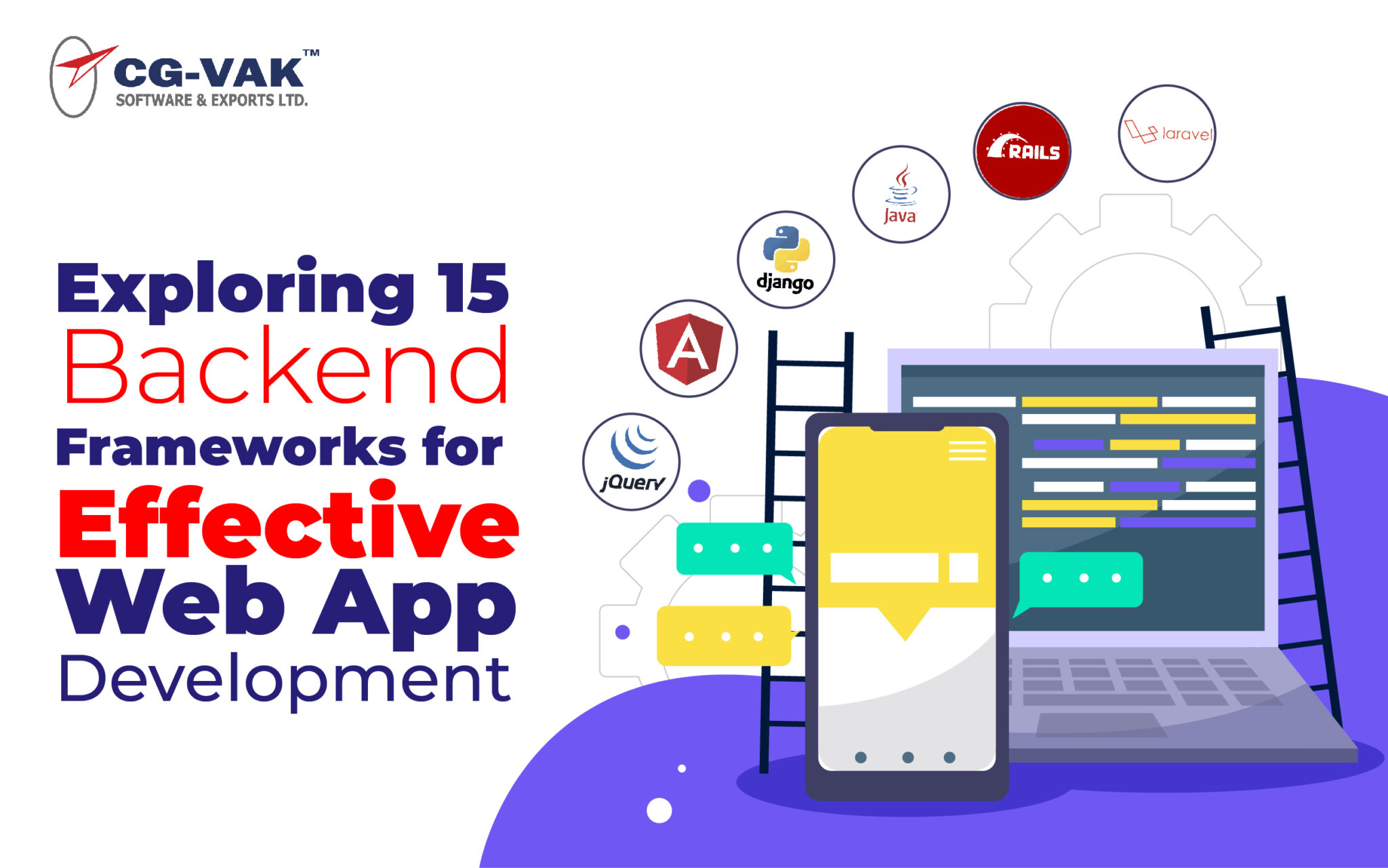
Exploring 15 Backend Frameworks for Effective Web App Development

Enter the dynamic realm of web application development! As this realm continues to expand, popular backend frameworks emerge as your essential allies, ready to help you craft exceptional digital experiences. These open-source backend web frameworks stand by your side, equipping you with the necessary tools and techniques for tasks such as database management, server setup, and route handling. They form the core of seamless web development.

But there’s more to these frameworks than lines of code. They’re all about enhancing user experiences, creating pathways for API communication, seamlessly integrating with databases, and optimizing server-side performance. They seamlessly guide rapid prototyping and smooth scaling, ensuring that your application is not only user-friendly but also highly efficient.

However, keep in mind that the tech landscape is in constant flux. What’s trending today might be outdated tomorrow. This is where staying up-to-date becomes crucial, and here’s where backend development services come into play. These services become your compass, helping you navigate the realm of popular backend frameworks. They ensure you’re equipped with the right tools, resulting in web applications that truly stand out.

Are you ready to dive into the world of popular backend frameworks, making the most of open-source flexibility? Eager to leverage backend development services for expert guidance? Join us on this journey as we transform your web development aspirations into reality!

What is Backend Framework?

A backend framework is a pre-built foundation simplifying web application development. It aids in the creation of full-stack web apps by providing tools for managing databases, routing data, and handling server requests. It’s the best software to create web applications efficiently, offering standardized solutions for common challenges and bolstering security measures. These frameworks ensure seamless web application development, empowering developers to focus on the user-facing features. If you’re looking to dive into this realm but lack the expertise, you might consider hiring a backend developer. With their skill set, they’ll navigate the backend framework intricacies, ensuring your web app thrives. So, whether you’re a pro or a newbie, a solid backend framework is your go-to for successful web application development.

Key Benefits of Backend Frameworks

Backend frameworks offer a plethora of key benefits that significantly enhance the process of web application development. Firstly, these frameworks provide a structured foundation that accelerates development by offering pre-built components, libraries, and tools. This standardized approach not only speeds up coding but also ensures consistency, reducing the likelihood of errors.

Security is another paramount advantage. Backend frameworks often incorporate built-in security features and best practices, safeguarding against common vulnerabilities like SQL injection and cross-site scripting. This proactive approach ensures that sensitive data remains protected, boosting overall application security.

Scalability is a crucial consideration for modern applications, and backend frameworks address this adeptly. They offer scalability features and optimization techniques that allow applications to efficiently handle increased user traffic and growing data volumes without compromising performance.

Moreover, backend frameworks contribute to team productivity by providing a shared set of conventions and practices, fostering collaboration and making it easier for developers to work on different parts of a project. Lastly, backend frameworks play a vital role in future-proofing applications. By adhering to industry standards and best practices, these frameworks make it easier to adapt to technological advancements and changes in the development landscape.

In essence, backend frameworks streamline development, fortify security, enable scalability, promote teamwork, and ensure long-term viability – collectively forming an indispensable toolkit for modern web application development.

Here is a list of 15 frameworks and their salient features

Laravel:

Laravel, an open-source PHP web framework, empowers developers to craft elegant web applications with minimal coding due to its graceful syntax. With its foundation in MVC architecture, it offers both simplicity and swift development, making it an ideal choice for web application development and the creation of full-stack web apps. Noteworthy attributes include efficient traffic handling, robust security, adaptability, seamless third-party integration, and straightforward unit testing, positioning it as one of the best software to create web applications.

Node.js:

Node.js, a favored technology, serves both frontend and backend needs through JavaScript. Its asynchronous, event-driven design suits scalable network apps, making it highly suitable for web application development and mobile app building. The framework’s strengths lie in scalability, mobile and developer-friendly usability, rapid reliability, real-time multi-user web applications, and economical development costs.

ASP.NET Core:

Developed by Microsoft, ASP.NET Core streamlines the creation of maintainable, scalable web applications using languages like F#, C#, and Visual Basic. Its cross-platform capability and optimized scalability are prominent, making it a powerful tool for web application development. Additional features encompass effortless cloud deployment, heightened security with inbuilt authorization and authentication, along with a solid caching system.

Fiber:

Fiber, tailored for Golang developers, boasts scalability and easy integration with third-party libraries. Rooted in Fasthttp, it delivers speed with minimal memory usage, making it a valuable asset for both web application development and mobile application development. Its core features encompass simple routing, REST API generation, customized prefix static files handling, and efficient performance with low memory overhead.

Phoenix:

Phoenix, an Elixir-based open-source web framework, expedites web application development, including the creation of full-stack web apps. Leveraging Elixir’s speed and Erlang’s reliability, Phoenix offers real-time capabilities with minimal memory footprint. Its noteworthy attributes include an inbuilt testing framework, concurrency focus, and support for real-time elements.

Ruby on Rails:

Also known as Rails, Ruby on Rails is an MVC framework for efficient web application development using Ruby. It offers flexibility, adherence to software patterns, and extensive tool and library support, making it one of the best software to create web applications. Key traits comprise easy utilization of HTML, CSS, JS, and a modular structure integrated with inbuilt testing functionalities.

Django:

Django, a high-level Python framework, operates on MVC architecture, focusing on simplicity and efficient development with concise coding. Key features include adherence to the DRY principle, HTML template rendering, and seamless database integration, making it a top choice for web application development and mobile app development.

Spring Boot:

Spring Boot, rooted in Java, simplifies creating stand-alone enterprise applications with clean, modular code, catering to web application development and mobile application development. Its scalability and robust authentication and authorization are highlights. The framework’s modular architecture enhances maintainability, and it supports various coding languages.

Flask:

Flask, a lightweight Python framework, speeds up web app creation by simplifying HTTP requests and responses. It’s scalable, customizable, and aligns with microservices architecture, suitable for both web application development and mobile app building. Key attributes include URL routing, built-in web server debugging, and seamless third-party extensions integration.

Express.js:

Express.js, a lightweight Node.js framework, excels in creating server-side apps and RESTful APIs. Its high performance, seamless third-party library integration, and robust error handling and debugging mechanisms stand out, making it a crucial component of both web application development and mobile app building.

Meteor.js:

Meteor.js eases cross-platform app development using JavaScript or TypeScript. It supports web, iOS, Android, and desktop apps, offering rapid prototyping, automatic CSS, and a reactive template system, catering to both web application development and mobile application development. Scalability, flexible coding, and consistent cross-platform usage define its features.

AppMaster:

AppMaster, a no-code platform, efficiently develops production-grade apps, automations, and IoT applications, encompassing both web application development and mobile application development. It generates AI-driven backends and offers visual editing tools, making it user-friendly for beginners. Key features encompass automation, AI-powered backend creation, and comprehensive implementation support.

Koa:

Koa, a lightweight framework, capitalizes on modern JavaScript features for expressive code. It handles HTTP requests and responses, supports asynchronous code, and seamlessly integrates with third-party tools, making it valuable for both web application development and mobile app building.

Next.js:

Next.js, an open-source React backend framework, excels in server-side rendering and CSS support. It optimizes loading speeds and user experiences through features like hot reloading and advanced pre-rendering, catering to both web application development and mobile app building.

CakePHP:

CakePHP simplifies custom web development with its MVC architecture, offering scalability and robustness. It supports ORM, security tools, and a potent routing system for efficient development, making it versatile for both web application development and mobile app building.

Conclusion

When considering the optimal backend frameworks, crucial factors demand your attention. Among these are the learning curve, accessible documentation, community support, library flexibility, security measures, update frequency, and scalability potential.

Exploring the previously outlined compilation of backend frameworks equips you with insights into their distinct traits and standout attributes. This insight guides your selection process for your project, indicating the framework that aligns best. For expert guidance tailored to your organization’s needs, you can consult a proficient team of software specialists who analyze your requirements and recommend the apt technology.

Our adept backend development professionals excel in constructing feature-rich, scalable, and user-friendly backend solutions. So, you can hire a backend developers now from CG-VAK.

Elevate your digital products by enlisting a backend developer proficient in leading frameworks and languages. This strategic move empowers your projects with enhanced strength and effectiveness.

AI-Driven Apps-Budgeting for Your AI-Powered Application

AI technology has emerged as the brightest star on the horizon. It’s like a superpower for businesses, offering valuable insights and predictive analysis. Whether it’s in healthcare or customer support, AI is rapidly becoming a must-have tool for many companies. But here’s the catch—it can also be quite expensive.

The cost of developing an AI application can vary significantly based on various factors. If you’re eager to find ways to save on your AI app project, be sure to check out our article on the ultimate AI builder for 2023. With our guidance, you can make the most of your budget and craft an impressive and powerful AI application.

In this post, we’ll dive into the different costs associated with developing an AI app and explore the various factors that can impact the final price tag. We’ll also share some valuable tips on how to economize while creating your own application. With our assistance, you can maximize the value of your budget and create a remarkable AI application.

Introducing Artificial Intelligence (AI) Apps

We’re living in an era where Artificial Intelligence (AI) has seamlessly integrated into our daily lives. Whether it’s the digital assistant on your smartphone or voice-activated gadgets in your home, AI is omnipresent. The rising demand for AI-driven applications has given birth to a fascinating world of AI apps designed for diverse purposes. But what exactly can these apps do?

AI apps are like the superheroes of the digital realm. They enhance user experiences, automate tasks, and unveil insights about data and customer behaviors. Their application spans across various industries and sectors, from healthcare and retail to manufacturing. These apps possess the uncanny ability to handle vast volumes of data and employ complex algorithms to uncover patterns and relationships that would otherwise remain hidden. For instance, an AI app can sift through customer data to predict future purchases or pinpoint areas where customer service needs improvement.

Developing an AI app entails a blend of programming languages, algorithms, libraries, and APIs. The cost of developing such an app hinge largely on the project’s scope and complexity. Additional factors like data storage requirements, platform specifications, and testing demands also contribute to determining the overall development cost.

Why do Businesses Invest in AI App Development?

Businesses invest in AI app development for several compelling reasons.

Firstly, AI enhances efficiency by automating repetitive tasks, allowing employees to focus on strategic endeavors.

Secondly, AI-driven apps enable data-driven decision-making by quickly processing and analyzing vast datasets, leading to better-informed choices.

Thirdly, AI-powered customer support and chatbots offer 24/7 assistance, improving customer service and satisfaction. Additionally, AI apps can provide valuable insights through predictive analytics, helping businesses anticipate trends and adapt proactively. AI also enhances personalization in marketing and product recommendations, increasing customer engagement and sales. Moreover, AI improves security through advanced threat detection and fraud prevention, safeguarding sensitive data. Lastly, businesses invest in AI to stay competitive in a rapidly evolving technological landscape, as AI continues to revolutionize industries across the board. In summary, AI app development empowers businesses with efficiency, data-driven insights, customer support, personalization, security, and a competitive edge.

Factors Driving AI-Powered App Development Costs

The cost of developing an AI-powered personal assistant app is influenced by several key factors, each playing a significant role in shaping the overall budget. Understanding these factors is essential for businesses and entrepreneurs looking to embark on AI app development projects.

Features and Functionalities:

The range and complexity of features you want to integrate into your AI app have a direct impact on development costs. If you’re working with a limited budget, it’s advisable to prioritize essential features and gradually add more advanced functionalities as your AI app development gains traction. However, a comprehensive feature set often leads to better user experiences and higher engagement rates, which can justify the additional investment.

Complexity:

The complexity of AI app development, exemplified by virtual assistants like Siri or Alexa, profoundly impacts project costs. Consider the distinction between a basic weather forecasting app and an advanced virtual personal assistant:

A basic weather app entails straightforward features such as location tracking and data retrieval from a weather API. Its development timeline is relatively short, requiring minimal resources, resulting in a cost-effective project.

In contrast, a virtual personal assistant like Siri involves a complex array of capabilities. These include voice recognition, natural language processing, appointment scheduling, web searches, and seamless integration with various services. Developing such a sophisticated AI app demands extensive time, a larger development team, robust computational resources, and thorough testing, significantly elevating costs.

Sophisticated features and intricate algorithms drive up resource requirements and development time, leading to higher project costs compared to simpler AI app endeavors.

Design:

The design of your app should not be seen as a mere cosmetic feature; it has a direct impact on your development budget and the overall success of your project. An app that boasts visually appealing animations, unique graphics, and an intuitive user interface often demands a larger financial investment compared to a more basic, standard design. This investment, however, is not just an expense; it’s a strategic move that can significantly enhance user engagement and overall development success.

When you allocate resources to create an attractive and user-friendly design, you’re not only making your app visually appealing but also increasing its potential for success. A well-designed app can capture users’ attention, keep them engaged, and encourage positive user reviews. Ultimately, this can translate into higher user retention rates, increased revenue, and a stronger competitive edge in the app market. So, consider design not just as an expense but as a valuable investment in the long-term prosperity of your app project.

App Platform:

The choice of platforms where your AI app will be available is a crucial cost determinant. Developing a virtual assistant app for multiple platforms, such as Android, iOS, and web, generally requires a larger budget than creating an app for a single platform. Cross-platform development tools can help optimize costs by enabling you to build once and deploy across multiple platforms.

Development Team’s Location:

The geographical location of your development team can have a substantial impact on AI app development costs. Hiring AI developers is also expensive. They often command higher hourly rates than their counterparts in emerging markets.

Outsourcing AI app development to countries with lower labor costs, such as India, can significantly reduce AI-powered app development expenses while maintaining high-quality work.

Technology Stack:

The choice of technology stack, including programming languages, libraries, and frameworks, is a critical factor in AI app development. Utilizing open-source tools like TensorFlow, Python, and Dialogflow can lead to cost savings, as these technologies are readily available and well-supported by the AI community.

Taking these factors into account is crucial when estimating AI app development costs. Collaborating with an experienced app development company or consulting with AI experts can provide valuable insights and a more accurate cost assessment tailored to your project’s specific requirements. By carefully considering these factors, you can make informed decisions and effectively manage your AI app development budget.

Cost analysis for AI powered App Development

The cost to develop an AI-software solution varies significantly depending on some factors, such as the personal assistant app features, the platform it will run on (iOS, Android, web server, etc.), the development team’s location, the technology stack, and so on. We have used here standard AI pricing model to estimate cost.

On an average, an AI personal assistant app development cost can range somewhere between $50,000 to $200,000. However, the integration of advanced AI technologies with multiple features and functionalities can widely increase this estimated cost, which could go upwards of $500,000 or more.

It is also worth considering that the AI powered App development costs quoted here is just the initial estimate of the overall cost of maintaining a successful virtual assistant app. There are also ongoing costs, such as maintenance and upgrade, which must be considered.

How CGVAK can help you?

CGVAK, a proficient IT services provider, offers a diverse range of services, including the development of custom AI solutions such as AI software development. We excel in creating tailored software, whether it’s for building an AI-powered app, web applications, mobile apps, or desktop software.

We specialize in delivering projects within budget while maintaining high-quality standards. We have a team of AI development experts with credible experience of developing advanced AI systems.

Moreover, we offer AI application management services, ensuring that AI-powered applications operate seamlessly and efficiently. Their team is well-versed in the features of AI software, enabling them to build solutions that harness the full potential of artificial intelligence.

With a strong focus on quality, we provide comprehensive quality assurance and testing services, guaranteeing the reliability of your software. Their expertise in IT consulting helps businesses optimize their strategies, streamline processes, and enhance technology infrastructure.

CGVAK is a reliable partner in designing cutting edge AI solutions to AI design and integration that can assist businesses at various stages of their software development journey, with a particular emphasis on AI software development and AI application management.

Cybersecurity Outsourcing: A Smart Move for Modern Enterprises

Cybersecurity has become a top concern for businesses of all sizes in today’s digital age. With the rise of cyber threats, it has become essential for companies to protect their sensitive data and systems. Outsourcing cybersecurity services has become a smart move for modern enterprises, and there are many benefits to doing so. In this article, we will discuss the benefits of outsourcing cybersecurity, its best practices, and how CGVAK can help businesses with their cybersecurity operations.

Key Reasons to Outsource Cybersecurity Services

Outsourcing cybersecurity can bring many benefits to businesses. Here are some of the key benefits of outsourcing cybersecurity services:

Access to the Latest Technologies and Expertise:

It provides businesses with access to the latest security technologies and expertise. Cybersecurity auditors and consultants can help businesses identify vulnerabilities in their IT infrastructure management systems and recommend the best course of action.

Simplifying compliance regulations:

Outsourcing cybersecurity operations makes it easy to follow HIPAA, SOC, PCI DSS, and GDPR as it can be challenging.  While some organizations invest in SIEM tools, they may struggle to manage and tune them properly. By outsourcing SIEM management, businesses can rely on expert specialists to identify, solve, classify, and address security vulnerabilities. These professionals can detect and respond to cyber threats quickly and efficiently, while also providing advice on how to protect data and comply with regulations like PCI DSS and GDPR.

Save on Hiring Costs:

Outsourcing cybersecurity services can also help businesses save money. Hiring a full-time cybersecurity team can be costly, but outsourcing services like those offered by Cybriant can provide affordable options for tiered cybersecurity services. By outsourcing, businesses can avoid the expense of hiring and training full-time staff, while still receiving dedicated, skilled services from highly trained professionals.

Cost-Effective Solution:

It can provide a cost-effective solution, especially for small and medium-sized enterprises. Hiring in-house cybersecurity teams can be expensive and time-consuming, and outsourcing cybersecurity can help businesses save on costs while still receiving high-quality cybersecurity services.

Around-the-Clock Monitoring and Incident Response:

Cyber threats can occur at any time, and businesses need to be prepared to respond promptly. You need Cybersecurity consulting with 24/7 monitoring and incident response, ensuring that any threats are identified and addressed promptly.

Access to Skilled Professionals:

Outsourcing cybersecurity provides businesses with access to a highly skilled cybersecurity team. Cybersecurity outsourcing providers have a team of experienced professionals who have years of experience in the field. By outsourcing cybersecurity, businesses can access this pool of talent and expertise, which they may not have in-house.

Free Up Internal Resources:

It can help businesses free up internal resources, allowing them to focus on their core competencies. With a dedicated cybersecurity team in place, businesses can focus on their day-to-day operations, knowing that their cybersecurity needs are being taken care of.

Best Practices of Cybersecurity Outsourcing

To ensure the best results when outsourcing cybersecurity services, businesses should follow some best practices. These include:

  1. Clearly Define the Scope of Work:

    Businesses should clearly define the scope of work. This will help ensure that the cybersecurity outsourcing provider understands the business’s needs and can provide the appropriate cybersecurity services.
  2. Select the Right Cybersecurity Outsourcing Provider:

    It is essential to select the right cybersecurity outsourcing provider. Businesses should look for a provider with a proven track record of delivering high-quality cybersecurity services.
  3. Ensure Effective Communication:

    Effective communication between a business and its cybersecurity outsourcing provider is essential. It’s important that there is clear communication between the outsourcing provider and the business’s internal team to ensure that everyone is on the same page when it comes to cybersecurity. This may include regular meetings to discuss any potential threats, progress reports on security initiatives, and updates on any security incidents that occur. By maintaining clear communication, businesses can ensure that their cybersecurity outsourcing provider is fully informed about the business’s needs and priorities, and that the provider is able to provide effective support and solutions. Effective communication can also help to build trust and confidence between the outsourcing provider and the business, which is essential for a successful partnership and effective cybersecurity protection.
  4. Monitor the Cybersecurity Operation:

    Businesses should monitor the cybersecurity operation to ensure that the cybersecurity outsourcing provider is delivering high-quality services.

Benefits of Outsourced Services

Outsourcing cybersecurity services provides many benefits to businesses. Here are some of the key benefits:

  1. Improved Security Posture:

    Outsourcing cybersecurity services can be an effective way to improve a company’s overall security posture. By bringing in a team of skilled cybersecurity professionals, businesses can ensure that their systems and data are protected from cyber threats. These professionals have the expertise to identify and address vulnerabilities in the company’s security systems, as well as to respond quickly and effectively to any breaches that occur. Outsourcing cybersecurity services can also be more cost-effective than hiring a full-time, in-house security team. Overall, outsourcing cybersecurity services can be a smart investment for businesses looking to protect their assets and safeguard against potential cyber attacks.
  2. Compliance:

    Outsourced cybersecurity services can help businesses meet regulatory requirements, ensuring that they adhere to industry standards and regulations.
  3. Scalability:

    Outsourced cybersecurity services provide businesses with the flexibility to scale their security measures as their needs change. This ensures that businesses always have the appropriate level of protection in place.
  4. Access to Advanced Analytics:

    Using advanced analytics tools provided by an external partner can help businesses identify potential cybersecurity threats before they occur. By analyzing data from various sources, including network logs and user behavior, these tools can detect patterns and anomalies that may indicate a potential security breach. This proactive approach to cybersecurity can help businesses stay ahead of the curve and prevent cyber attacks before they happen. Additionally, external partners can provide businesses with access to expertise and resources that may not be available in-house. By leveraging these resources, businesses can improve their overall security posture and better protect their systems and data from cyber threats. Overall, using external partners for advanced analytics can be a smart investment for businesses looking to take a proactive approach to cybersecurity.
  5. Reduced Downtime:

    Cybersecurity incidents can result in significant downtime, causing businesses to lose revenue and productivity. Outsourced cybersecurity services provide businesses with around-the-clock monitoring and incident response, reducing downtime in the event of a cyber attack.

Start collaborating with CG-VAK for Cybersecurity outsourcing

Outsourcing cybersecurity services to CG-VAK can provide businesses with a range of benefits. CG-VAK is a trusted provider of cybersecurity services, with a team of skilled professionals who are dedicated to helping businesses protect their systems and data from cyber threats.

One of the key advantages of outsourcing cybersecurity services to CG-VAK is access to advanced security technologies and techniques. CG-VAK offers a range of cybersecurity services, including vulnerability assessments, penetration testing, and incident response. These services are designed to help businesses identify and address vulnerabilities in their security systems, as well as respond quickly and effectively to any breaches that occur.

In addition to advanced security technologies and techniques, CG-VAK also offers around-the-clock monitoring and support. This means that businesses can have peace of mind knowing that their systems are being monitored for potential threats at all times, and that they have access to expert support in the event of an incident.

Another advantage of outsourcing cybersecurity services to CG-VAK is cost-effectiveness. Hiring a full-time, in-house security team can be expensive, particularly for smaller businesses. Outsourcing to CG-VAK can be a more cost-effective solution, as businesses only pay for the services they need, when they need them.

Overall, outsourcing cybersecurity services to CG-VAK can be a smart investment for businesses looking to protect their systems and data from cyber threats. With a range of advanced security technologies and techniques, around-the-clock monitoring and support, and cost-effective solutions, CG-VAK can help businesses stay ahead of the curve when it comes to cybersecurity.

Outsourcing cybersecurity services is a smart move for modern enterprises, providing access to the latest technologies and expertise, freeing up internal resources, and providing a cost-effective solution.

By following cybersecurity outsourcing best practices, businesses can ensure that they select the right cybersecurity outsourcing provider and receive high-quality cybersecurity services. CG-VAK is a trusted outsourcing provider of cybersecurity services, delivering customized solutions to clients across various industries.

Fintech Revolution with Embracing Predictive Analytics and AI

In the world of financial technology (FinTech), data has become the new currency. It is the driving force behind Fintech innovation and has the power to reshape the industry. With the rapid growth of digital transactions, online banking, and mobile payments, an enormous amount of data is generated every second.

However, the volume of data alone is not as significant as the insights that financial firms and institutions can gain by harnessing its potential. The scale of information that flows through the physical world and the global economy is vast and diverse. It comes from various sources, including sensors, satellite images, web activity, digital applications, videos, and credit card transactions.

But raw data alone is not enough to make informed decisions. Data must be combined with other data and converted into information to enhance decision-making. Contextualizing data, such as sales figures within historical data or market trends, can reveal valuable insights. Suddenly, these figures can indicate growth or decline compared to benchmarks or as a result of specific strategies.

As the volume of data generated from financial transactions continues to grow, it becomes increasingly important for FinTech companies to invest in data analytics and Fintech integration. The integration of predictive analytics supported by AI can help these companies harness the full potential of their vast datasets and enable advanced data analysis. They often seek the expertise of Fintech services and AI development services that employ algorithms and machine learning techniques to extract and identify patterns, enabling informed decision-making processes.

Improving Decision-Making with Advanced Analytics

The world of financial technology (FinTech) is evolving rapidly, and data has emerged as the new currency that drives Fintech innovation and has the power to reshape the industry. With the proliferation of digital transactions, online banking, and mobile payments, an enormous amount of data is generated every second.

Although the volume of data is massive, it is not as significant as the insights that financial firms and institutions can gain by harnessing its potential. The scale of information that flows through the physical world and the global economy is vast and diverse, originating from various sources such as sensors, satellite images, web activity, digital applications, videos, and credit card transactions.

However, raw data alone is not adequate to make informed decisions. Data must be combined with other data and converted into information to enhance decision-making. Contextualizing data, such as analyzing sales figures within historical data or market trends, can reveal valuable insights. Suddenly, these figures can indicate growth or decline compared to benchmarks or as a result of specific strategies.

The volume of data generated from financial transactions is increasing at a rapid pace, making it imperative for FinTech companies to invest in data analytics, Fintech integration, and AI development. The integration of predictive analytics, supported by AI, can help companies harness the full potential of their vast datasets and enable advanced data analysis. They often seek the expertise of Fintech services and AI development services that employ algorithms and machine learning techniques to extract and identify patterns, enabling informed decision-making processes.

Advanced data analytics, supported by artificial intelligence (AI), has numerous benefits for financial technology (FinTech) companies. Here are four ways in which AI-driven insights can improve decision-making and provide benefits in fintech:

Exploring the Benefits of AI analytics in FinTech

AI-driven predictive analytics is transforming the financial services sector, including fintech and software platforms. By leveraging AI algorithms, businesses can gain deeper insights into customer behavior, market trends, and risk management. Here are four advances in AI-driven predictive analytics in the financial services sector:

  1. Fintech and software platforms:

    AI-driven predictive analytics is revolutionizing the fintech and software platforms by providing real-time insights into customer behavior and preferences. By analyzing large amounts of data, these platforms can offer personalized financial products and services that meet the specific needs of their customers.
  2. Risk management:

    AI-driven predictive analytics is helping financial services companies identify and mitigate risks in real-time. By analyzing data and identifying potential risks, companies can make informed decisions that reduce risk and improve overall security.
  3. BaaS platform with AI:

    Business as a Service (BaaS) platforms offer a range of services, including data storage, analytics, and security. By integrating AI-driven predictive analytics into BaaS platforms, businesses can gain deeper insights into customer behavior and market trends, improving decision-making and reducing costs.
  4. Improved decision-making:

    AI-driven predictive analytics is helping businesses make more informed decisions about product development, marketing, and other business operations. By analyzing data and identifying patterns, businesses can make smarter decisions that improve profitability and competitiveness.

Use Cases of AI in Fintech

Artificial Intelligence (AI) is rapidly transforming the financial technology (fintech) industry, offering enhanced capabilities for companies to better serve their customers and improve business operations. Here are five use cases of AI in fintech.

  1. Fraud detection:

    AI algorithms can be trained to identify fraudulent transactions and suspicious activity in real-time. By analyzing data and identifying patterns, AI can quickly detect and prevent fraud, minimizing the risk of financial losses and improving security for customers.
  2. Personalized financial advice:

    AI can be used to provide personalized financial advice to customers based on their individual needs and preferences. By analyzing customer data, AI algorithms can generate personalized recommendations on products and services that are tailored to the customer’s specific financial situation.
  3. Risk management:

    AI can help financial services companies manage risk by analyzing data and identifying potential risks in real-time. This can help companies make informed decisions about investments and reduce the risk of financial losses.
  4. Chatbots and virtual assistants:

    AI-powered chatbots and virtual assistants can help fintech companies improve customer service by providing instant support to customers. These chatbots can answer customer questions, provide information on products and services, and help customers with transactions, all while reducing wait times and improving customer satisfaction.
  5. Credit scoring:

    AI algorithms can help fintech companies improve credit scoring by analyzing large amounts of data and identifying patterns. This can help companies make more accurate predictions about an individual’s creditworthiness, enabling them to offer better loan terms and reduce risk.

AI is transforming the fintech industry by offering enhanced capabilities for companies to better serve their customers and improve business operations. These use cases of AI in fintech demonstrate the potential for AI to improve fraud detection, offer personalized financial advice, assist with risk management, provide chatbots and virtual assistants for customer service, and improve credit scoring. As AI continues to evolve, it is likely that we will see even more innovative use cases of AI in fintech in the future.

Challenges in Implementing Real-Time Analytics

Implementing real-time analytics can be a challenging task for businesses. Here are three challenges that businesses may face when implementing real-time analytics:

  1. Data quality:

    For real-time analytics to be effective, high-quality data is needed. Poor data quality can lead to inaccurate insights and decisions, which can be costly for businesses. Ensuring data quality can be a challenge, especially when dealing with multiple data sources and complex data sets.
  2. Infrastructure:

    Implementing real-time analytics requires robust infrastructure to process large amounts of data quickly. This includes hardware, software, and networking equipment. Upgrading existing systems or implementing new ones can be expensive and time-consuming.
  3. Skilled workforce:

    Implementing real-time analytics requires a skilled workforce that is capable of working with complex data sets and advanced analytics tools. Businesses may need to invest in training their existing personnel or hire new personnel with the necessary skills. This can be challenging, especially in a competitive job market where skilled personnel are in high demand.

Implementing real-time analytics can be challenging due to factors such as data quality, infrastructure, and a skilled workforce. However, the benefits of real-time analytics, such as improved decision-making and better customer insights, can be significant for businesses that are able to successfully implement these technologies.

How CGVAK can help overcoming the challenges

CGVAK is an IT solutions provider that specializes in custom software development, data analytics, and business intelligence. Here is how CGVAK can help businesses deal with the challenges of implementing real-time analytics:

Data quality:

We help businesses ensure data quality by providing data cleaning and normalization services. They can also help businesses integrate data from multiple sources, ensuring that the data used for real-time analytics is accurate and reliable.

Infrastructure:

We can help in design and implement the necessary infrastructure for real-time analytics. This includes hardware, software, and networking equipment. CGVAK can also provide cloud-based solutions, which can be more cost-effective than on-premises solutions.

Skilled workforce:

CGVAK has a team of skilled professionals who can provide training and consulting services to help businesses develop the necessary skills to implement real-time analytics. They can also help businesses hire new personnel with the necessary skills.

Custom software development:

CGVAK can provide custom software development services that are tailored to the specific needs of each business. This can include developing custom analytics tools, data visualization tools, and other software solutions that are designed to help businesses make the most of their real-time analytics capabilities.

Additionally, we also provide ongoing support and maintenance to ensure that real-time analytics solutions continue to operate effectively. By partnering with CGVAK, businesses can overcome the challenges of implementing real-time analytics and realize the benefits of improved decision-making and better customer insights.

DevOps Implementation Made Easy – Winning Tips for Securing Continuous Delivery

DevOps is spreading rapidly throughout the technical community and the concept is wholeheartedly being embraced by developers for providing non-stop delivery. DevOps is a huge concept and covers various areas of development. Today, we will walk you through the concept of DevOps, its purpose and expert tips for securing continuous delivery through DevOps implementation.

We Need DevOps to Cope with the Dynamically Evolving Software and Internet Realm

Industries, based on software and internet, have transformed over the years and will continue transforming. Today software is an integral part of businesses, be it entertainment or banking, health or aviation.Companies use software application primarily to interact with clients in the form of online services, web applications,and other digital mediums.

Software applications are also used to boost operational efficiencies and stabilize business management. Whether it is logistics, communications, or customer management, software is ruling everything everywhere in order to transform value chain.

DevOps is vital for all businesses to improve their software delivery and boost their client service efficiency. Companies today must transform how they design and deliver software to their clients – it should be more agile, agile in methodologies, agile in principles and values, and agile in practices and tools.

What is DevOps All About?

The concept of DevOps is a new term emerging in the technology industry that combines two major trends, namely ‘Agile Operation’ or ‘Agile Infrastructure’, and ‘The Value Generated by Collaborating Development and Operation Staffs in Development Life-cycle Stages’.

In simple terms, DevOps is the collaboration of tools, practices, and ideologies that allows organization’s development team to deliver applications and services rapidly, at a higher velocity. It is a practice acquired by the development and operation team thatwork together in the entire lifecycle of a project, from design through implementation to after-delivery support.

The main purpose of being attuned to DevOps is to evolve and improve products at a faster pace than the traditional software development and infrastructural management processes what most organizations use.

DevOps provides the speed that gives organizations the capability to serve their clients more efficiently, at a reduced cost and time, and compete in the industry more confidently.

How Does DevOps Work?

Under this model, the Development and Operations team are grouped together and are required to perform under a single team. When a project is consigned, the engineers from both the teams work across the entire project development lifecycle – Design phase and Testing to Implementation and Operations – and produce a set of skills not limited to particular department or function.

Along with the Development and Operations Team, Quality Assurance and Information Security Teams may also closely work together with them throughout the application implementation process. The team integration differs in each DevOps model.

Teams refurbish the traditional manual and slow practices into automated processes. With the help of state-of-the-art technologies and defining tools, the team evolves the applications reliably and quickly.

The new set of tools and processes alsoallow individual engineers to accomplish tasks independently without having to rely on other developers. For instance, with the help of the DevOps model, engineers can easily deploy code and provision infrastructure on their own. This independence further boosts the team’s swiftness in project delivery.

DevOps promote continuous delivery, and continuous delivery reduces risks in several ways, such as:

  • Breaks down work, and incremental delivery moderates delivery cost and time
  • Adapting to changes becomes fast and reliable. Teams can respond to failures quickly and mitigate security threats positively
  • Implementing changes becomes cheaper
  • Adapting to changes and applying changes become a norm
  • Continuous Delivery ensures critical ‘last miles’ of productions superiorly taken care of

Tips to Make DevOps Implementation Easy and Secure Continuous Delivery

DevOps transition should be done systematically and everything implemented should be tracked correctly. That is why experts ask us to keep an eye on KPIs when migrating over to DevOps development.

1. Track Change Lead Time

Track the period of time between when a change is designed and when it is actually implemented into the production process.

2. Have a Look at the Featured Released Per Time Period

Determine what constitutes new features, as executives may more likely be interested to see data that reflects quarters. Youhave to also determine the overall tracking of release to show how DevOps model positively influencesthe speed of work done with fewer bugs.

3. Keep an Eye on Bugs

You will want to track the number of bugs that are reported in the development process. Once you employ a DevOps model, you should be able to show the significant difference in the numbers of bugs tracked after implementation.

4. Test Case Automation

It is important to track the metrics, such as the number of test cases automated, the average percentage of all test cases automated, and the time taken to run each test case. This should be followed from the very beginning of adding automation to your QC environment.

Here are 5 more quick tips for continuous delivery

5. Safety Check Measures for Automated Processes

Since you will make changes more often, you might be prone to making mistakes. Therefore, to find mistakes, you need simple and fast safety checks, before the authorities find out. Hence, you will have to add assets or tests for common mistakes at the end of the automated build pipeline in test and production. Some of the things you need to consider include default and missing credentials, HTTPS and SSL settings, identifying vulnerabilities, open ports, and user permissions.

There are tools and services that you can use to monitor the automated processes. InSpec, Cloud Services,Gauntit, OSQuery are few to name.

6. Conduct Rapid Risk Assessment

In order to ensure risks are visible to the teams and management, a lightweight risk assessment process should be your ideal action plan. The risk management test will enable developers and engineers to make decisions quickly and safely, while they continuously look out for potential new risks upfront before coding begins.

It helps teams and management find the right tools, framework, and libraries. Usually, a rapid risk assessment takes about 30 minutes to complete. The main objective of the RRA is to recognize the effects of a process or service to the productivity of the project. The assessment focuses on the data processed, stored or accessed.

7. Software Supply Chain Security against Database Vulnerability

Install a software tool that will automatically list and secure your continuous delivery process against database vulnerability. This is necessary to mitigate risks, technical debts, and security vulnerabilities that are injected by third-party codes. Some of the tools that you can leverage on for this purpose are OWASP dependency check, Licensed, GitHub Security alerts, Retire JS and Anchor Engine.

8. Conduct Security Units Tests

Security unit tests can benefit developers in several ways: they attest vulnerabilities are being fixed regularly, they teach developers how to eliminate happy path testing completely, and they prevent regressions. Although Normal tests can do the work effectively, you will have to further conduct happy tests, sad tests and bad tests to prove it.

You can use tools such as JUnit, NUnit,and Jasmine to write test as and when your find vulnerabilities, get it fixed by developers and then run the test again.

9. Code Scanning

Since accuracy and speed is very important in continuous delivery, you need to scan codes using automated static analysis scanners as they catch common coding mistakes and bad practices. It also backstops code reviews and fits naturally into workflows. Developers will receive the results directly.

Tools that will serve your purpose include Ruby on Rails (Brakeman), Java (SpotBugs, FindSecurityBugs plugin, FBContrib plugin), Docker (Hadolint), and Dot NET (Puma Scan, Microsoft DevSkim)

Achieving DevOps is more complex than reading a few books and playing around with tools and methodologies. You can attempt to do it on your own or better yet, outsource the process to a managed DevOps firm that has through and through experience in software development and exports.

Since, you will need to fill a number of key roles, such as DevOps Evangelist, Automation Expert, Software Developer, Software Tester,and a Manager, to ensure success, in case youdecide to implement DevOps internally, we encourage you to hire a professional team and further reduce your time and cost investment. DevOps is not only about deploying the right technology at the right time but also about streamlining the process and managing the change or transition through an experienced team.

Why Should You Care About Ecommerce UX? Improve Experience with 7 Best Ecommerce UX Optimizations

E-commerce is the most thriving business model of the current era not to forget the most promising one too. E-commerce is constantly evolving in user experience and everything towards a positive direction. However, there are plenty of areas where e-commerce can improve its UX, and we completely stress about it. UI and UX are where the customer interaction starts and ends for any e-commerce business. Multiple choices and increasing competition have put a question mark on customer loyalty. So, e-commerce websites have to create phenomenal UX to engross customers and retain their loyalty or make them buy atleast one product before they exit the website.

UX does not entail the looks of the website alone; it is also about the navigation, language, images, operation, and transitions. It affects your visitors, your customers, your profits and your business overall. If you invest one dollar in your website UX at a time, you will get 100 dollars in return from your customer.

UX is everything. But, it has always been undervalued and underestimated. Today, we shall help you understand why you should care about ecommerce UX and provide you best ways to optimise UX in your ecommerce website.

Why Should You Care about UX?

UX is User Experience in simple terms.Let’s give you an example: it’s your wedding next month and you go to a very grand show room with an empty mind. You meet a very unfriendly head-stylist, who not only turns out to be uncooperative but also in the mood of selling the most expensive dress to you instead of offering you a customised product. Even though you buy the dress, you do not feel completely satisfied. You go to another shop with a vibrant customer service. The owner congratulates you and delegates the best stylist and two assistants for you, knowing that you have less time for the wedding. They take your measurements, show you different fabrics and designs, and at the end promises to make a personalised outfit for you, in lesser price. Which one will you choose?

If you select the second shop, you went for it because of your user experience. The same concept is applied to ecommerce UX. The more personalised and comprehensive experience you provide to your customers, more profits you will earn from them.

Typically, an E-commerce UX is measured by how easy and enjoyable it was for the visitors to navigate your store, find their product, and make a purchase. It is important to know that apart from the design, there are other elements that form a positive UX of a website. They are:

  • Load time of the site
  • Navigation
  • Site’s mobile friendliness
  • Simplicity, specification,and clarity of content
  • Icon’s easiness to decipher
  • Icons and options clarity and labels
  • Process steps lucidity

In fact, every aspect of the website, including how you track your order or enter your OTP impacts the UX of it. And UX matters because today shoppers have lots and lots of options.

If you must know the figures, then in the year 2020 retail ecommerce sales will top $4 trillion, which is 14.6% of total retail spending of that year.

57% of the shoppers already abandon carts at the last minute as opposed to storeshopping, irrespective of a good UX. So, if your UX is annoying or just plain frustrating, shoppers won’t even think twice before walking out on your website.

Ecommerce Trends That You Should Follow In Coming Years

Here are few ecommerce UX trends that is been viral-ling in 2018 and that you should watch out in 2019.

a) Functional and Fascinating Brutalist Websites: 

It means minimising the amount of clutter on websites for customers to focus on the key aspect, such as icon, products, payment etc.

b) No More Hamburger Menus: 

Yes, although most retailers follow hamburger menus, it does have many flaws, such as hide key elements and make tasks difficult for users.

c) Simplified Landing Page Navigation: 

This essentially means that users will have clearer (and fewer) options to start with, leading them to take better decisions.

d) Shortcut Payment Process: 

Removes the need for users to enter lots of data while checking out. Features include automatic OTP confirmation, no need to enter card details or user name and password.

e) No Flat Design: 

Flat design signifies everything equally, including the weaker elements, which leads to the less attractive page and more effort on shoppers’ side.

f) Include More Animation: 

Although it is nothing new, micro UX animation is still trending and will continue to do so.

How Can You Improve Your Ecommerce UX? Top UX Optimising Solutions

While optimising an ecommerce website, several elements have to be checked and refined. We will focus on each element and discuss how to optimise it.

1. Optimizing the Homepage

The homepage determines the first look of your store, i.e. the storefront. You have to display the best assets of your store here without visually cluttering the space. Your homepage should mesmerise the customers in to buying atleast something before leaving the site.

Most first-time users judge the site they have landed on totally by its homepage content. And most customers pick things out of homepage content on a random shopping day. So, make your homepage diverse and personal. Include personalised content for each shopper entering into your site.

2. Optimizing Website Accessibility and Adaptiveness

Your website users should be able to access products and services on your site easily and comfortably, regardless of their age, location, language, device, operating system and internet speed. Your ecommerce site should be present and accessible everywhere and to everyone. For instance, you could add special accessibility or ambience for differently abled people, such as inclusion of ‘talk-back’ option for people suffering from low vision.

According to an adobe study, consumers use an average of five different devices. Include an aesthetically engaging homepage, with smooth and smart navigation. Your website should be able to adapt under any circumstances.

3. Optimizing Search and Navigation Time

Consumers place a lot of value on their search and navigation time on the website. Our attention span has considerably reduced to 7 minutes from 20 minutes. So, as a website you have to quickly provide everything to your consumer in those seven minutes. Autocomplete suggestions get the highest point when it comes to search optimization. This will encourage users to stay on your site to view products that are more available.

Good site navigation provides high-grade overview level of what the website offers. Properly labelling the pages will help customers easily identify and access the details of the product. Use specific and concise options, follow design conventions and navigations, and include many automatic search keywords.

4. Improving Site’s Responsiveness

Around 54% of the shoppers shop via their mobiles. Online shopping has translated into mobile shopping. In fact, due to changing lifestyle everyone prefers shopping on-the-go, while travelling, while visiting friends, in café and restaurants, and whenever and wherever they find time to look at their phones. So, obviously smartphones are a better choice for online shopping.

Here is an interesting fact revealed by KissMetrics: more than half of the shoppers leave a website if it takes more than 6 – 10 seconds to load. These people rely on their phone apps heavily as they loadfaster, not to forget background loading.

Therefore, if a retailer fails to make their ecommerce website mobile-friendly, they will actually be losing a big chunk of their customers. All of the website parameters should be optimised to suit mobile phones.

Adapting a responsive web design helps ecommerce websites improve each and every element the site offers and make it more fun for mobile users. For example, hamburger or dropdown menu can be used instead of website icons, the text and icon size can also be changed, the design and the navigation can be made more precise and so on.

5. Optimizing Listing of Products and Filters

54% of the major ecommerce websites suffer from poor categorization and 46% of the websites are severed because of very few product attributes in product listing. Consumers should be able to search, identify, and filter products in less than 60 seconds. If a website doesn’toffer such user experience, itis not optimised enough, and should probably aim for it.

Finding the right product without much effort is not possible without an efficient filtering system.

Ecommerce websites should come with great filters that can narrow any type of search within a category. This will help customers to browse through product categories smoothly and effectively.

6. Optimizing Cross-Selling Features

Cross selling is basically giving the user a personalised and comprehensive experience. For instance, if your consumer is purchasing a smartphone, recommend him or her with related products, such as phone cover and screen-guard. This feature considerably increases the purchasing rate, which directly impacts the profit ratio.

7. Products Details and Personalization

Today’s users are smart and intelligent. They buy products only after viewing the product details, its ratings, and reviews. The product description page plays a keyrole in determining the purchase rate.

Provide relevant and appropriate information. Do not cheat and do not overdo. Mention what actually it is. Divide the product description into relevant sections, such as product dimensions, description, payment, reviews, ratings, and FAQs.

Product name, pricing, mode of payment, and video and image quality should be optimized thoroughly.

You should also make sure that you offer a personalised experience to your consumer by placing cookies to their server. So, when the customer visits your site next time, he or she will be able to view a tailor-made list of choices on the homepage based on her or his previous search.

There are tools that can identify UX problems on your site. Use them to your advantage and get in touch with a professional UX/UI designer or a digital strategist for effective solutions. You have to prioritise things. You can do it yourself if you know what to look for and think from a consumer’s point of view.

Agile Sales Teams – The New Road to Enterprise Success

Change is constant and agility is part of the change. Agility defines the ability to swiftly re-organize into something dynamic when and as the environment asks for it. Agility in sales is very important. We live in a fast-phase world with technology driving our vehicles and lighting our rooms. Technology has changed the way we communicate and do business. So, if a sales teamfails to adapt to the rapidly changing demands in business, it will eventually land into a lot of trouble.

Before the internet, salespeople were the chief source of product information. Salesmen passed the information and based on it buyers made their purchase decision. The success of a sales team was determined on how effectively the team presented the product’s effectiveness in solving the buyers’ problems.

You either Adjust or Expire

Things have changed. Buyers research products online thoroughly and then contact the sales professionals. In fact, they complete 60% of the sales process themselves. They use the internet, run through social media, and use all possible ways to know more about the product than what they could find from the sales teams.

Phenomenal sales teams have adapted and adjusted to the changing needs by changing the way they sell. One of the tools that quick-thinking companies have implemented is developing CRM systems so that sales teams are able to produce shareable, high-quality, and widely interactive content to attract potential clients, and convert leads into customers.

What is Agile in Sales?

The agile methodology is coined by a group of software developers who were frustrated with the traditional software development process. Agile methodology brings ‘Collaboration’, ‘Flexibility’ and ‘Normalization of Uncertainties’ together. Agile Methodology focuses on four values of sales, namely:

  • A working software instead of documentation
  • People and communication over processes and tools
  • Customer loyalty and interaction over signing off stringent contracts
  • Responding to change instead of strictly following from plan A to plan B

Agile in Sales is an all-new way of project management. The traditional Waterfall approach’s rigidness – follow a step-by-step process, long planning sessions, coding and testing, and strictly adhere product planning rules – is considerably eliminated, or rather smoothened by Agile Methodology. It follows the rule, ‘complete small chunks of shippable code’, which can be designed, coded, tested, and shipped in a span of 15 to 30 days, i.e. a single sprint.

Agile developers work on short and defined periods to accomplish outputs instead of completing product in a long period of time.

Everything here is shared in daily stand-up meetings – including the challenges, current outputs, general achievements, highlights, weaknesses, and individual efforts. Feedback is asked at all times, while major strategic changes are implemented any given point based on the feedbacks, even if the product nears a delivery date. There are no set process rules in the agile method.

Agile Method is highly flexible, in terms of constant adaptation and improvement. This allows sales teams to respond to client’s specific needs and immediate demands more effectively.

Roles Defined in Agile Sales Teams

Sales Manager/ Team Leader: 

Although, he is not the major contributor, the manager or team leader is responsible for maintaining and channelizing the overall vision of the project. They coach the sales team on sales techniques, provide information, give valuable insights, and address issues faced by the team.

Scrum-master:

He is at the center of the team and acts as the coach of the team ‘Sales’. His work is to see if the team is moving in the right direction, implementing the right strategy, and making sure that the team is constantly motivated and rewarded.

Sales representatives:

Salespersons have individual and group targets and their aim is accomplishing their own target and helping team members to attain the team target. They are responsible for building the lead pipelines and initiating interaction with clients.

What Agile Sales Aim For – Their Core Values

  • Ensure the organization and the solution provided is in alignmentwith the customer’s needs.
  • Feed the top of the funnel with great leads by frequently collaborating with other teams to spot trends and mitigate technical and procedural issues.
  • Nurture and feed existing opportunities through sales lifecycle.
  • Ensure sales team is supported with the right tools and strategies, follows the correct steps, make sure their development is measured using right metrics.

You need to blend all of the above – right leadership, correct metrics, and systemized processes to bring out the best recipefor a successful Agile Sales Team

What Determines the Success of Agile Sales Teams

Agile sales, when done right, will reduce or completely uproot many issues, including a bad working environment, low team motivation, personal problems, nil team effort, and process misunderstanding. Instead of making your sales team a group of individuals who are aggressive, competitive and self-centered, adopting agile methodology will make your team an ideal model, known for working collaboratively, learning from each other, helping each other, working together to achieve a common goal.

The perfect blend of ingredients that determine success includes:

  • Strong Leadership
    The team should be led by a knowledgeable, empowering, benevolent, and prudent team manager. He should not hesitate to take account of his decisions and actions. He should lead the team forefront and should understand what is best for the team and stand by it.
  • Flexible yet Comprehensive Processes
    The team should thrive on an efficient process, designed by the team leader. Frequent sprint reviews, daily stand-up meetings, right feedback, and monthly and quarterly reviews should be properly implemented to help the team understand where they currently stand, where they need to work, and what worked for them and what did not.
  • Right tools and Metrics
    Tools like CRM, lead databases, smart tools like Boomerang and Hoopla and task automation are must empower the team to work smart and not hard. The team leader or manager should effectively measure the sales activities and performances closely through sales call data, pipeline analysis, conversion rate, win vs. loss rate and sales funnel analysis.
  • Prioritization
    One of the important keys to success is prioritization. The sales team manager should prioritize things as per ‘urgency’ and ‘importance’ and guide the team in the right direction. He should know what to do, when to do and how to do a particular task.
  • Avoiding Distractions
    Distractions should be strictly avoided until the target is achieved. Agile methodology in sales highly concentrates on avoiding wastes. It follows the proverb, ‘a stitch in time, saves nine’ and works towards achieving it.

Your entire sales team should be ready to shift to an agile method. Unless it is not, it will be a chaos. Every single person should be fully engaged to fulfill the team goal – right from planning goals and setting schedules to implementing and evaluating metrics. Make sure you encourage feedback and value employee opinions to carry a successful transition of the sales team into a dynamic Agile based sales team.

Alexa – The Advanced Voice Activated Technology is here to Evolve Your Workplace

Alexa is all ready to play a leading role in enterprise development

Voice-activated technology has been around for quite some time now. Remember the IVR that you often listen to while punching digits to get to your request – that is your traditional form of voice-activated technology. However, Interactive Voice Response (IVR) fails miserably to understand clear and explicit requests and ends up presenting maddening and irrelevant options.

Then there is Siri. It is good and we really appreciate its efforts, but it is still imperfect. Siri is still trying to improve its natural language processing.

On the other hand, writers, medical professionals, and medical transcriptionists have been using speech recognition software for years now. Similarly, other voice-activated devices that control your home appliances, such as the AC and washing machine, and that provides security to your home have also gained much popularity.

No doubt about it, these apps are pretty good and effective. However, if you start speaking beyond the words issued in the formatting commands, they become challenging to use. Most speech recognition software that medical transcriptionist use do not recognize words that are beyond medical terms.

Entry Alexa and Other Similar Voice-Activated Apps

Here comes Alexa, the most inventive voice-activated technology you will ever come across. From simple transactions, like answering “what’s the cricket score between India and Australia”, “what agile technology in sales means” Alexa has evolved into answering direct questions that require narrow, definable and to-the-point answers.

Alexa and similar other Voice-Activated Technology based apps, such as Google Home, Apple’s HomePod and Microsoft’s Invoke will soon be used to improve management functions and cut costs across several prime industry verticals, including IT, Healthcare, Manufacturing, Aviation, Financial Services, and Law. Alexa is already accessible from your smartphone, apart from your kitchen counter and echo.

And soon, Alexa’s new skills or voice commands will help businesses comprehensively – be it at a developing stage, or at marketing management, for an administrative purpose or for business analysis.

Alexa’s Technology Supports Smart Phones

According to a survey, 95% of Americans use some kind of smartphone and what will be more inescapable in terms of quantity is mainstream adoption are voice-enabled mobile applications. In other words, people will look for voice-activated apps that they can simply download on their existing smartphone, without fretting over purchasing a completely new device, setting it up, and learning how to use it.

Most of us are not yet comfortable with the idea of giving voice-activated devices whole access and control over our home devices, security, cars, and workplaces.

This is where Alexa makes things easier with comprehensive third-party integration, outperforming Siri, Google Voice, and Cortana. The Introduction of Amazon Alexa Skills Kit (ASK) ensures that third-party app developers are able to create apps powered by Alexa without needing any native support. ASK allows mobile and web app developers to tap the power of Alexa and it’s 30, 000 plus and growing skills.

It also lets developers build in the cloud for free without any coding required.

Alexa Allows Personalised Business Experience with Alexa Skills Sets

Alexa Skill Blueprints is a new way introduced by Amazon to create personalized skills and responses for Alexa. App developers just need few sets of easy to use templates and they will be all set to develop customized experience for their consumers, management, and end users.

Alexa allows developers to build personalized voice experiences, making it even more useful for users’ homes and offices. You can add any skill based on your requirement. It could be “Alexa, what is the best city in Madhya Pradesh, India?” or a particular skill that offers helpful information for your babysitter or driver or your housekeeper.

The experience of using Alexa Skills Blueprint is like filling in the blanks. You can use Skill Blueprints to create and share interactive stories and unlimited skills in areas like Fun and Games, Learning and Knowledge, Home, and Entertainment. Users will be able to share the skills via Social Media, Text, WhatsApp, Skype etc.

Amazon Alexa Skills KIT

Alexa’s Skills KIT are separated into Various Models, such as Custom Interactions, Smart Home Skills, Video Skills, Flash Briefing Skills, and List Skills. Developers should have a good handle on the coding basics to customize an Alexa skill. Alexa Skills Kit helps developers to strategize and develop new skills based on customer requirements.

All they need is an Amazon Developer account to develop customized skills. Based on the requirement, the Alexa interface supports Lambda, the Amazon Coding Language.
For instance, the Custom Interaction skills require more legwork in determining terminology and overall model interaction, while the rest of Skills come with a pre-defined API that allows more effective skill building. While the former provides flexibility and innovation, the latter makes work easy and quick.

Custom Interactions and Skills:

Developers define the intent of the skill, sample utterances, and invocation names when creating a custom skill. In simple words, ‘Intents’ are the actions you want Alexa to perform. ‘Sample Utterances’ represents the words and phrases used to start Intents. ‘Invocation Names’ is added to identify each skill as a whole.

Alexa furthermore allows developers to add images, audio files, and video files to accompany a skill, which helps the skills to carry out their ultimate goals. Amazon Alexa provides custom skill structures prototype, which developers can use as a tool to measure the standard, quality, and compatibility of new skills created.

API based Personalised Skills

With pre-built APIs, developers need not have to define the interactions, as is the case of Custom Interactions, which allows them to quickly build skills on the platform. Each skill is broken down furthermore to develop specific business-related skills. Each API comes with different instructions that developers must follow. Developers may have to work with different API to create a single skill. The number of APIs totally depends on the skill you plan to create.

Top 10 Business-Savvy Skills by Alexa

We have compiled a list of Alexa skills for enterprise success that would make the Artificial Intelligence behind Alexa more business-savvy.

Skill 1: Cloud Admin

As the name suggests, Alexa Cloud Admin skill manages your cloud services linked with Amazon Web Services. Developers can create invigorating functions, such as customized Lambda Functions, Analyse bills, Manage EC2 instances, and so many other interesting stuff.

Skill 2: Astrobot

Astrobot is an email assistant, which lets Alexa handle customer’s Gmail account or any other email account. Astrobot can read out messages, snooze notifications, delete and archive emails, and mark them as user instructions. What’s more? It can even send replies to mail senders. Android and iOS app developers can also integrate Astrobot’s Slack Version to power Android and iOS devices.

Skill 3: Quick Events

If you do not want to miss even a single important meeting and want to ace in time management, Quick Events will come to your rescue. You can either provide the details all at once or give them one by one. It is primarily integrated into your Google Calendar but can be personalized with other calendars as well. You can provide relative dates, such as ‘coming Thursday or two Sundays from now’.

Skill 4: Ticket Now

TicketNow empowers IT service management. It allows you to create and manage IT incident tickets in ServiceNow. By integrating Alexa TicketNow to AWS, users will be able to not only create and manage tickets but also add and review comments on them and report SLA breaches, just by talking to Alexa.

You can customize Alexa skill as per company need, functions, and IT infrastructure. Amazon is still working on its features. So, as of now, you will have to manually feed in priority and urgent details via touch-screen or keyboard.

Skill 5: Voice Metrics

Voice metrics eases out the job of going through vital business data on Slack Board, Google Sheet or Amazon REST API by reading them out to the user. The Voice Metric API also allows developers to set up ‘business briefing’ for business data. Any business data – your sales, your staffs, your customers, your orders or inventory status – will be reported by Voice Metrics.

Skill 6: Vigil Web Monitoring

This skill lets IT technicians and staffs identify website downtime and get a status update on their company website. The skill will let users know everything about a site which is down and will notify users when the site is up.

Skill 7: Git Knife

Extremely beneficial for software development and related products companies, Git Knife is all about providing information about software, new tools, new programs, and new applications in Git repositories. It also helps you pick up new tools and software based on your requirement and budget.

Skill 8: RingByName

RingByName is a smart VOIP service meant only for businesses. It lets users place calls by number, even to people who are not in the database. The skill can initiate a call to any telephone or extension in seconds.

Skill 9: Runtime Helper

This one is for the programmers out there. Whenever programmers want to know the run time of an algorithm, Alexa will butt in with an accurate answer. It acts as a vocal crib-sheet for the time complexity of algorithms or data structure. It will report user on average access, search, insertion, and deletion run times.

Skill 10: Bug Tracker

If you are a regular user or developer of Apache open source projects, then Alexa is here to help you track bugs real time by allowing you to find out how many open or recently closed tickets a project has received. Bug Tracker also offers status updates on particular tickets. There is a published code for the skill on GitHub that allows anyone to create their own version, which they can link to their bug tracker.

Alexa’s features have progressed 100% from 2017 and Amazon aims to bring in more functionalities to improve quality of life and quality of work. Soon Alexa voice-activated technology will be at the helm of the business, offering assistance to staffs to boost customer experience, reduce costs, and improve overall productivity.

Reason to Hire Outsourced Developers before New Year

New Year is around the corner and we are sure everything is merrier and happier now. However, you cannot leave your business – that secures bread and butter for your employees and you – behind. To ensure your business thrives and leaves no stone unturned in the coming year, it should function exceptionally. And, one of the best ways to make sure of that is by hiring outsourced experts and developers before the New Year.

CG Vak is here to tell you why it is important for you to hire outsourced developers now, before the New Year and reap double benefits. We also have the perfect solution – a whole new bunch of certified experts at your disposal, ready to shred your work off your shoulders instantly.

Reap the Benefits for Next 12 Months

Hiring employees is one of the important decisions that most organizations procrastinate and put off until the last minute. Unfortunately, this habit takes a heavy toll on the companies. For instance, stalling on hiring new software developers and engineers during New Year may lead to instability in normal business functions. Your business will demand your time and attention for the primary key functionalities post-New Year but you will continue dilly-dallying the outsourcing process.

Most start-ups and SMEs, and even corporations focus on planning and designing for the next year during the year-end. This process leads them to push their execution processes, such as hiring resources, on to the following year’s agenda. This is why it is important that you hire now while most of your competitors are planning.You will be able to hire the best from the lot without much negotiations or bargains.

Reasons Are Exceptional – Let Us Tell You One by One

We are going to walk you through the four most important reasons to hire outsourced developers before the New Year. Take this chance and make things easier and profitable for your company growth next year.

Reason 1: More Promotional Offers, Best Deals,and Discounts

If you think you get Black Friday and Christmas deals only on Amazon and eBay, then you are wrong. Most software development outsourcing companies are authorized to give clients lower prices and value added services during Christmas and New Year. As much as you need great experts to bring your business up, outsourced companies also need clients to get their business up and running in the coming year. So, the benefits are for both and you should take advantage of it as much as they will do.

Hiring remote developers during the holidays often save a lot of time and money. The year-end, because of many holidays, often takes a toll on business due to closed target market. So, you could use the holidays to your benefit. Get your company representative talking to the software company and see if he can get a fair deal with extra benefits for the holidays.

Reason 2: Use Your Downtime Effectively

Aswe pointed out in the last section, in the last few months of the year businesses tendto drastically slowdown, so much so that most companies operatewithout new client acquisitions or sales for a long period. You can use this downtime to your advantage by pulling the trigger.

Most companies do not have an ideaon how to use downtime productively and increase sales, and so they wind up for the New Year. On the other hand, you can make advantageous and lucrative decisions by starting to hire new developers from late November or early December at a lower price. In fact, this is the best time to start the process of interviewing new developers, hiring them and onboarding them before New Year eve.

Since this is the end of the year, and since the rate of operation tends to get slower now, you will more likely have extra time. The scenario is no different in outsourced product development companies. Therefore, if you collaborate with them now, you will stand a better chance at receiving their full attention and their comprehensive service in quick turnaround time. The takeover process will also be short and simple.

Makes Onboarding Simpler and Effective

Onboarding is the most difficult part of hiring outsourced developers. In some cases, it takes one day to get up and running, while it takes a couple of weeks for complex projects. However, if you hire now, when the market is slow and when the demand for sales is high, you will be able to use developers’ full potential at your pace, and complete projects long before your competitors even start the process in January.

Reason 3: Give Yourself a Jumpstart, Ahead of Competitors

Imagine already having best-outsourced developers approved and signed for your next year projects, while your competition is still on the design phase.

Most companies wait for the New Year to start new things, including hire outsourced software developers. As soon as January hits, your competitors will mindfully run towards hiring the best-outsourced developers for their projects.

You can avoid being one of the chasers and put yourself on top of the list of outsourcing software agencies, such as CG VAK, by taking indecisiveness to your advantage. Be fast and do not wait for ‘New Year, New Beginnings and New Hires’ motto. Jump at the first opportunity and hire new outsourced developers when everyone else is relaxing and singing carols.

Make the commitment now, and start implementing action plans from January. Don’t be in the exact same position as everyone else is.

Reason 4: Stay Focused on Your Decision

If you are a business decision maker and a leader, one of your primary job roles must be staying focused and giving all your attention to organizational goals. If you divert your attention into things that do not revolve around business goals, you will lose focus from all of them concurrently.

You may feel drained out without making any progress. And, this may lead to procrastination and stalling decisions. The more you procrastinate and stall, the more you gamble your chances of hiring best-outsourced developers for your projects.

So, making the decisions before New Year gives you an opportunity to concentrate on core business activities, new projects, and new decisions when January comes around. When new requirements and demands surface with the fall of New Year, and if you still haven’t outsourced by then, you will inevitably have to put the hiring decisions aside to deal with new work.

To avoid the unhealthy cycle year by year, simply ask your HR team to start hiring outsourced developers earlier than usual and bring them on-board before New Year. This will save your time and energy and clear your thoughts in addressing crucial business concerns.

If you are committed to working, you have to hire outsourced developers or remote talents imminently. So, instead of dilly-dallying, speed up the process a little more and make the best hiring decisions before New Year.

It is Time to Make the Right Efforts and Decisions

If you push everything after New Year, you will run the risk of getting torn between managing and hiring recruits for business processes and looking after new demands and trends. Don’tgo by what others do. Everyday is an opportunity and you should grab it by walking throughthe road taken seldom.

Contact us before the New Year and reap exceptional benefits. Also, win a chance to hire developers for the next entire year.

Software Testing Trends in 2019 that Development Teams Should Focus on

2019 is going to be all about customer experience over anything else. At present, high-quality software has become a table stake for organizations aiming to achieve bigger milestones. Customer expectations have matured and businesses must evolve to deal with it, as well as confront the challenges of the market. In 2018, we saw an array of new technology solutions surfacing and the empowerment of Software Testing and Quality Assurance. We also saw that Agile, DevOps, DevSecOps, and Test Automation practices soared and sustained in software testing cycle in 2018.

The continuous technology advancements keep software testers on their toes to attain precision and accuracy in process and practice. This is going to continue in 2019, and therefore, we have tried and gauged some key trends in software testing that developers should anticipate this year.

We have shared what we think development and quality assurance teams need to focus on 2019 to ensure they have the best and they will be offering the best:

Data Testing for Better Development within Business

Needless to say, data will indefinitely influence business decisions and improve decision-making capabilities of management and development team. Therefore, it is imperative to test data and make sure the results derived from it are perfect and delivered in a format that is easily understood.

Therefore, testers must test each data terabyte, verify its effectiveness, and break them down into clusters to bring out much-needed outcomes.

Quality of data is the primary concern, especially in big data testing. Quality can be attained by taking into account the characteristics, such as data accuracy, precision, duplicity, and data consistency. Testers can perform several testing, including security testing, performance testing, and functional testing.

AI and Machine Learning in Software Testing

An article on Forbes titled, ‘AI In Software Testing: Will A Bot Steal Your Spot?’ stated, “The trend of relying on technology for highly repetitive tasks while enabling people to focus on high-value activities, such as revenue generation, relationship building, and growth management, is speeding up the pace of change. Because much of testing space is repetitive, I believe AI can easily be utilized in those areas. The remainder will be left to the testers whose job will be to scrutinize the system and help work alongside AI to revolutionize the way testing is executed.”

This paraphrase concludes AI in Software Testing is extremely significant. AI should be applied in Software Testing for swiftness and accuracy. And, the application will increase with the digital transformation of businesses. Not only Artificial Intelligence will play an important role in software development and testing processes, but Machine Learning will also secure a critical role. Predictive Analytics, Defect Analytics, and Log Analytics will be positively influenced by machine learning.

Intelligent App Testing

Intelligent/instant apps today take a center stage. They include native mobile apps that are smaller in size but convenient for users. They eliminate the need to download standalone apps. Mobile apps having faster load time and state-of-the-art user experience is something that we will see high in demand in 2019.

ResearchAndMarkets predicts that the global instant app market will reach $93.4 billion by 2026 if the CAGR growth rate is estimated at 30.7% during the forecast period. The fuel for these apps is many, including the deployment of new products using the latest technology paradigms, flourishing big data & analytics market, and a persistent and soaring need for improved analytical tools.

Therefore, the requirement for instant apps is going to grow by numbers, and we cannot stop it. What we can do is boost the efficacy and astuteness of the apps furthermore by testing the apps by considering the following factors: security, performance, functionality, accuracy, and any other element specified by the client.

Continuous Testing and Integration with Digital Transformation

Digital transformation is a subject that was discussed and written about broadly in 2018. And, why not? Today businesses are uninterruptedly run and powered by digital innovation. Companies are going through unfathomable digital change. That being said, the evolution has also brought forth several challenges and insecurities that businesses are finding hard to overcome.

In the developers’ part, we have used methodologies, such as Agile and DevOps to make the testing processes responsive and streamlined to suit various business needs. However, in 2019, we will experience a tremendous need (more than demand) for continuous Software Testing, Deployment, and Integration. And, the need will only double or triple as and when the business grows.

Business digital transformation will only throw more and more challenges towards us in all segments of software development. We have to be prepared to combat these challenges in Security, Performance, and Functionality. We can easily do this by delivering new features in the measured pattern. However, the up and running apps have to continuously integrate and tested to exceed customer experience with performance engineering.

Performance Engineering will be Mandated

Performance engineering, and not just performance testing, will be a major criterion when providing supreme customer experience in 2019. Performance Testing has always been a top factor to consider when determining software testing strategies. In order to be on the top and offer uninterrupted services, developing companies make continuous efforts to ensure that client software applications work perfectly under changing and complex scenarios. However, in 2019, performance engineering will take control over the engine. Factors that influence Performance, Security, Usability, Scalability, Network Compatibility, Cost-effectiveness, and Speed will be given primary focus.

Testing is shifting its gear from mere bug removal to giving customer satisfaction while achieving business goals. Performance engineering will ensure the development of high-quality web and mobile applications, which will invariably increase customer experience and satisfaction. The entire system, right from hardware and software to configuration and evaluation will be observed to generate maximum revenue.

Testing will be hereby included earlier and earlier in process development. And more companies will promptly adopt DevOps and Agile models. Not just the methods, but also continuous testing and monitoring approaches. We have to improve the culture of ‘Continuous Software Testing and Improvement’ to enhance the quality and functionality of client products. A lot more trends will be added this year, which is an indication of the critical change companies and Software Testing and QA team will go through to stay relevant and grow in 2019 and further.