Migrate from Magento 1 to Magento 2 without Any Breakoff in Your Ecommerce Store

The life of Magento 1.0 is coming to an end, rather, unfortunately. The representatives of Magento have stopped supporting version 1 since June 2020. So, no new security upgrades, or no new builds, modules, themes, and extensions. The only choice you are left with is migrating Magento 1 to Magento 2. Our team of experts will help you with the Magento 2.0 migration without breaking off in your ecommerce store. You won’t face any downtime, data loss, speed loss, and performance issues.

You Worked Hard to Build Your eCommerce Platform and Customers

Act now and save it.

Hands down, Magento is THE best platform for ecommerce website development. However, if you are an eCommerce website using Magento version 1, you must act quickly to maintain your online store’s credibility and security. Your store is at high risk of using a dated and unsupported software.

You are left with only three choices now – look for external support for the Magento 1, upgrade your Magento online store to another CMS platform, or hire a Magento development company to implement cost-effective Magento 2.0 migration.

There are several reasons why we, 20+ years experienced software development company, recommend option 3, besides the fact that IT IS Magento 2.0 – The platform that provides hundreds of ecommerce-centric features to fulfil all requirements of online shopping.

We will discuss everything one by one in this blog. So read on.

For additional inquiry on custom Magento development or Magento 1 to 2 migration, contact our technical expert today.

Facts: Why Online eCommerce Platforms Must Consider Magento Migration

  • Magento ecommerce developers wrapped up support since June 30, 2020
  • CMS running without support are prone to multiple business and security threats
  • Your online store can be a victim of web skimming, code infection that steals customer information, such as credit card details, mailing address, and phone number
  • Your website design will soon become wobbly, performance will drop, and your speed will reduce considerably
  • You will run on a dated platform, meaning you will miss out the best things happening in ecommerce technology
  • You will also lose your website visibility on SERPs and potentially affect its SEO ranking. You see, Google doesn’t push unsupported websites
  • You won’t be working on the world’s most powerful platform, despite the hard work you put in to grow your store. It is a shame.

Advantages of Magento 2 Migration Services

Ask any top eCommerce store, such as Amazon, eBay, and Flipkart; they will recommend Magento store development.

In fact, 50% of online stores using Magento 1 have already migrated to Magento 2. Here are the benefits of eCommerce websites powered by Magento 2.0 development:

  • Magento 2 transforms the shopping experience with a brand new, versatile architecture, database design, and coding structure.
  • The cream of eCommerce web developers worldwide is working on Magento 2.0 to make it the best eCommerce platform.
  • Magento 2 runs 20% faster than Magento 1.
  • The platform offers several administration benefits. For instance, the Varnish Cache facilitates multiple-admin users to create and edit product data without conflicts.
  • It provides incredible user-friendly options for customers, such as faster checkouts, simplistic filter categories, international payment options, bilingual support, etc.
  • The improved indexer increases search performance speed.
  • Magento 2 delivers better security measures than its predecessor – password, dynamic Magento store file backup, 2-factor authentication, and unique URL.
  • Boost database flexibility, server response time, web page activities, and background operation functionalities.
  • Improved reporting for sales, customer data, products, and orders.
  • Responsive site design to accommodate all mobile development needs, including progressive web applications.

How to Migrate: Magento 1 to Magento 2 Migration in 4 Easy Steps

CG VAK Magento Development Company offers agile Magento migration from version 1.0 to version 2.0. Our team of experts can migrate your old Magento website to the latest CMS in 4 easy steps.

Magento migration 2 involves three primary components: Data, Extensions, and Themes.

1. Theme Migration in Magento 2

Since its inception in 2015, the Magento community has continually introduced newer technologies and innovative approaches to provide a personalized customer experience in online shopping. Themes are one of the key elements that boost customer engagement and retention. Therefore, Magento 2 primarily provides extensive ways to create new exciting themes or modify the existing one in a way that satisfies the Magento 2.0 protocols.

Our developers are expert in designing new Magento 2 themes and making them responsive to boost user experience. Note that you cannot directly migrate themes from version 1.0 to version 2.0. While you can also buy and download themes from the Magento 2 repository, we also provide custom Magento development for finer, unique outcomes.

2. Conversion of Extension to Magento 2 using Magento Marketplace

Good news your way – Magento 2 supports all kinds of extensions, thanks to the vast Magento marketplace. Besides, our experts can efficiently convert Magento 1 extensions to Magento 2. We give special attention to extensions, as they determine the functionality and offer new features to a website.

You have to remember that since we will be changing the entire architecture with Magento 2 migration, it is likely that some or all extension of Magento 1 may not function. You may face performance and compatibility issues. Therefore, we suggest you migrate only relevant extensions from the previous version and download better ones from the Marketplace.

Popular custom extensions for Magento 2 are customer segmentation, SEO suite, and abandoned cart email. If you want your own bunch of extensions, you can hire CG Vak’s Magento extension development services

3. Customization Migration using Code Migration Tool

You can now beautifully customize your website themes, layouts, and customer shopping experience with the Code Migration tool of Magento 2.0. The code migration toolkit has other benefits as well. As we know, Magento 1 is an open-source platform; it means your online store is running on custom code. The toolkit enormously reduces the effort involved in bespoke code migration.

However, you may have to modify some of the migrated files manually to fit into the Magento 2.0 framework despite the tool.

4. Magento 2 Data Migration using Data Migration Tool

Only after extension and theme migration and customizations should you plan data migration. It is the final step of the crucial Magento 1 to Magento 2 relocation process. You can streamline the data migration by leveraging the Magento 2 Data Migration Toolkit. The toolkit securely creates a pathway for transferring critical data, including products, categories, store, orders, ratings, reviews, and other settings and configurations, to Magento 2.

The data migration is an automated process that runs based on the defined set of rules in XML files.

You can install the Data Migration Tool, a standalone shell application, into the Magento 2.0 store through the Composer. Before installing the Magento 1 to 2 migration tool, ensure that the Magento 2 store version matches that of the Data Migration Tool. For example, if you are using the latest version of Magento 2, you must use the most recent toolkit version.

Remember that the data migration tool only migrates data to Magento 2 architecture. However, our expert eCommerce development team has other exporting options that enable theme, settings, and extension exportation to the new platform.

Once you have installed the tool, you have to configure files to process the migration.

How long will the Process of Migration from Magento 1 to Magento 2 take?

The project duration will depend upon your eCommerce website. The migration to Magento 2 can take anywhere from 50 hours to 200 hours or one week to 1.5 months based on the existing coding, development methodology, customization, features, data, and extension.

Magento proves to be the best technology for eCommerce website development. However, to get the most out of the migration, here are a few recommendations from us:

  • Completely backup your Magento 1 store, including the media, files, folders, and databases. Discuss this element with our Magento expert. He will provide better insights.
  • Do a through and through store analysis. Remove all the redundancies and useless codes, data, logs, compared products, recently used product files, and media before the migration.
  • The best way to save the production environment is by using a clone of your Magento 1 instance to perform migration testing instead of your database store’s original instance.
  • Analyze your Magento 1 themes, extensions, designs, and custom codes to check their compatibility with Magento 2.
  • Turn on ‘direct_document_copy’ to optimize performance.
  • The improved indexer increases search performance speed.
  • To minimize performance issues and stabilize uptime, installing a fresh copy of the Magento 2 architecture on the same hosting server where Magento 1 was hosted will help.
  • Go through the SEO elements to make sure they are optimized and streamlined, including meta tags, alt tags, title tags, prefixes and suffixes, keywords, canonical tags, image and video files, descriptions, etc. .

CG Vak’s digital marketing team will make sure the best SEO practices are applied and state-of-the-art technical analysis is carried out before migration begins.

Final Thoughts

No matter how perfect the deployment is or how efficient the ecommerce developers are, switching from a dated architecture to a brand new one is a long and complicated work. Let’s not forget about the fact that the migration is not fully automated. Not yet. You will have plenty of manual migration to do, particularly concerning media files and products. This will definitely develop specific performance issues and security lags.

To ensure your website functions efficiently, test the Magento 2 store thoroughly. Hire professionals to complete the migration without breaking off your eCommerce store. CG Vak ensures you and our developers are on the same page regarding the project scope, phase by phase goals, and costing before we proceed.

Do not delay. Every day on Magento 1 costs your business hundreds of dollars.

To simplify your mobile application development process, why Android application development is the best choice?

Now, the accelerating rise of smartphones in the market is proof enough that businesses are rushing up to meet the exact increasing requirements in this developed era that would enhance their revenues. As projected for the current year 2020, the revenue through app stores and in-app advertising is going to jump over whopping $188.9 billion; the mobile application services are setting good hands into the business world now.

This exclusive extension of mobile application services calls for a sound and strategized application development process to develop in a simple manner catering to the customer needs along with satisfying the main objective of the application. To manage and simplify the regular process of mobile application development to meet the increasing demand for quality and purposeful mobile application services, developers should follow certain profitable practices. Here are the strategies that simplify your mobile application development process.

Research well for Mobile App Development Program

To get to the nerves of the customers, what they require, what is currently trending, keen market research is required. Out of many mobile application services available in the digital market, your developed application must stand out. One can get customer requirements through surveys, reading reviews on competitive products, demands in trend and point of view, and can follow the right path to develop a user-friendly mobile application in the end.

Properly plan and analyze the process

With a good and sequential strategy, mobile application developers can lead from a definite source and move further to the destination confidently.

The planning and analyzing are coherent parts of the cost-effective and performance bonus app development process which shall include-

  • Main goals of the application
  • Inclusive features and interface design
  • Deciding Application development platform
  • Review mobile application development process steps
  • Optimum utilization of mobile app development tools
  • Releasing time for application
  • Marketing and promotional agenda

Try to keep it simple

No customer would like to put his hand on the complex and out of reach mobile applications. Rather than following the custom approach, developers should entertain flexibility in the mobile applications with interactive features and options for a mass appeal. The interface design should be simple yet appealing to the customers as a series of steps is an indication of the occurrence of results in a brief timing. This dynamic approach is beneficial and capable to entice multiple customers as complex services are being profited by them with simple operations.

Choose a perfect Mobile app development platform

A Mobile App Development platform is the need of the hour to simplify the mobile application development process as it offers a centralized location where multiple stages related to app development such as designing, developing, deploying and testing with use of robust tools are provided to the developers.  Such platforms allow the dedicated developers to create and design mobile applications with a low-coding approach utilizing front end development tools and it thus adds value to the apps development with cost-effectiveness and simplicity.

Android App Development – The Best Choice to Simplify Mobile Application Development Process

Android supported mobile applications are no wonder pretty trendy as the margin of Android Smartphone users is anyways higher than that of the iOS platform users. Any mobile app development company is interested in android mobile phone application development due to its remarkable advantages leading to a profitable and simple Application Development Process./vc_column_text]

Get a clear point of view by going through the robust features which any Android App Development Company can benefit from.

Comes with Open-Source Advantage

Being an open source software, Android software development would be free of licensing requirements. It adopts the Android Software Development Kit (SDK) tools to develop application software which integrates a highly efficient framework, debuggers, emulators and standardization to design the quality mobile applications.

Cost-Effective App Development

With Android App Development practices, the cost of development is almost less when compared with other contemporary platforms. Its SDK tools are available free of cost to developers which minimizes licensing costs, development costs and testing as well as application deploying prices with exclusive provision of free IntelliJ IDEA Community and provides benefit to Android application development company.

Customers Find It Appealing

Android users have grown with an exponential rise making it up to 2 billion monthly active users. This excellent mass appeal is a driven cause for the Android app development company to invest their application development businesses into the most desirable Android platform.

Adaptable Java Language Programming

Android applications are written in JAVA scripts admired by most of the application programmers for easy hand on this language script code. The script’s transition is smoother, and implementation is fast-tracking for the programmers on the Android Operating System platform which adds another advantage.

Easy Customization and Integration

Android OS is the only platform where the integration of processes programming architecture and applications can be customized according to the business requirements. The application User Interface is customization allowing developers and programmers to invest their creative ideas in minds to make the interface more attractive and engaging to the mass users.

Varied Sales Approaches

Multiple Sales Channels is another remarkable advantage of the Android Phone App Development. Developers have the choice of deploying Android App Development Services to third-party sales channels or personal sales distribution channels or websites. The marketing agenda can be decided, and the sales channel can be selected from Google Android Market, or another private Sales Channel for delivering exclusive mobile app services to the wide range of customers in the market.

How Android App Development Complements Businesses?

Many small businesses and startups get a chance to enter the business world through license free, open source Android App Development services. Integration of the advanced Software Development Kit (SDK) tools is a hit machine for application developers as it paves the path to smooth and robust business apps development process. Businesses adopting the Android Application Development process can forget the tension of Sales and marketing as it holds a place in each market segment widely, thanks to the Google Android market! Customization facility in User Interface is a driving factor for the developers to add their creativity into programming and thus expand the business more. Also, with a current 80 percent market share of Android platform in the Smartphones globally, it would be the deal of profit only to have a business started or growing with the Android Application Development Services.

CG-VAK facilitates optimized mobile application development services for both android and iOS application development along with Windows and Blackberry platforms too. Mobile App Development services include features such as mobile security, lab management, mobile application performance optimization, smart analytics for improved testing and more.

Summing Up

Mobile Application Development brings a lot of sound businesses when it is simplified, and the best mobile platform is chosen for it. The top mobile app development platform – Android got all points in its favor to be the best mobile app for your enterprise as well as for the developers which ends in establishing profitable businesses for the developers and team.

It’s time to convert your website to progressive web app for your business!

A new revolution in this digital market – the Progressive Web Applications! Growing tremendously as a successful business-maker and a potential alternative for the native business applications.

Progressive Web Apps or PWA is not an unknown term in this digital world. Rather it is attaining vast popularity since its launch with a wide investment of many big businesses. Expansion of PWA is visible in various sectors – E-Commerce, Banks, Insurance, Media, Hotels, Travel, Entertainment, Social Networking, etc. More other businesses are ready to adopt this new technology.

An application available on a website with the look and feel of a software application without the need for an installation could be a beneficial diversion for users and businesses in this tough Covid-19 time. We all have faced lockdown and its repercussions like market slowdown due to low demands, inaccessibility to customers, revenues loss, job loss, and what not! Still, we have a chance to secure businesses from extra costs and load by shifting from native application to Progressive Web Application as it holds the potential to fill the progress gap before and after this lethal pandemic.

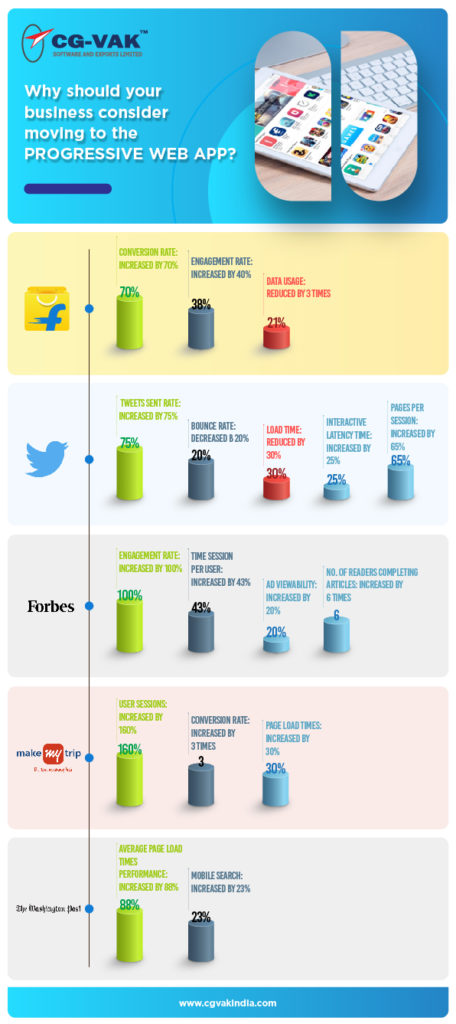
Why should your business consider moving to the Progressive Web App?

Most of the time, business companies consider the new technology or application when it has already proved its worth. Big market companies like Twitter, Alibaba, and Flipkart took a chance in the field of web application technologies when they decided to convert website to PWA and launched it for use publicly.

Let us have a view on achievements’ statistics of 5 of the companies who decided progressive web application development such as eCommerce PWA development, entertainment PWA development, information PWA development, etc. and continuing its use

There are many more companies like Trivago, BookMyShow, Pinterest, etc. who are facilitating mobile PWA or desktop progressive web apps widely (from eCommerce PWA development to Information PWA development). The achievements mentioned above prove for the requirement of progressive web application development for desktop as well as progressive mobile apps.

This trust of the companies stands on the multiple advantages of PWA over native apps and responsive websites such as –

  • Cost-effective App-like user interface
  • Web-based, quick loading
  • Offline Accessibility
  • Support to Low Network
  • Automatic Updates
  • Vast Searching Capacity
  • Advanced Security
  • Push Notifications, Call to Action, One-Click Payment
  • Mobile friendly and Desktop Apps
  • Supports All Operating Systems
  • Independency on App Store

When talking about the business PWA, the eCommerce Progressive Web App is equally valuable as mobile PWA for Small Business Enterprises to grow. It is a wide sector affair!

The big decision to convert website to Progressive Web App can be sorted well through checking business PWA benefits as discussed below:

Fastest Page Loading Experience

Owing to robust PWA designs, it works on low network connection efficiently and provides a faster page loading speed for progressive application and to increase business at a quicker rate.

Sharp Increase in Mobile Traffic

With an app like user experience in mobile interface design and interactive, user-friendly attribute in mobile PWA, it shows a tremendous increase in mobile traffic which prosperous the business ultimately.

Impeccable User Engagement Rate

Being an open source software, Android software development would be free of licensing requirements. It adopts the Android Software Development Kit (SDK) tools to develop application software which integrates a highly efficient framework, debuggers, emulators and standardization to design the quality mobile applications.

Cost-Effective App Development

Progressive Web Apps for eCommerce and other PWAs could achieve a high engagement rate with exclusive website user experience, quick loading, push notifications, easy search, accessibility, etc. attributes.

Big Reduction in Bounce Rate

The bounce rate of the website page would stoop down quite low with progressive design websites as PWA works offline, with low network and can be accessed anywhere.

Much Amplified Conversion Rate

Growth in Conversion Rate is a big aspect of a healthy business. Choosing to convert website into PWA can bring multiple folds increase in Conversion Rate with a user-friendly interface, one-click payments, dynamic uploading, wide compatibility, etc.

Quick Jump in Page per Sessions Rate

Each business website desires a growing Page per Sessions Rate which is possible by Progressive Web App development and its use. Interactive PWA designs cover a gap between native applications and responsive websites to deliver a quick web page loading allowing visitors to access multiple pages per session.

Effective Ways to Use PWA Designs for Better User Experience

Those businesses which are trying their first hands to convert website to Progressive Web App should consider certain aspects in their progressive design websites to create the user engagement never like before. Advanced preparation is required to shift from custom native apps designs to PWA designs.

Check out the helpful measures for the progressive web app development company to provide PWA users the best website user experience.

By Designing for Wide Range Compatibility

Hire Progressive Web App Developer to design PWA apps compatible with mobile devices, OS, desktop, or majorly used web browsers. It expands the accessibility area for users.

By Focusing on Offline Access

The dedicated developers by Progressive Web App Development Company can engage many users by driving focus towards an Offline approach to the PWA app when there is zero network connection.

By Swift Page Loading

Designs must determine the instant page loading on access without wasting the user’s time. For great user experience, PWA designers should implement the PRPL pattern introduced by Google.

P – Pushing Critical Resources

R – Rendering Initial Route

L – Lazy-loading rest parts

By Building Content Responsive PWA

UX must be really good during PWA development and making PWA content responsive should be a concern behind. Responsive content can be built with – One Click Sharing, Multiple Widgets, Placeholders use, placing links, interactive features, using native mobile interface design, etc.

By Avoiding Chances of Scrolling Glitches

With thoughtful use of web application technologies, the PWA should be designed such that the user would not have to suffer scrolling glitches like returning to the home page start position while going back from an opened page, blank feeds on scrolling, or other. The scrolling effect must be smooth and clear.

Get experts’ consultation over PWA development (Xamarin progressive Web App, Python progressive Web App, eCommerce progressive web app, or any) via our CGVAK as your offshore software development services.

Summary

Businesses of all scales have a great chance to redeem the loss in this pandemic by shifting from native applications to Progressive Application. One cannot ignore the multiple advantages owned by PWA today that helped business growth to a good list of companies in all sectors. Seeking the current tight scenario, we can say it is the time for companies to hire progressive web developer and get ready to convert website to PWA.

All you need to know about outsourcing mobile app development

Do you get flattered by the concept of outsourcing mobile app development but still have some uncertainty in mind? Find here answers to all of your queries and start fresh to outsource your mobile app development.

Statistically, an average man spends about 90% of the total mobile usage time over its integrated mobile applications and more than 60% of top IT companies are already outsourcing the mobile application development to the onshore, offshore, or hybrid app development organizations.

Why one should consider outsourcing mobile app development?

Mobile application development brings big business to the IT/software organizations of all scales including startups with billions of App download globally on both Android and iOS platforms. With the growing demand for mobile applications, many top mobile app development companies have thought of a smart move and decided to outsource mobile app development services.

Now, the answer to the main question – Why a mobile app development company should prefer outsourcing app development for mobile platforms than depending on the in-house app development team, we have some concrete reasons in form of advantages here.

1. Centralized Focus:

A mobile app development firm has to invest its time in activities such as application promotion, market research, selling apps, collecting revenues, etc. as well along with developing the application which is the job of the outsourced mobile app development partner now. In a way, it helps in centralizing focus on after development activities by the parent company for the best sales and profits.

2. Low Expenditure: 

The cost of outsourcing mobile app development is comparatively lower than invested in the in-house mobile app development team. It depends on geographical locations also, example – When you outsource mobile app development to India or a country like China, or Japan, charges are about 3 times cheaper than the salaries of the developers in countries like the USA, UK, and Australia. Onset with outsourcing MVP app development clears the path of outsourcing other complex applications.

3. Hiring Expertise: 

Mobile app development is a highly techy field and playing a major role in implementing new innovations into our lives. Hence, outsourcing mobile app development to India can provide you a complete access to get talented and experienced mobile application developers. You can get all the mobile app development solutions on demand with expert software outsourcing providing excellent performance and productivity increase about 10 to 100 times.

Cost of Outsourcing app development

It is crucial to have a pre-estimate about the approximate cost of outsourcing app development to practice a successful mobile development outsourcing. Phone app development cost through outsourcing depends on multiple factors.

This trust of the companies stands on the multiple advantages of PWA over native apps and responsive websites such as –

  • Application Platform – The app development cost varies for android app development or iOS application development. The cost varies slightly with the region as USA based outsourcing team charges less for IOS based application while it is vice versa for Asia and South America countries. Choice of the best mobile app development platform for the organization goes directly proportional to the relative cost.
  • Application Type – The cost of building an app also depends on the chosen application type whether native app development, flutter app development, hybrid app development, or cross platform mobile app development
  • Costs for three main application types in decreasing order: Native Apps>Cross-Platform Apps>Hybrid Apps.
  • Based on the level of complexity of features, costs vary.
  • Depending on the regions from where you have selected your outsourced app developers your cost may vary.

This comparison encourages outsourced mobile app development to India with the lowest costs charge from an offshore software development company.

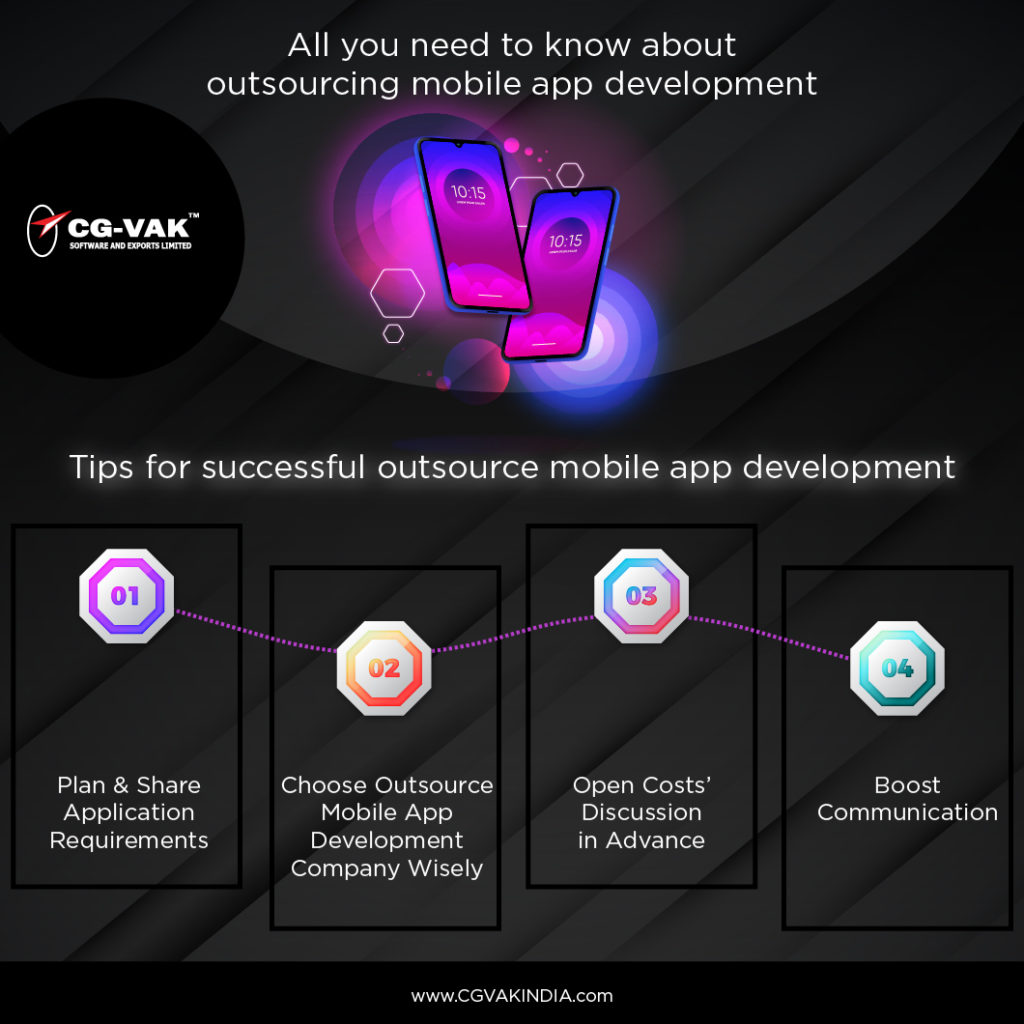
Check out the 4 smart and useful tips to successfully outsource software development for mobile platforms.

1. Plan & Share Application Requirements

When you have an idea of outsourcing your mobile application development, prepare a business plan that will help you analyze your exact business needs, evaluate your business scope and exact answers for what you exact from your outsourced mobile app development company.

And the next step is share you phone app development requirements like type, technologies, platform, etc. with your outsourced mobile app development partner before starting the process.

Suggestion: Prepare a flowchart or maintain an excel sheet with the required details for the app development and get it confirmed with the managers. A seeker should be clear of the requirements and deliver the right information to develop a mobile friendly application ultimately.

Tip2 – Choose Outsource Mobile App Development Company Wisely

It is a challenging task to pick one from the top mobile app development companies and still maintaining the budget. Check your advantages with the type– Offshore, Onshore, or Hybrid from the list of outsourced app development companies. The cost of outsourcing mobile app development is a factor. Many companies prefer to outsource mobile app development to India due to low costs. Seek the potential bidders, interview thoroughly, plan visits to mobile app development firm if possible for best outcomes.

Suggestion: Chances of finding apt outsource mobile app development company increases by checking review websites, following Google companies that focus on the required domain, recommendations from top outsourcing agencies, evaluating the company’s portfolio, etc.

Tip3 – Open Costs’ Discussion in Advance

A fair discussion over the cost of building an app or as a whole cost of outsourcing mobile app development should be there before making a deal. Other than overall costs, the hidden costs in form of tax, advanced resources, extra resources, new technology adaption should be brought out in advance to help dedicated developers pay off with optimum costs without bothering you.

Suggestion: Mention “Fixed” (for set specifications) or “Floating” (based on time and resources) pricing models before mobile development outsourcing that encouraging developers cost effective mobile app development with a clear picture. Choice of many big app development companies to outsource mobile app development to India than other countries calls for its cost-effective approach.

Tip4 – Boost Communication

Filling the communication gap is tough especially when you have chosen the offshore software development company to outsource app development. For that maintaining, a regular track on the progress of the app development project is required along with two-sided interactive regular meetings to exchange views, expectations, and requirements.

Suggestion: Maintain a Project Manager as the mediator between the company and outsourced mobile app development partner to exchange progressive details about the project constantly. It would help to eliminate any risks or shortcomings in the application features or design and provide a user-friendly and robust application.

Ready to create your own Mobile app?

All crucial measures in terms of advantages of outsourcing app development have been discussed so far for the companies to decide to go for it or not. These factors or considerations have the potential to bring a clear picture of the concept and benefits of outsourced mobile app development along with included risks.

If the clouds of doubts related to mobile app development outsourcing are shed-off and you are ready to create your own mobile app, then we have got you the best recommendation.

CG-VAK, being one of the top Offshore Software Development Company it offers the best deal and quality in outsourced mobile app development services. Advanced mobile security, performance optimization, enhanced testing, lab management, and other dynamic features are entertained. Explore it further if also interested in outsourcing web app development and custom software development.

Summary

A new wave of ideas and technologies get together when you have outsourced mobile app development for your company. Based on multiple factors such as app development cost, app requirements, location, etc. you can choose your outsource mobile app development firm with the best mobile app developers experts globally. Such business decisive discussions are helpful whether you are looking for software outsourcing or mobile app development outsourcing. Keep your wide eyes open upon the prominent factors to grow your business even in the current tough times of Covid-19 and join hands with the best outsourcing mobile app development company.

Right Time to Successfully Execute Cloud Migration Strategies and Boost your Business Continuity

In the light of the COVID-19 pandemic, business organizations have forgone the traditional work environment and adapted a more dynamic, innovative option to respond to the current crisis. It is Cloud Migration. Migrating into Cloud now could be the most profitable and appropriate strategy to accelerate business continuity when working remotely.

The remote workforce is the most prominent business transition that organizations have faced in 2020. However, it has been challenging – uncontrollable IT disruptions and software and collaborative tools outages. The challenges have heavily affected business continuity across the globe. AWS migration, Cloud-based services, and Cloud-based infrastructure must respond to the crisis and increase business continuity. 

Cloud-Based Infrastructure – How and Why COVID-19 has Accelerated Business Cloud Migration?

The pandemic has transformed 80% of organizations across the USA, the UK, Australia, and New Zealand into remote workforces, according to the LogicMonitor Survey. However, the report further reveals that the sudden shift to a remote working system stirred disruptions that affected normal operations, especially IT infrastructure – productivity, hardware and software, and other tools.  Many professionals (around 70%) confessed to endure challenges like security issues, outages, network strains, stability, and productivity.

That does not say that the companies who already had a remote workforce before the pandemic didn’t face any problems – they did. But they recovered quickly, as they were already were equipped to deal with the crisis.

Hybrid Cloud Solutions – an Increase of 25% since 2019

So, how are other companies tackling the situation? Here are recent trends that we came across from a definite survey:

  • Before the pandemic hit, only 65% of the organizations (survey respondents) had a cloud connection. The number increased to 85% in six months.
  • 90% of the organizations deployed Cloud-based strategies in the first quarter of 2020
  • Cloud adaption is slower in SMEs
  • Some companies had begun the cloud migration process in 2019
  • Trends indicate that within the next five years, 75% of companies across the globe will be working in a cloud environment
  • Cloud-based solutions are essential for companies that locate system users within the physical environment. More such companies have started strategizing Cloud-based software shift
  • Hybrid cloud solutions not only have eased the accessibility during the pandemic but also has helped in business continuity and scalability

What is our Successful Cloud Migration Strategy?

CG Vak is one of the leading Cloud-based application development providers that has also received the “Covid-19 Endurance Award” last month for being the only company to have grown amidst the lockdown and pandemic.

Being on the Cloud will never slow your business down – pandemic or otherwise – will promote digital transformation, increased scalability, agility, and work efficiency.

Being in the business for so long, we have heard many professionals asking us to migrate only critical business applications to the Cloud. Some of them successfully made the shift, while others struggled. With Cloud connection being the best response to the crisis, we have created a Cloud migration checklist to ensure a smooth transition and integration.

Learn the Risks of Cloud Migration

Cloud migration is not easy, especially for companies that run on ‘paper-based, binder-based, and store-in-the-shelf’ business. There are other constraints, too – massive data, uncategorized data, lack of resource, on-premise infrastructure, data privacy, and data security.

Some of the challenges that companies face while adopting cloud solutions are listed below.

Challenges of Full-Scale Cloud Migration

Industry Regulations:

Companies that operate in a highly- regulated industry or enclose a massive amount of intellectual property cannot shift everything on the cloud due to regulatory compliance and other adhering policies, such as HIPAA and GDPR. However, it is not entirely impossible.

Security Issues: 

Data security and privacy are of paramount importance in data migration. Data on cloud computing is encrypted, providing several layers of cloud-based security services.  On the other hand, on-premise data can be a victim of several risks and vulnerabilities, such as outages, human error, system failure, malware attack, etc.

Shortage of Resources: 

Cloud-based software migration will require dedicated expert resources, which most companies fail to have. This could cause inconsistency and skill gaps in migration.

Strategy Build-up: 

Firms with big data have to painstakingly sort through volumes of data to determine the kind of data they have – the ones that they need, the vulnerable ones, and the ones that are classified – before they decide where the data should go.

Despite the challenges, Cloud migration is booming, enabling 80% of global organizations to move to the cloud by the end of next year. It is a reality. Relying upon on-premises will put your data at the risk of a single-point-of-failure, which could result in breach, loss, corruption, or leak of data. On-premise applications will also put your firm behind innovations, as you will miss out on the latest ways to grow, scale, promote, and develop.

Best Practices for Cloud Migration Strategy

The following practices will give you significant control over your data, which we promptly use in our planning and execution. This will also ensure data privacy and safety throughout the migration process.

Data Classification: 

The first cloud migration step is classifying the data, as it will help you understand your data and gauge it appropriately to make the journey comfortable. It includes identifying sensitive data, places where data are located, and sorting the data into four categories –Classified, Restricted, Public, and Private.

Data Policies Assignment: 

This practice will help you establish control and protection for each tier and type of data. They could include watermarking, access control, expiration data, passcodes, etc., based on sensitivity and cruciality. You can grant control over data to select authorities or users.

Development of Access Control and Role-based Authentication: 

The practice allows you to manage and trace data actions and consequences in the Cloud in real-time. Automatic notification, security, and tracking tools will help you identify and mitigate risks in real-time.

External Auditing: 

Third-party audits help you identify weak links in your data that can potentially put the rest in danger. If you are in the legal or healthcare industry, this is a mandatory step, as 75% of data comprises vital and compromised client records and deeds. With penetration testing and SOC audits, you can eliminate the risk of value-chain attacks.

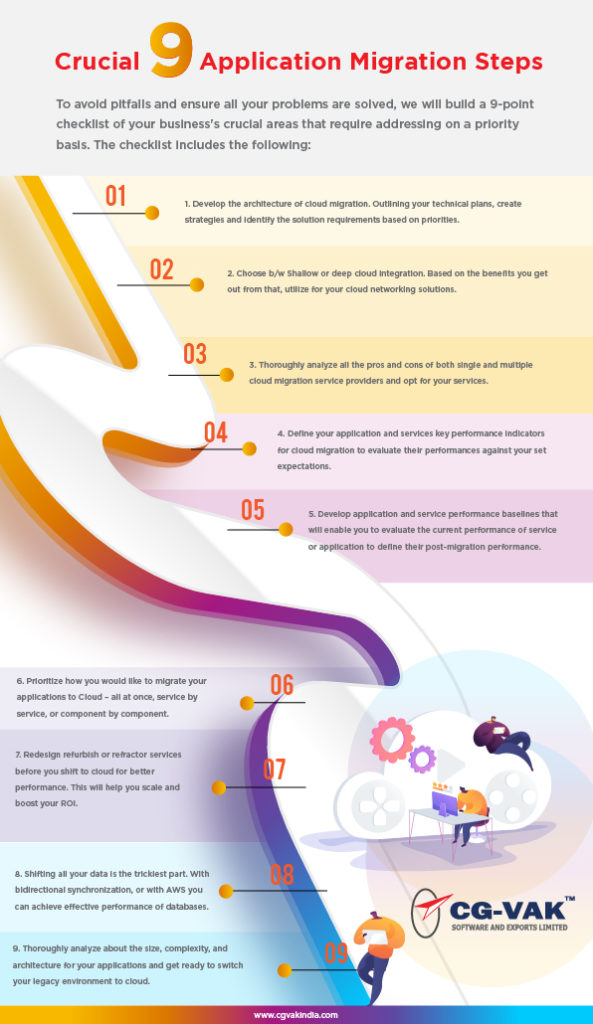
Crucial 9 Cloud Application Migration Steps

To avoid pitfalls and ensure all your problems are solved, we will build a 9-point checklist of your business’s crucial areas that require addressing on a priority basis. The checklist includes the following:

1. Develop the architecture of the cloud migration process at the system-level. It outlines the technical plans, defines the required do up to make the shift effective, creates the strategies, and identifies the solution requirement, the priorities, and migration mechanism.

2. Choose between shallow cloud integration and deep cloud integration. Shallow cloud integration is also known as the ‘lift and shift’ process, where we don’t make changes in the running applications. We neither use any unique cloud data migration solutions. Deep cloud integration allows users to make changes in the applications to utilize the benefits of Cloud-based networking solutions.

3. Pick between a single cloud provider and multiple cloud migration service providers. There are pros and cons to both. However, splitting between two and more service providers will allow you to utilize the best services that each provider offers.

4. Define your applications and services’ Key Performance Indicators or (KPIs) for cloud migration to evaluate their performances against your set expectations.

5.  Develop application and service performance baselines that will enable you to evaluate the current performance of service or application to define their post-migration performance. You can refer to the baselines during the migration process to ensure you are on the right track.

6.  Prioritize how you would like to migrate your applications to Cloud – all at once, service by service, or component by component.

7.  Redesign, refurbish, or refactor services or applications before you shift to Cloud so that they perform effectively in the new environment. This will help you utilize your resources and scale your applications better, besides boosting ROI.

8. Establish a viable cloud-data migration strategy, as shifting data is the trickiest part of cloud migration. If data-access is not handled accurately, it can significantly impact the performance of databases. We provide different options to fulfill this, including bi-directional synchronization, on-way synchronization, or use of AWS migration services.

9. Decide how you will switch your production from the legacy environment to cloud – all at once or bit by bit. Talk to our developers about the pros and cons. This also depends upon the size, complexity, and architecture of your applications.

Cost comparison in cloud migration

When it comes to cost, running applications and services in a legacy system is always high compared to cloud pricing. However, this could change depending upon several factors. However, the costs are different in both – running an on-premise infrastructure system may incur many hidden costs. The running costs are generally not crystal-clear. However, with cloud computing, you will receive a monthly bill from the service provider, with no hidden costs. Besides, cloud cost is usually OpEx (Operating Expenses), while on-premise is CapEx (Capital Expenses). It depends upon the type of business you have too.

In most cases, AWS migration has helped our clients to reduce costs significantly. Based on your financial models, we can help you calculate and compare cloud migration costs using different options (AWS TCO or Azure Pricing Calculator). It will allow you to pick the best option that suits your current infrastructure and financial goals.

Summing Up

Cloud-based solutions can solve 80% of your on-premise problems during this pandemic. And it is just the beginning of the cloud computing era – the capabilities are just going to magnify with time. CG-VAK can help you host your resources via three different cloud models, Hybrid, Private, and Public. However, Hybrid is the most in-demand now, for being a healthy recipe of public and private Cloud’s high availability, reduced costs, and reliability.

We have helped many companies secure their data, simplify processes, and deploy remote workforce via the Cloud. Learn how we can help you in your business continuity plan during the pandemic.  

It’s time to migrate from legacy .NET framework to .NET Core for your applications

Introduction of .NET Core framework by Microsoft in July 2019 for building interactive, mobile-friendly web applications, and early announcements of continuous upgrades each year from now is quite a thoughtful strategy. The standard IT organization has also planned to unify the current .NET Core 5.0 GA version to .NET with full compatibility to the legacy .NET web development framework from the next year (2021).

Do all these announcements point to migrating .NET to .NET Core? The current condition of the legacy .NET framework says it all. The .NET framework got is its last version update (4.8) in April 2019 and as announced by Microsoft, there shall be no major upgrade to it apart from security patches and bug fixing which means no additional feature and service updates. This is an undesirable situation for a .NET development company or those who outsource .NET development as innovations are limited now.

Why you should think about migrating from ASP.NET to ASP.NET Core?

ASP.NET is a useful component of the .NET framework to build dynamic websites and applications. But ASP.NET development is limited to the Windows platform only. As already announced by Microsoft, .NET is devoid of any further feature enhancement or addition, it would impact the performance of the custom application via ASP.NET development and also put security at risk.

While, if we consider ASP.NET Core, it is a complete package with robust services and integrations to build a customized application for multiple platforms including Windows. Moreover, the improvements and innovations assurance with regular updates to the new ASP.NET Core web application inspires many dedicated developers to migrate from ASP.NET to ASP.NET Core.

Are you ready to migrate? No need to be so quick for .NET Core migrations! We can take a break here and look at the definitive comparison here.

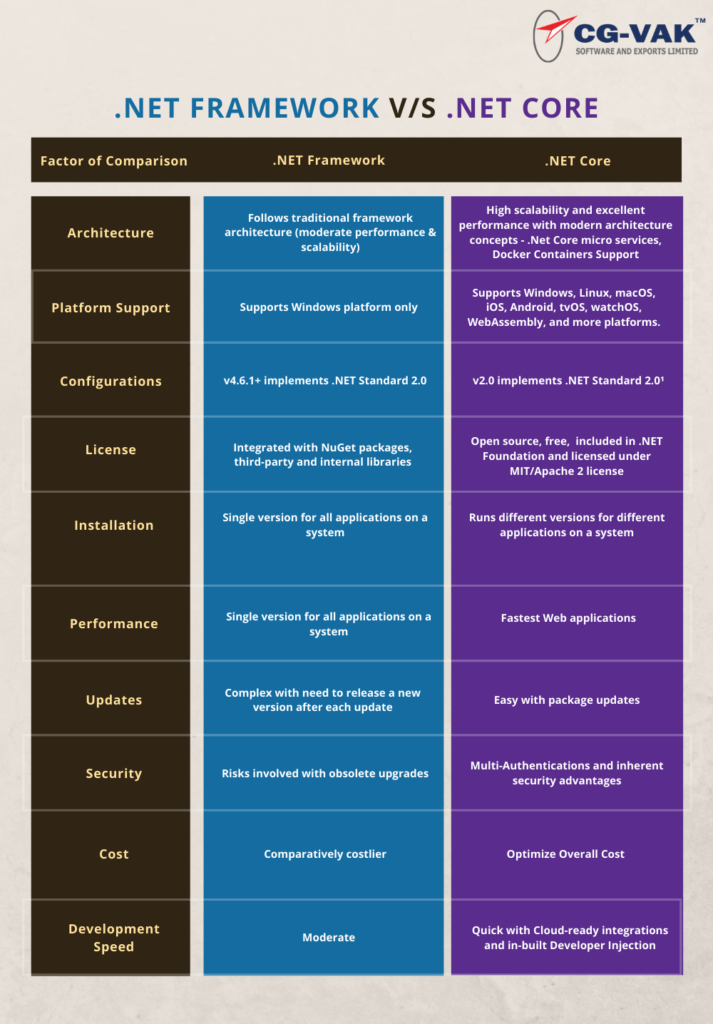
.NET framework V/s .NET Core

.NET Core is an improved extension of the legacy .NET framework and the dilution of the legacy .NET framework is planned in the coming year. Its service-oriented architecture is a bonus to the software developers to build flexible and high-performance software applications like never before. Both frameworks/platforms are used at almost the same ratio in the organizations today but many businesses are eager to migrate .NET to .NET Core due to its popularity and to eliminate the need for custom web application development and .NET development services.

Let us contemplate the exclusive advantages and robust features of the .NET Core over the .NET framework with a lucid comparison.

Migration of ASP.NET to ASP.NET Core

The comparison table depicts multiple business advantages with .NET Core over .NET development services developing interests in many web application developers to migrate from ASP.NET to ASP.NET Core. High-performance speed, user-friendly GUI, and high flexibility in ASP.NET Core web application are favorable aspects for them.

There is no direct ASP.NET to ASP.NET Core migration tool but we have prepared a constructive ASP.NET to ASP.NET Core migration strategy for all ASP.NET Core admirers. The prime requirement for this .NET to .NET Core migration is .NET Core SDK 2.2 or later.

1. Framework retargeting 

With ASP.NET Core projects, you can target .NET Core, .NET framework, or both. Select your choice.

Tip: If you target .NET Core, you can remove explicit package references using ASP.NET Core meta package and its precompiled Runtime Store can be used for improved performance.

2. Create New ASP.NET Core Project 

Simplify the project by eliminating XML merge conflicts and create a new project in the .csproj file format.

Tip: Edit project file using Visual Studio in ASP.NET Core web server as it facilitates file readability without any GUID based references to other projects.

3. App Bootstrapping

Perform route configuration, add filters, and area registrations using the entry point and configure the pipeline.

Tip: Use .NET Core improved bootstrapping mechanism which includes Startup as the entry point that helps in decoupling application and server to avoid issues in the implementation process.

4. Implement Store Configurations 

Use appsettings.jason project template to store configurations for deciding platform environment with strongly typed set of configuration objects.

Tip: Use the extension to configuration service known a Dependency Injection, an advanced part of .NET Core web server software architecture for large, scalable applications.

5. Follow Partial-App Migration

Divide ASP.NET applications by creating an IIS-sub application and using the URL structure of the application, move only certain routes from source to destination.

Tip: Use small modules and projects for quick and efficient .NET migrations to .NET Core while moving microservices.

6. Manage Over posting

Use Bind and Input Formatters attribute to avoid the overposting scenario.

Tip: Replace Bind attribute with same properties view model while using JSON Input formatters and JSON info controllers for parsing the data.

Consider the above standard reference steps carefully for migrating ASP.NET apps to ASP.NET Core platform efficiently. These are also applicable for migrating ASP.NET MVC to ASP.NET Core MVC when planning for MVC web development.

There is another approach, i.e. rewriting with porting. It is a cost-effective migration strategy useful for a large domain organization. It includes conversion of single domain functionality into microservice and porting it into .NET Core microservices one by one while using the existing code and the above ASP.NET to ASP.NET Core migration strategy.

Choose all resources including ASP.NET to ASP.NET core migration tool wisely and work under expert guidance always.

.NET Core: Is it the future for apps?

The smart, dynamic extension of the traditional .NET Framework, .NET Core holds various positive points in comparison. An ASP.NET Core Web application is highly scalable, interactive with enhanced performance owing to integrated software architecture like Docker Containers integration and .NET Core microservice. The advantages of Cross-platform support and provision to use multiple services on the same server on different .NET versions tend many developers to think for .NET Core migrations.

Still, the .NET Core framework includes minor flaws as it is not completely adapted to all of the .NET web development technologies, does not support 3rd party .NET libraries, and has limited or no access to Windows specific APIs..

But, Microsoft has already seen a future in .NET Core by promising new versions and continuous open-source projects along with a planned unification of the .NET framework and .NET Core. This negates the current limitations in the .NET Core framework and brings to migrate .NET to .NET Core.

Also, the exclusive support of .NET Core to the most popular programming language C# which makes it a candidate for an alternative to JAVA is the prominent attraction for any .NET application development company for migrating from ASP.NET MVC to ASP.NET Core MVC under the MVC web development category.

So, it would not be wrong to mention that the revolutionary .NET Core framework is the absolute future of robust and cost-effective web applications.

Get ready to migrate your .NET framework Legacy apps to .NET Core now!

Now, that we have contemplated both .NET and .NET Core frameworks features and aspects till now, the decision for migrating ASP.NET apps to ASP.NET Core is easier.

Are you preparing for .NET to .NET Core migration or on the path of migrating from ASP.NET MVC to ASP.NET Core MVC? Then we recommend you to visit CG-VAK and get smart consultation services from the dedicated IT professionals and experts. We are a reputed offshore IT services and solutions provider aimed to outsource excellent technology innovation solutions. You can send your queries and requirements via mailing and get connected directly.

Summary

.NET Core framework features are superior to legacy .NET framework for building flexible, user-friendly web applications. Microsoft got this idea in advance and is now interested in the further development of this framework. Relying on the trust in the standard IT organization and alluring with the advantageous attributes of the .NET Core framework, many IT organizations are routing towards it at a great speed.

Next Gen in Retail: Get Seamless Shopping Experience with Unified Commerce

Unified Commerce has become the lifeline for the mid-sized retailers who wish to sell their products to customers across multiple platforms. Building an eCommerce website with unified commerce solutions is the key that will unlock the answers to buyers’ need for a wholesome, consistent, and integrated experience from retailers’ both brick and mortar and online stores.

In a nutshell, unified Commerce offers retailers an omni-channel commerce platform that fulfills the following customer expectations:

– Shop at a specific location without any problem

– Get personalized services and information from a specific brand across all their stores

– Customers receive what they want instantly, even if the product is unavailable in the specific store branch

– Expect shopping cart continuity across all platforms

The Future of Retail is in the Hands of Unified Commerce – What is It?

Retailers implement different business applications to run their stores, such as retail POS systems, loyalty programs, eCommerce platforms, inventory management, and CRM. Retailers must gather huge amounts of customer data through business applications or touchpoints to deliver efficient service. However, instead of disconnected business applications, they need a robust and integrated platform to analyze the collected data, generate meaningful insights, and share it among the stakeholders to provide the most incredible shopping experience.

Solution: A Unified Commerce Platform, where online stores and eCommerce channels are effectively synced!

From eCommerce to Omnichannel to Unified Commerce: No More Confusing Customers’ Journey

Unified commerce business application puts together everything in one single platform – eCommerce, inventory management, in-store customer data, orders, checkouts, POS sale capabilities, and customer relationship management. It breaks down the walls between multi-store silos and uses a common platform.

An example will be helpful:

“Alex visits your store located on Jackson Street to test a few refrigerators for his home. However, he says to the in-store staff that he needs some time to decide. The staff obliges, as she doesn’t feel pressured to close the sale on the spot. Meanwhile, Alex goes home and finds that the products have been automatically added to a wish list, emailed to his mail id. He could easily move the items to the cart and pay for them whenever and however he wanted. He also finds that he could use the coupon code provided at the store while making the online payment and decide between in-store pickup and home-delivery”.

Unified Commerce is like a wholesome shopping experience for both buyers and retailers – customers can start their journey in the store and finish it online. In contrast, retailers can minimize the risks of losing the Customer to another store or ecommerce brand.

Why Switch from Omnichannel to Unified Commerce You May Ask

It is all about the best customer experience wherever they are with you – where all your selling channels work together to provide a combined buyer journey. Omnichannel retail solutions allow retailers to use different platforms to drive sales and engage customers, including social media sales, eCommerce, retail POS system, retail store system, ERP solutions, CRM, supply chain, and other mediums. And these mediums are often implemented, so it becomes difficult for the omni-channel approach to combine the back-end capabilities of each platform, link data, and perform analytics.

It creates many business silos, and while the approach works for short-term goals, it doesn’t provide a user-friendly and personalized customer experience – the need for the day. Customer expectations towards brands are rising by the day, and competition isn’t helping to slow down. An optimized shopping experience that allows customers to buy, engage and experience from a single source is crucial.

Unified Commerce provides precisely that, cost-effectively. .

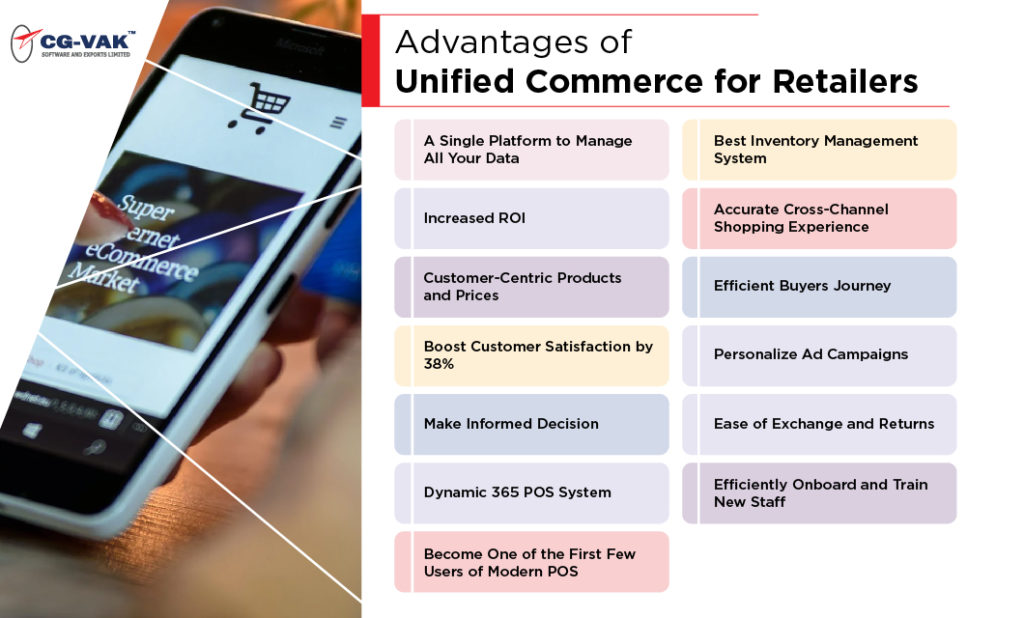
Advantages of Unified Commerce for Retailers

Unified ecommerce shopping experience is designed to fulfill the needs of modern customers who zig-zag through various mediums to complete shopping. The benefits of unified ecommerce store development for retailers are 50% more premium than omnichannel and ecommerce mobile shopping.

A Single Platform to Manage All Your Data: 

One-data model will enable everyone in your company to find complete customer information in one place, which will improve customer interaction.

Increased ROI:

A single, systematized commerce platform will significantly reduce overhead, IT and inventory management costs, and sales loss and boost employee efficiency and inventory turnover.

Customer-Centric Products and Prices: 

If your Customer doesn’t find size 44 Red Jacket in your store branch, you can locate it in another branch and get it delivered to his place on the same day.

Boost Customer Satisfaction by 38%:

Synchronized and centralized eCommerce store can increase conversion rate, marketing efficiency, and avg. order value, thereby improving the bottom line.

Make Informed Decision: 

One-point of access for customer preferences and purchase history for all channels will enable retailers to make the best decisions for pricing, incentives, promotions, and more.

Dynamic 365 POS System: 

Use advanced technology for the POS system that allows fast customer processing in real-time – mobile payments, self-checkouts, consumer purchase history, and online order.

Become One of the First Few Users of Modern POS: 

Research shows only 28% of retailers have updated their POS technology, and the average age of retail POS is 6.7 years. You could be one of the first few.

Best Inventory Management System: 

Unified commerce platform enables retailers to view and manage entire inventory across all channels in real-time, providing better figures for overselling and underselling.

Accurate Cross-Channel Shopping Experience: 

A dated POS hardware could have slow processing speed, less storage space, and staggered customer data access, which cannot deliver the best customer experience.

Efficient Buyers Journey: 

With multiple ways to buy a product, track its shipping, and make payment, order management is simplified across all touchpoints. Retailers can also embed shipping to the POS.

Personalize Ad Campaigns: 

Real-time tracking of customer interaction with the brand between multiple channels can help businesses in ecommerce manipulate or change ad targeting and improve customization.

Ease of Exchange and Returns: 

Synching online and offline storefronts will help brands provide the best post-purchase services. E.g. Customer sees the shoe at Store A, purchase online, and return it in Store B.

Efficiently Onboard and Train New Staff: 

It is easier to train staff one system than numerous business applications, enabling employees to intelligently and quickly learn marketing management.

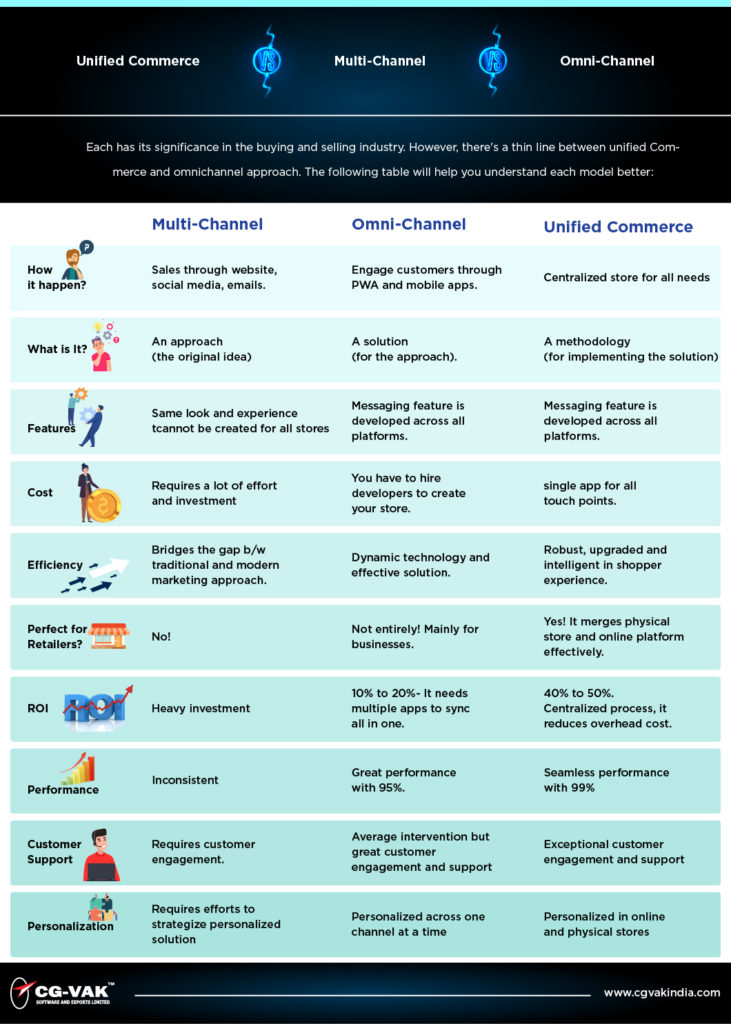
Unified Commerce vs. Multi-Channel vs. Omni-Channel

What Retailers Get from Unified eCommerce Platform?

Unified Commerce takes you beyond the great ‘omni-channel’ experience. While omnichannel is mind-blowing, Unified Commerce is one step ahead, as it includes the retail business. Customer is everything, and retailers have realized that to provide a wholesome customer experience, they have to break down the barriers between different internal departments and make everything one whole service platform.

Here are ways that unified commerce development can help support and grow your business across a broad customer base:

1. You don’t have to deal with separate systems to manage sales, inventory, or ecommerce portal – integration, maintenance, upgrades, and implementation are centralized, which reduces ecommerce store development costs and efforts.

2. You and all other stakeholders involved in the business will get access to one version of data = one version of the truth. This will streamline budgeting, financial reporting, planning, tracking customer history and buying patterns, analyzing product marketing and sales performance, and making fast decisions.

3. As a retailer, you will provide an interactive, hands-on customer shopping experience in the store, powered by digital technology.

4. You will have an all-encompassing view of the product inventory across all channels and all locations in real-time. One quick scan through warehouses, locations, distribution centers, and stores can help you evaluate stock levels.

5. You can compare past and present inventory data to derive trends in sales and forecast and plan growth strategies based on real-time statistics.

6. This IoT based Cloud commerce solution is perfect for digital-savvy customers. Such consumers are more knowledgeable and connected across multiple channels. They don’t stop at one shop or store – they have a list of several retailers. They compare prices, value propositions, and engagement opportunities. But above all, they value personalized services across all shopping channels.

7. It acts as a business intelligence tool that helps you bring together customer data, behavior, and interactions at one place that help predict and plan special offers based on customer desires and needs.

8. Product and customer information is maintained in a single database, shared to different touchpoints. This reduces delay in communication and risks of errors, such as advertising a wrong product price, promoting a faulty product to a Customer, selling a product online out of stock, or describing a work inappropriately.

9. Data from predictive analytics can help you develop AR/VR experiences to appeal to and engage customers’ visual sensibilities.

10. Finally, as the line between physical retail stores and online shopping starts to vanish further, unified Commerce will be a requirement and not just another badge to your business accomplishments. At a future date, you might have to shell out more money in developing a unified omnichannel solution as the skill demand increases.

So start switching to the future of Unified Commerce with CGVAK.

We can help you switch to the future of Unified Commerce with Microsoft Dynamics 365, uber-cool, next-gen Cloud-based Unified commerce framework and other ecommerce store development services. The creators designed the platform to centralize customer service, sales and marketing, and operations in a single business application. With Dynamics 365, you will also enjoy the functionalities of Microsoft Office 365, Azure Machine Learning, Cortana Intelligence, and other Microsoft Productivity Tools. Microsoft also offers a gamut of personalization options for retailers to accommodate their store’s needs.

Besides, when you work with us, our certified developers will make sure you take advantage of Dynamic 365’s exclusive data intelligence tools, such as Azure and Microsoft Power BI. These tools help gather, organize and analyze data in the most useful manner.

Unified Commerce is all you need to help modern consumer challenges that all retailers face. Contact our experts to discover how this magnificent omnipresent, multi-faceted, single-app platform can help you score a perfect customer experience every day, consistently.

Get ready to launch your ecommerce store in this holiday with given safe ways!

The holiday season is the right time to create an effective plan to launch and upgrade your online store, boost traffic to your website, and increase ROI without disturbing its performance or spending thousands. The good news is that you can do a lot to bring about a profitable change using the best conversion optimization tools and eCommerce development services.

Excited to know more?

This blog will help you explore eCommerce website optimization strategies that will lead to more traffic in a safe way.

“When your customers are gearing up for the online shopping spree, you can do an SEO audit, enhance or create your landing page, implement on-page SEO for eCommerce marketing, change the company logo, optimize the site structure, test website performance, or even migrate your eCommerce store to Magento 2.0 to make it 2021 ready”

Get Real Visitors to Your Website with Life-Saving eCommerce Website Optimization Plans

There is no denying that this holiday will be ‘the year’ for eCommerce brands across the world – a lot of people will be shopping online for gifts – our priority will be to ensure you don’t lose your current traffic. However, before you start the Christmas sale, you need to prepare your eCommerce store for the holiday shopping.
P.S. – You still have enough time. Get those visitors’ traffic high by 30% with a set of proven strategies.

Reasons Why You Must Utilize the Holidays to Bring Traffic to Ecommerce Website

It will be helpful to learn why exactly you need to relaunch your online store during the holiday. Conversion optimization services are calculated, and proven tactics eCommerce development companies take to improve stores’ performance.

If a site is not up to the mark, it can lead to the following scenarios:
1. Unresponsive site, resulting in poor customer experience
2. Slow website load time and speed, leading to decreased click-through-rates.
3. More and more shopping cart abandons and low sale conversions.
4. Inefficient SEO plan, leading to decreased search engine ranking.
5. Negative reviews from annoyed customers causing poor online reputation

All of these issues can ultimately lead to a revenue drop.

While website optimization should be an on-going process throughout the year, it should be a priority during the holiday shopping season to deliver a smooth consumer experience across all channels.

Although user experience is an important parameter, security and protection shouldn’t be overlooked. eCommerce sites are highly vulnerable to data leaks and thefts, considering the massive consumer data they store.

Regular maintenance and upgrades will help websites run securely and are devoid of dated programming codes and aggressive hackers.

Besides, launching a new website or Migrating your current eCommerce store to the latest platform could help you score the perfect goal among the right group of the target audience.
Check out these helpful pieces of information on ‘How you can migrate to Magento 2.0 without any break’ and ‘how to boost sales with eCommerce Web Development’

Safe Ways to Launch and Optimize Store for Conversion

All retailers and online brands rely on the holiday season to cover up the financial year’s revenue target or generate more sales. For that, they have to create a seamless and beautiful experience for the customers. And it starts by preparing a checklist.

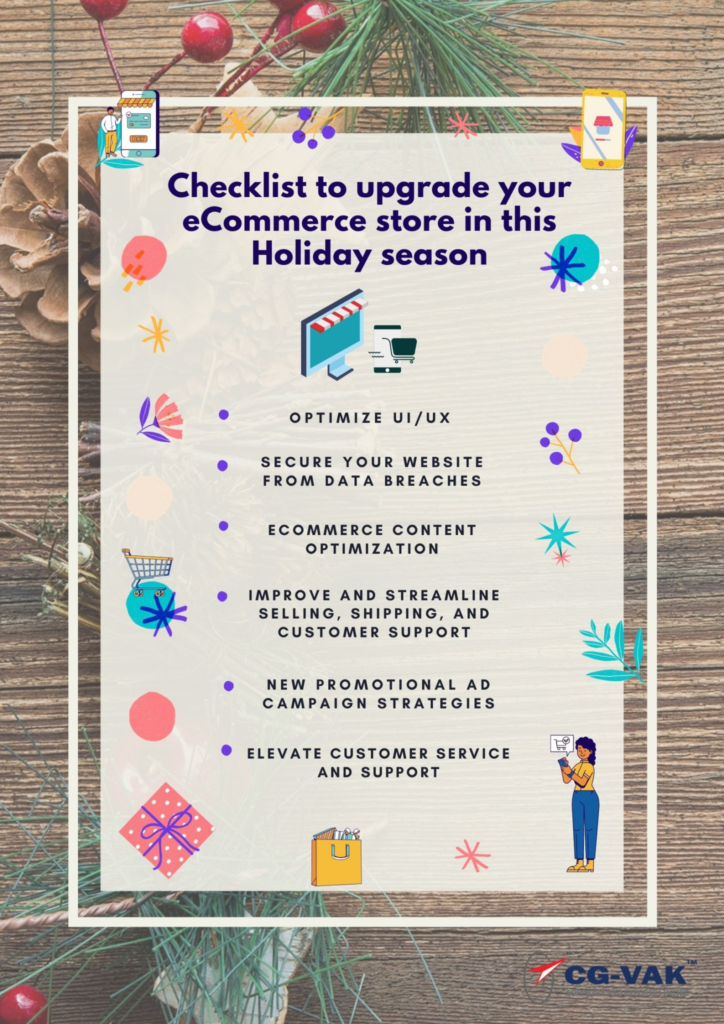
Holiday eCommerce Checklist

The checklist will help eCommerce executives to create and deliver an accurate optimization strategy:

8 Incredible Ways to Boost Traffic to Your Website Online

Let’s go through simple and affordable ways to improve website performance.

1. Evaluate and Upgrade Overall Website Performance

Testing overall website performance will ensure your infrastructure can handle the surge in visitors during the holiday season. You can contact us to perform a quick website performance test on both the web and mobile. It will include website navigation, third-party integrations, website load time, and website speed testing. Even a single day’s delay in one of these can reduce your eCommerce conversion by 8%.

Also, don’t forget to check your online store’s mobile responsiveness. Make sure the images are well optimized and the designs are mobile-friendly.

If you are working on a limited budget yet want to deliver a beautiful shopping experience to your end-users, we recommend considering launching a Progressive Web Application instead of a downloadable mobile application.

2. Optimize Your Keywords

Google search console will help you optimize conversions by showing you different ways to do it, such as creating landing pages for the commonly used search phrases used by customers during the holiday. Use last year’s Google Ads to check which campaigns increased conversions, and based on the result, plan this year’s PPC strategies.

3. Use Right eCommerce SEO Services

SEO is the basics of all eCommerce optimization strategies. You must follow the latest SEO trends to ensure your Google ranking goes up each day. However, you have to use a different set of on-page SEO for eCommerce during the holiday season. The regular won’t work out, as customers will be searching for your products with different keywords. Hire our SEO professionals to perform a keyword search and holiday landing page optimization.

4. Improve Your Checkout Page

Attract your customers with exclusive shipping offers. Free shipping should be your biggest promotional tool. Make sure your message is loud and clear on the home page. Besides, using a single checkout page on mobile devices and enabling guest checkouts will be a game-changer. Other ways to improve your checkout page is by adding various payment modes, pay-later options, multi-recipient functionality, and fast and quick shipping and fulfillment.

5. Consider Unified eCommerce

If you wish to sell your products across multiple platforms with a personalized touch, you must implement unified commerce. It provides a wholesome experience to online customers, where they can order the product on Facebook, pay the amount on your eCommerce site, and pick it up from your local store. Learn more about Unified Commerce.

6. Check and Fix Site Errors

Identifying and fixing certain types of issues should be part of your regular site maintenance. Fix the following errors before your site is up for the holiday sale:

Use a crawler to find common website errors, including 404 errors, redirects, grammatical errors, duplicate content, bad content quality, broken links, etc.

Lookup Google and Bing Webmaster Tools and Search Consoles to identify structured data errors. Fixing it will improve ecommerce site visibility.

7. Optimize with Best eCommerce Email Marketing Campaigns

This has two parts – start an effective email marketing campaign and improve email deliverability.

Since consumers frequently check their phones during the holiday season to get the best deals on products, sending a variety of offers on email will increase traffic on site.
Send out promotional emails with highlighted texts and encourage shoppers to click on the landing page.

Email deliverability makes sure that your potential customer receives your mail and opens it. To enable this, you will have to set up your domain name email setting correctly, remove your domain name from the blacklist if it’s listed, and set up security records (DMARC, SPF, and DKIM).

8. Enhance Your On-Site Search Engine

When new visitors use your eCommerce website, you will have to help them find what they are looking for. Good navigation and beefed-up internal search engine will make sure they find what they need. In order to boost on-site search, you will have to set up internal search tracking and use Google Analytics to monitor traffic. Based on the featured results, improve the search experience internally.

Launch and upgrade your ecommerce store in this holiday season with CG-VAK

CG-VAK is an ISO Certified eCommerce Web Development Company that can deliver custom holiday eCommerce store optimization solutions. Businesses should consider outsourcing eCommerce development services. Outsourcing has several benefits – While you concentrate on the core business operations, we take care of the optimization and delivery.

Right from developing cost-effective, basic SEO plans to complete migration and store management services, we have the required infrastructure, expertise, and platforms to make your store Christmas and New Year ready in two to three weeks.

CG-VAK’s Business Strategy to Manage Covid-19 Disruption?

The pandemic has caused a significant impact on many company’s operations worldwide. While several businesses set up a remote workforce to manage the COVID-19 outbreak, many companies had to lay off their employees in a desperate attempt to keep their business running. CG-VAK also faced two challenges: preparing the workforce for the pandemic and how fast and how to manage the economy without taking out the employees of their jobs.

How Did CG-VAK Sail Through the Tough Time during the Pandemic?

We prepared ourselves in three folds: Our managers accepted the new reality and new threats proactively, invested in modern telecommunication and IT systems, and established remote workforce synergy, and introduced a new set of employee awards.

While we knew pivoting the operations wasn’t impossible, the hurdles were many, mainly because we dealt with a massive amount of sensitive database, IT infrastructure, and over 500+ employees working in different locations. However, we managed to sail through by making the right decisions at the right time and by incorporating new, inventive ways to establish an efficient workforce. This included changing certain operations, communicating with staff frequently, and incorporating employee rewards and recognitions periodically.

Many businesses have reopened their operations with uncertainty in the last quarter of 2020. If you are one of them, these following tips will help you build a measurable growth strategy in 2021 as they helped us.

Best Practices to Respond to Covid-19 Crisis

CG-VAK’s top management continually looks up and analyzes statistics, news, and social media data in regions where we have set up a customer base to understand how the pandemic has impacted the country’s economy.

1. Open Options for Remote Working

A large portion of your workforce (non -manufacturing) can be transitioned to a remote telecommunication system, such as accounting, payroll, HR, sales and marketing, customer service, processing, meetings & management, and IT. Being a Offshore Software Development Company and Solution Provider, we could replace 90% of our infrastructure with a remote workforce.

  • Made sensible working rules with flexible working hours and trained managers to enforce them to make 2021 promising.
  • Identified and hired employees who can work effectively from a remote location without much assistance.
  • Develop ideas and tactics on how to continue operations with limited access to resources.

2. Reward and Promote WFH Employees and Build a Strong Team for 2021 

With less physical meetings, fewer lunches together, and less people talking to each other, we altered the traditional employee appreciation and reward system for the virtual workforce:

3. Built a Remote Workforce Community

We organize online meetings through chats, phone calls, and video conferencing every day to share and brainstorm new ideas. We ensure there is an active involvement between everyone so that officials don’t feel isolated. We also facilitate team-wise and one-on-one meetings to develop confidence among executives.

4. Provide Sustenance through Employee Recognition

To keep day to day workers, managers, and leaders motivated and sustained, we recognize our people differently.

  • We reflect on our people and express heartfelt appreciation for their loyalty and resilience.
  • Unlike many companies, we have forgone cutting down the monthly salaries or incentives by 25%.
  • Introduced pandemic-based new incentive schemes to keep staff motivated.
  • We are specific at pointing out employee accomplishments, so they realize their efforts are recognized and valued.
  • Personally thanked the silent heroes like our employees who worked behind the scenes, consistently, without seeking appreciation. They are the backbone of our company.
  • Included their family members while recognizing the efforts of our staff.

5. Stayed Practical by Providing Incentives that is Needed

Right now, a restaurant coupon or a gift card would be an inappropriate incentive or reward. We instead ask our employees what they would prefer as an incentive in return for a job well done.

6. We Think Beyond Emails

We ensure to communicate beyond emails to ensure steady connection throughout the day. For instance, Skype and Go To Meetings are the most preferred communication tools. We also communicate via social media apps and phone calls to check on projects and provide feedback.

7. Virtual Events in CG-VAK

Since we are spread out across India and the USA, we have employees working from different cultural backgrounds. It is now even more important to respect each person’s religious events and cultures when rewarding them. Besides, we hold virtual events every month to celebrate important milestones achieved by our teams and Indian festivals to ensure unity and active communication despite the remote work environment.

8. Use of Current Telecommunication

All of the above goals will be impossible to achieve without significant changes in telecommunication and operations. We did not hesitate to install and implement modern tools to improve business continuity across all departments. We have encouraged our employees to use the best internet connection providers with better network speed, increased the number of VPN connections, using competitive video conferencing services and collaborative tools like Microsoft teams, purchased better laptops and tablets for remote workers, and upgraded our OS and IT systems to latest frameworks.

CG-VAK is Focusing on Success

Summing up, amidst the current, sharp economic downturns, we take pride in having fared well. We have hired more remote workers, improved our customer and employee experience despite the challenges in transition, and tried to focus on the success of our business, health management of our individual employees. We have worked hard to soothe employees’ minds with motivation, hope, and confidence. We channel power from each other and look for opportunities to grow forward rather than blame the COVID-19 and play the victim.

It is the right time to celebrate what we have – our people, our health, our business, and products and services – and take positive inspiration.

A deep dive into how ASP.NET Core helps to build Microservices!

Microservices is a tough alternative for the traditional or legacy app development architecture and had profited many businesses including Amazon, Netflix, PayPal, Twitter, and eBay till now. The concept of Microservices architecture is building a full-size application (Microservices web application or Microservices based applications) which is actually a suite of several individual services modules or components. These components are functionally targeted, work independently, and interact with each other via defined APIs.

Businesses with legacy applications are facing many setbacks in terms of complications in modifications, nil scalability, slow to modifications, suppressed innovations, interdependencies, and more. Microservices based applications, on the other hand, comprises no such limitations. In fact, any effect on the functioning of a component or a Microservices of the application does not affect other components which ultimately do not cost much effort on its remedy. Thus, it is good for many business applications with an increase in resilience with minimal impact of failures, improved scalability for any high demand Microservice, easy deployment of innovations, long-term commitments, and high flexibility.

For building Microservices application, the development of individual Microservices is required and the best framework for it could be the ASP.NET Core owing to its astounding advantages like cloud-based configurations, high-speed development, cross-platform support, etc. beneficial for any business who wants to grow with time and demands scalability and flexibility with quick app innovations.

One remarkable reason for businesses to adopt ASP.NET Core for Microservices development in comparison to other frameworks or programming languages is that both complements each other with almost similar methodologies in app development architecture.

Components of Microservices and key benefits

Microservices application development architecture is composed of multiple functional components. Each component along with Microservices has its specific function in the Microsoft Microservices Architecture Style.

Identity Provider  : 

It is a component in the Microservices environment that is responsible for managing the Client’s identity information and a source of authentication services to the whole network in the structure.

Key Benefit: 

IdentityServer4 is useful in Microservices-based applications with its wide range of features – Single Sign-on, user management with Admin UI (in beta version), refresh token, token-based security, generated token revoke, External Identity Provider (Google, Facebook) support, and more.

API Gateway : 

Composed of multiple small projects for clients with Microservices sharing viable responses.

Key Benefit: 

Using API Gateways, implementations like Authorization, HTTPS termination can be performed. Besides that, responses can be collected from multiple services and shared with the client in a single run eliminating the need for individual information exchanges.

Content Delivery Network (CDN) : 

A network channel or provider of static content or resources including the web content or web pages to a distributed network within the Microsoft Microservices architecture.

Key Benefit: 

Direct communication with clients with complete transparency in the static resources being used in application development makes it flexible for scaling and improvements.

Service Discovery : 

It is a services tracking component which records service address, location, endpoints using the Service Registry component.

Key Benefit

The Service Discovery and Service Registry mechanism are useful in knowing the state of the services out of the cluster with IP address information and service requests can be sent to load balancer easily with registered services information.

Node Management : 

It is the node maintenance component for a Microservices (also known as Load Balancer).

Key Benefit: 

It provides a balanced traffic routing to nodes to a Microservices raising query to the Service Registry getting the accurate location via registered IP address.

Why ASP.NET core for Microservices?

ASP.NET Core development services are treated as a superior web development framework for building web applications as it integrates the standard platform – dot NET. The ASP.NET Core is an open-source, advanced version of ASP.NET, introduced in the year 2016, known for its compatibility with Docker Container, Windows, Linux, and macOS, cross-platform support, cloud-based configurations, fast performance, and more which has caused many developers to migrate from ASP.NET to .NET Core. Many big enterprises including Alibaba Travels have included ASP.NET Core development in their tech sacks for building scalable, flexible, and high-performance web applications.

Microservices and Dot NET Core Framework Comparison

Dot NET Core framework was used in its earlier project with the type of architecture where services were used to build applications via integrated Simple Object Access Protocol which is quite similar to the web application Microservices architecture (the modern one) used to build Microservices web application and Microservices-based applications.

Also, in-built assistance and Docker container related technologies within the framework persuade developers and designers more to choose ASP.NET Core for Microservices creation and Microservices solutions.

Key Qualities of ASP.NET Core for Building Microservices

From the previous section, we have gained some profitable mottos to choose ASP.NET Core for Microservices. We also found out a commonality in the methodology adopted by both ASP.NET Core architecture and Microservices-based architecture to build web applications. Building Microservices with ASP.NET Core development framework would prove a great deal to developers owing to its excellent features and qualities.

Light-weight Framework:  

ASP dotNET Core is a light-weight and modular framework that is ideal for developers to build instant container-based Microservices.

Cloud-based Configurations : 

Cloud-support and scope of scalability deliver highly secured, feature-rich, performance-driven dot NET Core Microservices. Azure Cloud technology is popular among .NET developers and helpful to build efficient dot Net Microservices.

Advanced Cross-Platform support : 

From system to mobile, Windows to macOS, .NET Core builds applications for all platforms. It supports all technologies, Operating Systems including Linux. It also supports Docker Container and building Microservices with Docker is favorable for developers as Microservices and docker container complement each other.

IDE Selection : 

ASP dot NET Core developers have the full choice to select IDE apart from Microsoft Visual Studio to develop .NET Core apps using Microservices. There are nil conditions and the developers are free to choose any right technology which can be free software to develop Microservices–based applications effectively.

Kubernetes & Docker Support : 

NET Core supports both Kubernetes and Docker technologies to build ASP Core Microservices. The use of Docker in Microservices is always encouraged by developers through ideal access of entire resources information and details in Microservices and containers. Kubernetes, on the other hand, is an add-on technology of Core development that enhances Microservices development through its advanced properties and features.

High-performance & Instant Containerization:

In the latest ASP.NET Core versions, developers can utilize the high-definition image as an add-on feature along with a quick development cycle. Docker container technology is supported for almost all ASP.NET Core apps which are quite suited to build web applications based on Microservices web architecture.

Hence, ponder over the above key qualities of the ASP.NET Core for building Microservices and choose your further app development projects.

Wrapping Up

Microservices building is ideal on the .NET Core development framework with its supporting and beneficial features as discussed widely in the blog. For genuine guidance and satisfactory implementation of the ASP.NET Core services, any business can hire an expert ASP.NET development company.

At CG-VAK, our onshore/offshore clients are offered exclusive ASP.NET Development services and expert consultancy through experienced professionals at competitive pricing. Contact us for free guidance on your projects.