React Native: A Powerful Framework for Building Cross-Platform Apps

Constructing applications that operate seamlessly across distinct platforms is pivotal for reaching a broader audience and boosting the potential user base. It is where the potent framework, React Native, comes into play. React Native will permit developers to create cross-platform apps employing a single codebase, making the development process more efficient and cost-effective.

React Native leverages the prominent JavaScript library, React, and extends its capabilities to mobile platforms. By employing a combination of native components and JavaScript, React Native will offer a native-like user experience while permitting developers to write code once and deploy it on distinct platforms.

The versatility of React Native lies in its ability to access platform-specific APIs and features, notably camera access, geolocation, or push notifications, making it a go-to choice for constructing highly functional and interactive mobile applications. With its robust performance, efficient development cycle, and strong community support, React Native has gained primary traction in the mobile app development landscape.

In this article, let’s explore the key features and perks of React Native, highlighting why it has become a preferred framework for developers looking to build cross-platform apps.

React vs. React Native

React is a JavaScript library that emphasizes building user interfaces for web applications. It follows a component-based architecture, permitting developers to create reusable UI components and efficiently manage the state of their application.
With React, developers can build interactive and dynamic web applications by writing declarative code. React excels at building complex web applications that require dynamic user interfaces. Its virtual DOM implementation ensures efficient rendering and optimal performance. React is an ideal option for web developers who want to build single-page applications, progressive web apps, or large-scale enterprise applications.
React Native, on the other hand, is a mobile development framework that extends the capabilities of React to create native-like mobile applications. It permits developers to write code once and deploy it on distinct platforms, making it a cost-effective solution for cross-platform app development. React Native leverages native components and APIs, offering a native user experience while using JavaScript for development. React Native shines when it comes to developing mobile applications for the iOS and Android platforms. It offers a native-like experience, leveraging platform-specific components and features. React Native is an ideal option for firms and developers who want to build cross-platform apps with a consistent user interface and performance. It is particularly useful for startups or firms with limited resources, as it permits a shared codebase and faster development cycles.

Why Choose React Native for Mobile App Development?

React Native offers countless technology and business perks. Its functional component enhances the performance and functionality of apps built using React Native. Here are the primary reasons:

Live Reload: 

React Native’s live reload feature permits real-time viewing and editing of changes in the application. Developers can make error fixes while the app is loading, with automatic reloads reflecting the changes. It saves time and effort during the compilation process.

3rd Party Plugins: 

React Native offers a distinct range of 3rd party plugin options, including JavaScript-based and native modules. These plugins eliminate the need for explicit web view functions and enhance app features, functionality, and productivity.

Cross-platform Functionality: 

React Native streamlines development by permitting the creation of high-quality mobile apps that work seamlessly on both iOS and Android platforms. With a single codebase, firms save time and resources while providing a consistent user experience across platforms.

Cost-effectiveness: 

React Native’s code reusability reduces development costs, as firms do not need separate Android and iOS teams. Additionally, React Native offers pre-built elements and components that accelerate app development and limit costs.

Faster Performance: 

React Native’s code reusability and optimized rendering approach results in faster performance compared to traditional native app development. It delivers smooth animations and better overall performance, offering an enhanced user experience.

Compatibility With Diverse Platforms: 

React Native applications are compatible with distinct web browsers, whether on mobile devices or desktop computers. The framework permits firms to build apps for both iOS and Android platforms employing JavaScript, simplifying development and reducing costs.

Large Community: 

React Native has a strong GitHub community of developers and contributors. The community offers valuable resources, libraries, and documentation, ensuring continuous improvements and support for the framework.

Quality Assurance: 

React Native offers multiple options for quality assurance, simplifying testing, and bug-fixing processes to ensure the delivery of high-quality apps.

Dependability: 

React Native is a reliable framework trusted by leading firms, including Facebook itself. Its stability and continuous improvement make it a dependable option for mobile app development.

Robustness: 

React Native’s modular architecture and reusable components will permit the development of robust and scalable mobile apps capable of handling high user traffic.

Performance: 

React Native apps deliver native-like performance comparable to apps developed in Java and Swift, eliminating concerns about performance degradation.

Swiftness: 

React Native’s streamlined development process limits coding time compared to constructing separate applications using native-backed languages.

Simplicity: 

React Native is easy to learn and utilize, especially for developers with a basic understanding of JavaScript. It’s simplicity and declarative approach to building UIs make app development straightforward.

UI Focus: 

React Native leverages the React JavaScript library to create swift and highly responsive application interfaces. Its component-based approach simplifies the development of both simple and complex UI-focused designs.
With its multitude of perks, React Native is an ideal option for firms seeking efficient and cost-effective mobile app development, enabling the creation of high-quality apps across platforms.

A Review Of Top React Native Projects:

Here’s a review of the top React Native projects and their relevance to the React Native mobile development framework, building mobile apps with React Native, React Native app development, and cross-platform app development:

Facebook:

Facebook’s React Native is one of the most prominent and influential projects built on the React Native framework. It offers a platform for developing native mobile applications using JavaScript and React, permitting developers to build cross-platform apps for iOS and Android. React Native’s popularity and extensive community support make it a favorable choice for offshore React Native developers.

Airbnb:

It has adopted React Native to streamline its mobile app development process. They leveraged the perks of React Native’s cross-platform capabilities to maintain a single codebase for both iOS and Android. Airbnb’s success with React Native showcases the framework’s suitability for building high-quality mobile apps.

Instagram:

Instagram incorporated React Native into its app development workflow. By employing React Native, Instagram achieved faster development cycles and code sharing between platforms, ensuring a consistent user experience across iOS and Android devices. Instagram’s use of React Native reinforces its value for creating mobile apps with the framework.

Bloomberg:

Bloomberg adopted React Native to enhance their mobile app development. React Native permitted Bloomberg to leverage their existing JavaScript knowledge to develop high-performance, feature-rich apps for iOS and Android simultaneously. The successful implementation by Bloomberg showcases the perks of React Native for mobile app development.

Wix:

Wix employed React Native to extend its services to mobile devices. By embracing React Native, Wix simplified their development process and accelerated the creation of cross-platform mobile apps. Wix’s experience demonstrates how React Native serves as an effective app development platform.

Discord:

Discord leveraged React Native to deliver a seamless mobile experience. By employing React Native’s cross-platform capabilities, Discord achieved efficient code sharing and accelerated feature implementation. The success of Discord’s React Native integration highlights the framework’s suitability for building mobile apps with a focus on user engagement.

SoundCloud Pulse:

SoundCloud Pulse chose React Native for its mobile development needs. React Native’s ability to deliver high-quality native experiences across multiple platforms helped SoundCloud Pulse provide a consistent and efficient app interface for its users. This project emphasizes React Native’s potential for mobile app development, particularly in the media and entertainment industries.

Walmart:

Walmart adopted React Native for its mobile app development strategy. React Native enabled Walmart to streamline their development process, leading to faster iterations and improved efficiency. Walmart’s employment of React Native highlights its value for large-scale enterprises seeking to build mobile apps.

How CG-VAK Can Help You in React Native Mobile App Development

CG-VAK, the best app development platform, is well-equipped to provide technical assistance in React Native mobile app development, offering expertise in creating React Native apps and building robust mobile applications. With their competent team of developers, they can effectively create React Native apps from scratch, leveraging the framework’s capabilities to build feature-rich and high-performance mobile applications.
CG-VAK’s proficiency extends to customizing app development, ensuring that the final product aligns with specific business requirements. They possess the technical skills and experience necessary to build cross-platform apps, enabling seamless functionality across various mobile devices.
Whether you wish to create a React Native app or build a mobile app with React Native, CG-VAK is a reliable partner in delivering successful React Native mobile app development projects.

Machine Learning Impact on Software Development: Automating Operations & Optimizing Decision-Making

In this rapidly shifting technological landscape, the integration of machine learning in software development emerged and transformed into a game-changer, revolutionizing how applications are constructed and operated. Machine learning-powered tools, models, and algorithms have paved the way for enhanced automation, optimized decision-making, and streamlined development processes. In this article, let’s explore the profound impact of machine learning on software development and delve into the machine learning development life cycle, the emergence of machine learning services, and the transformative potential it holds for software development companies.

From deep learning software to developing innovative applications, the realm of machine learning software development and app development has opened up a world of possibilities for the future of software engineering.

Applications of Machine Learning in Software Development

Machine learning has revolutionized software development, encouraging and empowering developers with a distinct range of applications and tools that significantly boost numerous aspects of the development process. From quality assurance to code generation, predictive maintenance to natural language processing, and security to fraud detection, machine learning has made its mark across the software development landscape.

Quality Assurance and Testing

Machine learning-powered tools and algorithms have automated the detection and prediction of bugs in software. Leveraging predictive analytics and machine learning models can detect and prioritize potential defects for efficient test case optimization. Notably, Google’s DeepMind has employed machine learning to detect bugs in its code, resulting in fewer errors and boosting software quality.

Code Generation and Optimization

Machine learning models permit automated code generation, streamlining the development process and saving valuable time for developers. Additionally, code optimization techniques driven by machine learning algorithms enhance software performance and limit resource consumption. Platforms like GitHub’s Copilot leverage machine learning to generate code snippets and offer developers valuable coding assistance, facilitating more efficient code writing.

Predictive Maintenance

Machine learning models play a pivotal role in predicting software failures and system breakdowns. Real-time monitoring of software performance permits the timely identification of potential issues, enabling proactive maintenance interventions. For instance, streaming giant Netflix employs machine learning algorithms to predict and prevent service disruptions, ensuring uninterrupted and seamless streaming experiences for its users.

Natural Language Processing and Chatbots

Machine learning’s capabilities in natural language understanding and sentiment analysis have fueled the development of advanced chatbot systems. These chatbots cater to customer support and assistance needs, offering language translation and content generation capabilities. Amazon’s renowned voice assistant, Alexa, employs machine learning to comprehend user queries and deliver personalized assistance, enhancing the overall user experience.

Security And Fraud Detection

Machine learning’s power in anomaly detection and pattern recognition has transformed the field of security. Using machine learning algorithms, security threats can be detected, and fraud detection and prevention measures can be implemented. Machine learning models facilitate behavior analysis and authentication techniques to enhance security measures. Firms like PayPal leverage machine learning to detect fraudulent transactions, safeguarding users from financial losses.

The integration of machine learning into software development has unlocked the door for new possibilities and transformed the way applications are developed, tested, optimized, and secured. By employing machine learning-powered tools, algorithms, technology, and models, software development firms can enhance their capabilities in developing innovative applications while boosting efficiency, quality, and user experience. Machine learning software development and app development continue to evolve, empowering developers to unlock the full potential of this groundbreaking technology.

Navigating Challenges and Considerations While Applying ML

Integrating machine learning into software development brings forth a unique set of challenges and considerations that demand careful attention. Recognizing these factors is pivotal to successfully implementing machine learning and harnessing its full potential.

Critical Considerations for Employing Machine Learning in Software Development

To guarantee a smooth integration of machine learning into software development, the following pivotal pointers should be taken into account:

Data Quality and Availability: 

Machine learning algorithms primarily rely on high-quality and relevant data. It is crucial to ensure the availability of clean and comprehensive datasets to achieve accurate predictions and valuable insights.

Algorithm Selection:

Opting for the appropriate machine learning algorithm shall be a complex task. Comprehending the cons, pros, and applicability of different algorithms in certain scenarios is mandatory for making informed choices.

Model Interpretability:

As machine learning models have turned more sophisticated, their interpretability may come down. Striking a balance between model accuracy and the ability to explain and comprehend the model’s decision-making process becomes mandatory, specifically in critical domains.

Scalability and Performance: 

Scaling machine learning models to maintain large datasets and real-time processing can pose technical challenges. Maintaining optimal performance and efficiency throughout the software development process is crucial for seamless integration.

Ethical and Legal Considerations: 

Machine learning introduces ethical and legal considerations, including privacy, bias, and algorithmic fairness. Ensuring transparency, accountability, and compliance with regulations is imperative to address these concerns appropriately.

Software development companies recognize the significance of machine learning in constructing innovative solutions that permit them to stay competitive in the market. They often employ competent software developers who possess expertise in developing software applications and integrating machine learning algorithms.

The realm of machine learning software development and machine learning app development is continuously evolving as developers strive to leverage this powerful technology to construct cutting-edge solutions. By embracing the challenges and considerations associated with machine learning, software development firms can unlock new opportunities for growth, efficiency, and customer satisfaction.

Benefits of Opting for ML For Improved Workflow and Decision-Making

The integration of machine learning into software development brings forth countless perks, revolutionizing workflows and decision-making processes. By leveraging machine learning-powered tools, models, and algorithms, software development companies can boost their efficiency, accuracy, and overall performance. Here are the primary perks of opting for machine learning in software development:

Boosted Workflow Automation: 

Machine learning permits the automation of repetitive and time-consuming tasks in the software development process. By automating processes such as bug detection, code generation, and test case optimization, developers can focus on more complex and critical aspects of software development, resulting in boosted productivity and faster delivery times.

Enhanced Decision Making: 

Machine learning models analyze huge volumes of data and offer valuable insights that aid in decision-making processes. By employing predictive analytics and machine learning algorithms, software development companies can make informed decisions regarding project planning, resource allocation, and feature prioritization, leading to more effective and accomplished software development projects.

Increased Accuracy and Efficiency: 

Machine learning algorithms can analyze large datasets with speed and precision, surpassing human capabilities. By leveraging these algorithms, software development companies can significantly boost the accuracy and efficiency of various tasks, including bug detection, code optimization, and quality assurance, resulting in higher-quality software products.

Personalized User Experiences: 

Machine learning permits the development of software applications that can adapt and personalize the user experience based on individual preferences and behaviors. By employing techniques like natural language processing and sentiment analysis, software developers can construct applications that comprehend user needs and provide customized recommendations, leading to higher user satisfaction and engagement.

Enhanced Security and Fraud Detection: 

Machine learning algorithms can effectively detect anomalies and patterns in data, permitting robust security measures and fraud detection in software applications. By leveraging these algorithms, software development companies can detect and mitigate security threats, protect sensitive user information, and prevent fraudulent activities, ensuring a secure and trustworthy software environment.

Continuous Learning and Improvement: 

Machine learning models can continuously learn from new data and adapt to changing circumstances. It permits software applications to boost over time, becoming more accurate, efficient, and user-friendly. By incorporating machine learning into the development life cycle, software development companies can construct software products that evolve and adapt to meet evolving user needs and market demands.

How Can CGVAK Help You?

The incorporation of machine learning into software development represents a significant advancement in automating operations and optimizing decision-making processes. By harnessing the capabilities of machine learning-powered tools, models, and algorithms, developers and firms can unlock new levels of efficiency and productivity.

To fully capitalize on the potential of machine learning, software development firms must allocate resources, both in terms of competent professionals and robust infrastructure. By staying abreast of the latest developments in machine learning and exploring innovative applications, firms can position themselves at the forefront of technological innovation.

Additionally, leveraging high-quality machine learning services can offer a competitive edge by harnessing the power of data and automating processes. This integration can lead to boosted decision-making, streamlined workflows, and enhanced overall efficiency in software development.

Embracing machine learning and adapting to its transformative capabilities will enable firms to thrive in the era of automation and advanced decision-making. By embracing these advancements, software development companies can unlock new opportunities and deliver exceptional software applications that meet the evolving needs of users and the market.

By embracing machine learning in their development practices, software development companies can stay at the forefront of innovation and deliver high-quality, intelligent software applications to meet the needs of their users.

Leveraging Agile IT Outsourcing for your Business Scalability and Growth

Achieving scalability and fostering growth are critical for organizations to maintain a competitive edge. To address this need, businesses are turning to an increasingly popular strategy known as Agile IT Outsourcing. By leveraging the power of Agile methodologies within the realm of IT outsourcing services, companies can unlock a host of advantages, including accelerated time-to-market, enhanced product quality, and optimized costs. It enables companies to adapt to the ever-changing demands of the market by providing the necessary scalability. Whether it’s expanding the development team, setting up additional support systems, or strengthening the quality assurance process, this approach allows businesses to flexibly adjust their IT resources as needed.
In this blog, we will explore the optimal scenarios in IT Outsourcing, discuss essential factors to consider, and share best practices that can help businesses maximize the benefits of this smart outsourcing strategy.

Identifying Optimal Scenarios for Agile IT Outsourcing

Since organizations face the constant challenge of staying agile and adaptable to meet changing market demands. One effective strategy that businesses are increasingly turning to is Agile IT outsourcing. By harnessing the power of Agile methodologies in the realm of software development outsourcing, companies can not only enhance their scalability but also achieve faster time-to-market, improved product quality, and cost optimization.
One of the primary benefits of Agile IT outsourcing is resource scalability. In an agile software development environment, businesses often need to rapidly scale their IT resources to keep up with market demands. Whether it’s expanding the development team, setting up additional support systems, or strengthening the quality assurance process, Agile IT outsourcing provides the flexibility to quickly adapt to evolving business needs. By partnering with an outsourcing provider, organizations can tap into a pool of skilled professionals who can be readily allocated to different projects and tasks, ensuring that the necessary resources are available when needed.
Complex projects often require specialized expertise that may not be readily available in-house. In such scenarios, it becomes invaluable. Organizations can access a broader talent pool with diverse skill sets by partnering with external service providers. It allows them to tackle complex projects effectively, leveraging the expertise and experience of outsourced teams. The external teams bring fresh perspectives, innovative ideas, and specialized knowledge to the table, reducing the learning curve and accelerating project delivery.
Cost optimization is another significant advantage of IT outsourcing. By strategically outsourcing specific tasks and functions, businesses can optimize costs and allocate resources more effectively. Instead of maintaining an in-house team for all IT functions, organizations can focus on their core competencies while leveraging the expertise of external providers in non-core areas.
Furthermore, it aligns perfectly with the needs of custom software development. Agile methodologies emphasize iterative and collaborative approaches, where frequent communication, continuous feedback, and adaptability are key. Partnering with an Agile IT outsourcing provider, organizations can establish a collaborative environment that promotes open communication, trust, and knowledge sharing between in-house teams and outsourced partners.

Essential Factors to Consider in Agile IT Outsourcing

Leveraging agile software development outsourcing and considering these essential factors, businesses can harness external expertise, optimize costs, and achieve scalability in their custom software development, mobile app development, and other software development services.
Here are seven critical factors to consider in agile IT outsourcing:

  • Resource Scalability:

    Agile software development outsourcing provides businesses with the flexibility to rapidly scale their IT resources, meeting the demands of dynamic markets. Whether it involves expanding the development team, enhancing support systems, or reinforcing the quality assurance process, agile IT outsourcing solutions ensure organizations can quickly adapt to changing needs.
  • Complex Projects:

    Organizations often encounter intricate IT projects that require specialized expertise. In such cases, agile software development outsourcing offers access to a diverse talent pool with the necessary skill sets. Leveraging external expertise enables businesses to effectively tackle complex projects, reduce the learning curve, and expedite delivery, whether it’s custom software development or mobile app development.
  • Cost Optimization:

    Agile IT outsourcing solutions enable businesses to optimize costs by tailoring resources based on project requirements. Instead of maintaining an in-house team for all IT functions, organizations strategically outsource specific tasks, achieving cost efficiency. By leveraging agile outsourcing services in non-core areas, businesses can focus on their core competencies while benefiting from external providers’ expertise.
  • Cultural Alignment:

    Successful agile software development outsourcing relies on cultural alignment between the organization and the outsourcing partner. Shared values, communication styles, and work ethics foster collaboration, effective communication, and seamless integration between in-house and outsourced teams, ensuring a harmonious working relationship.
  • Communication and Collaboration:

    Agile methodologies emphasize frequent and transparent communication. Establishing clear communication channels and collaborative tools between the organization and the agile IT outsourcing provider is crucial. These facilitate seamless collaboration, real-time updates, and efficient decision-making throughout the software development process.
  • Security and Confidentiality:

    Agile IT outsourcing services necessitate robust security measures to protect sensitive data and ensure confidentiality. Organizations should thoroughly assess the outsourcing partner’s security protocols, compliance standards, and data protection measures. Implementing non-disclosure agreements (NDAs) and service level agreements (SLAs) safeguard intellectual property and maintain client confidentiality.
  • Clearly Defined Expectations:

    Clearly defining project objectives, deliverables, and timelines from the outset is crucial in agile software development outsourcing. This shared understanding establishes a solid foundation for collaboration. Articulating the project scope, quality standards, and key performance indicators (KPIs) ensures alignment and concerted efforts towards common goals.
  • Embrace Iterative Approach:

    Agile software development outsourcing embraces an iterative approach to project execution. Breaking down complex projects into manageable sprints with well-defined goals and deliverables allows for regular review, feedback, and adaptation based on evolving requirements. Embracing this iterative approach promotes agility and responsiveness throughout the software development lifecycle.

Best Practices for Agile IT Outsourcing

Implementing these best practices in Agile IT outsourcing ensures that organizations can leverage the significance of Agile IT outsourcing effectively. By clearly defining expectations, choosing trusted outsourcing partners, fostering effective communication, embracing Agile principles, and fostering collaboration and trust, organizations can optimize their outsourcing engagements and drive successful outcomes in software development services and IT outsourcing services.
When it comes to Agile IT outsourcing, implementing best practices is crucial to maximize the benefits and ensure successful collaboration. Here are five best practices that highlight the significance of Agile IT outsourcing and guide organizations in their smart outsourcing strategies:

  • Clearly Define Expectations:

    To lay the foundation for a successful Agile IT outsourcing engagement, it is essential to clearly define expectations. Clearly articulate project objectives, deliverables, timelines, and quality standards at the onset. This ensures that both the organization and the outsourcing partner have a shared understanding of the project’s goals and desired outcomes. Clear expectations help avoid misunderstandings, align efforts, and set the stage for a productive partnership.
  • Choose Trusted Outsourcing Partners:

    Partnering with trusted outsourcing providers is critical in Agile IT outsourcing. Select vendors with a proven track record in agile software development outsourcing and a reputation for delivering quality results. Conduct thorough research, evaluate their expertise, review client testimonials, and seek recommendations to identify reliable and experienced outsourcing partners.
  • Foster Effective Communication:

    Agile methodologies thrive on effective communication and collaboration. Establish robust communication channels and ensure open lines of communication between the organization and the outsourcing partner. Emphasize frequent and transparent communication to share project updates, address concerns, and make informed decisions promptly. Utilize communication tools, such as video conferences, project management software, and regular meetings, to facilitate real-time communication and foster a collaborative environment. Effective communication fosters trust, minimizes misunderstandings, and keeps all stakeholders aligned.
  • Embrace Agile Principles:

    Agile IT outsourcing aligns with the principles of Agile software development. Embrace an iterative and incremental approach, breaking down the project into manageable sprints with well-defined goals and deliverables. Encourage the use of Agile practices, such as regular sprint planning, daily stand-up meetings, and sprint retrospectives, to promote transparency, adaptability, and continuous improvement.
  • Foster Collaboration and Trust:

    Successful Agile IT outsourcing thrives on collaboration and trust between the organization and the outsourcing partner. Foster a collaborative environment by promoting open and honest communication, encouraging knowledge sharing, and building strong working relationships.

How CGVAK Can Be Your Strategic Partner

With deep insights into the distinct hurdles businesses encounter while outsourcing their IT needs, CG-VAK, a leading software outsourcing company based in India, is committed to delivering a seamless and triumphant outsourcing experience. Our relentless dedication sets us apart as the ideal partner for your agile outsourcing needs.
In a business environment that is continuously evolving, adopting agile IT outsourcing becomes essential for achieving effective scalability. By embracing flexibility, collaboration, and rapid adaptation, you can stay ahead of the competition and drive substantial growth.
Agile IT outsourcing enables you to leverage global talent, optimize resources, and navigate challenges with ease. It’s time to unleash the potential of this dynamic approach by connecting with leading software development services, revolutionizing your operations, and thriving in the ever-changing market.
Seize the opportunity to embark on the agile outsourcing journey and unlock a world of possibilities for the success of your business with recognized software development outsourcing services.

Grow Your Business with Azure AI – Know its Benefits and How it Can Help You

This is the age of Intelligence and that’s why we recommend Azure AI services to our clients to solve their business problems intellectually and aesthetically.

Artificial Intelligence (AI) has got all the power to enhance our capabilities beyond our knowledge and extend our ingenuity, and help us achieve more in less time and at a reduced cost. Azure AI has the competence to transform industries by making us more productive and by aiding usin solving complex business challenges, provided it is readily accessible to everyone.

Azure AI technology instils super smart and intelligent algorithms in to your applications, websites and bots so that it becomes easier to see, hear, speak and perceive human language and actions through natural methods of communication.

This intelligent technology is slowly creeping into our lives and improving our lifestyle and living dynamically. Azure AI also promises to change the IT world in unfathomable ways. Azure AI has unparalleled cognitive services, which we shall enclose in the following headings for you.

Vision API

The Vision API provides developers the access to advanced algorithms for processing images and coming back with meaningful information. It makes possible for apps and services to identify and scrutinize image and video contents accurately. For instance, Vision API can determine if an image or video contains adult or racy content and find clearly distil information within the images.
Computer Vision works on popular image formats, such as PNG, .JPG and .JPEG. Depending on the visual features you want to apply, Computer Vision API algorithms can significantly work on the content of the image in different ways.

You Can Use Vision API in Your Application for Three Different Processes, including:

  • Analyse Images with actions, such as tag visual features, categorise images using category taxonomy, describe image using complete sentences, detect faces, detect domain specific content to identify if an image face match any celebrity or landmark, detect colours and generate appropriate thumbnail.
  • Extract Text using OCR. You can use OCR or optical character recognition to identify text within an image and transform and recognize words into machine readable language stream. The OCR can rotate the text around image axis. It is also used to recognise printed and handwritten text from images of various objects, including receipts, posters, business cards, banner, letters and white boards.
  • Moderate Image Content, such as rate the image based on its adult or racy factor. It identifies adult and racy content and generates a confidence score for both.

The Face API

The Face API helps you to recognise all faces featured in an image. It detects, analyses, tags and organizes faces. There’s something called Face Confidence Score that is applied to see the likeliness of two faces belonging to the same person.

The Face Recognition analyses and calculates Age, Emotion, Gender, Smile, Facial Hair and 27 other landmarks for each face in an image.

Then there is Face Grouping that group together dissimilar or unidentified faces in to groups based on their visual similarities.

The Emotion Recognition in Face API can now easily fathom and group together different emotions from an image, such as anger, disgust, fear, happiness, neutral, surprise and sadness. Also, you can tag similar faces and make it a collection.

Speech API

The Azure Speech API provides developers a powerful way to create speech-enabled features in their application. It basically supports conversion of spoken language into text or produces an audio speech from text. Other features include voice command control, speech transcription and detection, and natural speech conversation.

If you come across varied vocabularies or speaking style, use Azure Speech API and customise your language model of your app’s speech recognition based on your industry, expression, geography, demography, speaker style and market terms.

Main functions of Speech API include:

Speech to Text: 

Convert human speech to text to use it as input or command to control application

Text to Speech: 

Convert text to audio streams and use it to playback to your application user.

Speaker Identification and Verification: 

Identifs who is speaking and uses voice for verification.

Azure Speech API offers 75 voices and 45 languages to choose from. It also provides exclusive parameters, such as speed, volume, pronunciation, pauses and dialects. If you need a unique voice agent with an impressive personality, contact us for initial consultation.

Language API

Language API makes it easy for developers to understand ununiformed and unstructured text or voice message. It can also be used to recognise the intent behind a voice’s utterances and understand sentiments, and evaluate what the speaker wants. The three features of Language API entails:

Language Detection: 

 The API provides a numeric score between 0 and 1 for detecting language. Scores that are close to 1 indicate the language identified is 100% accurate. The Language API supports around 120 languages.

Sentiment Detection and Analysis:

The API provides a numeric score between 0 and 1. Scores closer to 0 indicate negative sentiment and scores closer to 1 indicate positive sentiment. The score is projected using a classifier model. The technology includes n-grams feature, word embedding feature, and features created from part-of-speech tags.

Entity Identification in Text: 

The API returns after detecting all entities in a text, including location, people, organization, phone numbers, emails, addresses and more. It certifies distinct entities by associating text with information on the web.

Search API

Azure Search API provides a dynamic search experience to personalised applications while developing them. It helps apps and services to harness the power of Web-scale ad-free search engine. If you want to look across billions of webpages, images and videos and news search results, make use of CG VAK’s Search API Services.

REST API is the perfect way to add search capability for it includes operations, such as create and manage indexes, execute queries, handle results and implement search features.

Bing Autosuggest API:

Provides complete search suggestions enabling users to type less and find more.

Bing Entity Search API:

Through Bing’s Knowledge Graph look for real-world entities, such as places, people, local business and things.

Bing Custom Search API:

Build a customised search that fits all your requirements with an easy-to-use, highly commercial-grade, ad free search tool.

Easy Launch:

You are enabled to easily and quickly refine and adjust your parameters of your search domain without even writing a single code. Use hosted Bing user experience to render search results layout.

Specific Content Search:

Create an unparalleled and compelling search experience that caters to specific needs. Work around images, auto-suggested words and web pages, and promote and filter results with Bing Custom Search API.

Bing Global Scale Search Index:

Make users see only relevant results from the domains, sub-sites and web pages by defining only those particular parts you want to draw results from.

If you want to transform digitally, and if you want your business to walk side-by-side with Artificial Intelligence, then it is time you got your gears ready and apply for Azure AI. Get in touch with us now for a comprehensive expert consultation.

Truly Progressive Web Apps are The Future of E-commerce

Truly Progressive Web Apps are The Future of E-commerce

If you want to win customers over across the globe, create sustaining brand image and boost your profits, you have to build omnichannel engagement strategies. Omni-channel experience is a multi-platform marketing, selling, branding and customer service approach that creates integrated and consistent customer experience, no matter which channel the customer reaches out.

Businesses with omni-experience strategies enjoy 9.5% average annual increase in revenue, years over years. With omnichannel experience, a customer can shop online from a desktop or smartphone, or by telephone, or in a showroom and receive similar kind of enhanced experience.

Thanks to the advancement of technologies, it has integratedinto our daily lives seamlessly. As we continue down the innovative pathways, we will come to see technology become a more crucial part of our lifestyle.

Soon the lines between what we do in real life and what we do on the internet will fade. So, today we will focus on PWA, one particular technology that has been catching our eyes and ears for quite sometime now.

Personalization is What Customers are Looking for…

As a brand or merchant, you need to be everywhere. With the world going digitally crazy retailers have to ensure that they offer personalized service to the customers throughout their engagement with the brand.

Our lives now totally revolve around our smartphones. And if statistics matter to you, listen to this: According to Statista report, by 2021 72% of retail e-commerce is expected to be generated from m-commerce, a major leap from 58% in 2017. This also means today people use their free times and travel times to browse through Amazon, Etsy and other online shopping websites and apps and shop.

And what’s more amazing is the truth that people shop on their mobile while they stand at the bill counter of a shop, paying bills. Now that is what technology does to us.

Mobile applications have become more user-friendly and offer a personalized customer experience that websites don’t. And this makes people choose mobile applications over websites for shopping. However, mobile applications are usually limited to particular device and operating system. This is why Progressive Web Apps are becoming the next big thing in enhancing web experience for customers.

What is Progressive Web App?

Progressive Web App (PWA) became known in 2015, when a Google Engineer, Alex Russell wrote an article where he proposed a new kind of web application that could work online and in the background as well.

Progressive Web Applications are basically websites that can give you the experience of (and also appears like) mobile applications or traditional applications.

Progressive Web Applications are supported by Google Chrome, Safari and Mozilla Firefox.

The best thing about PWA is that they don’t appear or behave like Chrome, which means no address bar, no history, no multiple tabs or anything that looks like a web browser. What is more? They are data-friendly and do not crash when Wi-Fi and data network signal fail or is down.

Itis really very hard to tell the difference between PWA and native mobile applications and that’s what makes it quite compelling.

Although there are a number of PWAs across the industries and considering the current popularity of it, only a few are well-known websites. Some of them are Twitter Lite, Trivago, Flipboard,and Forbes.

So, how can you tell if a site is PWA or not?

It is quite simple. If you are an android phone user, open your Chrome browser and type in any website (if you want to be sure, try one of the above). Open the website and wait for a few seconds. The android system will ask if you would like to “Pin Website to Home Screen”. If you get the pop-up, then that’s your PWA.

Today companies are just starting out to build their own PWA, but if the version 1.0 is so fabulous, imagine what it can do in the near future?

Why Would Customers Choose PWA over Native Mobile Applications?

It’s a good question, but here is the answer:

Though native mobile applications have many plus sides, such as personalization, better feel and look, high performance and consistency, their biggest drawback is they lack real-time updates, takes up huge storage space and has low search engine visibility, whereas PWA can reach customers three times faster than mobile applications.xperience and add an icon on the home screen.

“Twitter, one of world’s largest social media sites, decided to combine their web presence with native app to a PWA, Twitter Lite. This integration resulted in better usage and more number of user sign-ins and also 4X more time spent on the site.

Similarly, Flipkart, India’s number on e-commerce website after launching its PWA, Flipkart Lite, saw a 70% increase in conversions.”

Progressive Web Applications are mobile applications on the website. They work like a native application that includes app-style navigations and options. They run on web browsers, are self –contained, and more importantly,don’t take up your mobile storage space.

Classy Reasons Why Businesses Should Opt for Progressive Web Applications (Unique Benefits of PWA)

Progressive Web Application Experience is created by combining the best of native apps and best of web browsers.

They load quickly, unlike web browsers and do not require installations, unlike native mobile apps, and over time it becomes eveneasier as users progressively build a relationship with the apps.

They are Universally Accessible

Progressive Web Apps are very similar and straightforwardas using a web browser. No need of Wi-Fi connection for downloading heavy stuff, for that’s our first thought when we see an application with huge storage space requirement.

Gives Longevity to Apps

You won’t be using an app always, perhaps twice or thrice a week maximum? So, more or less apps stay uselessly lying on your mobile space. With Progressive Web Apps, once you have pinned the website to the home screen, it will not occupy mobile space as PWAs usually push and pull data from the web directly.

Extremely Cheap for Medium Sized Businesses

Imagine you are a local Italian restaurant or medium-scale enterprise of grocery chains – although for you native apps can be handy, maintaining them is not always cheap. You have to build and pay for separate apps for Android, Apple and Windows store. The cost of the developer, the cost of constant monitoring, bug fixes and recurrent upgrades can cost you a bomb. With PWA, you will be developing only one single app with simple requirements.

Other Major Advantages of Progressive Web Applications include:

– They are responsive, reliable and can fit into any device. They provide native app-styled user navigation and interactions.

– With the help of Service Workers, Progressive Web Applications can even work offline in the background as content are cached and local changes are synchronized to the local server.

– They provide latest and fresh updates, thanks to Service Workers.

– They are secured and encrypted, and so, no one can play with your application without proper authorization.

– Easy installation, all you need is to add a pin to home screen.

– Progressive Web Applications feature Push Notifications, which enhances user engagement, and it can be easily shared via URL.

Progressive Web Applications are here to stay forever, and they are only going to get better. They are not only the future of e-commerce but also the next big competitors for native apps. It is a collection of state-of-the-art technology, web apps, designs, and best content management that work together to provide users mobile application like experience, regardless of the platform, location, network,and user.

If you are one of those competitive brands, you really need to ace your game with PWAs. Try it and we ensure that you will never regret the investment cost.

Use React JS – Get better application with high ROI

React JS is the future of JavaScript. Not Convinced? Read these epic reasons to choose React JS for your future projects…

React is a JavaScript Library that was created by Facebook to run the web interface of Instagram, one of the most creative social media platforms. React JS is an open source library which can be also converted into a framework. For this reason alone, React JS is extensively used in web and mobile application user interface development.

One of the primary reasons for inventing React JavaScript was to build large applications that have recurrently changing data.

Furthermore, ReactJS streamlines the development, maintenance & support, and updating of UI component that tremendously help project developers working on projects with medium and great complexities.

Since React JS uses XHTML/XML type syntaxes, developers find it easier to create quick templates and highly secured coding. Developers can also create encapsulation components while creating complex UI for applications.

Difference between React JS and Similar Libraries

React uses a different approach as opposed to classic MVC that is usually used by other JS libraries. React JS lets users develop new application feature without hampering or changing the existing code.

Its server-side rendering feature allows pre-rendering the initial components in the server and ultimately make faster page loading, even without waiting for the entire component to load.

React opts for ‘Separation of Interest’, unlike other libraries that focus on ‘Separation of Duties’. This basically means React JS groups all the code based on the scope of usage than according to its functions, such as presentation, data etc.

Furthermore, React JS try to avoid two-way data binding, i.e. bidirectional data flow, and cascade update of DOM tree. Instead, it has introduced a new concept “Virtual DOM”, which greatly enhances application performance in the rendering process.

The Virtual DOM creates a data structure in memory to replicate the existing DOM, which ultimately stops re-rendering pages for any new change.

Why React JS Better – Benefits and More

  1. It is backed by a wide developer community
  2. It is a free open source library
  3. Perfect for building high load, extra complex, and large application with changing data structure
  4. Faster and enhanced updates
  5. A product of Facebook, rest assured of its authenticity, scalability and performance up-keep
  6. It offers a lightweight DOM for enhanced performance
  7. Developers can create dynamic and scalable applications using data binding feature of React JS
  8. You can create, recycle and integrate several components with React JS library
  9. Most popular platforms, such as Twitter, Walmart, Netflix and New York Times use React JS for their web application development projects

Why Choose React JS – Exclusive Features

1. It has an All-Inclusive JS Library

React JS can be used with or without JSX. JSX is a pre-processor for XML syntax and is a nice blend of HTML and JavaScript. With the help of JSX, developers can dynamic web applications in no time as it is known for reducing in writing components for applications.

2. Virtual DOM

Usually updating DOM is considered the bottleneck when it comes to web performance. And DOM manipulations are still not fast enough. React’s Virtual Document Object Model is a memory abstraction of the UI components, which effectively manages and caches the changes made in the DOM.

Any view changes made are reflected in the VDOM first and then an algorithm is created to compare and differentiate between the current and previous DOM. After which, the Virtual DOM calculates the best way to initiate the changes with the minimum amount of updates.

3. It is Awesome for SEOs

All of JavaScript Frameworks are not Search Engine Friendly, and that is their biggest weakness. Improvements have still not helped this challenge.

However, React JS is quite the friend of Search Engines – you can run React JS on the server, while the virtual DOM will be returned and rendered to the browser in the form of a regular webpage.  It is as simple as this.

4. Enhanced User Interface

React JS is quite responsive when supporting web design. Unlike Angular JS, Firebase etc, React Native is truly focused on user interface. Java interactions between React Native and Native environment of the device provide users a responsive user interface. This increases application load time and helps the interaction run smoothly without any interruptions.

5. Quite Efficient in Creating Own DOMs

React JS can develop its own DOM during the development process, ensuring scalable performance and superlative gains. The changes are calculated periodically and the DOM-tree is updated as and when required. This also helps users avoid costly DOM operations.

6. Makes Testing and Debugging Easier

React JS installs the extension, which makes testing easier. It allows users to directly look into virtual DOM and since the DOM is created by React JS, the test cases can be more proficiently, yet easily written.

7. Declarative Data Rendition and Seamless Event Handling

React JS offers a cross-browser interface with wide-ranging event objects to choose from. This minimizes data overhead. Furthermore, since React JS is used to build user experience rich mobile and web applications, the declarative form of React JS retrieves perfect data even when a lot of changes take place.

8. Provides Native Architecture

You can create native applications for Android, iOS and cross-platform desktop applications using React Native.

React JS is quite unique, it is a proven technology for building powerful application interface and it is most useful for developing long-standing, modernized web and mobile app. If you are trying to develop a web application that is SEO friendly and that can handle continuous heavy moving web traffic, such as Facebook and Twitter, then you definitely should take advantage of React JS.

And if you are looking to hire proficient, qualified and passionate React JS developers who can build feature-rich web and mobile applications, contact CG VAK today and enhance your business performance.

Significant Benefits of Laravel PHP over Plain PHP

Choosing the right framework can make or break your web application development process. So, it is important that you invest time in understanding each frameworks before you decide on the true ONE. However, if you are looking for a complete package, then Laravel should be your best choice. It is an open-source PHP framework used to build a variety of efficient web applications.

Laravel PHP framework is extremely reliable for custom software development, and more than 35, 000 developers around the world have given Laravel’s dynamic features and comprehensive functionalities highest stars.

Why is the Platform Magnificent?

Laravel can be used to develop web applications for several industry verticals, including business, entertainment, media, ecommerce, technology, news, and automobile.  The technology can be leveraged for building both browser and device applications. Laravel was created for those web applications development processes that followed the Model View Controller (MVC) architectural program.

Laravel has an expressive syntax, has the ability to simplify database migration and allows multiple user database access.

Web application development can be quite daunting and monotonous, but Laravel makes web development enjoyable, fulfilling and a knowledgeable experience. This is because the open source platform eases the common tasks like authentication, queuing mechanism, routing, caching, page-load performance and sessions.

Now that we know why this platform is so superb, let us also tell you why you should choose Laravel over plain PHP.

Benefits of Laravel PHP Framework That Set it Apart from Other Plain PHP

1. Acts as a Security Shield

SQL injection, cross-site request and cross-site scripting are some of the common vulnerabilities that affect system during web app development. However, if you use Laravel technology, rest assure of your system vulnerable exposures as it easily shields and protects application from several serious security dangers, leaving you to perform better on a safer environment.

2. Makes System Authentication Easier

It is necessary to establish an authentication system to provide role-based access to web application users. Laravel provides resource permission and applies effective authorization logic, and thus enables users to configure the roles, which ultimately makes authentication easier.

3. Easy Integration That Improves Web Application Performance

Now you can easily configure the system to store cached files on the back end by leveraging Laravel technology, as it has the capability to seamlessly integrate with multiple tools, like Memcached and Redis.

The integration with cache backend heightens the overall performance of the web application.

4. Effectively Combats Technical Vulnerabilities

Technical vulnerabilities can affect customer satisfaction severely. Laravel PHP is embedded with Mono-log logging library that works as a support for various log handlers, which effectively controls the errors that hamper user experience.

5. Features Automated Testing

Laravel’s automated testing functionality makes sure that any new change that takes place within the application does not affect the functionality of the application.

6. Follows MVC architecture

The Modular View Controller architecture of Laravel lets users to identify the difference between logic and presentations. Furthermore, the MVC architecture allows developers to improve performance and build documentation which provides several built-in functionalities.

7. Offers Dynamic Mailing Services

Most end clients seek for web applications that have the ability to send automated and instant mail notifications to users. Drivers like SMTP, Spark Post, Sendmails are few drivers that Laravel provides to allow clients to send and receive mails through local and cloud-based networking services.

Lavaral can also create customised notifications that can be sent via SMS, email and instant messaging system (IMS).

8. Meticulous Task Scheduling Process

And finally, Laravel’s command scheduler effectively handles tasks that schedule web applications commands, such as send emails to all its users or clear up the table end of the day. The scheduled tasks can be managed within application code and can be scaled using git source control system.

It takes very little time to complete a web development project using Laravel. This boosts the number of online traffic to your site immensely.  Hence, it is considered an all-rounder open source platform. We offer customised Laravel web application development services that are highly scalable and cost effective. We have enforced a robust development team for Laravel platform; so if you are a start-up or a giant business warrior, be rest assured, we keep everyone satisfied and help clients deliver amazing applications.

Six steps for a Successful Human Centered UX 

Human Centered Design is a creative means of problem-solving that starts with users and ends with optimized solutions that cater to their needs. It starts by understanding the users and design from their perspective. When you market your solution, you know that it will be a success as you’ve kept the user at the heart of the process. This is what we did when we designed an App for a fashion retailer.

We teamed up with our ideators, developers, designers, and engineers with one goal and that is to deliver an app that the end users want to use.

Here are the six steps that we utilized in building our HCD

1. Observation

The first step is to observe the end-user. It is about learning, and understanding the people you are designing for. It is about identifying their problems and turning those problems into opportunities to build a viable solution. It is to see, feel, and experience what they go through.

2. Ideation

The second step is brainstorming with your team with what information you have gathered from the users. It is about gathering multiple ideas, while ensuring each one of them focuses on the needs of the end-user. If you do this, individual ideas will eventually give rise to the right solution.

3. Prototyping

The third step is to quickly build a simple model of your idea. This allows you to test it with the end-user. The goal is not to build a perfect solution here, but to ensure that it is on the right track. So keep it simple and test it with the user to get user feedback as soon as possible.

4. Feedback

The fourth step is to allow the user to examine the prototype and to get the feedback. This step is crucial because this is going to accelerate the entire process from here. The feedback from the user will help you make sure that the solution is on the right track.

5. Iteration

The fifth step is the concept of iterative development done using the feedback from your user. Continue updating your design by iterating, testing, and including the user feedback to develop a fine-tuned, optimized solution.

6. Implementation

This is the sixth and the final step is where you get your solution out into the market. You have a validated, fully optimized solution fuelled by the user feedback, which is ready for the end-users to use.

When designing apps, or websites, repeat the process from step 1. With every new update that you include, keep observing your users and focus your design on them, and use their feedback to plan for your future projects.

Top 6 Challenges in Implementing A.I in Healthcare

We keep witnessing the incredible potential of Artificial Intelligence in redesigning Healthcare. The capacity of A.I in scheduling treatments, assisting repetitive tasks like prioritizing emails in the doctors’ inbox, finding relevant medicine related documents in seconds and assisting in complex surgeries are some of the familiar areas where A.I applications thrive.

However, the way we understand the capacity of artificial intelligence applicable to everyday life is still questionable. After getting a clear insight of the capabilities of A.I in Healthcare, it is crucial for us to get a thorough understanding of the top challenges in implementing A.I in Healthcare.

Top 6 challenges in Implementing A.I in Healthcare:

  1. Technological Challenges
  2. Medical Challenges
  3. Ethical Challenges
  4. Regulatory Challenges
  5. Misconceptions & Overhyping
  6. Human Rejections

Technological Challenges

The Artificial Intelligence that we are witnessing today is the Artificial Narrow Intelligence (ANI), the first stage of A.I. These are narrowly intelligent programs built to perform tasks better than humans. But each one is unique. For instance, IBM’s supercomputer Deep Blue winning at chess is a great example. The downside of such algorithms is that they are not capable of performing other tasks like driving cars or creating art. Each task requires a different narrow program, physically built to perform that particular task.

Narrow programs can currently recognize topics from texts or derive the meaning of documents. We still have a long way before we move closer to Artificial General Intelligence (ANI) where a machine is capable of documenting concepts from limited experience and exchanging knowledge across domains.

Medical Challenges

Processes such as image recognition, machine learning, and deep learning algorithms in Radiology carry the risk of feeding the computer with thousands of images along with the underlying bias. For instance, images originate from a particular area and the framework that is used to conceptualize that particular algorithm requires several subjective assumptions. The predicting abilities of a smart algorithm are connected to the previous cases and it won’t be helpful in treating new cases of drug side effects or treatment resistance.

Administrative tasks such as streamlining medical records are another big challenge. Computers are clueless in analyzing the notes scribbled by doctors which they themselves cannot recognize it weeks later.

Ethical Challenges

Like the medical and technological challenges of A.I, there are still some ethical challenges that must be overcome. The regulations deciding on the safety must be measured out in case A.I fails to make an accurate prediction.

Complex ethical and legal issues should be sorted out before implementing A.I in order to allow time and space for mapping the potential risks and downsides. Independent biomedical research groups must monitor the process closely.

Regulatory challenges

Acknowledging and approving A.I Technologies tend to be slow. The momentum at which A.I technologies evolve is very high and it is in the hands of decision-makers to guide the process of implementing A.I in Healthcare. They must make it possible to put affordable solutions on the table and help in setting up standards on usage.

Misconceptions and Overhyping

Overhyping A.I capabilities through exaggerated media promotions seem to do nothing but destroy the image of A.I in Healthcare. Such misconceptions hinder the implementation of A.I in healthcare systems. Precise definitions of machine learning, deep learning, smart algorithms, AGI and any similar concept related to A.I must be communicated properly.

Human Rejection

The fears around A.I are definitely hindering its implementation. The misinterpreted message that A.I could take over our jobs is simply not true. Without a clear view of the complete potential of A.I and the capacity of humans to take control and program A.I exactly the way it is supposed to function, A.I applications seem to be rejected across various domains including healthcare.

‘Humans and Machines’ is always a winning combination, even in Healthcare. All that needs to be done is to project A.I accurately and address individual challenges professionally in order to implement A.I for the best version of modern healthcare.

AI Transforms Healthcare – How?

The number of companies using artificial intelligence in healthcare has increased from less than 25 in 2012 to nearly 65 in 2016 and this growth keeps accelerating.

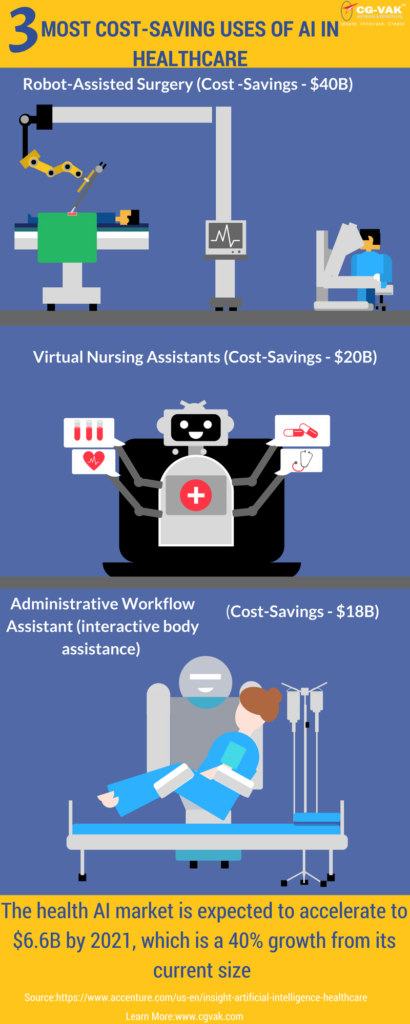
Growth is expected to accelerate with the AI healthcare market set to reach $6.6 billion by 2021, a 40 percent growth from now.

With that great insight, let’s take a look at the three most cost-saving uses of AI in healthcare.

Robot-Assisted Surgery

Robotic Technology is transforming the way surgeries are performed. Hi-Tech robotic platforms enable surgeons to perform more complex surgical procedures with only minimal incisions.

Utilising robotic technology to perform complex surgeries has its own advantages such as shorter hospitalization, reduced pain, and faster recovery time. Patients can now have a personalized surgical experience based on their specific diagnosis and anatomy.

Robotic surgery is definitely a breakthrough in various fields of healthcare including orthopedic surgeries. This innovative technology allows surgeons to position a joint replacement on a patient more accurately. It also assists in having a precise pre-operative planning to ensure extreme precision with bone cuts. Robot-assisted surgery offers more accuracy and precision that cannot be achieved with traditional manual techniques.

Another area where robot-assisted surgery is used is to treat oral, head, and neck disorders. Oral robotic surgery allows accurate removal of tumors of the mouth and throat with no major invasion.

This innovative procedure results in a dramatic improvement in treating head and neck cancer patients. Tumors are removed without affecting their normal activities like speech, swallowing, and other quality of life issues. Precision robotic arms and high-resolution cameras enable surgeons to work in narrow areas with no compromise on accuracy.

The Cardiothoracic field is another area which is immensely benefited by robot-assisted surgery. Here, minimally invasive robotic and video-assisted thoracoscopic surgery operations are done to treat lung cancer and adult cardiac issues.

Unlike the former surgery for lung cancer which acquired a big incision to remove part of the lung, robot-assisted surgery helps to operate with only five small incisions between the ribs without the need to open the inside of the chest.

No wonder in the future, robotic technology will continue to be an indispensable tool in the healthcare industry.

Virtual Nursing Assistants

These are AI enhanced healthcare applications used in providing nursing assistance to patients who are discharged after treatment. This feature offers advantages in terms of simplifying the provision of outpatient services, increasing the accuracy of monitoring patient status and compliance after they are discharged from the hospital, and offers huge cost savings to both the patient and the healthcare provider as well.

They are available as AI-enabled simple wearable devices and on smartphones. These virtual healthcare providers perform services like reminding patients to comply with their drug prescriptions, diet, and exercise plans as suggested by their physician, answering simple queries related to their treatment plan, and alerting healthcare providers about any abnormalities in the patient’s health like a sudden increase in blood pressure or a seizure.

Administrative Workflow Assistance

Today AI is used in the administrative process of the healthcare industry. AI is utilized in scheduling patient appointments. Patients who visit for the first time and those that visit for a review are scheduled in advance based on the physician’s time slots. Emergencies are included as add-ons to the physician schedule.

Considering the challenges in healthcare management, an AI-enhanced system optimizes the proper use of all resources. AI in patient care is both cost-effective and patient-friendly. This system is helpful to hospitals that witness a large number of patients on a daily basis.
This AI-empowered scheduling helps the hospital administration by optimizing the time of their doctors, nurses, and healthcare assistants.

AI-enhanced Robots are also used in other healthcare administration activities, thereby facilitating a more personalized patient care. Right from greeting patients at the front desk to offering interactive body assistance, AI-based robots are used for patients who need critical care. These robots can lift and move patients in and out of their beds, help patients to stand, and to turn them in order to keep bed sores at bay.

To learn more about the AI-enhanced healthcare applications, Talk to Us Today!