Right Time to Successfully Execute Cloud Migration Strategies and Boost your Business Continuity

In the light of the COVID-19 pandemic, business organizations have forgone the traditional work environment and adapted a more dynamic, innovative option to respond to the current crisis. It is Cloud Migration. Migrating into Cloud now could be the most profitable and appropriate strategy to accelerate business continuity when working remotely.

The remote workforce is the most prominent business transition that organizations have faced in 2020. However, it has been challenging – uncontrollable IT disruptions and software and collaborative tools outages. The challenges have heavily affected business continuity across the globe. AWS migration, Cloud-based services, and Cloud-based infrastructure must respond to the crisis and increase business continuity. 

Cloud-Based Infrastructure – How and Why COVID-19 has Accelerated Business Cloud Migration?

The pandemic has transformed 80% of organizations across the USA, the UK, Australia, and New Zealand into remote workforces, according to the LogicMonitor Survey. However, the report further reveals that the sudden shift to a remote working system stirred disruptions that affected normal operations, especially IT infrastructure – productivity, hardware and software, and other tools.  Many professionals (around 70%) confessed to endure challenges like security issues, outages, network strains, stability, and productivity.

That does not say that the companies who already had a remote workforce before the pandemic didn’t face any problems – they did. But they recovered quickly, as they were already were equipped to deal with the crisis.

Hybrid Cloud Solutions – an Increase of 25% since 2019

So, how are other companies tackling the situation? Here are recent trends that we came across from a definite survey:

  • Before the pandemic hit, only 65% of the organizations (survey respondents) had a cloud connection. The number increased to 85% in six months.
  • 90% of the organizations deployed Cloud-based strategies in the first quarter of 2020
  • Cloud adaption is slower in SMEs
  • Some companies had begun the cloud migration process in 2019
  • Trends indicate that within the next five years, 75% of companies across the globe will be working in a cloud environment
  • Cloud-based solutions are essential for companies that locate system users within the physical environment. More such companies have started strategizing Cloud-based software shift
  • Hybrid cloud solutions not only have eased the accessibility during the pandemic but also has helped in business continuity and scalability

What is our Successful Cloud Migration Strategy?

CG Vak is one of the leading Cloud-based application development providers that has also received the “Covid-19 Endurance Award” last month for being the only company to have grown amidst the lockdown and pandemic.

Being on the Cloud will never slow your business down – pandemic or otherwise – will promote digital transformation, increased scalability, agility, and work efficiency.

Being in the business for so long, we have heard many professionals asking us to migrate only critical business applications to the Cloud. Some of them successfully made the shift, while others struggled. With Cloud connection being the best response to the crisis, we have created a Cloud migration checklist to ensure a smooth transition and integration.

Learn the Risks of Cloud Migration

Cloud migration is not easy, especially for companies that run on ‘paper-based, binder-based, and store-in-the-shelf’ business. There are other constraints, too – massive data, uncategorized data, lack of resource, on-premise infrastructure, data privacy, and data security.

Some of the challenges that companies face while adopting cloud solutions are listed below.

Challenges of Full-Scale Cloud Migration

Industry Regulations:

Companies that operate in a highly- regulated industry or enclose a massive amount of intellectual property cannot shift everything on the cloud due to regulatory compliance and other adhering policies, such as HIPAA and GDPR. However, it is not entirely impossible.

Security Issues: 

Data security and privacy are of paramount importance in data migration. Data on cloud computing is encrypted, providing several layers of cloud-based security services.  On the other hand, on-premise data can be a victim of several risks and vulnerabilities, such as outages, human error, system failure, malware attack, etc.

Shortage of Resources: 

Cloud-based software migration will require dedicated expert resources, which most companies fail to have. This could cause inconsistency and skill gaps in migration.

Strategy Build-up: 

Firms with big data have to painstakingly sort through volumes of data to determine the kind of data they have – the ones that they need, the vulnerable ones, and the ones that are classified – before they decide where the data should go.

Despite the challenges, Cloud migration is booming, enabling 80% of global organizations to move to the cloud by the end of next year. It is a reality. Relying upon on-premises will put your data at the risk of a single-point-of-failure, which could result in breach, loss, corruption, or leak of data. On-premise applications will also put your firm behind innovations, as you will miss out on the latest ways to grow, scale, promote, and develop.

Best Practices for Cloud Migration Strategy

The following practices will give you significant control over your data, which we promptly use in our planning and execution. This will also ensure data privacy and safety throughout the migration process.

Data Classification: 

The first cloud migration step is classifying the data, as it will help you understand your data and gauge it appropriately to make the journey comfortable. It includes identifying sensitive data, places where data are located, and sorting the data into four categories –Classified, Restricted, Public, and Private.

Data Policies Assignment: 

This practice will help you establish control and protection for each tier and type of data. They could include watermarking, access control, expiration data, passcodes, etc., based on sensitivity and cruciality. You can grant control over data to select authorities or users.

Development of Access Control and Role-based Authentication: 

The practice allows you to manage and trace data actions and consequences in the Cloud in real-time. Automatic notification, security, and tracking tools will help you identify and mitigate risks in real-time.

External Auditing: 

Third-party audits help you identify weak links in your data that can potentially put the rest in danger. If you are in the legal or healthcare industry, this is a mandatory step, as 75% of data comprises vital and compromised client records and deeds. With penetration testing and SOC audits, you can eliminate the risk of value-chain attacks.
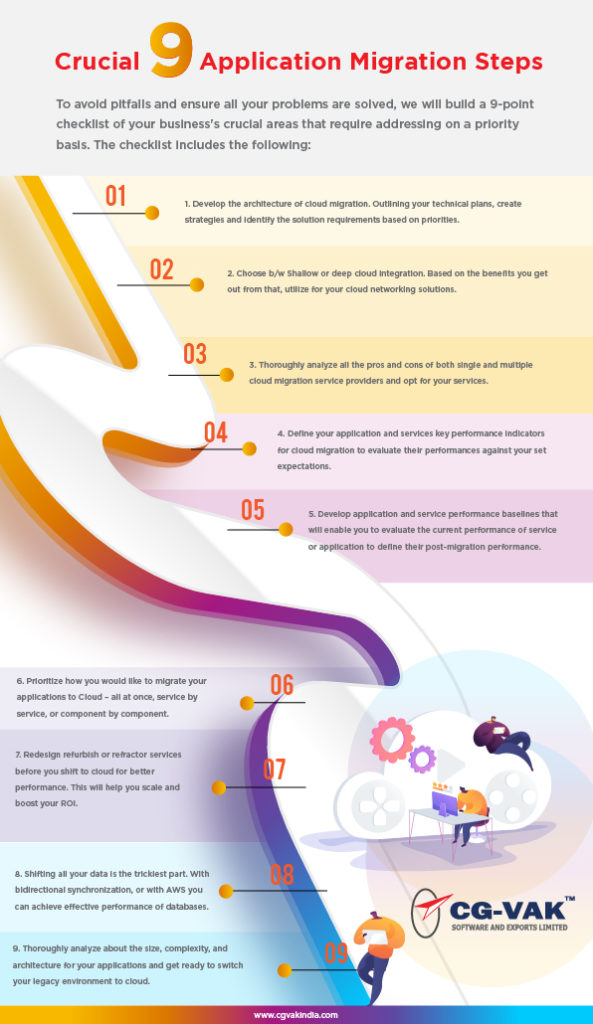
Crucial 9 Cloud Application Migration Steps

To avoid pitfalls and ensure all your problems are solved, we will build a 9-point checklist of your business’s crucial areas that require addressing on a priority basis. The checklist includes the following:

1. Develop the architecture of the cloud migration process at the system-level. It outlines the technical plans, defines the required do up to make the shift effective, creates the strategies, and identifies the solution requirement, the priorities, and migration mechanism.

2. Choose between shallow cloud integration and deep cloud integration. Shallow cloud integration is also known as the ‘lift and shift’ process, where we don’t make changes in the running applications. We neither use any unique cloud data migration solutions. Deep cloud integration allows users to make changes in the applications to utilize the benefits of Cloud-based networking solutions.

3. Pick between a single cloud provider and multiple cloud migration service providers. There are pros and cons to both. However, splitting between two and more service providers will allow you to utilize the best services that each provider offers.

4. Define your applications and services’ Key Performance Indicators or (KPIs) for cloud migration to evaluate their performances against your set expectations.

5.  Develop application and service performance baselines that will enable you to evaluate the current performance of service or application to define their post-migration performance. You can refer to the baselines during the migration process to ensure you are on the right track.

6.  Prioritize how you would like to migrate your applications to Cloud – all at once, service by service, or component by component.

7.  Redesign, refurbish, or refactor services or applications before you shift to Cloud so that they perform effectively in the new environment. This will help you utilize your resources and scale your applications better, besides boosting ROI.

8. Establish a viable cloud-data migration strategy, as shifting data is the trickiest part of cloud migration. If data-access is not handled accurately, it can significantly impact the performance of databases. We provide different options to fulfill this, including bi-directional synchronization, on-way synchronization, or use of AWS migration services.

9. Decide how you will switch your production from the legacy environment to cloud – all at once or bit by bit. Talk to our developers about the pros and cons. This also depends upon the size, complexity, and architecture of your applications.

Cost comparison in cloud migration

When it comes to cost, running applications and services in a legacy system is always high compared to cloud pricing. However, this could change depending upon several factors. However, the costs are different in both – running an on-premise infrastructure system may incur many hidden costs. The running costs are generally not crystal-clear. However, with cloud computing, you will receive a monthly bill from the service provider, with no hidden costs. Besides, cloud cost is usually OpEx (Operating Expenses), while on-premise is CapEx (Capital Expenses). It depends upon the type of business you have too.

In most cases, AWS migration has helped our clients to reduce costs significantly. Based on your financial models, we can help you calculate and compare cloud migration costs using different options (AWS TCO or Azure Pricing Calculator). It will allow you to pick the best option that suits your current infrastructure and financial goals.

Summing Up

Cloud-based solutions can solve 80% of your on-premise problems during this pandemic. And it is just the beginning of the cloud computing era – the capabilities are just going to magnify with time. CG-VAK can help you host your resources via three different cloud models, Hybrid, Private, and Public. However, Hybrid is the most in-demand now, for being a healthy recipe of public and private Cloud’s high availability, reduced costs, and reliability.

We have helped many companies secure their data, simplify processes, and deploy remote workforce via the Cloud. Learn how we can help you in your business continuity plan during the pandemic.  
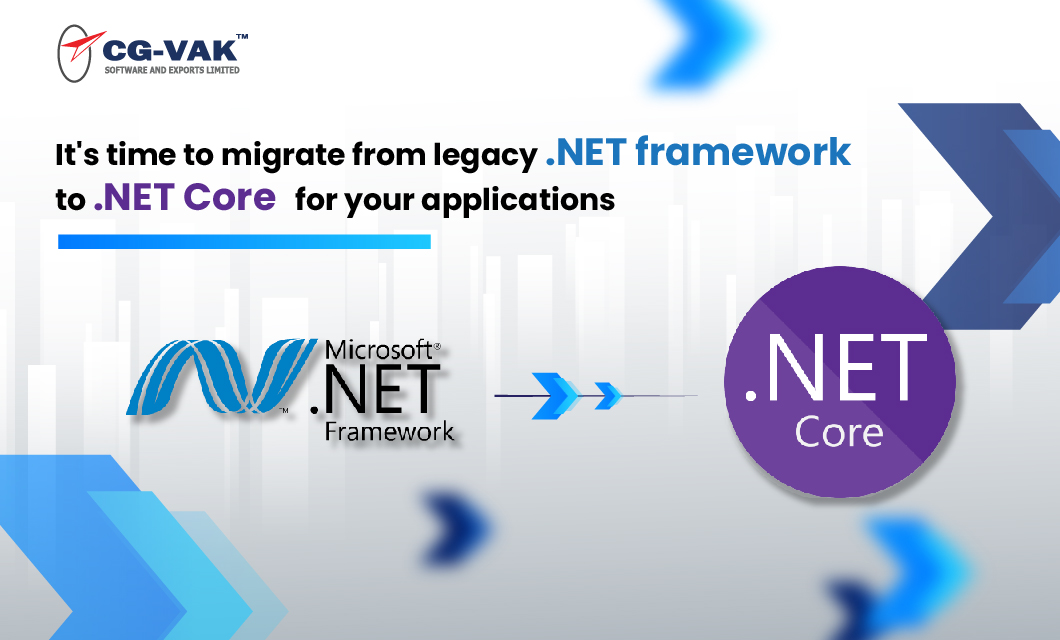
It’s time to migrate from legacy .NET framework to .NET Core for your applications

Introduction of .NET Core framework by Microsoft in July 2019 for building interactive, mobile-friendly web applications, and early announcements of continuous upgrades each year from now is quite a thoughtful strategy. The standard IT organization has also planned to unify the current .NET Core 5.0 GA version to .NET with full compatibility to the legacy .NET web development framework from the next year (2021).

Do all these announcements point to migrating .NET to .NET Core? The current condition of the legacy .NET framework says it all. The .NET framework got is its last version update (4.8) in April 2019 and as announced by Microsoft, there shall be no major upgrade to it apart from security patches and bug fixing which means no additional feature and service updates. This is an undesirable situation for a .NET development company or those who outsource .NET development as innovations are limited now.

Why you should think about migrating from ASP.NET to ASP.NET Core?

ASP.NET is a useful component of the .NET framework to build dynamic websites and applications. But ASP.NET development is limited to the Windows platform only. As already announced by Microsoft, .NET is devoid of any further feature enhancement or addition, it would impact the performance of the custom application via ASP.NET development and also put security at risk.

While, if we consider ASP.NET Core, it is a complete package with robust services and integrations to build a customized application for multiple platforms including Windows. Moreover, the improvements and innovations assurance with regular updates to the new ASP.NET Core web application inspires many dedicated developers to migrate from ASP.NET to ASP.NET Core.

Are you ready to migrate? No need to be so quick for .NET Core migrations! We can take a break here and look at the definitive comparison here.

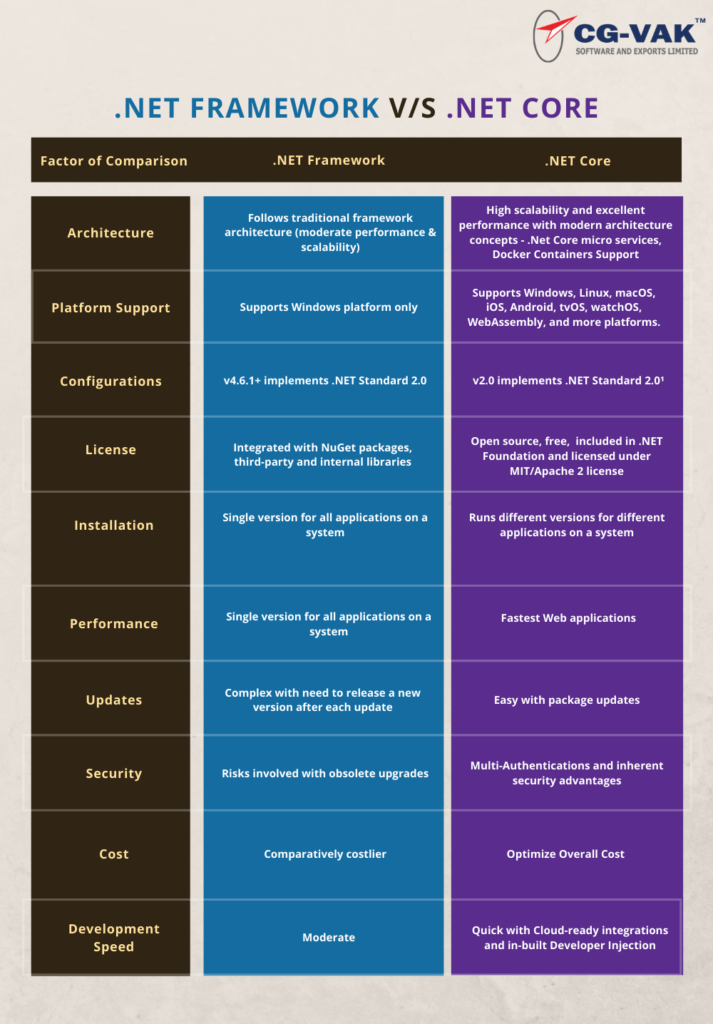
.NET framework V/s .NET Core

.NET Core is an improved extension of the legacy .NET framework and the dilution of the legacy .NET framework is planned in the coming year. Its service-oriented architecture is a bonus to the software developers to build flexible and high-performance software applications like never before. Both frameworks/platforms are used at almost the same ratio in the organizations today but many businesses are eager to migrate .NET to .NET Core due to its popularity and to eliminate the need for custom web application development and .NET development services.

Let us contemplate the exclusive advantages and robust features of the .NET Core over the .NET framework with a lucid comparison.

Migration of ASP.NET to ASP.NET Core

The comparison table depicts multiple business advantages with .NET Core over .NET development services developing interests in many web application developers to migrate from ASP.NET to ASP.NET Core. High-performance speed, user-friendly GUI, and high flexibility in ASP.NET Core web application are favorable aspects for them.

There is no direct ASP.NET to ASP.NET Core migration tool but we have prepared a constructive ASP.NET to ASP.NET Core migration strategy for all ASP.NET Core admirers. The prime requirement for this .NET to .NET Core migration is .NET Core SDK 2.2 or later.

1. Framework retargeting 

With ASP.NET Core projects, you can target .NET Core, .NET framework, or both. Select your choice.

Tip: If you target .NET Core, you can remove explicit package references using ASP.NET Core meta package and its precompiled Runtime Store can be used for improved performance.

2. Create New ASP.NET Core Project 

Simplify the project by eliminating XML merge conflicts and create a new project in the .csproj file format.

Tip: Edit project file using Visual Studio in ASP.NET Core web server as it facilitates file readability without any GUID based references to other projects.

3. App Bootstrapping

Perform route configuration, add filters, and area registrations using the entry point and configure the pipeline.

Tip: Use .NET Core improved bootstrapping mechanism which includes Startup as the entry point that helps in decoupling application and server to avoid issues in the implementation process.

4. Implement Store Configurations 

Use appsettings.jason project template to store configurations for deciding platform environment with strongly typed set of configuration objects.

Tip: Use the extension to configuration service known a Dependency Injection, an advanced part of .NET Core web server software architecture for large, scalable applications.

5. Follow Partial-App Migration

Divide ASP.NET applications by creating an IIS-sub application and using the URL structure of the application, move only certain routes from source to destination.

Tip: Use small modules and projects for quick and efficient .NET migrations to .NET Core while moving microservices.

6. Manage Over posting

Use Bind and Input Formatters attribute to avoid the overposting scenario.

Tip: Replace Bind attribute with same properties view model while using JSON Input formatters and JSON info controllers for parsing the data.

Consider the above standard reference steps carefully for migrating ASP.NET apps to ASP.NET Core platform efficiently. These are also applicable for migrating ASP.NET MVC to ASP.NET Core MVC when planning for MVC web development.

There is another approach, i.e. rewriting with porting. It is a cost-effective migration strategy useful for a large domain organization. It includes conversion of single domain functionality into microservice and porting it into .NET Core microservices one by one while using the existing code and the above ASP.NET to ASP.NET Core migration strategy.

Choose all resources including ASP.NET to ASP.NET core migration tool wisely and work under expert guidance always.

.NET Core: Is it the future for apps?

The smart, dynamic extension of the traditional .NET Framework, .NET Core holds various positive points in comparison. An ASP.NET Core Web application is highly scalable, interactive with enhanced performance owing to integrated software architecture like Docker Containers integration and .NET Core microservice. The advantages of Cross-platform support and provision to use multiple services on the same server on different .NET versions tend many developers to think for .NET Core migrations.

Still, the .NET Core framework includes minor flaws as it is not completely adapted to all of the .NET web development technologies, does not support 3rd party .NET libraries, and has limited or no access to Windows specific APIs..

But, Microsoft has already seen a future in .NET Core by promising new versions and continuous open-source projects along with a planned unification of the .NET framework and .NET Core. This negates the current limitations in the .NET Core framework and brings to migrate .NET to .NET Core.

Also, the exclusive support of .NET Core to the most popular programming language C# which makes it a candidate for an alternative to JAVA is the prominent attraction for any .NET application development company for migrating from ASP.NET MVC to ASP.NET Core MVC under the MVC web development category.

So, it would not be wrong to mention that the revolutionary .NET Core framework is the absolute future of robust and cost-effective web applications.

Get ready to migrate your .NET framework Legacy apps to .NET Core now!

Now, that we have contemplated both .NET and .NET Core frameworks features and aspects till now, the decision for migrating ASP.NET apps to ASP.NET Core is easier.

Are you preparing for .NET to .NET Core migration or on the path of migrating from ASP.NET MVC to ASP.NET Core MVC? Then we recommend you to visit CG-VAK and get smart consultation services from the dedicated IT professionals and experts. We are a reputed offshore IT services and solutions provider aimed to outsource excellent technology innovation solutions. You can send your queries and requirements via mailing and get connected directly.

Summary

.NET Core framework features are superior to legacy .NET framework for building flexible, user-friendly web applications. Microsoft got this idea in advance and is now interested in the further development of this framework. Relying on the trust in the standard IT organization and alluring with the advantageous attributes of the .NET Core framework, many IT organizations are routing towards it at a great speed.

Next Gen in Retail: Get Seamless Shopping Experience with Unified Commerce

Unified Commerce has become the lifeline for the mid-sized retailers who wish to sell their products to customers across multiple platforms. Building an eCommerce website with unified commerce solutions is the key that will unlock the answers to buyers’ need for a wholesome, consistent, and integrated experience from retailers’ both brick and mortar and online stores.

In a nutshell, unified Commerce offers retailers an omni-channel commerce platform that fulfills the following customer expectations:

– Shop at a specific location without any problem

– Get personalized services and information from a specific brand across all their stores

– Customers receive what they want instantly, even if the product is unavailable in the specific store branch

– Expect shopping cart continuity across all platforms

The Future of Retail is in the Hands of Unified Commerce – What is It?

Retailers implement different business applications to run their stores, such as retail POS systems, loyalty programs, eCommerce platforms, inventory management, and CRM. Retailers must gather huge amounts of customer data through business applications or touchpoints to deliver efficient service. However, instead of disconnected business applications, they need a robust and integrated platform to analyze the collected data, generate meaningful insights, and share it among the stakeholders to provide the most incredible shopping experience.

Solution: A Unified Commerce Platform, where online stores and eCommerce channels are effectively synced!

From eCommerce to Omnichannel to Unified Commerce: No More Confusing Customers’ Journey

Unified commerce business application puts together everything in one single platform – eCommerce, inventory management, in-store customer data, orders, checkouts, POS sale capabilities, and customer relationship management. It breaks down the walls between multi-store silos and uses a common platform.

An example will be helpful:

“Alex visits your store located on Jackson Street to test a few refrigerators for his home. However, he says to the in-store staff that he needs some time to decide. The staff obliges, as she doesn’t feel pressured to close the sale on the spot. Meanwhile, Alex goes home and finds that the products have been automatically added to a wish list, emailed to his mail id. He could easily move the items to the cart and pay for them whenever and however he wanted. He also finds that he could use the coupon code provided at the store while making the online payment and decide between in-store pickup and home-delivery”.

Unified Commerce is like a wholesome shopping experience for both buyers and retailers – customers can start their journey in the store and finish it online. In contrast, retailers can minimize the risks of losing the Customer to another store or ecommerce brand.

Why Switch from Omnichannel to Unified Commerce You May Ask

It is all about the best customer experience wherever they are with you – where all your selling channels work together to provide a combined buyer journey. Omnichannel retail solutions allow retailers to use different platforms to drive sales and engage customers, including social media sales, eCommerce, retail POS system, retail store system, ERP solutions, CRM, supply chain, and other mediums. And these mediums are often implemented, so it becomes difficult for the omni-channel approach to combine the back-end capabilities of each platform, link data, and perform analytics.

It creates many business silos, and while the approach works for short-term goals, it doesn’t provide a user-friendly and personalized customer experience – the need for the day. Customer expectations towards brands are rising by the day, and competition isn’t helping to slow down. An optimized shopping experience that allows customers to buy, engage and experience from a single source is crucial.

Unified Commerce provides precisely that, cost-effectively. .

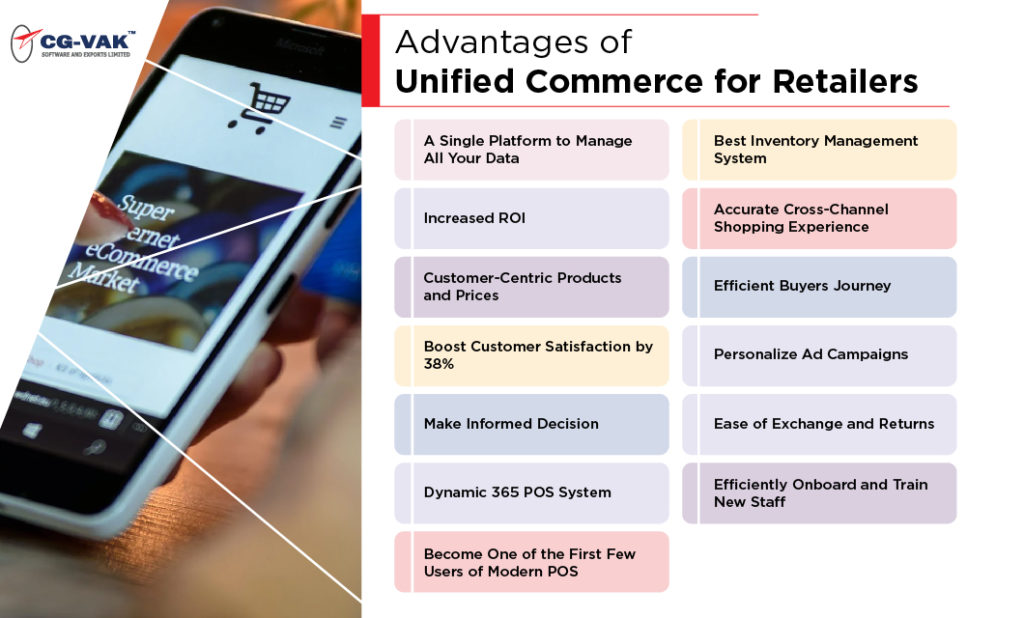
Advantages of Unified Commerce for Retailers

Unified ecommerce shopping experience is designed to fulfill the needs of modern customers who zig-zag through various mediums to complete shopping. The benefits of unified ecommerce store development for retailers are 50% more premium than omnichannel and ecommerce mobile shopping.

A Single Platform to Manage All Your Data: 

One-data model will enable everyone in your company to find complete customer information in one place, which will improve customer interaction.

Increased ROI:

A single, systematized commerce platform will significantly reduce overhead, IT and inventory management costs, and sales loss and boost employee efficiency and inventory turnover.

Customer-Centric Products and Prices: 

If your Customer doesn’t find size 44 Red Jacket in your store branch, you can locate it in another branch and get it delivered to his place on the same day.

Boost Customer Satisfaction by 38%:

Synchronized and centralized eCommerce store can increase conversion rate, marketing efficiency, and avg. order value, thereby improving the bottom line.

Make Informed Decision: 

One-point of access for customer preferences and purchase history for all channels will enable retailers to make the best decisions for pricing, incentives, promotions, and more.

Dynamic 365 POS System: 

Use advanced technology for the POS system that allows fast customer processing in real-time – mobile payments, self-checkouts, consumer purchase history, and online order.

Become One of the First Few Users of Modern POS: 

Research shows only 28% of retailers have updated their POS technology, and the average age of retail POS is 6.7 years. You could be one of the first few.

Best Inventory Management System: 

Unified commerce platform enables retailers to view and manage entire inventory across all channels in real-time, providing better figures for overselling and underselling.

Accurate Cross-Channel Shopping Experience: 

A dated POS hardware could have slow processing speed, less storage space, and staggered customer data access, which cannot deliver the best customer experience.

Efficient Buyers Journey: 

With multiple ways to buy a product, track its shipping, and make payment, order management is simplified across all touchpoints. Retailers can also embed shipping to the POS.

Personalize Ad Campaigns: 

Real-time tracking of customer interaction with the brand between multiple channels can help businesses in ecommerce manipulate or change ad targeting and improve customization.

Ease of Exchange and Returns: 

Synching online and offline storefronts will help brands provide the best post-purchase services. E.g. Customer sees the shoe at Store A, purchase online, and return it in Store B.

Efficiently Onboard and Train New Staff: 

It is easier to train staff one system than numerous business applications, enabling employees to intelligently and quickly learn marketing management.

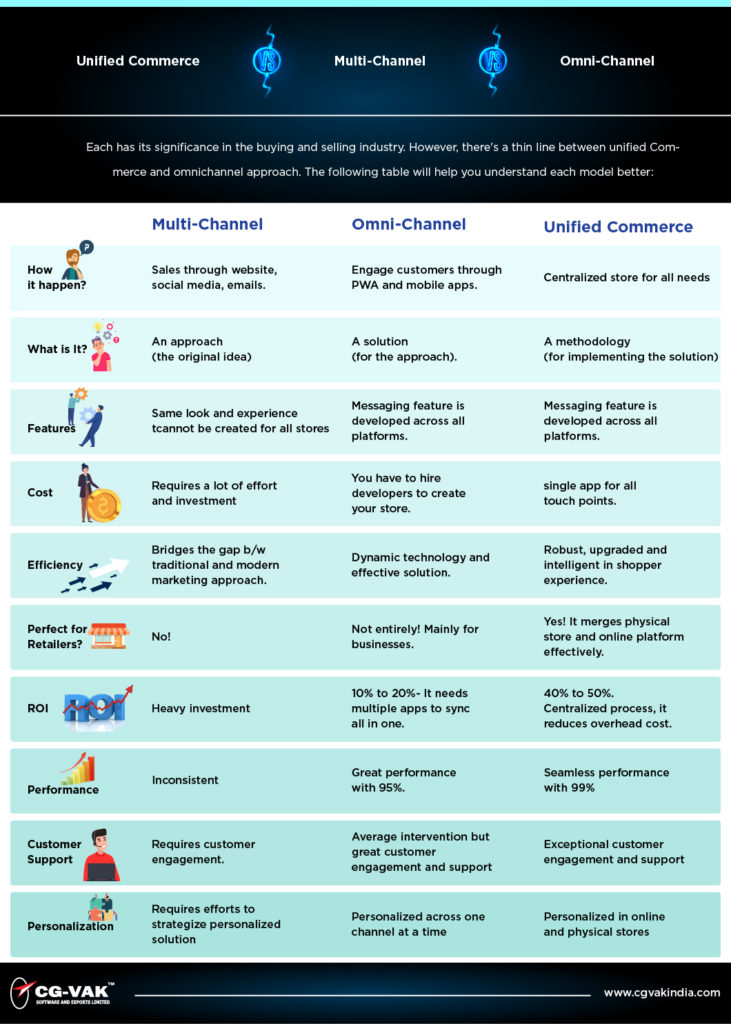
Unified Commerce vs. Multi-Channel vs. Omni-Channel

What Retailers Get from Unified eCommerce Platform?

Unified Commerce takes you beyond the great ‘omni-channel’ experience. While omnichannel is mind-blowing, Unified Commerce is one step ahead, as it includes the retail business. Customer is everything, and retailers have realized that to provide a wholesome customer experience, they have to break down the barriers between different internal departments and make everything one whole service platform.

Here are ways that unified commerce development can help support and grow your business across a broad customer base:

1. You don’t have to deal with separate systems to manage sales, inventory, or ecommerce portal – integration, maintenance, upgrades, and implementation are centralized, which reduces ecommerce store development costs and efforts.

2. You and all other stakeholders involved in the business will get access to one version of data = one version of the truth. This will streamline budgeting, financial reporting, planning, tracking customer history and buying patterns, analyzing product marketing and sales performance, and making fast decisions.

3. As a retailer, you will provide an interactive, hands-on customer shopping experience in the store, powered by digital technology.

4. You will have an all-encompassing view of the product inventory across all channels and all locations in real-time. One quick scan through warehouses, locations, distribution centers, and stores can help you evaluate stock levels.

5. You can compare past and present inventory data to derive trends in sales and forecast and plan growth strategies based on real-time statistics.

6. This IoT based Cloud commerce solution is perfect for digital-savvy customers. Such consumers are more knowledgeable and connected across multiple channels. They don’t stop at one shop or store – they have a list of several retailers. They compare prices, value propositions, and engagement opportunities. But above all, they value personalized services across all shopping channels.

7. It acts as a business intelligence tool that helps you bring together customer data, behavior, and interactions at one place that help predict and plan special offers based on customer desires and needs.

8. Product and customer information is maintained in a single database, shared to different touchpoints. This reduces delay in communication and risks of errors, such as advertising a wrong product price, promoting a faulty product to a Customer, selling a product online out of stock, or describing a work inappropriately.

9. Data from predictive analytics can help you develop AR/VR experiences to appeal to and engage customers’ visual sensibilities.

10. Finally, as the line between physical retail stores and online shopping starts to vanish further, unified Commerce will be a requirement and not just another badge to your business accomplishments. At a future date, you might have to shell out more money in developing a unified omnichannel solution as the skill demand increases.

So start switching to the future of Unified Commerce with CGVAK.

We can help you switch to the future of Unified Commerce with Microsoft Dynamics 365, uber-cool, next-gen Cloud-based Unified commerce framework and other ecommerce store development services. The creators designed the platform to centralize customer service, sales and marketing, and operations in a single business application. With Dynamics 365, you will also enjoy the functionalities of Microsoft Office 365, Azure Machine Learning, Cortana Intelligence, and other Microsoft Productivity Tools. Microsoft also offers a gamut of personalization options for retailers to accommodate their store’s needs.

Besides, when you work with us, our certified developers will make sure you take advantage of Dynamic 365’s exclusive data intelligence tools, such as Azure and Microsoft Power BI. These tools help gather, organize and analyze data in the most useful manner.

Unified Commerce is all you need to help modern consumer challenges that all retailers face. Contact our experts to discover how this magnificent omnipresent, multi-faceted, single-app platform can help you score a perfect customer experience every day, consistently.

Get ready to launch your ecommerce store in this holiday with given safe ways!

The holiday season is the right time to create an effective plan to launch and upgrade your online store, boost traffic to your website, and increase ROI without disturbing its performance or spending thousands. The good news is that you can do a lot to bring about a profitable change using the best conversion optimization tools and eCommerce development services.

Excited to know more?

This blog will help you explore eCommerce website optimization strategies that will lead to more traffic in a safe way.

“When your customers are gearing up for the online shopping spree, you can do an SEO audit, enhance or create your landing page, implement on-page SEO for eCommerce marketing, change the company logo, optimize the site structure, test website performance, or even migrate your eCommerce store to Magento 2.0 to make it 2021 ready”

Get Real Visitors to Your Website with Life-Saving eCommerce Website Optimization Plans

There is no denying that this holiday will be ‘the year’ for eCommerce brands across the world – a lot of people will be shopping online for gifts – our priority will be to ensure you don’t lose your current traffic. However, before you start the Christmas sale, you need to prepare your eCommerce store for the holiday shopping.
P.S. – You still have enough time. Get those visitors’ traffic high by 30% with a set of proven strategies.

Reasons Why You Must Utilize the Holidays to Bring Traffic to Ecommerce Website

It will be helpful to learn why exactly you need to relaunch your online store during the holiday. Conversion optimization services are calculated, and proven tactics eCommerce development companies take to improve stores’ performance.

If a site is not up to the mark, it can lead to the following scenarios:
1. Unresponsive site, resulting in poor customer experience
2. Slow website load time and speed, leading to decreased click-through-rates.
3. More and more shopping cart abandons and low sale conversions.
4. Inefficient SEO plan, leading to decreased search engine ranking.
5. Negative reviews from annoyed customers causing poor online reputation

All of these issues can ultimately lead to a revenue drop.

While website optimization should be an on-going process throughout the year, it should be a priority during the holiday shopping season to deliver a smooth consumer experience across all channels.

Although user experience is an important parameter, security and protection shouldn’t be overlooked. eCommerce sites are highly vulnerable to data leaks and thefts, considering the massive consumer data they store.

Regular maintenance and upgrades will help websites run securely and are devoid of dated programming codes and aggressive hackers.

Besides, launching a new website or Migrating your current eCommerce store to the latest platform could help you score the perfect goal among the right group of the target audience.
Check out these helpful pieces of information on ‘How you can migrate to Magento 2.0 without any break’ and ‘how to boost sales with eCommerce Web Development’

Safe Ways to Launch and Optimize Store for Conversion

All retailers and online brands rely on the holiday season to cover up the financial year’s revenue target or generate more sales. For that, they have to create a seamless and beautiful experience for the customers. And it starts by preparing a checklist.

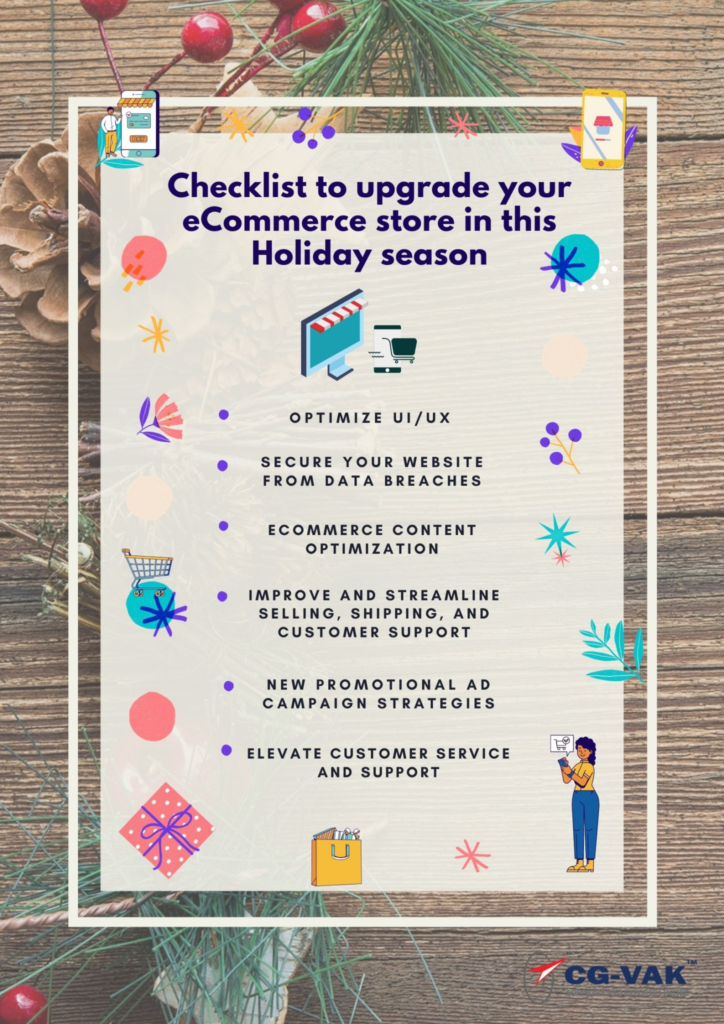
Holiday eCommerce Checklist

The checklist will help eCommerce executives to create and deliver an accurate optimization strategy:

8 Incredible Ways to Boost Traffic to Your Website Online

Let’s go through simple and affordable ways to improve website performance.

1. Evaluate and Upgrade Overall Website Performance

Testing overall website performance will ensure your infrastructure can handle the surge in visitors during the holiday season. You can contact us to perform a quick website performance test on both the web and mobile. It will include website navigation, third-party integrations, website load time, and website speed testing. Even a single day’s delay in one of these can reduce your eCommerce conversion by 8%.

Also, don’t forget to check your online store’s mobile responsiveness. Make sure the images are well optimized and the designs are mobile-friendly.

If you are working on a limited budget yet want to deliver a beautiful shopping experience to your end-users, we recommend considering launching a Progressive Web Application instead of a downloadable mobile application.

2. Optimize Your Keywords

Google search console will help you optimize conversions by showing you different ways to do it, such as creating landing pages for the commonly used search phrases used by customers during the holiday. Use last year’s Google Ads to check which campaigns increased conversions, and based on the result, plan this year’s PPC strategies.

3. Use Right eCommerce SEO Services

SEO is the basics of all eCommerce optimization strategies. You must follow the latest SEO trends to ensure your Google ranking goes up each day. However, you have to use a different set of on-page SEO for eCommerce during the holiday season. The regular won’t work out, as customers will be searching for your products with different keywords. Hire our SEO professionals to perform a keyword search and holiday landing page optimization.

4. Improve Your Checkout Page

Attract your customers with exclusive shipping offers. Free shipping should be your biggest promotional tool. Make sure your message is loud and clear on the home page. Besides, using a single checkout page on mobile devices and enabling guest checkouts will be a game-changer. Other ways to improve your checkout page is by adding various payment modes, pay-later options, multi-recipient functionality, and fast and quick shipping and fulfillment.

5. Consider Unified eCommerce

If you wish to sell your products across multiple platforms with a personalized touch, you must implement unified commerce. It provides a wholesome experience to online customers, where they can order the product on Facebook, pay the amount on your eCommerce site, and pick it up from your local store. Learn more about Unified Commerce.

6. Check and Fix Site Errors

Identifying and fixing certain types of issues should be part of your regular site maintenance. Fix the following errors before your site is up for the holiday sale:

Use a crawler to find common website errors, including 404 errors, redirects, grammatical errors, duplicate content, bad content quality, broken links, etc.

Lookup Google and Bing Webmaster Tools and Search Consoles to identify structured data errors. Fixing it will improve ecommerce site visibility.

7. Optimize with Best eCommerce Email Marketing Campaigns

This has two parts – start an effective email marketing campaign and improve email deliverability.

Since consumers frequently check their phones during the holiday season to get the best deals on products, sending a variety of offers on email will increase traffic on site.
Send out promotional emails with highlighted texts and encourage shoppers to click on the landing page.

Email deliverability makes sure that your potential customer receives your mail and opens it. To enable this, you will have to set up your domain name email setting correctly, remove your domain name from the blacklist if it’s listed, and set up security records (DMARC, SPF, and DKIM).

8. Enhance Your On-Site Search Engine

When new visitors use your eCommerce website, you will have to help them find what they are looking for. Good navigation and beefed-up internal search engine will make sure they find what they need. In order to boost on-site search, you will have to set up internal search tracking and use Google Analytics to monitor traffic. Based on the featured results, improve the search experience internally.

Launch and upgrade your ecommerce store in this holiday season with CG-VAK

CG-VAK is an ISO Certified eCommerce Web Development Company that can deliver custom holiday eCommerce store optimization solutions. Businesses should consider outsourcing eCommerce development services. Outsourcing has several benefits – While you concentrate on the core business operations, we take care of the optimization and delivery.

Right from developing cost-effective, basic SEO plans to complete migration and store management services, we have the required infrastructure, expertise, and platforms to make your store Christmas and New Year ready in two to three weeks.

CG-VAK’s Business Strategy to Manage Covid-19 Disruption?

The pandemic has caused a significant impact on many company’s operations worldwide. While several businesses set up a remote workforce to manage the COVID-19 outbreak, many companies had to lay off their employees in a desperate attempt to keep their business running. CG-VAK also faced two challenges: preparing the workforce for the pandemic and how fast and how to manage the economy without taking out the employees of their jobs.

How Did CG-VAK Sail Through the Tough Time during the Pandemic?

We prepared ourselves in three folds: Our managers accepted the new reality and new threats proactively, invested in modern telecommunication and IT systems, and established remote workforce synergy, and introduced a new set of employee awards.

While we knew pivoting the operations wasn’t impossible, the hurdles were many, mainly because we dealt with a massive amount of sensitive database, IT infrastructure, and over 500+ employees working in different locations. However, we managed to sail through by making the right decisions at the right time and by incorporating new, inventive ways to establish an efficient workforce. This included changing certain operations, communicating with staff frequently, and incorporating employee rewards and recognitions periodically.

Many businesses have reopened their operations with uncertainty in the last quarter of 2020. If you are one of them, these following tips will help you build a measurable growth strategy in 2021 as they helped us.

Best Practices to Respond to Covid-19 Crisis

CG-VAK’s top management continually looks up and analyzes statistics, news, and social media data in regions where we have set up a customer base to understand how the pandemic has impacted the country’s economy.

1. Open Options for Remote Working

A large portion of your workforce (non -manufacturing) can be transitioned to a remote telecommunication system, such as accounting, payroll, HR, sales and marketing, customer service, processing, meetings & management, and IT. Being a Offshore Software Development Company and Solution Provider, we could replace 90% of our infrastructure with a remote workforce.

  • Made sensible working rules with flexible working hours and trained managers to enforce them to make 2021 promising.
  • Identified and hired employees who can work effectively from a remote location without much assistance.
  • Develop ideas and tactics on how to continue operations with limited access to resources.

2. Reward and Promote WFH Employees and Build a Strong Team for 2021 

With less physical meetings, fewer lunches together, and less people talking to each other, we altered the traditional employee appreciation and reward system for the virtual workforce:

3. Built a Remote Workforce Community

We organize online meetings through chats, phone calls, and video conferencing every day to share and brainstorm new ideas. We ensure there is an active involvement between everyone so that officials don’t feel isolated. We also facilitate team-wise and one-on-one meetings to develop confidence among executives.

4. Provide Sustenance through Employee Recognition

To keep day to day workers, managers, and leaders motivated and sustained, we recognize our people differently.

  • We reflect on our people and express heartfelt appreciation for their loyalty and resilience.
  • Unlike many companies, we have forgone cutting down the monthly salaries or incentives by 25%.
  • Introduced pandemic-based new incentive schemes to keep staff motivated.
  • We are specific at pointing out employee accomplishments, so they realize their efforts are recognized and valued.
  • Personally thanked the silent heroes like our employees who worked behind the scenes, consistently, without seeking appreciation. They are the backbone of our company.
  • Included their family members while recognizing the efforts of our staff.

5. Stayed Practical by Providing Incentives that is Needed

Right now, a restaurant coupon or a gift card would be an inappropriate incentive or reward. We instead ask our employees what they would prefer as an incentive in return for a job well done.

6. We Think Beyond Emails

We ensure to communicate beyond emails to ensure steady connection throughout the day. For instance, Skype and Go To Meetings are the most preferred communication tools. We also communicate via social media apps and phone calls to check on projects and provide feedback.

7. Virtual Events in CG-VAK

Since we are spread out across India and the USA, we have employees working from different cultural backgrounds. It is now even more important to respect each person’s religious events and cultures when rewarding them. Besides, we hold virtual events every month to celebrate important milestones achieved by our teams and Indian festivals to ensure unity and active communication despite the remote work environment.

8. Use of Current Telecommunication

All of the above goals will be impossible to achieve without significant changes in telecommunication and operations. We did not hesitate to install and implement modern tools to improve business continuity across all departments. We have encouraged our employees to use the best internet connection providers with better network speed, increased the number of VPN connections, using competitive video conferencing services and collaborative tools like Microsoft teams, purchased better laptops and tablets for remote workers, and upgraded our OS and IT systems to latest frameworks.

CG-VAK is Focusing on Success

Summing up, amidst the current, sharp economic downturns, we take pride in having fared well. We have hired more remote workers, improved our customer and employee experience despite the challenges in transition, and tried to focus on the success of our business, health management of our individual employees. We have worked hard to soothe employees’ minds with motivation, hope, and confidence. We channel power from each other and look for opportunities to grow forward rather than blame the COVID-19 and play the victim.

It is the right time to celebrate what we have – our people, our health, our business, and products and services – and take positive inspiration.

A deep dive into how ASP.NET Core helps to build Microservices!

Microservices is a tough alternative for the traditional or legacy app development architecture and had profited many businesses including Amazon, Netflix, PayPal, Twitter, and eBay till now. The concept of Microservices architecture is building a full-size application (Microservices web application or Microservices based applications) which is actually a suite of several individual services modules or components. These components are functionally targeted, work independently, and interact with each other via defined APIs.

Businesses with legacy applications are facing many setbacks in terms of complications in modifications, nil scalability, slow to modifications, suppressed innovations, interdependencies, and more. Microservices based applications, on the other hand, comprises no such limitations. In fact, any effect on the functioning of a component or a Microservices of the application does not affect other components which ultimately do not cost much effort on its remedy. Thus, it is good for many business applications with an increase in resilience with minimal impact of failures, improved scalability for any high demand Microservice, easy deployment of innovations, long-term commitments, and high flexibility.

For building Microservices application, the development of individual Microservices is required and the best framework for it could be the ASP.NET Core owing to its astounding advantages like cloud-based configurations, high-speed development, cross-platform support, etc. beneficial for any business who wants to grow with time and demands scalability and flexibility with quick app innovations.

One remarkable reason for businesses to adopt ASP.NET Core for Microservices development in comparison to other frameworks or programming languages is that both complements each other with almost similar methodologies in app development architecture.

Components of Microservices and key benefits

Microservices application development architecture is composed of multiple functional components. Each component along with Microservices has its specific function in the Microsoft Microservices Architecture Style.

Identity Provider  : 

It is a component in the Microservices environment that is responsible for managing the Client’s identity information and a source of authentication services to the whole network in the structure.

Key Benefit: 

IdentityServer4 is useful in Microservices-based applications with its wide range of features – Single Sign-on, user management with Admin UI (in beta version), refresh token, token-based security, generated token revoke, External Identity Provider (Google, Facebook) support, and more.

API Gateway : 

Composed of multiple small projects for clients with Microservices sharing viable responses.

Key Benefit: 

Using API Gateways, implementations like Authorization, HTTPS termination can be performed. Besides that, responses can be collected from multiple services and shared with the client in a single run eliminating the need for individual information exchanges.

Content Delivery Network (CDN) : 

A network channel or provider of static content or resources including the web content or web pages to a distributed network within the Microsoft Microservices architecture.

Key Benefit: 

Direct communication with clients with complete transparency in the static resources being used in application development makes it flexible for scaling and improvements.

Service Discovery : 

It is a services tracking component which records service address, location, endpoints using the Service Registry component.

Key Benefit

The Service Discovery and Service Registry mechanism are useful in knowing the state of the services out of the cluster with IP address information and service requests can be sent to load balancer easily with registered services information.

Node Management : 

It is the node maintenance component for a Microservices (also known as Load Balancer).

Key Benefit: 

It provides a balanced traffic routing to nodes to a Microservices raising query to the Service Registry getting the accurate location via registered IP address.

Why ASP.NET core for Microservices?

ASP.NET Core development services are treated as a superior web development framework for building web applications as it integrates the standard platform – dot NET. The ASP.NET Core is an open-source, advanced version of ASP.NET, introduced in the year 2016, known for its compatibility with Docker Container, Windows, Linux, and macOS, cross-platform support, cloud-based configurations, fast performance, and more which has caused many developers to migrate from ASP.NET to .NET Core. Many big enterprises including Alibaba Travels have included ASP.NET Core development in their tech sacks for building scalable, flexible, and high-performance web applications.

Microservices and Dot NET Core Framework Comparison

Dot NET Core framework was used in its earlier project with the type of architecture where services were used to build applications via integrated Simple Object Access Protocol which is quite similar to the web application Microservices architecture (the modern one) used to build Microservices web application and Microservices-based applications.

Also, in-built assistance and Docker container related technologies within the framework persuade developers and designers more to choose ASP.NET Core for Microservices creation and Microservices solutions.

Key Qualities of ASP.NET Core for Building Microservices

From the previous section, we have gained some profitable mottos to choose ASP.NET Core for Microservices. We also found out a commonality in the methodology adopted by both ASP.NET Core architecture and Microservices-based architecture to build web applications. Building Microservices with ASP.NET Core development framework would prove a great deal to developers owing to its excellent features and qualities.

Light-weight Framework:  

ASP dotNET Core is a light-weight and modular framework that is ideal for developers to build instant container-based Microservices.

Cloud-based Configurations : 

Cloud-support and scope of scalability deliver highly secured, feature-rich, performance-driven dot NET Core Microservices. Azure Cloud technology is popular among .NET developers and helpful to build efficient dot Net Microservices.

Advanced Cross-Platform support : 

From system to mobile, Windows to macOS, .NET Core builds applications for all platforms. It supports all technologies, Operating Systems including Linux. It also supports Docker Container and building Microservices with Docker is favorable for developers as Microservices and docker container complement each other.

IDE Selection : 

ASP dot NET Core developers have the full choice to select IDE apart from Microsoft Visual Studio to develop .NET Core apps using Microservices. There are nil conditions and the developers are free to choose any right technology which can be free software to develop Microservices–based applications effectively.

Kubernetes & Docker Support : 

NET Core supports both Kubernetes and Docker technologies to build ASP Core Microservices. The use of Docker in Microservices is always encouraged by developers through ideal access of entire resources information and details in Microservices and containers. Kubernetes, on the other hand, is an add-on technology of Core development that enhances Microservices development through its advanced properties and features.

High-performance & Instant Containerization:

In the latest ASP.NET Core versions, developers can utilize the high-definition image as an add-on feature along with a quick development cycle. Docker container technology is supported for almost all ASP.NET Core apps which are quite suited to build web applications based on Microservices web architecture.

Hence, ponder over the above key qualities of the ASP.NET Core for building Microservices and choose your further app development projects.

Wrapping Up

Microservices building is ideal on the .NET Core development framework with its supporting and beneficial features as discussed widely in the blog. For genuine guidance and satisfactory implementation of the ASP.NET Core services, any business can hire an expert ASP.NET development company.

At CG-VAK, our onshore/offshore clients are offered exclusive ASP.NET Development services and expert consultancy through experienced professionals at competitive pricing. Contact us for free guidance on your projects.

Could startup can leverage from outsourcing their software product development?

Being amongst the large group of start-ups booming up every day, it is important to know the best expertise on outsourcing your software product development. This article will help you understand the why, when and how software product development outsourcing can be beneficial for start up companies.

A go getter with a motive in mind to speed ahead on the software development front, every start up would need a few basic requirements to fulfil their dreams. Cost factors would be a little high considering technology and resources to cater to the development needs of the customers.

How outsourcing can help?

Resource Availability

Larger companies with a huge manpower and the latest technologies are already available sometimes with resources not being utilized to their 100 percent. Start ups can get in touch with these outsourced companies who can provide resources on a short term or a long term basis depending on the technology and the domain area of development.

Technology expertise

Being a large company with expertise on multiple technologies and industry verticals, mix of resources with varied technology expertise is available to choose from. The start ups can opt to choose the correct mix of technology and experience as required for their project.

Cost Benefits

Huge costs can be curtailed by reducing the go-to-market time and cost for your development. Outsourced cost is more competitive than permanent employee costs.

This pandemic has increased the use of remote work, which will make us understand how important and efficient outsourced companies can co-ordinate on the product development benefitting both the start-ups and the outsourced companies.

  • Cost effective, if software development outsourcing is done correctly the savings are significant.
  • Focus on core business processes, which will bring immense experience and superior tech talent from worldwide.
  • Easy scalability, in this fast-changing business world, a business should always offer more today than it offered yesterday and this is possible with outsourcing.
  • There is no need for micromanagement, thereby ensuring full transparency of the development process.
  • t guarantees effective communication inside the team, by focusing only on your tasks and not on building bridge and warming up activities.
  • With effective collaboration, it saves a business owner much time without any work interruption.

How to build a successful outsourcing strategy?

The below information will help you to understand the outsourcing strategy in its best possible way.

Step 1: Set your goals and define it 

  • Your goal should be realistic, well-balanced, and achievable.
  • Make a long-term goal in order to reduce costs, as well as find a reliable outsourcing software development company.

Step 2: Gather your requirement and delegate tasks 

  • Note down your requirements and take care of all the documentation which will be useful in future.
  • Delegating task is a top priority, you have to consider who will be the right fit for the right job and transfer the required knowledge to help them gear ahead.

Step 3: Upgrade your operation with your technological profile

  • When outsourcing the projects the primary concern should be on the technology expertise and the experience of the resources who would be handling the projects. These needs to be carefully examined and verified with the outsourced company.
  • Make sure its security policy is up-to-date, since data leakage is not uncommon.

Step 4: Select your provider accordingly 

  • To reach cost saving for long-term, select customer-driven service provider with lots of references.
  • To reach cost saving for short-term, select offshoring service provider with sufficient resources and lower service rate.
  • Research about your service provider for the sake of good understanding.

Step 5: Access to establish good relationship with your outsourced software company 

  • Reaching out to the outsourcing partner on regular basis and reviewing the project at defined intervals is important.
  • Motivating with incentives and appreciation will be helpful in getting better business result.
  • These will be helpful in improving project productivity level.

How robustly CG-VAK delivers software product development?

When a company is into software development for more than 2 decades, they have their dedicated teams who will accelerate the processes and techniques to deliver according to the client requirements. And that is what we do in CGVAK very effectively and efficiently.

1. Vision and ideation: 

  • Make a plan which will defines the general steps according to the requirement.
  • Team will discuss about allocating human and material resources and estimating costs for the project.
  • Delegate the responsibilities for the team members during each step of the phase.
  • Project manager will sit with the team and set up a calendar, so that these steps may not overlap to a previous steps.

2. Planning and feasibility study: 

  • In the requirement phase, teams group up to gather the information and analyze to setup a plan, and communicate it to development teams.
  • Next step is on checking the feasibility on project time to be complete, budget, team size delivery process.
  • Anticipating the risks.

3. Design and development: 

  • Software designers will map requirement to 2 design types. Logical, physical designs which will be reviewed and developed by various departments.
  • Simultaneously, the team will also engage rapidly in creating a prototype to compare the different solutions to find the required match.
  • All required security measures are taken up to protect the application from data leakage.

4. Feedbacks from client: 

  • Support operations begins to ensure smooth operation of the system.
  • Software fixes are developed by getting feedbacks from the client, by collecting their problems and questions through the help desk.

5. Testing and bug fixing: 

  • Repairing and maintenance operation begin.
  • The team takes all necessary steps to ensure that the system works properly.
  • Systems will undergo several types of testing such as:
  • Functional testing
  • Performance testing
  • Unit testing
  • Security testing
  • Usability testing

Once the error is identified and fixed, the developer will forward the software back to QA team for re-testing. This process will repeat until the product is bug free.

6. On time delivery: 

  • CG-vak then jumps to considering the root cause analysis of any issues or concerns and the critical factors and takes the required efforts to deliver the project on time.
  • With separate and dedicated teams, CG-vak has all the advantages for timely delivery and client satisfaction.

7. Maintenance and support: 

  • CGVAK is available to all our customers at any time to address their clarifications and questions even after the actual delivery of the product.
  • Support teams are constantly in touch to ensure smooth coordination.

Summary

As a start-up, developing a software without much of an experience might be a mountainous task. But with an expert software development outsourcing company like CG-vak, equipped with the required infrastructure, independent development and testing teams and efficient managers who can take care of your complete development process, you have nothing to worry. You can rest assured that you are outsourcing your start-up project to an interactive and dynamic agency. We will help you to accelerate your software development through synergized processes, technological expertise and automation.

Top web development trends and tips which helps to boost your website

In this fast-changing world, the trends also change to cutting-edge and modern technologies. Irrespectively website have become essential for every kind of business, to create a website web development is a dynamic field to perform well with consistency and with better user experience.

To be successful in the business, and be standard in market, it is crucial for all developer to adapt for latest web design trends.

With these changing trends, a business should have up-to-date website who follows the latest web development trends and who thinks and achieve the future of web development with latest technologies.

Fortunately, our best web development service provider CG-VAK has a web design and development team to give top niche and innovation in web development with the latest and redefined strategies to maintain your website successfully.

In CG-VAK by analyzing the market demand and development in the industry, let us briefly look about the latest web development trends that reinvent the earlier technologies 2020-2021.

Top web development trends and strategies that will redefines with latest web development technologies in 2021.

1. Single Page Websites: 

  • When a user interacts with website, website design approach for faster loading and attractive user interfaces.
  • It dynamically rewrites the current page instead entire page reloading. This makes it faster than websites and web apps.
  • They provide ease of maintenance to the owner of the website.

2. Blockchain Technology: 

  • It has been popular among the industry for long time, but entry to the world of web development in only recent time.
  • Which is known as public record of digital information that build a secure network over the internet.
  • The system of API offers data building opportunity, where it gathers data by itself and interrelate them.

3. AI ChatBots:

  • AI refers to artificial intelligence, which is displayed by a machine.
  • As it replaces human intelligence, it will be time saving for automation, communication, and analytics solutions using these developers will be focusing on building AI-based ChatBots and virtual assistant apps.
  • AI is useful for predictive approach, which is implemented for product or content recommendation on websites.

4. Progressive Web Apps (PWA): 

  • PWA offers cutting-edge functionalities that support interactive mode, responsive action, offline way of working, app-like functions, and offer good quality web applications.
  • This technology is apt at revolutionizing client experience bigtime.
  • PWA brings the both of web and mobile applications together.

5. Internet of Things (IoT):

  • The internet of things (IoT) has held much promise for quite some time, but 2021 could be the year we see exactly what can be done.
  • Two areas, in particular, voice search and smart speakers, could be responsible for this growth.
  • Web development in IOT example:
    • Personal assistant
    • Smart watch
    • Computing device
    • Smart camera

6. AR/VR: 

  • The Augmented Reality and Virtual Reality Technologies, which were introduced only two years back, have now become a core part of the modern web development frameworks.
  • It will get into the mainstream as video communicational tool.
  • This new technology is not prominent because of cost efficiency to design the video and make it run on websites.

7. JavaScript Frameworks: 

  • JavaScript continues to remain one of the most preferred web development languages owing to its flexibility, power and evolving frameworks.
  • It is favoured web development from adoptability, power, and developing structure.

8. Motion UI: 

  • Motion UI involves the use of visual cues and makes it possible for web applications to respond to users, creating a more fluid and enjoyable user experience.
  • It is attributable to its extraordinary capacity for making an intuitive website

9. Voice search: 

  • It’s estimated that there will be 8 billion digital voice assistants in use by 2023 and it is expected there will be 163 million smart speakers by 2021.
  • Steps to optimize your website content for voice search:
    • Have a seamless navigation
    • Format the content properly by using subheading and bullets
    • Provides quick answers at the top of your page
    • Improve your page speed.

10. Push notification:

  • Push Notification is replacing the Newsletter service.
  • It is not very old but maintaining a high conversion rate better than Newsletters.
  • There are three ways to use push notification for your marketing funnel:
    • Retention
    • Retargeting
    • Content distribution

Tips that will enhance your web development services in 2021

1. Have a list of plans: 

  • CG-VAK maps out your strategy, that will help to identify in which area your website getting noticed and the area where your users interact with.
  • CG-VAK ensures the customer with, what page are they going to view, what content are they going to read, and what offers you going to showcase to convert on.
  • To understand the customer, CG-VAK figure out the emotion, thought, goal, pain point, and opportunity which will help you design a site that actually helps you to nurture leads through the sales funnel.

2. Use the right strategy that works for your audience: 

  • CG-VAK creates a website with understanding of conveying your brand message with certain elements and values like developing your name logo and tagline with consistent brand guideline.
  • By considering your overall business strategy, identify your target clients you can reach to your client group. Where CG-VAK will analyze everything calculative and increase your brand positioning.
  • CG-VAK also make it important to avoid too many on-page animations, which will be overwhelming and distract to the audience from reading what’s on the page.

3. Convincing tone content: 

  • There are some elements that CG-VAK helps to shape up the tone of the content effectively
    • Purpose and reason to compose a paragraph
    • Tone and attitude to convey a paragraph subject
    • Audience who the writer intends to address.
  • CG-VAK consider using pictures and videos to clarify complex ideas.
  • CG-VAK helps to optimize and promote content, tell the audience what you do over and over again but differently.

4. Implement call-to-action:

  • Once the visitor is convinced with the website. CG-VAK make sure and help you to convert them.
  • Most of the people are busy or exhausted. CG-VAK make it easy for them, they don’t have to struggle to find what they are looking for.
  • Rather than sending them directly to contact us page. We CG-VAK make them aware of their problems, guide them with current concern which will makes them likely converted.

5. Include social share buttons: 

  • Your testimonials should visually look like for them to effectively build that trust with your users when they see them.
  • The video testimonials have been rated the best. This is because the medium naturally holds your user’s attention longer and also establishes a stronger human connection.
  • You also have the option of receiving textual testimonials, which, when they aren’t designed and incorporated correctly, will always help build the confidence of your users.

6. Navigation through entire site: 

  • There’s nothing worse than a site with a disorganized or confusing navigation interface, we CG-VAK never practice like that.
  • This would include streamlined content, navigation hierarchy, and responsive design, so the experience doesn’t drastically change on mobile.
  • Clean and specifically organized navigations like this let the user know that you want them to have an easy time moving around your website and that there’s nothing to hide.

7. Keep it mobile friendly: 

  • Ask yourself why is someone accessing my site on mobile? What would they be looking for? Does my experience currently allow them to do these things easily?
  • We CG-VAK also helps you to build lagging free smooth mobile experience for our users.

8. Stay focus on SEO: 

  • Your website also needed to be designed well, or you risk squandering all of that organic equity you have been building.
  • In CG-VAK, SEO and web design work together more seamlessly which will make your website performance better.
  • Speaking of crawling sitemap helps to make the search engine smarter about what they crawl on your website, so the website speed will be quick.

9. Continuous testing on website: 

  • CG-VAK ensures that your website should be evolving piece of your company, not static
  • This is where we CG-VAK bring A/B tests. Taking two variations of a page and testing them against each other which will reveal certain areas that are creating issues for your users.
  • Each test can reveal a variety of data that identifies why users are interacting with pages in particular ways.

10. Easy Contact with experts for service: 

  • At the end of all, letting the user to reach the customer is the final task. Where you have to make the users way too simple.
  • CG-VAK helps them to choose the best pricing with most efficient way, without taking the step back and not get confused.

Key take away

As the new technologies are emerging, with these latest web development trends and by taking time to implement these tips on your website which will helps to improve performance, experience and customer conversion rates of your website.

By foreseeing the future of web development and its trends, objective is to design and develop a website that will serve the target audience better. By using relevant and useful content.

Have in mind it is not simple to make website, by following these innovation and trends in web development We CG-VAK deliver the best in the industry

How RPA helps in Automating your Accounting/Financial Business Process?

Robotics Process Automation to automate Accounting/Finance

Robotics Process Automation (RPA) technology holds immense potential to outrun complex challenges faced by businesses and enterprises involved in the repetitive tasks and procedures currently handled manually. The integration of Artificial Intelligence (AI) in RPA to act according to inducted change in the regular process makes it even more productive and robust for any business. The emerging industries which are considering this technology as a boon in their processing are health, retail, bank, account, and finance. RPA automation solutions in any sector are always fruitful if the actual process stage is identified with prior analysis and on which Robotic Process Automation implementation does not bring any significant change to the other levels of the processing.

RPA in finance and accounting is revolutionary and includes no bar in raising the business’s productivity and efficiency. There is a large scope of shifting from tedious, repetitive, and mundane human tasks to quick and efficient automated processes in the respective sectors. Steady business profits are attainable by setting pre-defined logical parameters (based on the ideal structural process) to be analyzed by the Robotic Process Automation solution for data analysis and decision making automatically. This automation eliminates the chances of process breakage, prioritization, fraud, and lack of efficiency in manual processing.

Why banking and Accounting investing in RPA tools?

Financial management system including banking and accounting was devoid of automation technology for a long time and most of the processes were executed by humans only who used to work on some kind of processes continuously resulting in erroneous processes, incomplete tasks, forgotten steps, and high utilization of time as well as efforts. Many insincere employees got a good chance of performing cheats or frauds in accounting and payments due to the unavailability of financial tracking software and RPA solutions in banking.

But the scenarios are changing. According to a report by Gartner, more than 70 percent of financial businesses have deployed RPA in financial firms. With many advantages of Robotic Process Automation in banking and accounting such as streamlining processes, nil error, cost cut down, reduction in complexity, and more, many analytics think it is a great way to stand steady in the growing competitive market. Any integrated financial management system which has deployed Robotics Process Automation software as one of the financial management solutions can deal with many high-volume and repetitive manual tasks like invoice processing, tax management, receivables management, Financial statement closing, reporting, supplier onboarding, regulatory compliance, inventory management task, etc. automatically based on the process parameters and algorithms on which it is designed to work.

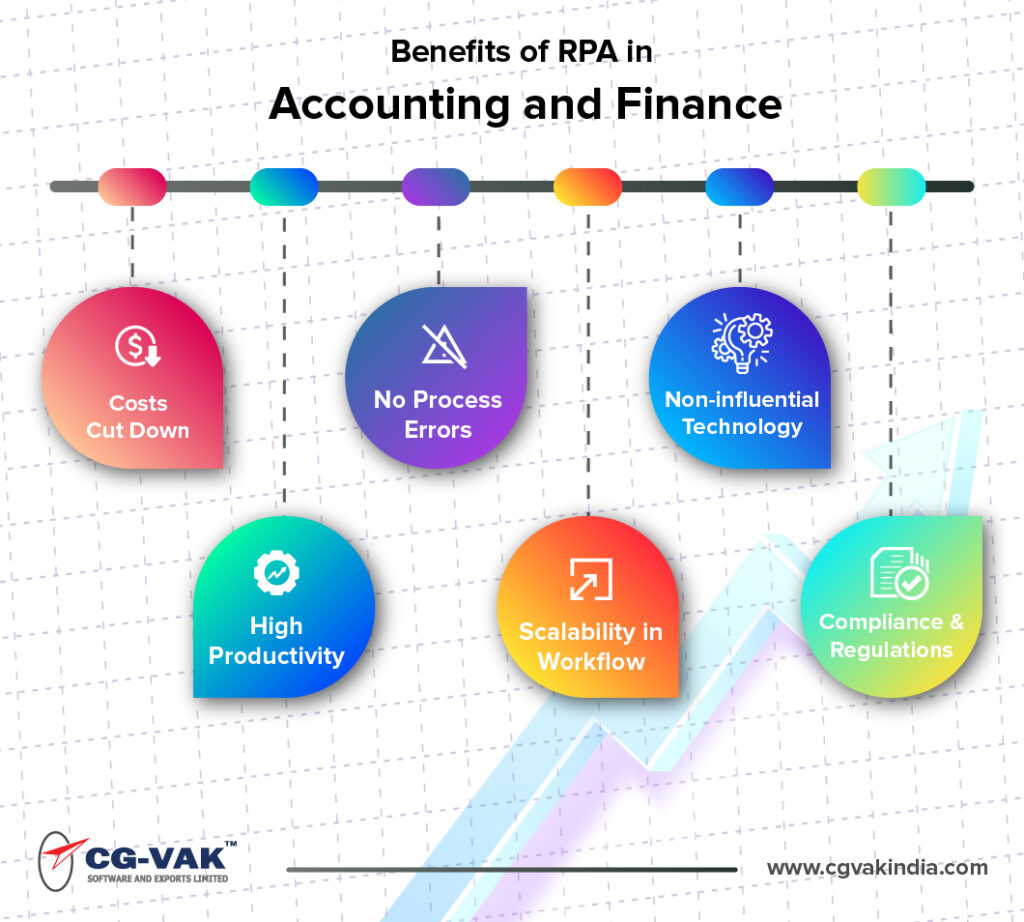
Benefits of RPA in Accounting and Finance

With RPA Robotic Process Automation software deployment, financial organizations have managed to become a strong compliance regulator and big output provider in a short time and thrive to achieve more in coming years. Get a brief knowledge about the main benefits of Robotic Process Automation technology in the Accounting and Finance sectors.

1. Costs Cut Down:

Introducing Robotic Process Automation for Accounting and Finance eliminates the requirement of manpower and back-office resources which ultimately cut down the related costs and also free up employees for another business requirement than repetitive, high volume tasks.

2. High Productivity:

In place of working for a definite working shift by humans, the quick and 24*7, non-stop processing by RPA automation solutions, for example – invoice processing, financial statement closing, etc. helps in increasing business productivity like never before while managing the clients’ reputation as well.

3. No Process Errors:

Tasks automation in finance/accounting processes like tax management and supplier onboarding brings reduced rate or nil error as workflow pattern is pre-decided and meant to produce consistently accurate results.

4. Scalability in Workflow:

RPA technology is easy to implement and modify for certain sections of accounting and financial services as required by the business management thus providing a customizable workflow to manage certain financial services simultaneously.

5. Non-influential Technology:

While deciding to deploy Robotic Process Automation software in any industry, a crucial analysis on the automated accounting software development based on the process and workflow is performed keeping it completely ineffective to the existing framework or structure of the organization making it a fully non-invasive technology.

6. Compliance & Regulations:

RPA in Accounts and Finance is crucial to maintain regulatory and compliance standards based on the strict software process automation and set parameters to be followed by everyone to maintain the business security.

Know about real-time use cases of RPA in finance and accounting

Apart from the automation of regular manual tasks of accounting and management in the financial organizations, the real-time use cases of RPA as enterprise financial management software interest a lot. Let us understand some common picked up examples.

1. In Accounts Payable & Receivable

A huge sense of process accuracy and performance in Accounts Payable with automated payments, workflow, data entry, approvals, vendor management, and more; order processing, credit approvals in Receivable with RPA applications.

2. In Insurance Claim/Loans Processing

Having implemented smart RPA software for loan or insurance claim processing, the accuracy and efficiency have increased which helped a lot in saving unproductive time and efforts of applicants who were following the old traditional processing system.

3. In Detecting Forgery

Implementation of RPA solutions for cybersecurity in financial institutions can reduce the risk of online thefts (money processing), accounts hacking or identity forging to a very low level and keep updated the organization of any foreign intruder with financial tracking software.

4. In Credit Card Management

Credit Card management after the issue is a challenging task as its loss can create a drill in the customer security which now can be capably managed by automated RPA solutions to record each cardholder’s personal and verification details to ensure its real master and facilitates to block it away for malicious persons.

5. In Data Entry

Maintaining the accounts record of a bunch of customers based on their investments and processing is now an easy task with RPA software solutions eliminating heavy work of both front and back-office operators.

RPA- Your best solution for Accounting and financial business process

For secure, streamlined, cost-effective, customizable, and high-performance Accounting and financial business processes, the RPA platform is the best. It would be a great decision for any business to migrate accounting with RPA to enhance business performance and reap soaring profits. It is a transformational technology for financial and accounting businesses by automating complex, repetitive tasks performed manually to deliver a high rate of accuracy and low rate of risks and errors.

Summary

Robotic Process Automation is an incredible automated technology that is a potential lawbreaker in Accounting and Finance industry is discussed along with its high-end benefits and real-time examples.

CG-VAK is the trusted custom software development company and one of the best Robotic Process Automation companies in India. It delivers both onshore and offshore services excelling in the field of Robotic Automation platform. Contact us sharing your project details.

Everything that matters, WHAT, WHY and HOW QAOps is important for your organization. Approaching it with a DevOps mindset!

In this modern technological world where all organizations are moving with the trends of automation with continuous delivery, whereby the product provides the best user experience to the customer, we focus and give priority to quality.

Maintaining a record of Ontime delivery with good quality At CGVAK has emerged through practicing QAOps.

With the DevOps approach making the software development process simpler and more effective,this article willlet us look into the effectiveness of QAOps and how it made its way to the industry.

To understand more, let us know what is QAOps?

The role of every individual involved in this process during the software development process has changed. Under testing, the role of QA or software tester is now not limited and is involved in every aspect of software development. QAOps is the practice that brings developers, testers, and operation teams together and continuous testing is combined with DevOps such as CI and CD, which bring the independent teams together.

CI and CD pipeline (Continues Integration and Continues Delivery) is the cornerstone of DevOps strategy. Continuous testing is done through the use of automation which makes the development cycle faster. With QAOps, the process is speeding up and gives more efficient results. When an application is created and with the release of the first version, you’ll see how it works. With CI and CD, you will find that there are a few or a lot of things you can do better. Thereby it increases the user’s satisfaction.

Why using QAOps?

By implementation of QAOps in DevOps there are some benefits which are as follows:

  • The methodology of workflow that brings faster results with better quality.
  • The QA team works with other team, thereby increasing their skill level.
  • A higher degree of quality, stability, and reliability which ensures better customer experience.

Although less popular than DevOps, QAOps is fast emerging as a crucial methodology to pursue in the delivery lifecycle. In fact, in QAOps, the QA team holds a pride of place very similar to what a development team holds in the SDLC process.

It is important for an organization to know, how QAOps can be practiced?

There is no need for a complete cultural change in the workplace in the implementation of the QAOps setup. However faster results are acquired with the help of collaboration with developers and testers and the team. The application can be checked for any changes thoroughly before the release.

Therefore, the importance of communication is key to the technical team. Before implementing QAOps, they must understand the value behind this framework. By practicing this, the rest of the expertise like IT operation managers, developers, testing engineers, etc; have to understand the requirement and collaborate accordingly. It will take time to realize the importance of this framework which will take time to practice, but once the importance is served by having the QAOps framework the organization will be considered on a different standpoint of execution.

An organization needs three unique QAOPs process to practice:

  • The tests should be triggered only based on the changes that are made to the functionality. The more the number of tests, the greater the time to run the tests and share the results. Therefore, the triggering step should be well planned and mapped with the automation testing life cycle
  • Different tests will be executed on the functionality. To achieve parallel testing, make sure you have the infrastructure that can scale and distribute the loads according to the need. Which will execute the process as planned without any hiccups during the QAOps life cycle.
  • Once the tests are triggered and executed, the reporting module showcases the results of the tests. A perfect reporting module design should provide quick summary information as well as provide detailed information. This will be helpful for anyone taking a look at the reports and compare the results.

These three unique steps ensure the stable release of the application, which will be validated and can be used within for organization development.

DevOps Explained!

DevOps uses CI/CI principles, which helps in rapid software testing and release. The testing team will verify the build at different stages of development and deploy them after verifying its run. It will continue in 2021 with more and more organizations adopting this patternwhich emphasizing communication, integration, and collaborationto manage end to end processes.

Differences between DevOps and QAOps?

There are a few differences between the two. Though QAOps is derivative of DevOps, the differentiation will give an understanding:

In a DevOps testing strategy, the DevOps specialists mainly comprise developers, testers in a secondary role, and members of the operations team. Thus, even though the main thrust is on quality, the QA specialists remain in the background. However, in QAOps, the operations team mainly communicates and collaborates with the QA team to ensure continuous delivery with excellent quality.

Best practice of QAOps Be Referred As Continuous Testing in DevOps

By the continuous testing process into SDLC, CG-vak achieves a successful delivery cycle. With previous experience here is some best practice to follow continuous testing as a part of the DevOps process:

  • By reducing risk and ensure faster release and time to market.
  • All the teams in the organization ensure to collaborate and communicate efficiently during the entire course of the release.
  • Doing CI/CD on regular basis, and each person’s works should be merged into the release pipeline which will help to identify the defects at the early stage.
  • During development, it will be more effective if the quality teams work alongside the development team to provide vital inputs.
  • During the release process in the defined interval, every team’s metric should be measured.
  • QA test engineers should make use of automation tools and scripts to automate as much of the testing as possible. Deep regression testing will make sure existing features are not broken.
  • Developers and testers should start thinking about each point of view, which will make everyone responsible for the overall quality.

Conclusion

Although it is quite new, QAOps is an emerging trend that allows the automation of processes between software development, IT, and QA. when correctly designed and implemented, definitely paves the road to faster software delivery, bringing QAOps into action involves a great deal of persuasion on the part of the business stakeholders. Once you’ve passed this point, it’s supposed to be a smooth sail ahead.