Secure your AWS Cloud: Stay Up to Date with the Latest Security Updates and Services

Cloud security is a subject that is getting greater attention in today’s cybersecurity as more businesses use cloud computing services and move their data to Amazon Web Services.
AWS is a cloud computing platform that offers a wide range of services to help businesses and organizations host and manage their applications and data in the cloud. AWS provides many security features and services to ensure the security and protection of customer data, applications, and infrastructure in the cloud.
Although AWS provides some of the strongest security capabilities available to safeguard its infrastructure, because of the shared responsibility model, every organization still has its obligations.
In this post, let’s see how to secure your Amazon cloud services or AWS cloud services and stay up to date with the latest security updates and services.

Latest AWS Cloud Security Updates:

Here are some of the latest AWS Cloud security updates.

Security Hub’s New Integrations:

AWS Security Architecture, or “hub,” a comprehensive security service, has added new integrations to help customers automate security compliance checks across their AWS accounts. These integrations include services such as AWS Systems Manager, AWS Single Sign-On, and AWS Control Tower.

AWS Key Management Service, Or KMS, Expands Key Size Limits:

AWS KMS now supports key sizes up to 4,096 bits for asymmetric keys, providing increased security for customers who require larger keys for decryption and encryption.

Firewall Manager’s New Features:

AWS Firewall Manager now supports AWS PrivateLink, which enables customers to access AWS services privately without going over the internet. Additionally, Firewall Manager now provides more granular control over AWS WAF rules.

Amazon Inspector’s New Assessment Templates:

Amazon Inspector, a security assessment service, has added new assessment templates to help customers evaluate the security and compliance of their AWS workloads. These templates include assessments for ISO 27001, HIPAA, and PCI DSS compliance.

AWS Certificate Manager Private CA’s Availability:

AWS Certificate Manager Private CA, a service that enables customers to create and manage private certificate authorities, is now available in more AWS regions.

AWS Security Lake:

By regularly scanning for possible security threats and vulnerabilities, the new Amazon service AWS Security Lake aids in the protection of your AWS resources. By utilizing this service, you may automate the procedure for locating and fixing any infrastructure-related difficulties without depending on human assistance. They are making it even simpler for customers that utilize IAM responsibilities in their accounts to guarantee that only those who are permitted may access their accounts using Amazon Verified Permissions services.

Amazon Verified Permissions:

Verified Permissions, a brand-new tool, offers users a simple method to check the rights linked to their Amazon accounts. But, even without this service, you may automate the process of spotting and fixing infrastructure problems without depending on a thorough audit.
With just a few clicks, you can easily find out who can access your accounts and what they are permitted to do. Just click “Enable Verified Permissions” from the Amazon Security Hub menu, then pick all the resources that must be verified along with all users and roles.
When the permissions are confirmed, you’ll get a report with the findings. The report may then be used to decide whether your account needs to be changed.
Customers may use the new tool to check if they are utilizing the appropriate roles in their accounts. You will be able to tell which role is the principal part and which roles are supporting roles if there are numerous roles with the same identity.
If you’ve been attempting to adopt a new security policy or modify your current one but are unsure of how it’s functioning, this can be very helpful.

How Does the Cloud’s Security Keep The Cloud Environment Secure?

Cloud security helps keep cloud environments secure by implementing a wide range of security measures and practices designed to protect the integrity, confidentiality, and availability of data and applications hosted in the cloud.
Here are some ways cloud security helps keep cloud environments secure:

Identity And Access Management:

Cloud security solutions implement robust IAM policies and controls to ensure that only authorized users have access to cloud resources. IAM controls can be used to define roles, permissions, and access policies for different user groups, ensuring that only authorized users can access sensitive data or applications.

Encryption:

Cloud security solutions use encryption to protect data in transit and at rest. This involves encrypting data before it is transmitted over the network and ensuring that data is stored in an encrypted format. Encryption keys are carefully managed to ensure that unauthorized users cannot access sensitive data.

Network Security:

Cloud security solutions use a variety of network security measures to protect cloud environments from unauthorized access or attacks. These measures may include intrusion detection and prevention systems, firewalls, and security groups that can be used to restrict network traffic to and from cloud resources.

Compliance:

Cloud security solutions help organizations meet regulatory compliance requirements by implementing controls and processes to protect data according to relevant regulations and standards.

Monitoring And Logging:

Cloud security solutions provide continuous monitoring and logging of cloud environments to detect and respond to security incidents in real-time. It includes automated alerts that notify security teams when unusual activity is detected or when unauthorized access attempts are made.

Incident Response:

Cloud security solutions provide a comprehensive set of security measures and practices designed to protect cloud environments from various security threats. By implementing these measures and procedures, organizations can ensure the security and protection of their data and applications hosted in the cloud.

10 Best Practices for AWS Cloud Security

Include Security in Your Cloud Strategy:

To guarantee that security is integrated right away, it is crucial to include security in your cloud plan. You may always assess how well it functions for your entire cloud strategy later and make adjustments.

Add Security to Each and Every Layer:

After security has been established as a key component of your cloud strategy, make sure security is used at every single tier.

Establish Security Policies and Maintain Them Currently:

Make sure your policies specify your obligations in detail. Additionally, make sure you include your security staff in setting up these rules and have the papers evaluated frequently for the newest security changes.

Take Advantage of Well-Integrated Security Services:

AWS provides comprehensive security services. It is strongly advised that you utilize these as well.

Track User Access:

Make sure you have access control rules included in your security policies since Amazon needs you to handle its access control policies. You can control and keep an eye on who has access to your resources and instances using the Amazon Management Console.

Updating Your AWS Procedures:

New services are continually being introduced by AWS. It might be difficult to stay current with AWS standards but doing so is essential to ensuring cloud security.

Maintain The Latest SSL/TLS Certificates:

To prevent embarrassing security alarms in your client browsers, update your SSL/TLS certifications before they expire. The better option is to use the Amazon Certificate Manager, or ACM, to create and automatically renew your certificates for you.
Do Security Penetration Testing (PEN) And/Or Posture Assessments (SPA) Regularly:

Without seeking permission first, you can conduct security audits or security testing on your AWS infrastructure to find gaps in your security measures. PEN testing is supported for the Amazon EC2 instance metadata service as well.

Regular Data Backup:

To guarantee that you can frequently back up your data on the cloud, Amazon offers backup options. You may manage and automate backups for all Amazon services using their solutions.

Information Encryption:

According to Amazon Key Management Service, encrypting sensitive data and recovering encryption keys in AWS are both rather simple processes. All Amazon services that deal with customer data offer options to encrypt data at rest as well as data in motion.
To make sure that your environment is set up following best practices to reduce the risk of compromise, get in touch with a reputable AWS cloud-managed service partner like CG-VAK to undertake an evaluation of the AWS security posture and offer AWS cloud-managed services and cloud optimization services.
CG-VAK encourages doing a penetration test to find out if your system is vulnerable to attack. Although an internal penetration test concentrates on evaluating assaults that would be carried out by an opponent who has already obtained a connection to your network, an external penetration test can evaluate your system against attacks conducted from outside the perimeter of your network.


Top API Testing Tools for REST And SOAP Automation

Tools for API testing provide a wide range of testing, including security and functionality checks. The rising use of APIs in software development makes it necessary to automate these tests to maintain efficient agile processes.
APIs offer a wide range of attack vectors across digital applications. Tools available on the market should cater to the requirements of each API component. This includes endpoints, open-source APIs, third-party services, private APIs, and any other process components. It is best to utilize tools or an integrated tool to collect the most significant amount of data.
Find a tool or comprehensive solution that can handle all of your development team’s different demands. There are minimal failure vectors when things are kept simple. Moreover, you’ll need tools that integrate CI/CD, let testers work more productively, and work with various test scenarios.
Reusing tools for different aspects of a project not only saves money but also benefits teams by streamlining the testing procedure. The best automation testing tools on the market are covered in this blog post.

API Vs Plugins

Application Programming Interface, or API, and plugins are two different approaches to extending the functionality of a software application. Here are some of the primary distinctions:

Integration:

APIs require developers to write code to integrate with the application, whereas plugins can be installed and used by end users without any coding knowledge.

Purpose:

An API is a set of routines, tools, and protocols, for constructing and building software and applications. It provides a way for developers to access and interact with the features and functions of an application or service. On the other hand, a plugin is a software component that adds specific features or functions to an existing application.

Flexibility:

APIs offer greater flexibility and customization options for developers who want to build custom solutions. Plugins are more limited in scope and often provide a specific set of features or functions.

Maintenance:

APIs require ongoing maintenance and updates to ensure compatibility with new technologies and changes in the software application. Plugins also require updates, but they are typically easier to maintain and update than APIs.

Dependency:

APIs are not dependent on any particular programming language or platform, which makes them more versatile. Plugins, on the other hand, are typically written for a specific platform or application and may not be compatible with other platforms.

Types Of API Tests:

Every developer should be aware of the important role that HTTP requests play in testing. But security testing tools are crucial when it comes to typical forms of API testing because open APIs are often used and many systems also employ partner APIs. With the use of testing tools, developers may examine several API features, from basic functions to the most important security precautions. To be most successful, API tests must be diverse, many, and repeated frequently. They might range from checking for syntax mistakes and other Javascript problems to enhancing confidential code for a private organization.
On APIs, a variety of tests may be executed, including:
Static API security tests examine the source code of apps to identify potential attack surfaces. In these tests, features in the code that could potentially result in violations are sought. They need static tools since they depend on languages.
To identify threats, dynamic API security tests involve active testing that mimics real-world attacks. They may show up in internal code or open-source components.
In the latter phases of workflow, validation testing examines if an API is functioning as it should in terms of effectiveness, output, and behavior.
To guarantee backend and frontend cohesiveness, UI testing offers information from the end-user perspective.
Functional testing examines API operations against certain scenarios to assure desired outcomes.
When the entire or a portion of the codebase has been run, load testing is conducted. It examines how well apps work and execute under ideal and undesirable circumstances.
Fuzz testing examines a system’s capacity for handling an abundance of fuzz or data to test for the worst-case scenarios.
Later in the pipeline, when non-experts analyze an API to look for flaws, penetration testing takes place.
Runtime and error testing compares an API’s functionality to a global codebase to look for bugs, resource leaks, or monitoring needs.
An API’s protection against external threats, encryption techniques, access control planning, and authorization and authentication are all examined during security testing.
Software composition analysis, or SCA, examines an application’s dependency structure before comparing it to a database of security risks. If any are discovered, your team gets notified, allowing you to handle the problem right away.

Top AI Testing Tools and How To Pick The Right One For You

It takes more than just creating a numerical list to determine which API testing tools are the best. Each tool has a distinct focus and a distinctive set of features to provide. Selecting only one won’t be enough for your testing requirements. You must determine the features your team needs, as was already indicated. Once you’ve done that, choosing the tools that best suit your needs will be easy.
The intricacy of functional and non-functional testing spanning APIs, UIs, databases, microservices, and more is simplified with this market-leading automated testing platform.
You can easily automate test design, execution, and maintenance for complicated applications using CG-VAK. The Smart API Test Generator, driven by AI, examines API traffic patterns to produce realistic software test cases using software testing services.
Load, performance, and security testing may all benefit from reusing API functional test suites. Work on test refactoring is made simpler by change effect analysis. The subset of tests required to validate updated code is identified by smart test execution, which provides quicker feedback to fix issues in CI/CD.

#1. RapidAPI:

In addition to numerous subscription-level choices that include CI/CD integration and more API calls, RapidAPI provides a free trial version. It may create tests using a test editor that is code-based or has a drag-and-drop interface, or it can base its creation on the attributes of an API.
Despite being few, the supported protocols contain the most essential formats. The program creates execution and global performance monitoring statistics with essential information for test creation.

#2. REST-Assured:

The Java-based API framework from REST-Assured employs a BDD structure for REST API testing. The replies to queries for REST API automation tools may be validated and verified using this open-source, free application. It excludes performance evaluation. As it only supports a few protocols, it is less suitable for big corporate systems, and response times for the testing process may be slower than with other tools. It is better suited for highly technical staff with Java coding expertise.

#3. Karate DSL:

A completely open Java testing tool called Karate DSL integrates API testing, mocks, load testing, and performance testing tools inside a framework that resembles BDD. It does not need users to develop step definitions for API-based BDD tests, although it is advantageous for users to have coding skills.  Moreover, it permits switching between configurations and multi-threaded concurrent execution. A thorough view of test findings is provided via the built-in reporting tool.

#4. Postman:

Postman, which is primarily geared toward REST API development, also offers automatic and exploratory API testing. Users may develop automated tests, execute queries, monitor APIs, diagnose issues, and run tests.  It offers integration support for the OpenAPI and Swagger formats. A free edition or an enterprise plan is available to businesses for a monthly price per user.
It all boils down to what purposes your APIs serve and how nimble you need to be when choosing the correct tool catalog. Not all APIs will be open to the public, and your team might not utilize partner APIs. You will thus require a separate set of API testing tools.
Reviewing several tools’ pros and cons can help you choose which ones will best support your team as a whole.
Automated software testing tools may be more advantageous than simple alternatives since API automation tools play a crucial role in streamlining operations. You may choose the tools that are best for you by asking yourself several questions.

  • How much can you spend?
  • Do you have any language requirements or restrictions that are particular to the domain?
  • Do you require support for several formats?
  • What role does seamless integration play?
  • What degree of knowledge do your testers possess?

This is merely the beginning. Your development staff will be knowledgeable enough to pick the appropriate tools.
The recognized software development firm CG-VAK offers a wide range of services, including automated REST and SOAP API testing tools. To put it briefly, CG-VAK may offer an all-inclusive solution for choosing, integrating, and personalizing API testing solutions for your company.
Our knowledge in this field can guarantee that your testing procedures are successful, efficient, and in line with your company’s objectives. It’s time to improve your software skills now that you know about a few of the top API testing tools!

How Custom Website Design Can Elevate Your Brand and Business

Hundreds of new custom-built websites and template-based websites are being launched every day. Many business owners are considering whether or not to invest their time and money into a custom website design or development. However, the answer is straightforward. In order to succeed in a competitive market, opting for customization is the recommended approach. It’s a big investment at first, but is more beneficial and potentially more cost-effective in the long run branding.
Of course, working from a template is often cheaper and faster. You can buy it for a meager price, fill it with content and have a brand-new site up in a couple of hours. But there’s a chance your next-door neighbor has the same template for an entirely different business. Ensuring that a template appears to be uniquely branded can be challenging, especially when it could be easily associated with another company. You will realize how limited the template features are as soon as you customize it to your needs when your business starts growing.
A survey conducted by Adobe revealed that 59% of users are drawn towards aesthetically pleasing and well-crafted custom-built websites, instead of simplistic ones.
The Pew Research Center discovered that 39% of web users are allured by color more than any other visual element on a website.

Exploring the Advantages of Custom Website Design

As the digital landscape continues to evolve at a breakneck pace, it is no longer sufficient for businesses to have an online presence simply; they must have a website that sets them apart. The question then becomes: what is the optimal approach to creating a website that captures the essence of your brand and delivers accurate business results? The answer lies in custom website design and development, a tailored approach that has proven to be a game-changer for businesses looking to stay ahead of the curve. We will delve into the top five benefits of custom website design and development, unraveling this approach’s unique advantages to businesses of all sizes and types.

Enhances Business Branding

Custom website development costs may pinch you, but as the online storefront for your business, your website is an opportunity to showcase your unique products, services, and personality. With custom web design and development, you can partner with a design team to create a personalized and branded experience that stands out. This includes custom color schemes, fonts, icons, tailored page layouts, and unique features that meet your specific business needs.
A customized website design will give your business a distinctive and memorable online presence that will set you apart from your competition.
Improves Customer Experience (CX)Custom website design enables businesses to build a site that delivers real business results via an optimal structure and user experience. A web design agency should be asking about your business goals before developing and designing your website. Likewise, you’ll want to have an idea of the customer journey with regard to your product or service. Creating a customer-centric website that helps visitors navigate the site easily and take actions that produce your desired results will increase conversions and, ultimately, revenue.
For instance, if you’re running an automotive repair business, your homepage should have a “request service” form front and center to drive leads. Designing a website with a clear call-to-action and intuitive user experience can increase customer engagement and build brand loyalty.

Increases Search Engine Optimization

One of the most significant benefits of custom website design is the potential for improved search engine optimization (SEO). With a custom site design project, you’ll have access to web developers and SEO specialists who can work together to implement best practices that help your site rank better on search engines. By crafting metadata, page URLs, alt tags for images, and site content that incorporates relevant keywords, your site will be better optimized for search engines.
In addition, a custom site architecture that is user- and mobile-friendly will further improve your site’s SEO. By including internal links that enhance the user experience and working with SEO specialists to identify which pages should be “crawled” by search engines, you’ll have a better chance of ranking higher on search engine results pages (SERPs).

Boosts Response to Business Changes

A custom website design gives businesses the freedom to scale the development process. Although developers will initially set up a proper architecture while creating the site’s roadmap, you may need to add additional functionality or content in response to business changes. With an established relationship with a custom website design services provider, you’ll have a trusted partner to turn to when these changes arise. This saves you time and effort and ensures that your site is updated and maintained correctly to meet changing business needs.

Increases Competitive Advantage

A personalized website design gives your business a competitive advantage. A custom-made website optimized for user experience and search engines will help you stand out from competitors relying on generic template designs. A personalized website that reflects your branding and offers unique features and functionality will help build trust with customers and demonstrate that you are committed to providing a high-quality experience.

Optimized Functionalities

When it comes to website development, having custom-built websites can provide your business with several benefits. One of the key advantages is the ability to tailor the site’s functionality to meet your specific needs. It allows you to add, edit, or delete features as necessary, creating a truly bespoke online presence.
While open-source content management systems (CMSs) can also be customized, this process can be complex, expensive, and time-consuming. Customizing a CMS requires a deep understanding of the underlying code and architecture and the ability to modify and extend the system in a way that meets your needs without compromising its stability or security.
By working with a custom web design company, you can ensure that your website is developed to meet your exact requirements while also providing the flexibility and scalability needed to support your business as it grows and evolves over time. Whether you want to create a simple landing page or a complex e-commerce platform, a custom website can provide the foundation you need to succeed in today’s digital marketplace.

Effective Navigation

Effective navigation is an essential component of any successful website. It not only ensures the smooth functioning of your website across different browsers but also assists search engines in indexing pages of your website. A well-structured website with clear navigation ensures that search engines can easily crawl and index your website, leading to improved search engine rankings and increased online visibility.
In addition to search engine benefits, effective navigation also improves the user experience of your website visitors. Users can access your website efficiently, quickly finding the information they need, which can lead to increased engagement and conversions. A user-friendly website increases the likelihood of repeat visits from satisfied customers.

Enhancing Your Online Presence with CGVAK’s Custom Website Design Services

One of the main advantages of working with a custom web design company like CGVAK is that they can create a custom-built website that caters to your unique requirements. With a custom website, you can have a site that reflects your brand identity and offers the functionalities needed to grow your business.
Moreover, CGVAK’s custom website design services also include content management systems that easily add, edit, or delete features and content on your site. These content management systems are designed to be user-friendly, meaning that even those without technical expertise can manage their website easily. Another benefit of working with CGVAK is that they understand that every business is different and strive to provide custom web design solutions that suit your specific business goals.
If you want to enhance your online presence and stay ahead of the competition, choosing a custom web design company like CGVAK is a right choice. With our custom web design options, you can have a website that looks great and offers the functionalities you need to take your business to the next level.

Top AngularJS Frameworks to Streamline Your Web Development Process

Web app development is a complex and ever-evolving field that requires a lot of skill and experience. However, with the advent of new technologies and frameworks, the web development process has become much more straightforward and efficient. One such technology that has taken the web development world by storm is AngularJS. It is a powerful and flexible JavaScript framework that developers widely use for building dynamic and interactive web applications. It offers many features and functionalities that make it an ideal choice for building complex web applications. Top AngularJS Frameworks like Angular Material, Ionic Framework, and Mean Stack are some of the most popular options for Angular web app development.

However, even with all its built-in features and functionalities, web app development using AngularJS can still be daunting. That’s where AngularJS frameworks come into play. These frameworks provide additional tools and functionalities that simplify web development and help developers build better applications.

Choosing the framework that fits your specific requirements is essential if you’re looking to hire AngularJS developers for your web app development project. Some popular AngularJS frameworks worth considering include Angular Material, Ionic Framework, Mean Stack, and many more.

In this post, we’ll explore some of the best AngularJS frameworks that can help you simplify your web development process and build better applications. Whether you’re a seasoned developer or just starting out, these frameworks can help you save time and effort while building robust and dynamic web applications.

How to Choose the Right AngularJS Framework for Your Web App Project

Choosing the right AngularJS framework for your web app project can be daunting. With so many options available, understanding which framework will best suit your needs can be challenging. However, taking the time to research and evaluate different frameworks can make all the difference in the success of your web app development project. We have outlined some key factors to consider when choosing an AngularJS framework for your project:

Project Requirements:

The first step in choosing the proper AngularJS framework is understanding your project requirements. Consider what features and functionalities you need for your web app and any specific challenges or constraints you may face during development. For example, if you need to build a real-time chat application, consider a framework like Socket.io specifically designed for real-time communication.

Community Support:

Another essential factor to consider is community support. Look for frameworks with a strong community of developers actively contributing to the project. It can help ensure the framework is well-maintained and up-to-date with the latest technologies and best practices. It also means that you can rely on the community for support and guidance when you encounter development issues. It is a matter of great importance.

Developer’s Documentation:

It is another crucial factor to consider when choosing an AngularJS framework. Look for frameworks with the clear and comprehensive documentation that is easy to understand and follow. Documentation can help you get up and running quickly and simplify troubleshooting issues during development.

Performance:

Performance is also an important consideration when choosing an AngularJS framework. Look for frameworks that are optimized for performance and can handle the demands of your web app. Consider factors like load time, rendering speed, and memory usage when evaluating different frameworks.

Integration with Other Technologies:

If your web app relies on other technologies, such as a backend framework or database, it’s essential to consider how well the AngularJS framework integrates with these technologies. Look for frameworks with built-in support for popular backend frameworks and databases or that can easily integrate with these technologies.

Security:

Security is a critical consideration for any web app development project. Look for frameworks with built-in security features designed with security in mind. Consider factors like encryption.

Top Angular JS Frameworks

AngularJS is a popular and powerful JavaScript framework that is widely used for developing web applications. It provides developers with a structured approach to building complex web applications by offering a robust set of tools, features, and functionality. In addition to the core framework, there are also several AngularJS frameworks and libraries available that extend its capabilities and provide additional features and functionality. In this article, we’ll take a look at the top 5 AngularJS frameworks.

Angular Material:

Angular Material is a UI component library built on top of AngularJS. It provides a set of pre-built and customizable UI components that follow the Material Design guidelines. It simplifies the process of building responsive and modern web applications, as it includes all the necessary components such as buttons, forms, grids, and more. Angular Material also provides built-in accessibility features and a theming engine for easy customization.

Ionic Framework:

Ionic Framework is a complete mobile app development platform that is built on top of AngularJS. It provides a comprehensive set of tools and components for building cross-platform mobile applications. Ionic Framework includes a set of pre-built UI components, native plugins, and a powerful CLI for easy development and deployment. It also supports popular mobile platforms such as iOS, Android, and Windows, and provides a seamless integration with other popular tools and libraries.

Protractor:

Protractor is a popular end-to-end testing framework that is built on top of AngularJS. It provides a simple and intuitive API for writing automated tests for AngularJS applications. Protractor can be used to test user interactions, perform assertions on the DOM, and simulate user behavior. Protractor also integrates seamlessly with other testing tools such as Jasmine and Karma.

AngularUI:

It is a collection of UI components and directives that are built on top of AngularJS. It provides a set of reusable and customizable UI components that can be used to build complex web applications. The framework includes a range of components such as modals, tooltips, pagination, and more. It also provides a simple.

Why You Should Hire Angular JS Developers

Hiring an Angular developer can be an excellent choice for businesses looking to create dynamic, responsive, and interactive web applications. Here are a few reasons why hiring an Angular developer can be beneficial:

Expertise in Angular:

Angular developers are experts in building complex applications using the Angular framework. They understand the intricacies of the framework and can leverage its features to create robust applications that are scalable and easy to maintain.

Improved User Experience

Angular developers can create responsive, interactive, and user-friendly web applications that provide an excellent user experience. They use Angular’s built-in features such as directives, templates, and services to develop dynamic interfaces that engage users.

Time and Cost Savings:

Hiring Angular developers can save businesses time and money. These developers can quickly develop and deploy applications, reducing the time and cost of development. Additionally, they can work on a project-by-project basis, allowing businesses to save money by not having to maintain a full-time development team.

Cross-Platform Development: 

 Angular developers can create applications that can run on different platforms, including web browsers, desktops, and mobile devices. This allows businesses to reach a wider audience and provides a seamless experience across devices.

Why hire Angular developers in CG-VAK?

At CGVAK, we have a team of experienced Angular developers who are passionate about creating exceptional web applications using the Angular framework. Our developers have a deep understanding of Angular and are dedicated to delivering high-quality, scalable, and user-friendly applications. We have a proven track record of delivering successful projects to clients from various industries. By hiring our Angular developers, you can be assured of exceptional results that meet your business requirements. It is among top Angular JS development companies in India. We offer web application development services to many global companies across the world.

Preparing for the Migration from Web 2 to Web 3: What You Need to Know About Web 3

The world is witnessing a new era of the internet with the rise of Web 3. This cutting-edge technology promises to revolutionize how we interact with the digital world, offering users greater control, privacy, and security. With Web 3, the power is no longer in the hands of a few centralized entities but in the hands of the users themselves. Decentralized applications (damp’s) built on blockchain technology enable peer-to-peer transactions without intermediaries, making processes faster, more efficient, and cost-effective.
Furthermore, Web 3 empowers users to take ownership of their data and control who has access to it. It helps to address data privacy and security concerns, which have become increasingly pressing in the digital age.
Web 2, the “read-write” web, allowed users to interact with websites through social media and user-generated content. Web 3, on the other hand, is the “decentralized” web, which uses blockchain technology to enable trustless transactions, enhanced privacy, and increased security. As more businesses and individuals move towards Web 3, it is crucial to understand the difference between Web 2 and Web 3 and how to migrate from one to the other.

Difference between Web 2 and Web 3

The evolution of the internet from Web 1.0 to Web 2.0 significantly changed how we interact with the internet. Web 2.0 was characterized by the rise of social media platforms, user-generated content, and the ability to share information and collaborate online. However, Web 2.0 had its limitations, and as a result, Web 3.0, also known as the decentralized web, emerged as the next evolution of the internet.
Web 2.0 was focused on content creation and sharing. It was driven by a few centralized entities, such as Facebook, Google, and Amazon, who controlled the data and information on their platforms. Web 2.0 allowed users to create and share content, but they had to trust centralized authorities with their data. It meant that users had limited control over their data and were often at risk of their data being misused or compromised.
Web 3.0, on the other hand, focuses on data privacy and security. The decentralized nature of Web 3.0 means that no central authority governs it, and users have complete control over their data. In Web 3.0, users own their data and can control how it is used and shared. It makes Web 3.0 more secure, as no central control point can be hacked or compromised.
The decentralized nature of Web 3.0 is made possible by blockchain technology. Blockchain technology enables trustless transactions, meaning users do not have to trust a third party to carry out transactions. Transactions are validated and recorded on a public ledger, making them transparent and easily verifiable.
The main difference between Web 2.0 and Web 3.0 is the focus on content creation and sharing in Web 2.0 versus data privacy and security in Web 3.0. Web 2.0 was controlled by a few centralized entities, while Web 3.0 is decentralized. In Web 2.0, users had to trust centralized authorities with their data, while in Web 3.0, users have complete control over their data. The emergence of Web 3.0 has paved the way for a more secure, transparent, and decentralized internet.

Essential factors you focus while migrating from web 2 to web 3

Migrating from Web 2 to Web 3 requires a few essential factors to be considered. The first factor is to understand the current Web 2 architecture and identify which parts can be migrated to Web 3. The second factor is to choose the right blockchain platform for Web 3 development. The third factor is to ensure that the migration is cost-effective and does not impact the user experience. The fourth factor is to plan for the future and ensure that the migrated application is scalable and can handle increased traffic. It is an important step towards building a more secure and decentralized internet. However, it requires careful planning and execution to ensure a smooth transition. Here are some essential factors to consider when migrating from Web 2 to Web 3.

Understand the current Web 2 architecture:

It is essential to understand the contemporary architecture of your Web 2 application. Identify which parts of the application can be migrated to Web 3 and which parts need to be redeveloped from scratch. When making these decisions, it is essential to consider factors such as data storage, security, and user authentication.

Choose the right blockchain platform:

Choosing the right blockchain platform is crucial for Web 3 development. Several blockchain platforms are available, such as Ethereum, Polkadot, and Binance Smart Chain, each with its own strengths and weaknesses. It is essential to evaluate these platforms based on scalability, security, and developer community before making a decision.

Ensure cost-effectiveness:

Migrating from Web 2 to Web 3 can be expensive, so it is essential to ensure that the migration is cost-effective. This can be achieved by using open-source tools and frameworks, reusing existing code where possible, and optimizing the application for the blockchain platform.

Plan for scalability:

Web 3 applications are designed to handle a large volume of transactions and users, so it is crucial to plan for scalability when migrating from Web 2. It can be achieved using a scalable blockchain platform, such as Polkadot or Binance Smart Chain, and by designing the application architecture to handle increased traffic.

What transactions need to be stored in web2 to web3 migration?

When migrating from Web 2 to Web 3, it is important to consider what transactions need to be stored to ensure that the migration is successful and that the data is secure. Here are some trades that may need to be held during Web 2 to Web 3 migration:

User data:

In Web 2, user data is typically stored on centralized servers controlled by the application provider. In Web 3, users can manage and keep their data on decentralized platforms such as blockchain. When migrating from Web 2 to Web 3, user data must be securely transferred and stored on the blockchain.

Payment transactions:

Web 2 applications often rely on third-party payment providers such as PayPal or credit card processors to facilitate transactions. In Web 3, payments can be made using cryptocurrency, which is stored and verified on the blockchain. When migrating from Web 2 to Web 3, payment transaction data must be securely transferred and stored on the blockchain.

Innovative contract interactions:

Web 3 applications often rely on smart contracts to automate transactions and interactions. When migrating from Web 2 to Web 3, it is vital to ensure that smart contract interactions are securely stored on the blockchain.

Identity verification:

In Web 2, identity verification is typically done through centralized services like Facebook or Google. In Web 3, identity verification can be done using decentralized identity protocols such as Decentralized Identifiers (DIDs). When migrating from Web 2 to Web 3, it is vital to ensure that identity verification data is securely transferred and stored on the blockchain.

Content creation and sharing:

Web 2 applications such as social media platforms, rely heavily on user-generated content. When migrating from Web 2 to Web 3, it is crucial to ensure that user-generated content is securely transferred and stored on the blockchain.

Advantages of web3 over web2

Web 3 offers several advantages over Web 2:

• Web 3 is decentralized, which means that there is no central authority controlling it. It makes it more secure and less susceptible to hacking and other cyber attacks.
• Web 3 enables trustless transactions, meaning users do not have to trust a third party to carry out transactions. It enhances privacy and reduces the risk of fraud.
• Web 3 is more transparent, as all transactions are recorded on a public blockchain, making tracking and verifying transactions easier.

Conclusion

The migration from Web 2 to Web 3 is inevitable, and businesses and individuals must prepare for this shift. Migrating from Web 2 to Web 3 requires carefully analyzing the current architecture, choosing the right blockchain platform, ensuring cost-effectiveness, planning for scalability, and ensuring that all transactions are migrated securely. With the help of a Web3 development company like CG-VAK, businesses and individuals can smoothly migrate their applications from Web 2 to Web 3, taking advantage of the benefits that Web 3 offers. Migrating from Web 2 to Web 3 requires careful planning, execution, and collaboration with an experienced Web3 development company.
CG-VAK can provide expertise and support in web app development services, migrating Web 2 applications to Web 3, including selecting the right blockchain platform, ensuring data privacy and security, and implementing cost-effective and user-friendly solutions. With CG-VAK’s assistance, businesses can leverage the benefits of Web 3 technology and stay ahead in the rapidly evolving digital landscape.

Compelling Reasons Why Python is the Top Choice For AI-Based Projects

Artificial intelligence is an integral part of computer science that aims to create intelligent machines that can perform tasks that typically require human intelligence, such as making decisions, recognizing speech, and solving problems.
AI is transforming the way humans live and work by improving efficiency, automating complex processes, and enhancing decision-making.
Python is one of the most demanding programming languages used in AI-based projects. Its versatility, simplicity, and extensive library of tools and frameworks make it well-suited for machine learning, a subset of AI that focuses on developing algorithms that can learn from data and make anticipations based on that learning.
Python is particularly popular in the AI community due to its ease of use, readability, and ability to handle large datasets. Its active community continually develops and updates libraries and tools that make it easier to develop AI-based projects.
Python has become an essential language in the field of AI, and its popularity is only expected to increase in the future. In this blog, let’s find out the reasons why software development companies in India employ Python for AI-based projects.

Why Choose Python for Machine Learning and Artificial Intelligence?

Unlike regular software initiatives, AI programs are unique. The distinctions are in the expertise needed for an AI-based project, the technological stack, and the requirement for in-depth analysis.
You could pick a programming language that would be reliable, adaptable, and equipped with tools to proceed with your AI ambitions. All of these features will be provided by Python. Hence, Python AI applications are prevalent nowadays.
Python aids programmers and developers in self-assurance and productivity regarding the program they are constructing, from creation through deployment and upkeep.
The advantages of Python for machine learning and AI comprise platform freedom, flexibility, access to excellent libraries and frameworks for ML, and a large community. They also boost the language’s general appeal. The benefits of Python for AI are countless, and here are a few:

A Wide Range of Frameworks and Libraries

Algorithm implementation can be difficult and time-consuming. To allow new Python developers to create the greatest coding methods, a well-structured, well-tested environment is essential. Programmers use a variety of popular libraries and frameworks for AI in Python to speed up development. Software libraries are collections of pre-written code that programmers utilize to handle typical programming tasks. Python provides a huge selection of ML and AI packages because of its robust technological stack.

Straightforward and Dependable:

Python provides code that is clear and readable. The productivity and scalability of Python for AI enable developers to create reliable systems, but machine learning and AI are powered by complicated algorithms and flexible processes.
Instead of concentrating on the language’s technical details, developers may devote their entire attention to addressing an ML problem. Python is also enticing to many developers because it is simple to learn. It is simpler to effortlessly create machine learning models as Python code is human-readable.
Python is regarded by many computer programmers as being more user-friendly than other computer languages. Others draw attention to the numerous frameworks, libraries, and extensions that make it easier to implement various functionalities.
Python is typically seen as being appropriate for collaborative development when several developers are engaged. It is a general-purpose language, so it can do a variety of sophisticated machine-learning tasks and make it simple to construct rapid prototypes to assess your product’s suitability for machine learning.

Platform Independence:

Programming languages and frameworks that are platform-independent enable developers to create things on one system and utilize them unchanged on another.
Python’s popularity can be attributed in part to the fact that it is a platform-independent language. The majority of popular operating systems are capable of helping develop standalone executable programs using Python code, allowing Python software to be dispersed to operate on those computer systems without a Python interpreter. Moreover, programmers typically employ services for their computer requirements. However, you can frequently find businesses and data scientists who practice their ML models on their computers with potent GPUs. Python’s platform independence makes this training far more accessible and affordable.

Community Support:

Strong community support created around a programming language is usually highly beneficial. It applies the same to Python’s developer community support. Python is an open-source language, so there are many resources available for programmers at all levels, from novices to experts.
There is a ton of Python material online and in Python groups and forums, in which programmers and ML developers work out difficulties, discuss faults, and support one another. The Python programming language and a wide range of helpful libraries and tools are both free.

Options for Good Visualization:

Python offers a wide range of libraries, some of which are excellent tools for visualization, as we’ve already said. Nonetheless, it’s crucial to emphasize for AI developers that being able to express data in a human-readable style is essential for AI, deep learning, and ML.
Data scientists may create charts, plots, and histograms using libraries to improve data presentation, interpretation, and visualization. A variety of application programming interfaces also streamline the visualization procedure and facilitate the development of understandable reports.

Readability:

Every Python developer can comprehend the code of their peers and copy, alter, or share it since Python is relatively simple to read. Professionals in AI and ML may communicate algorithms, ideas, and tools more effectively when there is no inaccuracy, ambiguity, or clashing paradigms. Also, there are tools accessible, including an interactive shell that offers extra capabilities including testing, debugging, tab completion, and others that streamline the work process.

Low Entrance Threshold:

Operating in the ML and AI sectors requires dealing with a lot of data, which you must analyze practically and efficiently.
The low entry barrier makes it possible for more data scientists to rapidly learn Python and begin utilizing it for AI development without investing a lot of time in doing so.
The similarity between the Python programming language and standard English makes learning simpler.  Due to the clear relationships between the system elements and its simple syntax, it enables you to collaborate with complex systems with ease. Python’s emphasis on simplicity makes it appropriate for use in AI applications.

Flexibility:

Python is a fantastic option for machine learning because of its flexibility. It gives users the choice of using scripting or OOPs. Also, developers can make any changes without having to recompile the source code and can observe the effects right away.
Python and other languages can be combined by programmers to achieve their objectives. Additionally, flexibility enables programmers to select the programming paradigms with which they feel most comfortable and even combine these paradigms to best solve various problems.

Python Libraries and Frameworks for AI

Let’s examine Python’s role in machine learning and artificial intelligence. Python is the dominant language for these uses since it has numerous capabilities that are useful for AI and ML in particular. It makes sense that Python is used in a variety of sectors for machine learning and prediction applications. Let’s examine some examples:

Travel:

To anticipate the behavior of new airplane routes, the world’s largest travel site has utilized an unsupervised ML algorithm written in Python.

Financial Technology:

AI applied in financial services helps to solve issues with customized banking, automation, fraud prevention, risk management, and other technologies that help offer users high-quality financial services.

Transportation:

Transportation is one of the best uses of Python in artificial intelligence. Python was used by a popular transportation firm to create the Michelangelo PyML ML framework. They apply it to daily tasks by making predictions both online and offline.

Healthcare:

AI is revolutionizing the healthcare sector by assisting in the prediction and scanning of illnesses, the detection of accidents, and the support of patients in maintaining their health even daily through user-friendly mobile applications. The sector is home to numerous excellent AI-based initiatives.
Python programmers are in increasing demand within the data science community as a result of the language’s popularity. It is good to select a language with high demand since it will likely enable greater capabilities in the future.
Artificial intelligence is becoming more and more complex. And Python is greatly simplifying the process of developing AI-based projects. Thus, if you have little programming knowledge of Python, you should work with Python development companies like CG-VAK, who can assist you with every step of your Python AI project.
If you think you need to hire Python developers to implement Python for AI and ML in your product, get in touch with our development team. Even if you want to include Python and machine learning in your product, get in touch with us for the suggestions and help you require.

Reasons Why Businesses Would Like to Invest in Nearshore Software Development

Does your firm find it difficult to create and retain strong internal teams to keep up with the constant technological advances? The ideal solution for your company is to use nearshore software development services or invest in a nearshore software development company.

Nearshore development outsourcing is a growing trend, and while the approaches may differ, the goals are typically the same. To save costs and address capacity challenges, businesses are outsourcing to nearshore IT service providers, which provides extra in-house staff to concentrate on key business operations.

We believe that our in-depth guide to nearshore software development should make it easier for you to comprehend the importance and advantages of software development nearshoring.

Why Should You Focus on Nearshore Software Development?

Outsourcing software development to service suppliers in nearby nations or in the same time zone is known as “nearshore IT development.”

This strategy of outsourcing maintains parity between procedures and delivery while concentrating on the needs and objectives of a firm. As a result, engagement and growth take place concurrently, closing the time zone variation. This strategy can help you better manage the operating costs of your company and increase your bottom line.

With few times zone differences, comparable language and cultural backgrounds, and proximity to a place, nearshore software outsourcing have several advantages.

You must work with a reputable and agile nearshore software development business if you want to gain from it. It strives to reduce your time and effort while also removing any obstacles to communication.

Top Benefits of Nearshore Software Development:

Moderate Charges:

Outsourcing would be pointless if costs were not cut, which is only natural. Utilizing a software firm as opposed to hiring someone internally lowers HR costs, saves on acquisition expenses, and spreads out extra costs like non-IT fees.

For nearshore application development, you must offer direction, which is a prerequisite for any project, but you are not required to divide the project into multiple teams or set priorities. Your outsourced software provider can take care of the majority instead.

A good nearshore software development outsourcing company needs to have a sizable, dedicated crew. You can save costs since you can hire people in your neighboring nations for less money.

When you employ a nearshore firm in a nearby nation, you may also receive reduced tax advantages. Additionally, nearshore software outsourcing enables you to lower your company’s fixed expenses. And based on the production demands, you may scale up or down the requirement for resources and skills.

IT executives are looking at outsourcing nearshore software development as a viable alternative to maintain corporate sustainability at the moment. It not only saves money but also makes it easy to handle the whole process. It’s because the suppliers’ time zones are similar or the same.

Lower Travel Costs:

Meetings in person may promote cooperation and boost output among distant and remote teams. Planning and funding in-person meetings will be simpler and less expensive when they are outsourced locally as opposed to overseas.

Your employees will devote considerable time to discussing in person and spend less time traveling if you are located closer together.

Exposure to Excellent Resources and Talent Pools:

It’s not always simple to add the best people to your internal project team. You have access to a huge global talent pool via nearshore outsourcing. You can be sure that the infrastructure is in place since several well-known nearshore locations have been created to meet your company’s demands.

You may utilize the technological know-how and infrastructure of other nations using this paradigm. Use it to efficiently construct a reliable IT product or service.

ROI:

The resources and work required to cooperate successfully are reduced by nearshore development, allowing you to increase your ROI or return on investment.

Putting an Emphasis on Business-Critical Responsibilities And Activities:

You may concentrate more on your core business competencies by outsourcing your IT needs to a close-shore software development company. This methodology will minimize a load of superfluous tasks outside of their skill set, allowing your internal staff to focus their time and energy on other business-critical operations. As a result, it is a useful method that enables you to concentrate on what matters most for your company.

Continuous Communication:

A longer distance results in more administration, communication, coordination, and supervision challenges.

Outsourcing to a far-off foreign nation causes several language and cultural issues. Communication is exceedingly challenging as a result. However, nearshoring is a viable solution to this issue.

Communication between the IT organization and the vendor runs more smoothly when the time zones are similar, and the languages are similar.

Effective communication between the two parties will improve their comprehension of company needs and eventually boost productivity. Better business cooperation and product creation need open and efficient communication.

Enhancing Risk Management:

Better risk reduction is achieved by segmenting and delegating software development procedures and components. It is usually a good idea to divide up the duties among several people or groups.

Your ability to manage company risk will improve as you distribute duties more evenly. Before delegating your work, you must do extensive research to choose the best nearshore software development business. Additionally, selecting this model aids in minimizing upcoming difficulties.

Instant Integration:

The success of a firm depends heavily on having a shorter time to market in the extremely competitive industry of today. You can significantly shorten your operational timeframes by outsourcing software to a nearshore location. With this outsourcing strategy, you are not required to manage everything yourself.

On the other hand, you may speed up company outcomes by simply delegating your work. The time to market is drastically minimized by this improved teamwork.

How to Choose a Trustworthy Nearshore Software Development Firm Effectively?

It won’t be easy to choose a nearshore software development business that meets your objectives, notably for projects that demand a lot of resources. When searching for a team to partner with, it’s crucial to establish a set of rules to adhere to.

Let’s look at a few of these things to think about.

Reputation:

Another consideration while choosing the best firm to engage for nearshore software development services is reputation. A lengthy list of previous clients who had positive experiences is a solid indication that they know how to operate and are probably used to being an outsourced partner.

To determine whether outsourcing teams can produce quality software on their own or with little oversight, it might be useful to review client testimonials, previous projects, years of experience, and other achievements.

Team Size:

The volume of the team should be considered while selecting a nearshore software development team. This is not to argue that a more visible and larger team is always better, but depending on your needs, a certain team size may be appropriate.

To make up for its size and improve its probability of victory, a bigger, more complicated project would need more personnel and a larger development center.

Smaller team numbers, however, would be preferable for a more straightforward and cost-effective job. Because larger businesses tend to embrace new technology more slowly, these projects are frequently best completed by a team of a smaller size.

Competence & Capabilities:

The nearshore company’s capacity and competencies should be considered initially. Software development is a broad industry with several specialties, so it’s crucial to select a team that has experience working with your technology.

Get to Know Your Nearshore Software Development Services- CGVAK

When a single or two of your primary employees depart, our wide range of offshore outsourcing services will guarantee that your company won’t have to pay for new hire training fees.

Increased reliance on primary employees for expert knowledge of services is a problem that most SMEs deal with often. But when one of these individuals decides to stop working, this might put any organization in danger.

The business will experience a protracted lag period until a new person is hired, trained, and competent at the level that is expected.

You may select CG-VAK as your nearshore IT outsourcing partner because:

  1. We provide affordable solutions.
  2. CG-VAK’s services are reasonably priced by highly qualified developers.
  3. We can do the task swiftly.
  4. We’ll get our hands unclean, so you don’t have to.
  5. CG-VAK offers customizable engagement models and options.

The well-defined techniques of CG-VAK, which have been developed and applied for 23 years, enable businesses to manage the shift to offshore outsourcing without jeopardizing the effectiveness, quality, and responsiveness that characterize outsourcing standards.

The worldwide nearshore market’s size and worth are rapidly expanding as companies seek to build and implement digital transformation solutions within their enterprises. You may lessen or perhaps do away with many of the difficulties encountered in software development with the aid of a committed nearshore development team.

With 25+ years of expertise in offshore software development services and manpower to clients worldwide from diverse business verticals, CG-VAK is a trustworthy strategic IT outsourcing associate. We can successfully meet all your IT outsourcing demands, whether you’re seeking IT staff augmentation, managed IT services, or end-to-end software development.

You may stay agile to tackle ongoing shifts in business management and stay ahead of the competition with the aid of CG-VAK outsourcing services.

PHP Vs. ASP.NET: Which is the Better Web Development Language?

For online projects, web users frequently choose between PHP and ASP.NET. But which is superior?
Although both web development languages are capable and have a supportive community, there are a few factors that favor ASP.NET. Understanding the difference between PHP and .NET is essential to choosing the scripting language. In this article, let’s compare all aspects of ASP.NET versus PHP web development services to perhaps help you pick which is the better fit for your needs.

Understanding Of PHP And ASP.NET

PHP and ASP.NET are both server-side scripting languages used for developing dynamic websites and web applications.
Hypertext Preprocessor is an open-source language that is freely available for use and development. The scripting language has been widely used for web development and is particularly suited to developing dynamic and database-driven websites.
PHP is compatible with almost all web servers and operating systems, making it a versatile and flexible choice for web development.
ASP.NET, on the other hand, is a web application framework developed by Microsoft. It is used to construct dynamic web pages and web applications, and it runs on Microsoft’s .NET platform.
ASP.NET is more competent than PHP in terms of the range of functions and features it provides, and it is particularly well-suited for developing large-scale web applications. However, it is less flexible than PHP and requires a Windows operating system to run.
Ultimately, PHP will be a popular choice for smaller projects or for projects that require greater flexibility, while ASP.NET is often preferred for larger, enterprise-level projects that require advanced features and functionality.
Now, let’s get into the job of comparing both web development languages.

✓ Performance And Speed Of PHP Vs ASP .NET

Performance is a crucial factor to take into account when selecting a programming language for web development. Let’s compare PHP performance with that of ASP.NET.
Built-in caching mechanisms in ASP.NET may significantly boost the speed of online applications. Although this capability is not built into PHP, there are a variety of third-party caching options available.
Therefore, ASP.NET will often run better out of the box, which is crucial. Since PHP is an interpreted language, it already uses a lot of resources.
Every time the program is called, its code is interpreted, while ASP.NET code has only ever been compiled into machine code once, and that code is then executed.

✓ Cost And Scalability Of PHP Vs. ASP.NET

PHP is an open-source language, which makes it a cost-effective choice for web development, especially for small to medium-sized projects.
ASP.NET, on the other hand, is a Microsoft technology, which means that it requires licensing fees for development and deployment. It can make ASP.NET more expensive than PHP, especially for small projects. However, for enterprise-level projects, ASP.NET can be more cost-effective.
In terms of scalability, both PHP and ASP.NET can be scalable, depending on the architecture of the application and the resources available.
PHP applications can be scaled horizontally by adding more servers to handle the increased load. However, this may require additional infrastructure and expertise to manage.
ASP.NET provides a more comprehensive and integrated development environment, which makes it a more scalable choice for enterprise-level applications that may require high availability and performance.

✓ Community Support And Resources For PHP vs. ASP.NET

There is little doubt that ASP.NET outperforms PHP in terms of support. One advantage of ASP.NET is that it is backed by Microsoft, which provides a wealth of resources and support to developers, including tutorials, documentation, and online forums.
While ASP.NET has full support packages from Microsoft, PHP has a smaller development community. With ASP.NET, you’re more likely to find the assistance you require for your development tasks.

✓ Security Features And Vulnerabilities Of PHP Vs. ASP.NET

The powerful ASP.NET security features are one of its main advantages. It contains several features that help shield your data from unauthorized access and has been built from the ground up with privacy in mind.
Even banking software may be developed with ASP.NET. Although PHP doesn’t have as many built-in security measures as other programming languages, security may be increased by various third-party solutions.
Both PHP and ASP.NET have security features and vulnerabilities that developers should be aware of when building web applications.
By following best practices and staying up-to-date with the latest security trends and developments, developers can ensure that their applications are secure and protected against potential threats.

✓ The Popularity of PHP Vs ASP. NET

In terms of popularity, PHP has been around for longer and has a larger community of developers, which has contributed to its popularity.
According to the TIOBE Index, PHP is currently the 6th most popular programming language, while ASP.NET is ranked 15th.
However, both PHP and ASP.NET have their strengths and weaknesses, and the choice between the two depends on various factors, such as the project budget, the project’s requirements, the skills of the development team, and personal preferences.
Ultimately, PHP and ASP.NET are capable of building high-quality web applications, and the choice between the two should be based on the specific needs of the project.

✓ Ease Of Use And Learning Curve Of PHP And ASP.NET

The ease of use and learning curve of PHP and ASP.NET can vary depending on the experience of the developer and the complexity of the project.
The PHP learning curve is generally considered to be easy to learn and use, especially for developers who are already familiar with other scripting languages like Python or JavaScript. It has a simple and intuitive syntax, and its dynamic typing system allows developers to write code quickly and with less overhead.
Furthermore, there are many online tutorials and resources available for PHP, which can help developers get up to speed quickly.
On the other hand, ASP.NET has a steeper learning curve, especially for developers who are new to Microsoft technologies. It is a comprehensive framework that includes many different components, such as the Web API, MVC framework, and Razor view engine, which can take time to learn and master.
However, once developers become familiar with the framework, they can take advantage of its powerful features and develop robust and scalable web applications.

✓ Examining The Future Trends And Developments For PHP And ASP.NET

For PHP, the future looks bright as it continues to be widely used for web development, especially for small to medium-sized projects.
The PHP community is actively working on improving the language, and the latest version, PHP 8, has introduced several new features and improvements, such as named arguments, just-in-time compilation, and union types.
Moreover, the popularity of PHP frameworks like Symfony, Laravel, and CodeIgniter is expected to continue, as they offer developers a faster and more efficient way to build web applications.
As for ASP.NET, Microsoft is investing heavily in its development, with the latest version, ASP.NET Core 6, being released in 2021.
In the future, we can expect to see more advancements in ASP.NET Core as Microsoft continues to invest in its development and integration with other Microsoft technologies, such as Visual Studio and Azure.
Overall, both PHP and ASP.NET are expected to continue to play a significant role in web development, with developers choosing the language and framework that best suit their needs and preferences.
However, as new technologies and frameworks emerge, developers need to stay up-to-date with the latest PHP and ASP.NET trends and developments to build high-quality and scalable web applications.

Choosing The Right Language for Your Next Web Development Project

It’s time to choose which of PHP and ASP.Net web development services is superior as this discussion of their differences comes to a close.
Developers may freely select between the two development frameworks depending on the requirements of the process because both perform remarkably well.
Although PHP is a better framework, it also has several flaws that can significantly hinder the development process. On the other hand, because Microsoft, a well-known firm, is behind ASP.NET, it is expected to have more potential in the future.
But if you’re still having trouble choosing, get in touch with our competent professionals at CG-VAK, and we’ll be happy to assist you. CG-VAK will provide you with both ASP.NET web development services and PHP web application development services. Our services will enable us to provide you with the best answer to your difficulties.

Outsourcing Your Software Development: Navigating Challenges for Business Success

Software outsourcing! The term is cliché, but still relevant even after three decades. But why we are still discussing it today. It’s not just the big players in the game who are using this method anymore. Smaller developers are joining in, and companies worldwide are catching on to this widespread business practice.
Did you know that the IT outsourcing market in the US is predicted to be worth a whopping $132.9 billion in 2020? And it’s only expected to grow further! So, what motivates companies to consider software outsourcing as part of their business model? Well, there are several advantages to it.
However, successful software outsourcing can be challenging and requires effective integration of outsourcing partnerships. Failure to do so can result in low employee morale, poorly written code, missed deliverables, and a low return on investment. To avoid such issues, companies can benefit from the services of reliable and reputable software outsourcing providers.

Benefits of Outsourcing software development

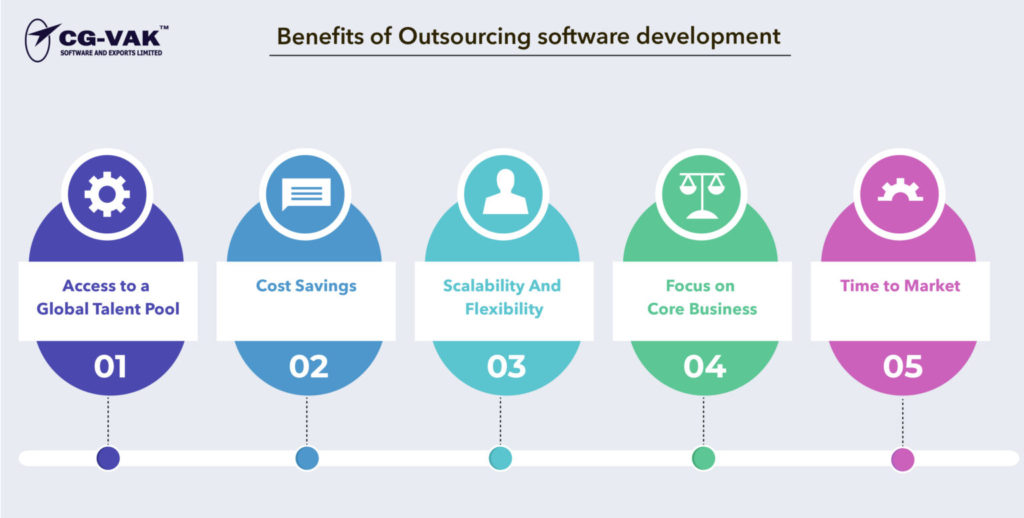
Outsourcing has some apparent advantages. Here is a list of 5 major benefits its offers:

Access to a Global Talent Pool:

When you outsource software development, you gain access to a vast pool of talented developers worldwide. With software outsourcing, geographical barriers no longer hinder finding the most talented developers. By partnering with an outsourcing company, you can access a diverse team of highly skilled developers specializing in various technologies and programming languages. This means that you can easily find the perfect fit for your project, whether it’s a mobile app, a web application, or a complex enterprise system.

Cost Savings:

Let’s accept it! Who doesn’t like to save money? Outsourcing developers can be significantly less expensive than hiring an in-house team of developers. When you partner with an outsourcing company, they can provide you with top-notch services at a fraction of the cost of hiring an entire in-house team. Outsourcing companies typically have lower overheads and fewer operational expenses, which allows them to offer their services at a lower cost. You can save a significant amount of money on salaries, benefits, training, and equipment. This is particularly beneficial for small and medium-sized businesses with limited budgets, as it allows them to access high-quality development services without breaking the bank. With outsourcing software development services, you can save a lot of money, while still getting the quality work that you need. It’s a win-win situation for any business looking to maximize their resources and stay competitive in today’s market.

Scalability And Flexibility:

When outsourcing software development, you can quickly scale up or down depending on your project’s needs. This is particularly useful for startups and small businesses that may not have the resources to hire a team of developers. Outsourcing allows you to access additional resources as and when needed, without the financial burden of hiring full-time employees.

Focus on Core Business:

Outsourcing software development allows you to focus on your core business objectives without getting bogged down in technical details. You can delegate the software development process to a team of experts, freeing up your time to focus on other critical business functions. It allows you to maximize your resources and ensure you are making the most of your time and expertise.

Time to Market:

Outsourcing software development services can significantly reduce your time to market. With a dedicated team of developers working on your project, you can get your product or service to market much faster than if you were to hire an in-house team. This can be particularly beneficial for startups and small businesses that need to move quickly to gain a competitive advantage in their market.

How to overcome the challenges of Outsourcing software development

Identify a Reliable and Experienced Outsourcing Partner:

When selecting an outsourcing partner, it is essential to do your due diligence and choose a company with a proven track record of delivering high-quality work. Look for a partner with experience in your industry and the specific technology or programming language you require.

Clearly Define the Scope of Work:

It is essential to have a well-defined scope of work before you begin outsourcing. This will help ensure that both parties are on the same page and that there are no misunderstandings about the project’s requirements or deliverables. Make sure to clearly communicate your expectations and requirements to your outsourcing partner.

Maintain Good Communication:

Effective communication is essential when working with an outsourcing partner. Establish regular communication channels and schedule regular status updates to keep track of progress and ensure that everything is on track. If any issues arise, address them promptly to avoid any misunderstandings or delays.

Set Realistic Expectations:

Setting realistic expectations when outsourcing software development is important. Be realistic about timelines and deliverables, and understand that unforeseen issues can arise during development. Be open to adjusting timelines or deliverables if necessary to ensure the project is completed successfully.

Provide Adequate Resources:

To ensure successful outsourcing, ensure your outsourcing partner has access to the resources they need to complete the project. This may include software licenses, development tools, and hardware. Providing adequate resources will help ensure that the project is completed on time and to the required quality standards.

Protect Your Intellectual Property:

When outsourcing software development, it is important to protect your intellectual property. Make sure that your outsourcing partner signs a non-disclosure agreement (NDA) and takes appropriate security measures to protect your confidential information.

Test and Review Code Regularly:

Regular testing and code reviews are essential to ensure that the project is progressing as planned and that the code is of high quality. Establish regular testing and code review cycles to catch issues early and ensure the code meets your quality standards.

Best Practices and Guidance from CG-VAK Experts

When you outsource software development services to a reliable and experienced partner like CG-VAK, you can rest assured that you are leveraging the expertise of one of the best software development outsourcing companies. CG-VAK follows best practices and guidance in the industry, ensuring that your project is completed efficiently and effectively. With CG-VAK as your outsourcing partner, you can tap into their extensive experience and knowledge of the latest technologies, programming languages, and software development methodologies. You’ll be able to take advantage of their experience in managing outsourcing software development services while still maintaining control over the project and ensuring that your business goals are being met.

Conclusion

Outsourcing software development has become necessary for businesses that want to stay competitive in today’s fast-paced digital world. Companies need to be agile, innovative, and efficient to survive and thrive. Outsourcing software development services can help businesses achieve these goals by providing access to a pool of talented developers with diverse skill sets and expertise. By partnering with software development outsourcing companies, businesses can free up their internal resources to focus on core competencies and strategic initiatives while ensuring that their software development needs are met on time and within budget. With the right outsourcing partner, businesses can navigate the complexities of software development outsourcing and leverage the expertise of experienced professionals to stay ahead of the curve.

Effective Strategies for Leading & Optimizing A Remote Software Development Team

In a rapidly evolving digital landscape, the nature of employment has undergone a significant transformation. Remote software development teams have become the norm, enabling firms to tap into a global talent pool and function efficiently across geographical boundaries. However, leading and optimizing such teams comes with its own unique set of challenges.

As remote work becomes increasingly common, software development services need to have effective strategies for leading and optimizing their work. Hiring remote software developers and managing a remote team brings unique challenges, such as communication barriers and potential productivity issues.

To succeed, leaders must prioritize effective strategies to lead and optimize remote teams. By following these strategies, remote software development teams can work together effectively and efficiently to achieve their goals.

Why Hire Remote Software Development Teams?

In the ever-evolving landscape of software development, hiring remote software developers teams has emerged as a compelling option for firms seeking to construct efficient and innovative software products.

Here are some high-level reasons why hiring remote software development teams is advantageous:

Access To a Global Talent Pool:

When you hire remote software developers, you permit firms to tap into a vast global talent pool, transcending geographical limitations. It enables firms to attract top-notch professionals with diverse skill sets and domain expertise from around the world, ensuring access to the best talent available.

Cost Efficiency:

Remote software development teams often offer a cost-effective solution compared to conventional in-house teams. Firms can save on software development costs and expenses related to equipment, office space, infrastructure, and employee benefits. Additionally, remote teams located in regions with lower labor costs can offer significant cost savings without compromising quality.

Enhanced Flexibility and Scalability:

Remote teams offer unparalleled flexibility and scalability for businesses. Firms can effortlessly scale their development capacity up or down based on project requirements without the need for extensive hiring or downsizing. This agility enables firms to adapt quickly to market demands and effectively manage resource allocation.

Enhanced Productivity:

Remote teams often exhibit higher productivity levels due to minimized distractions and enhanced autonomy. Remote work eliminates the constraints of a traditional office environment, permitting team members to construct a working setup that suits their individual needs and maximizes their efficiency.

Furthermore, remote teams can leverage asynchronous communication and collaboration tools to work across distinct time zones, enabling round-the-clock productivity.

Diverse Perspectives and Innovation:

Remote software development teams bring together professionals from distinct cultural backgrounds and experiences. This diversity fosters a rich exchange of ideas, innovative thinking, and unique problem-solving approaches.

By embracing diverse perspectives, firms can enhance creativity and drive innovation in their software development processes.

Reduced Time To Market:

With a remote team, firms can leverage the concept of distributed development. By breaking down projects into smaller tasks and assigning them to specialized team members, work can progress concurrently, minimizing the overall development time. This accelerated development cycle permits firms to bring their products to market faster, gaining a competitive advantage.

Business Continuity and Risk Mitigation:

Remote software development teams provide a level of resilience and risk mitigation. In the face of unforeseen events such as pandemics, natural disasters, or local disruptions, remote teams can continue working seamlessly, ensuring business continuity.

Also, by diversifying the team’s geographical locations, firms can mitigate risks associated with geopolitical challenges or localized issues. By embracing remote software development teams, firms can harness the advantages of global talent, achieve cost efficiency, drive innovation, and maintain business continuity.

With the right strategies and tools in place, firms can leverage the power of remote teams to accelerate their software development efforts and stay ahead in a rapidly changing market.

Significant Challenges In Approaching Remote Software Development Teams

Time Management Techniques for Remote Software Developers:

One of the hardest aspects of employing a remote software development team is controlling their work hours.

The Fix:

• You may fix this by explicitly outlining each developer’s goals and expectations while offering them tools that include project management software.

• Managers should also build an accomplished communication plan that fosters open conversation among developers and regular check-ins to track progress.

Encourage Remote Software Development Teams To Collaborate And Be Creative:

Working remotely might make collaborating and being innovative with the entire software development team more difficult.

The Fix:

• Managers should foster a collaborative environment by giving enough resources, including virtual whiteboards, video conferencing capabilities, and collaboration applications, to remote engineers.

• Managers should also schedule regular brainstorming sessions so that the entire company can collaborate on novel solutions.

Securing Data in Remote Software Development:

There is always the potential for data security breaches using remote software development due to insufficient access restrictions or poor management.

The Fix:

• When exchanging sensitive information between parties, it is critical to apply encryption and authentication procedures. It is also critical to have a robust monitoring system in place to identify possible data integrity concerns and ensure that all staff understands their responsibilities to preserve personal information.

Communication And Collaboration:

Remote teams face communication and collaboration hurdles due to physical distance and potential language and cultural differences. A lack of real-time interaction can lead to miscommunication and hinder team cohesion.

The Fix:

• Utilize various communication tools like video conferencing, instant messaging, and project management software to facilitate regular and efficient communication among team members.

• Encourage open and transparent communication within the team. Establish clear channels for sharing project updates, feedback, and concerns to maintain a cohesive working environment.

• Conduct regular team meetings to discuss project progress, clarify requirements, and address any challenges. Encourage participation and active engagement from all team members to foster collaboration.

Managing Time Zones:

Remote teams often span across distinct time zones, making it challenging to coordinate schedules and ensure real-time collaboration.

The Fix:

• Establish guidelines for overlapping working hours or specific periods of availability to ensure effective collaboration during common working hours.

• Utilize communication tools and project management platforms that permit team members to communicate and collaborate at their convenience, even if they are not working at the same time. It might lower delays and maximize productivity.

• Provide advance notice for meetings, deadlines, and important discussions, taking into account time zone differences. It permits team members to plan their schedules accordingly and ensures everyone is on the same page.

Performance Tracking and Accountability:

Monitoring and evaluating individual and team performance can be challenging in a remote setting where physical oversight is limited.

The Fix:

• Establish measurable goals and key performance indicators that align with project objectives. It might provide clarity on expectations and permit an objective evaluation.

• Encourage team members to provide frequent progress updates and share their work-in-progress. It helps managers and stakeholders stay informed about the project’s status and detect any potential roadblocks early on.

• Utilize project management software that enables tracking of tasks, milestones, and time spent on each project. It allows for accurate performance evaluations and facilitates transparent reporting.

Building Trust and Team Cohesion:

Building trust and a sense of camaraderie can be challenging when team members are physically separated and have limited face-to-face interactive sessions.

The Fix:

• Encourage team-building activities, such as team challenges, virtual social events, or informal video chats, to promote bonding and build rapport among team members.

• Construct opportunities for casual conversations and informal interactions, such as virtual coffee breaks or dedicated communication channels for non-work-related discussions. It helps replicate the social dynamics of an office environment.

• Promote collaborative work on projects by assigning tasks that require team members to work together, fostering a sense of shared accomplishment and trust.

• By addressing these significant challenges and implementing the suggested solutions, organizations can effectively approach and manage remote software development teams.

• Embracing effective communication, fostering collaboration, building trust, and implementing performance-tracking mechanisms will contribute to the accomplishment of remote software development projects and optimize team productivity.

How Can CGVAK Help You in Software Development?

Consider collaborating with CG-VAK if you have a software project in mind and are seeking a trusted and dependable software development partner.

CG-VAK can provide you with exclusive access to a remote firm team for software development that will remain at your disposal and will assist you in achieving your goals. Do not neglect to outsource and enjoy the advantages of remote software developers by creating a potential partnership with CG-VAK.

Conclusion

Remote software development teams are growing in popularity because they provide countless benefits over conventional in-office development techniques.

With careful preparation and excellent management, a high-performance remote workforce may be effectively managed. We have defined the procedures required to construct and manage an effective remote software development group in this post.

We hope that these recommendations might assist you in creating the ideal atmosphere for your team to thrive and deliver high-quality work products.