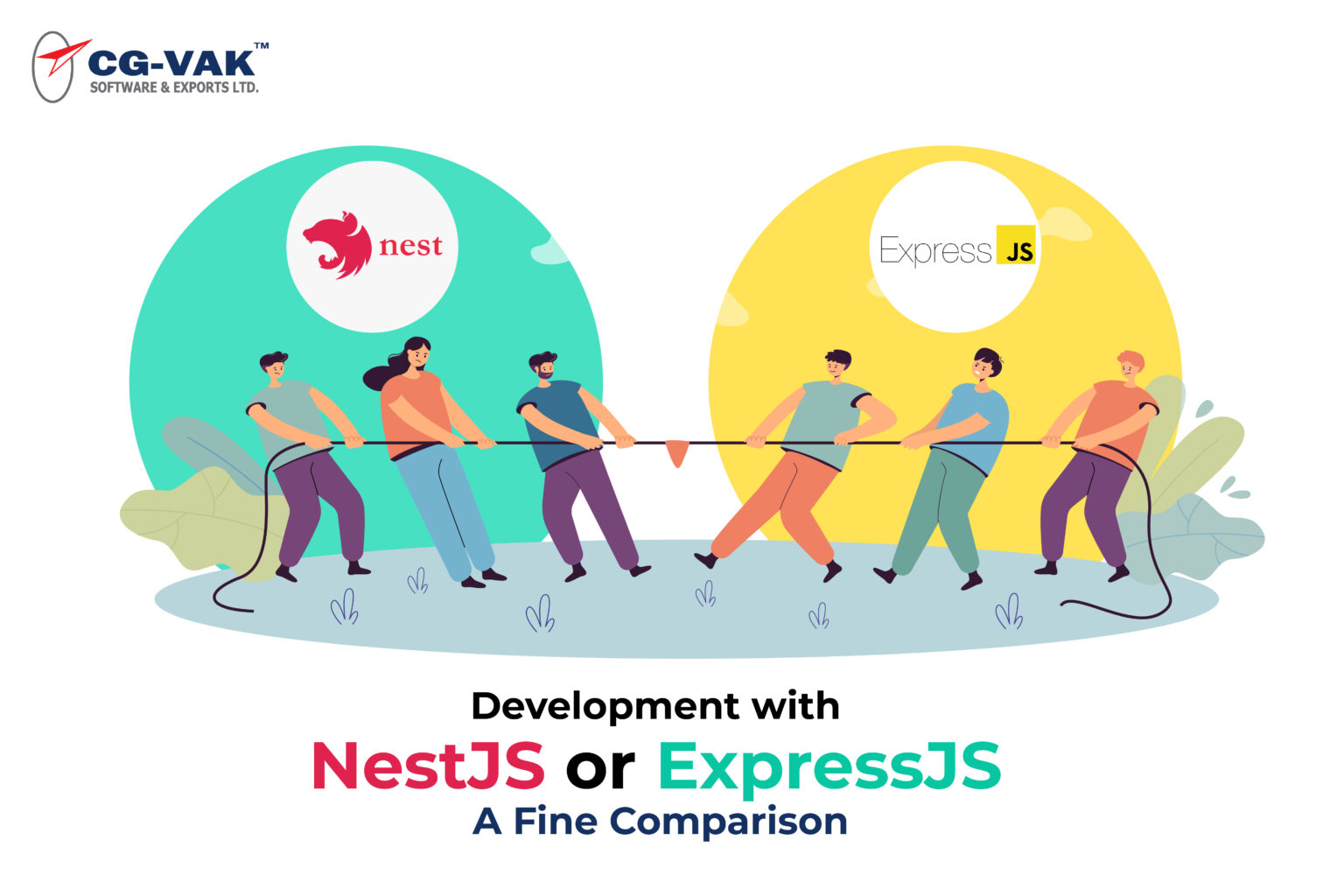
Development with NestJS or ExpressJS – A Fine Comparison

The two mostly used Node.js frameworks nowadays are Nest and Express. For building web applications, it is important to understand their basic features and differences.

In recent times, the Express web application has become the first choice for building a web application framework since it is fast, flexible, and minimal.

For building large-scale applications, developers often go for lightweight frameworks, and thus creating the NestJS app is gaining popularity.

NestJS

What is NestJS?

NestJS is an open-source, cross-platform framework that enables to write of server-side and networking applications.

This framework is mainly inspired by Angular and is built on Typescript using progressive JavaScript.

Nest makes use of the Express HTTP framework by default and can work with any Node HTTP framework. For example, it can optionally be configured to use Fastify.

One of the best things about NestJS is that anything supported in the ExpressJS framework is also supported in the NestJS application.

How to install NestJS?

Nest has an excellent CLI that makes it easy to build the application.In the Command Prompt terminal, type the following: npmi-g @nestjs/cli Now use the cd command to change into the directory where we want to build our app.

Execute the commands as:
nest new nest-blog-api
cd nest-blog-api
npm run start:dev

In any browser, go to http://localhost:3000 . You should see a “Hello World” message.

NestJS core components

NestJS core components have three main components: modules, providers, and controllers.

Nest module system is simple in design. A module is a class that has been annotated with the @Module() decorator. NestJS integration uses the metadata provided by the @Module() decorator to arrange the application structure.

There is a root module in each NestJS which is used as a starting point to resolve the structure and relationships of the application. Another powerful feature of the Nest module is the Dynamic module. This allows you to create customizable modules that can dynamically register and configure providers easily.

Nest relies heavily on Providers to build relationships between different objects. A provider can be injected as a dependency. Classes like repositories, services, and helpers can be treated as providers.

When an HTTP request is received, the routing mechanism routes it to the correct controller within NestJS. Controllers handle the incoming requests and respond to the application’s client side.

Features of NestJS

Some notable features that make NestJS a good choice among developers are here:

For heavy applications:

Working with Express and Node is great for building a lightweight application where the code is easy to read and write. However, when you add more features to your application and it becomes complex, your code will start to get a little messier and harder to manage. This problem is eliminated with the use of NestJS.

Components: 

It combines the elements of OOPs (Object-Oriented Programming), FP (Functional Programming), and FRP (Functional Reactive Programming).

Support for Databases: 

It supports various databases like PostgreSQL, MongoDB, MySQL, Redis, Apache Cassandra, etc.

Support for dependency injection:

Nest also supports dependency injection.

Fewer lines of code: 

It provides a wide range of functionalities, libraries, and APIs, and so that you can build applications with fewer lines of code.

Using Express middleware: 

NestJS uses the Express web application framework by default as the request processing pipeline.

Express.js

What is Express.js?

Express is a Node.js web application framework that provides a wide range of functionality for mobile applications and web app development. You can use Express with Node to create single-page, multi-page, or hybrid web application development. Hence, Express is the most popular web development frameworks.

Since it is written in Javascript frameworks, absolute beginners can also get into a framework for web development easily.

How to install Express.js?

To use Express for our project, we first need to install it:

npm install express

Then import Express inside the project:

import express from ‘express’;

Next, initialize the application, give it a port to listen to, and respond to a request on that path:

const app = express();

app.get(‘/’,(req, res)=>{

res.send(‘Hello World!’);

});

app.listen(3000,()=>

console.log(‘Example app listening on port 3000!’),

);

Express.js Components

Express has no specific structure. Hence, there remains a possibility for an application to end up inefficient and less optimized. However, this can become a problem as the complexity of the application grows.

Features of Express.js

Some of the features of ExpressJS are described below.

Middleware:

Middleware is a program component that has access to a database, client requests, and other middleware. It is majorly responsible for the systematic organization of various Express.js functions.

Routing mechanism:

When it comes to routing, Express includes a sophisticated routing mechanism that uses URLs to preserve the state of the webpage.

Template:

Express includes template engines that help developers to create dynamic content for web pages by creating HTML templates on the server side.

Shedding Light on both for better understanding

The below table shows the comparison of NestJS vs ExpressJS:

FeatureNestJSExpressJS
UsageIt is used to build server-side, input-output, and event-driven apps.It is used to build web apps using the approaches and principles of Node.js.
Level of featuresFewer features.More features than Node.js.
Building BlockIt is built on Google’s V8 engine.It is built on Node.js.
Written inC, C++, JavaScriptJavaScript
Coding timeIt requires more coding time.It requires less coding time.
ControllersControllers are not provided.Controllers are provided.
Routing Routing is not provided.Routing is provided.
MiddlewareDoes not use such a provision.Uses middleware for the arrangement of functions systematically server-side.
Framework/PlatformRun-time platform or environment designed for server-side execution of JavaScript.Framework based on Node.js.

Concluding

Express.js is one of the best and most popular backend development frameworks using JavaScript and will likely remain so for some time. But, according to some developers, NestJS has a significant advantage early on. Both have their unique pros and cons. Now you can get a understanding between those two frameworks which helps you decide to take a right decision to opt. Get expert advice and assistance for using both NestJS and Express JS technologies at CG-VAK and clear out all queries in one place.
Cloud Storage Solutions- Precise View on Cloud Storage and Best Options

Some businesses even have entire offices in the cloud—and that’s not just because they’re cheap; it’s because it helps them to be more flexible and mobile. Businesses can now be run from anywhere with an internet connection, and affordable cloud storage services are fast becoming essential for most companies. Additionally, as cloud storage options continue to increase, individuals are turning to these services for their data needs. Research shows that 50 percent of those surveyed use cloud storage at home or the office. Cloud-based storage providers also offer additional services beyond storage, such as collaboration and security. You want your office work stored safely away from home, where your data is always a step closer to disaster. So, how you will make a right choice in these circumstances. You may be tempted to pick based on how much free storage space you get—but it’s surely not the best way.

How Cloud Storage Works

Cloud storage is a system for storing files over the Internet. It usually involves at least one data server. In the case of enterprises, multiple data servers allow users to connect via Internet, sending files from their computers to the server, which forwards them to multiple servers. The stored data can then be accessed via a web-based interface.

Cloud storage provides users with a host of storage space so they can upload all their important content, such as documents, videos, photos, music albums and movies. The fascinating feature of cloud storage solutions is that you can upload or download files from anywhere in the World, even without carrying your laptop. You can access your personal and official data anywhere, anytime.

Cloud Storage Benefits

Cloud solutions are ideal for storing data online. In the past, most companies depended on on-premise servers to store their growing collection of files and data; but today, cloud storage is the next big thing as it allows unlimited storage at an affordable price. You pay only for what you use. The best thing about cloud IT solutions is it ensures affordability and that it can be accessed from anywhere in the world.

Selecting the right Cloud Service Provider

With hundreds and thousands of cloud storage service providers offering cloud storage tools, making right choice is not an easy choice. Here are some of the things you need to consider:

1. Consider the Type of Storage You Need

As the purpose of your cloud storage solution is different, you need to assess your cloud storage requirements and the features you require. Also, evaluate carefully how much storage do you need, what is your budget, how much backup you require etc.

2. Consider Security

Security is of vital consideration while choosing cloud storage tool. You need to consider various factors whether the platform offers proper password protection mechanism, 2-Factor Authentication, File Encryption, Controlled User Permission etc. Additionally, it should be in compliance of GDPR and other regulations.

Cloud storage apps often enhance security by requiring multifactor verification before allowing users to access files. For example, cloud storage users might sync up their accounts with their phone numbers or email addresses so they can verify their login sessions on an additional device, preventing unauthorized users from accessing files in the cloud.

3. Refine the Choices and Take a Free Trial

What looks very promising on the paper may not turnout up to your expectations. You cannot guarantee whether it will work for you or not. Therefore, take a Free Trial for some time to understand its capabilities. It will give you a good idea whether the cloud storage system you want to opt will solve your problems or not.

Major Cloud Storage Options You Can Prefer

Though there are hundreds of cloud storage and backup solutions in the market and each of them claims to be the best and most secure cloud storage tool; the question arises then how to make the right choice. We have curated a list of some credible names. However, there are many more good options as well of research deeply. Here are some of the most popular cloud platforms that you can consider:

  • iDRIVE

Counted among the best cloud storage options, iDRIVE is a highly flexible and secure cloud storage solution currently available in the market. Its cloud storage pricing is also affordable. The personal plan starts from $79.50 per month.

  • Amazon Cloud Drive

Amazon S3 (Amazon Web Services) is a popular object storage service; however, it’s best suited for enterprises and large corporations. Amazon Cloud Drive (Amazon) is an ideal personal cloud solution, providing sync services for Android, iOS, macOS, and Windows devices. Amazon Prime members get 5GB of free cloud storage, unlimited photo storage and speedy backups through delta sync.

  • OneDrive

Offered by Microsoft, it is among the best cloud storage options available in the market. It also offers reliable and best secure cloud storage solution. If you’re a Microsoft 365 user, this should be your natural choice as it’s ideal for the users using Windows and Microsoft Office. There are also enterprise cloud storage options for large corporations.

Microsoft offers 5GB of free storage through OneDrive. It also offers an extra terabyte per user, starting at $6 per month for the Microsoft 365 Business Standard plan. This plan maxes out at six people or 6TB of storage.

  • Nextcloud

Millions of people use Nextcloud, including its users at organizations like Siemens, Regio IT and DEGES. Nextcloud is a cloud storage solution that works through your web browser or on a mobile or desktop app.

This cloud strorage backup solution is GDPR (General Data Protection Regulation) and HIPAA-compliant. It integrates with Microsoft Outlook and Mozilla Thunderbird, allowing you to collaborate on documents through these programs. You can also lock and unlock files, exchange secure files with banks, hospitals, governments and notaries.

Conclusion

So, what is the best cloud storage service? The answer depends on many aspects. And we help you to find out. Contact our experts now. We are ready to help you with cloud storage solutions.

Uncovering Application Integration Vs Data Integration: How They Vary from each other

Though sound similar, data and application integration are two distinct concepts, and they pose a significant challenge for every organization. The reason is simple: they need to ensure various applications hosted on-premises and in the cloud interact seamlessly, and fast and provide a correct picture of required business function.

To address these challenges, an organization needs to adopt different approaches. Data integration aims to set up a process to handle data movement between two or more databases. It typically deals with data in a batch-oriented manner, which means that the process that created the data has been completed. On the other hand, application integration is about integrating live operational data as it happens in real-time between two or more applications.

This post will try to gain a high-level overview of application and data integration and their use cases.

What is Application Integration?

When business processes involve multiple applications, live data must move from one application to another, one event at a time, in close to real-time. This might happen, for example, when an organization adds a new employee — data about the person might start in a human resources system, but also needs to be recognized in payroll and other operational applications. Application integration software can orchestrate this process by serving as middleware between systems.

Application integration is a part of the software development process by which data can be transferred between multiple OLTP applications. Application integration also requires knowledge about business or application logic, and you must understand the various application approaches while building an application integration software or creating an enterprise application integration platform.

What is Data Integration?

Put simply, data integration is the process of pulling data from multiple systems and combining them to create an analysis-ready database. Once in the database, additional analysis can be performed using tools like SQL queries and reporting, enabling companies to expand their geographies or dive deep into newly acquired data.

The question that arises here is why data integration is required in the software development process. The answer is simple: a company might receive all the data, but the problem is the data resides in different silos. To make sense of this disparate data, IT managers need to focus on building a robust data integration platform. A typical data integration solution may require combining data from CRM systems, web traffic, and marketing automation software, to name a few.

Unlike application data schemas, data integration in the data warehouse requires creating tables and columns so that data engineers can add or delete tables as per requirement.

Application Integration Vs Data Integration

Application integration is a real-time process that helps businesses collect relevant information from multiple sources and instantly provide uniform access to the information within an application. Application integrations can be part of DevOps (software development), but they also work with smaller data sets and are used for improved workflow and better data quality. Data integration deals with large data sets at rest and occurs after creating new data sets. You will need it to combine static data and analyze it for analytics purposes. Furthermore, the size of your data sets can vary; you must ensure that those sets are consistent and easily accessible for future analysis techniques.

Use Cases of Application Integration and Data Integration

Both application integration and data integration have comprehensive use cases. Businesses have to think about application integration while collecting data from IoT devices or hosting applications on cloud-based CRM applications to enhance their workflows with automation between applications.

Secondly, enterprises now host many SaaS applications on their cloud ecosystem, such as A SaaS CRM like Salesforce or HRMS platform. All these applications should work into architecture to avoid data silos and black boxes. Data integration is suitable in circumstances when you migrate data from various sources to a single unified data warehouse. This is due to the proliferation of cloud-based platforms. It has also use cases in analytics and data warehousing. Therefore, organizations are looking for credible cloud data warehouse solutions. Also, real-time data analysis demands real-time data and application integration capabilities, along with cloud-to-cloud application integration capabilities.

Thirdly, in many circumstances, various applications hosted on the cloud need to interact seamlessly, or the system will not work. Let us say, you run an e-commerce store, but you may need to integrate your Shopify or Magento store with order fulfillment or inventory management processes.

Fourth, you may be using an on-premises application to an ERP that is deployed behind your firewall in your private cloud. Earlier, it required custom coding for internal application integration. Now the same goal can be achieved through a middleware platform.

Fifth, organizations often need to adopt a data replication process that requires copying data from one source to another, ensuring synchronization to operational uses.

Sixth, for many enterprises, providing a 360-degree of customer behavior is crucial to building a holistic marketing strategy. Marketing managers want a summary of all customer interactions that helps them devise a holistic marketing campaign. However, that requires pulling disparate data from CRM applications, ERP platforms, technical support software systems, ecommerce systems, or any other form of application that helps them understand and drill down into customers’ history.

Conclusion

You must have gained a high-level overview of Application Integration and Data Integration by now. It is critical to understand the context of the usage of each term as it is not the case of which of them is better, it is about what you’re looking for. Whether you are looking to build a predictive application by using various data assets or later, build an application to suit your business needs. Application integration matters when speed is paramount without compromising accuracy, which is ensured by data integration. Therefore, both complement each other. They don’t compete.

If you’re wondering how to move ahead, CG-VAK can help you guide to leverage data integration and application integration capabilities.

Migration of Xamarin To .NET MAUI- Say Goodbye to Xamarin For Your App Development!

What is .NET MAUI all about? Many might know that Microsoft is constantly searching for the newest disruptive tools and technologies.

In this digital scenario, if you read anything about “Xamarin.Forms,” “.NET 6.0,” or related to both, you must have undoubtedly heard of a new framework known as “.NET MAUI”.

Microsoft has determined that Xamarin will undergo a significant update, and MAUI will be the organization’s next key advancement in its cross-platform app development capabilities.

.NET MAUI will take on the role of Forms, which is heavily influenced by Xamarin, since support is expected to terminate in November 2023. To get the newest capabilities and compatibility for mobile operating systems, you must be ready to migrate your app from Xamarin Forms to .NET.

Is migrating from Xamarin to MAUI right for your firm? What are the MAUI benefits over Xamarin? Find out by reading on.

Migrate Xamarin To .NET MAUI For a Reason:

Every second incorporates technology. Technologies that are popular now can become outmoded tomorrow. It is crucial to use cutting-edge tools and technology if you want to maintain a competitive advantage.

Therefore, Microsoft has embraced Xamarin, altered it, and built MAUI to achieve the integration of Xamarin into a universal .NET development environment. They also included a few fresh features and capabilities that will enhance, speed up, and expand the development experience overall.

Firstly, Microsoft will be able to completely integrate Xamarin into .NET and unify all latency, SDKs, and libraries into a unified platform with MAUI. Microsoft has pushed for Xamarin to be a component of their integrated developer experience from the beginning, but the cross-platform tool hasn’t exactly seemed like it belongs in the .NET environment.

A significant portion of the reason why Xamarin .NET Embedding and Xamarin Forms developers are now struggling is because of the damages that Microsoft has made a sincere effort to repair. Additionally, Microsoft wished for .NET and C# to be the preferred programming languages for creating apps, allowing developers to write their code once and have it run across all platforms in a single ecosystem.

The key points you will notice while migrating Xamarin Forms apps to .NET MAUI are listed below.

Aiming Several Platforms with Multiple Targets:

Run settings are kept to a minimum thanks to this single-project structure, which also hides many of the details that were essential with earlier Xamarin platform-specific applications. This improvement in the quality of life is meant to make the new Android and iOS development frameworks simpler.

Shared Asset Libraries:

Unlike earlier Xamarin app development projects, materials like fonts and graphics may now be stored in a single project’s resources. Again, each project had copies of every asset. The complexity of your project may be significantly reduced as a result.

MAUI Tackles Concerns with App Loading And Performance:

For many years now, Xamarin has been the preferred cross-platform mobile app development tool for many developers. It has aided in the delivery of well-liked and creative apps for top-tier businesses.

Nevertheless, we must concede that certain Xamarin-built apps are experiencing performance challenges. These problems are mostly caused by the lengthy loading times for Xamarin’s apps and their substantial size, both of which have long been sources of contention among developers.

To guarantee that the apps maintain the right appearance for the platform on which they will operate, developers may construct custom renderers in Xamarin.

Also, renderers may be a major pain when tackling a particular project or under certain circumstances, which is why they are steadily losing use. Microsoft reboots them with MAUI and refers to them as “handlers.”

The Need To Migrate A Xamarin Forms App To .NET:

We anticipate that you have a lot of queries right now, specifically about Xamarin app development. Let’s sort them all.

Is Migrating Xamarin Forms Apps to .NET MAUI the Right Call for My Project?

When faced with a required refactor, the first thing to do is examine other frameworks. If you are planning on spending time reworking, it can be worth it to invest in a new framework if it would help your project. When beginning a mobile project, you should consider all of these issues.

Does My App Heavily Depend On External Libraries Or Platform-Specific Rationale?

Implementing cross-platform logic that is strongly tied to other libraries may be challenging since MAUI has a variety of platform-specific problems from its early editions. Additionally, many currently used libraries will need to be updated shortly to support MAUI rather than Xamarin.Forms.

Particularly at this early stage in the release cycle, only a small number of Xamarin.Forms libraries have had the opportunity to adapt their libraries to MAUI. It could need further refactoring work to include current functionality in MAUI.

What Will Be The App’s Scope? Is It Anticipated That My Project Will Develop Considerably Over Time?

You might want to think about selecting a different framework if your program will go through several iterations over the years. When stacked on top of the current Android and iOS platforms, cross-platform frameworks sometimes make assertions about internal frameworks. This leaves out a significant amount of functionality, which is apparent in a project of this size and scope.

The future chronology of MAUI is similarly obscure. The fact that so many things are still up in the air, especially with the far-off .NET 7.0 release, makes MAUI an unsuitable framework for a sizable project of this nature. And remember that only very little information is provided in the documentation for MAUI Embedding Extensions.

Click here to read Xamarin Toolkits with New .NET MAUI- Replacing with New Alternatives

Wrapping Up:

The upcoming version will undoubtedly cause “Xamarin.Forms” developers frustration. Here, your only choices are to either set up Xamarin Forms migration or to stop supporting “Xamarin.Forms” altogether. This covers any further Android or iOS platform versions, bug patches, and support for external third-party libraries.

Migration for Xamarin.Forms may be configured. However, it is advised against migrating your Xamarin.Forms codebase entirely all at once.

Make sure you follow the steps exactly. Spend one or two sprints integrating your code and sparking a few mobile frameworks.

Finally, see if MAUI is a good fit for you by getting suggestions from CG-VAK. The investment will be worthwhile.http://www.cgvakindia.com/contact-us/

Reasons for Migrating from Visual FoxPro to .Net- Why enterprises should think about migration

Visual FoxPro has been the choice for many enterprises. It is a very flexible program, but with the advancement of technology, Visual FoxPro is outdated and needs to be upgraded. And this is where migration comes in. Microsoft has announced that it will no longer support FoxPro and Visual FoxPro, two programming languages used to develop business applications. In January 2015, Microsoft recommended that users migrate their applications to .NET. Since Microsoft’s announcement, developers have begun VFP to .Net conversion and are rapidly moving toward web- and mobile-based applications.

Visual FoxPro: The End of Life?

As many experts proclaim at the top of their voice, there is no end of life for Visual FoxPro. No, it’s just taking a nap. For those of us who have been around long enough to remember the glory days of FoxPro, you might be surprised to know that even though its name is synonymous with database management, it isn’t very good at it anymore.

Migration from Visual FoxPro to .Net

Why you should migrate your Visual FoxPro-based application to .NET. Here are some of the reasons for the move:

First, Microsoft will no longer provide proactive support for future builds of Visual FoxPro. The reason? The company has determined that Visual FoxPro lacks the technical architecture to meet today’s global business requirements.

Second, Visual FoxPro does not have version control. This means that you cannot commit the code in a repository to check the last code version and edit/re-do the code to meet ongoing business requirements. Version control saves a lot of time and effort. Many advanced Web 2.0 based platform like .NET provides this feature, which helps build scalable and lightweight applications.

Third, FoxPro applications are becoming increasingly expensive to maintain due to the decreasing availability of skilled FoxPro developers. No new developers are learning the language, so the pool of people with appropriate skills and knowledge is shrinking. Most have moved on to other languages or retired, while a few have even passed away. Benefits of Migration from Visual FoxPro to .Net.

Fourth, in certain circumstances, your computer systems must be kept up to date in order to meet regulations or certification criteria. This is because you cannot afford to be stuck running outdated versions of Windows. Even being unable to install some software updates may cause you to fall foul of your regulations or certification criteria.

Fifth, the database tables can be opened outside of the application itself, and because of this, it’s impossible to introduce higher levels of security without compromising on functionality. The data in these tables, by necessity, must be available to all system users for it to function.

Sixth, FoxPro is a 32-bit application. The world of computing is moving towards 64-bit. The existing 32-bit compatibility layers will eventually go away, so FoxPro won’t be able to run on a 64-bit-only operating system.

Seventh, it does not work well on the web. There are ways to web-enable FoxPro, but they are not very effective. Further, there is no platform (e.g., iPhone/Android) to develop mobile applications)

Benefits of Migrating VFP to .NET

Visual FoxPro is a legacy application, and though it solved the challenges of that era, it has no longer remained relevant.

Organizations must expense a lot of amounts on the maintenance of such systems. By migrating, they can save on these unwarranted expenses and other benefits of migrating to .Net are:

  1. .Net provides language interoperability ie., multi-language support.
  2. Rich Library support
  3. Compatible databases and helps retrieve data/ record quickly
  4. Platform independent and helps build robust applications.
  5. Provision and facility to adapt for future updates.
  6. Enhanced Security

And more…

Procedure for Successful VFP Migration Projects

VFP to .NET conversion can be a complex process, particularly if the new system must be deployed in a live environment. You need to consider all of the factors that go into VFP to .NET conversion—including the legacy core functionality of your application, its user interface and workflow, and your architecture. The process is not easy and can be technically challenging of VFP to .NET migration.

1. Set Clear Goals

Let’s start with a goal. What do you want your organization to look like after the migration? If you’re not sure precisely what you want, make a list of features that are important in your business and how they will benefit from a new system. You don’t have to know everything about migrating an entire organization; just focus on what’s important to your company. You’ll find that by working together as a team, everyone will get where they need to go faster.

2.  Document your files

If you plan to do any development work, it’s essential to document the existing application to provide metrics and a basis for your estimates. You can find a free tool written in VFP8 at VFPConversion.com (see sidebar) that will scan a PJX (project) file and output some measurements for the project. This tool provides a good starting point for documenting an existing VFP application.

3. Understand different conversion functions

Conversion projects can be broken down into two categories. The first is simple, in which you change the format of an existing application with SQL Server instead of DBFs to store data. The second type is more involved, as it changes the basic architecture and uses the knowledge gained from the old application to create an entirely new version. In this article, I’ll discuss the most typical conversion project-replacing current functionality with .NET code.

4. Evaluate the best strategy for converting files

If the existing application is built using DBF files, you must decide whether to modify it for it to work with a SQL Server back end. This approach works well when the support staff is not familiar with SQL Server and when there is sufficient time in the timeline because it allows them to become familiar with administering SQL Server and allows time for fine-tuning the database before switching to an entirely new code base. Unfortunately, when you take this approach, you’ll do some work on the existing code base and you’ll have to toss that work aside when moving to the new code base.

5. Convert Application Logic

If your existing application was built using DBF files, you’ll have to decide whether to modify it in order for it to work with a SQL Server back end. This approach works well when you have time and resources available to learn about SQL Server administration, but it can be difficult when there are not enough people on your team who know how to administer SQL Server.

Is the Migration Challenging?

As Visual FoxPro is phased out, the need to migrate VFP to .NET platform forces developers to consider an upgrade. However, the learning curve for migrating applications can be steep so developers may find migration challenging for mission-critical applications. The task can be completed with ease with a professional legacy application migration services provider.

Starting Your Migration from Visual FoxPro to .Net with CG-VAK: A Reliable FoxPro Migration Partner

It is no coincidence that CG-VAK has a reputation for being the leading company in the .NET migration market. We are counted among the top FoxPro Migration Services provider in India. At CG-VAK, we understand the complexities of each business environment, so we can help you migrate from Visual FoxPro to .NET with ease and efficiency. A successful migration requires competent programmers like those employed by CG-VAK who are proficient in all aspects of migration, different approaches and specific nuances of various coding languages.

Just share your .Net development service requirements with us, and we will set up a call to help your business needs and provide a perfect solution.

How Businesses Can Get Benefit & Growth Adopting Cloud Native Platforms

The Cloud Native platform based on a web-based cloud solution is a new, scalable, and flexible way to build modern software. It’s quickly becoming a favored tool for developers, IT teams, startups, and enterprises because it has the advantages of both a traditional application backend and an infrastructure stack. Coming out at the turn of the decade already several companies are adopting these platforms, as businesses have realized their benefits. Adopting cloud-native web development platforms make businesses more agile, agile, and scalable. Cloud Native platform makes you worry less about the infrastructure and more about your code. It allows you to focus on your core business without being bothered by the underlying complexities of the infrastructure.

In this post, we will discuss the advantages of cloud-native platforms.

An Overview of The Cloud Native Platforms

Cloud-native applications are completely different from their predecessors, the traditional software platforms. They have no boundaries and operate in a cloud environment. These applications build on open-source processes, tools, and methodologies to help organizations deliver more valuable solutions faster. In the cloud-native microservices architecture, a single application code base can handle different types of requests without updating or modifying the code. When this process is used in conjunction with containers and container orchestration services, developers can compile applications that can be deployed in production without having to wait for the deployment to complete before new features are added.

Why should businesses opt for cloud-native platforms?

With the development of cloud-native computing, enterprises have started to face more and more complex challenges. To solve these issues and make their business more efficient, many companies are collaborating with other cloud companies in this area. The case below provides a brief overview of what cloud-native means right now, as well as some advantages that it can offer based on real-life examples. Here are some of the advantages of cloud-native applications:

#1. Reduces Time to Market

Time is money, and every business wants to lessen its development cycle. With cloud-native applications, businesses can reduce the amount of time it takes them to roll out products, while also embracing software as a service and the flexibility it offers. For example, if you’re in the healthcare industry, which has been one of the fastest-growing industries in America over recent years, then adopting cloud-native principles will undoubtedly help your business grow more rapidly than it would without them.

For example, after the upgrade to Kubernetes, Department of Defense programs were able to shorten their lead times from three months to one week. This 100+ year time savings is the result of DevOps principles on F-16s and large armored warships.

#2. Ease of Management

Cloud-native infrastructure enables the management of applications by staying away from physical servers. A cloud-native application is distributed across different instances and infrastructures that are manageable via a web-based visual environment. Such a workflow enables the development and deployment of cloud-native services in an automated way, with minimal effort. Using serverless platforms does not require configuring on-premises networking, planning for the best cloud-based storage, and provisioning cloud instances.

#3. Boosts Apps Performance

Cloud-native applications significantly improve app performance. To achieve this, developers can leverage today’s cloud technologies to build their apps in an agile fashion and launch them quickly. Cloud-native apps are built as services that are done dynamically as needed. With these benefits, the cloud can provide developers with increased flexibility and speed while they build and deploy those applications effectively on demand.

#4. Fosters Productivity

When it comes to managing complex software, whether for internal or external use, you might find yourselves continuously integrating new features and features. Cloud-native programming is about applying this integration strategy to improve business efficiency and customer satisfaction. Over the past decade, we have seen a high-velocity shift to the cloud. It represents an opportunity for modern businesses that want to leverage the best tools available but don’t want to sacrifice control over their internal development platforms or risk not having adequate resources for integration testing.

How does this transformation take place? By creating new relationships with other businesses, native cloud service providers, and related apps as you develop new solutions and platforms using this cloud-native strategy. The trend toward integrating more tools, apps, and platforms is probably something you already know about.

#5. Reduces Costs

Cloud-native computing represents the next phase in the development of software-defined infrastructure. It provides organizations with a way to optimize existing hardware and software rather than spend time, money, and resources on conceptualizing new systems or hardware.

Since most businesses spend 80% of their IT budget on supporting an already existing infrastructure instead of investing in organizational development and 30% of data center capacity is generally not used, cloud-native computing offers an organization another path and approach to infrastructure, shifting its budgets from expensive ecosystems working non-stop and channeling those savings into new functionality roll-out. For instance, Smart Cards made its first step towards digitalization with its transition to a cloud solution. The company decided to turn to innovative DevOps best practices and its in-house expertise: creating a custom-built cloud infrastructure that could provide automated software delivery and speed up time to market.

#6. Enhances Security

Why does cloud-native make applications more secure? It’s because cloud-native applications are developed with security in mind. Such applications are designed along with security professionals on board, tested for various threat scenarios, and can be quickly ported to other cloud environments in case of a risk. Cloud-based technologies have changed the way we think about software. The ability to run your apps on public and private clouds has opened a lot of opportunities for businesses, especially in terms of scalability and performance. But there’s more than just the technical benefits that cloud-native apps offer. As IT professionals and DevOps teams grow their expertise with each new release – which is where containers come into play – their reliance on external vendors for security products becomes an increasing liability.

#7. Increases Scalability and Flexibility

While businesses that use a cloud-native approach to their software-development strategy generally gain confidence over the future development and delivery process, flexibility is also one of their most important factors. Flexibility helps organizations take advantage of potential changes in real time, which helps them serve their customers’ evolving needs more effectively.

Cloud-native solutions are based on microservices that are designed to be environment, scalable and auto-scalable. This is achieved by making use of cloud schedulers, containers, and micro-services. Cloud-native apps take advantage of the resource abstraction offered by modern cloud infrastructures. They scale vertically in the same way as we do with our physical servers: using commodity hardware without any costs. They also scale horizontally by simply adding more resources when they are not needed anymore — a big difference between classic applications developed on virtual machines and typical web application containers.

#8. Vendor Lock-in

Choosing a cloud provider is a crucial decision. However, one should not be afraid to switch to a cloud-based management services provider if the service proves to be poor quality. Web-based cloud solution infrastructure allows customers to use multiple cloud providers without sacrificing their network services. Cloud Native applications are designed to be independent of one vendor’s platform, allowing for their use on multiple cloud providers. This flexibility makes it possible to move to a better cloud pricing and benefits plan with any cloud-native application.

#9. Automation & Flexibility

Adopting agile methodology practices and DevOps leads to automation throughout the software development cycle. With collaboration and CI/CD processes, the deployment, testing, and gathering of feedback is a continuous loop of enhancing productivity and customer satisfaction. With flexibility, the cloud-native application removes the restrictions that traditional architecture introduced, by allowing organizations to work on multiple cloud platforms, be it public, private, or hybrid without introducing any changes or additional requirements.

#10. Easy Troubleshooting

Cloud-native applications have a built-in fault tolerance mechanism. This is because they are divided into microservices, where each act as a service function. Once tracking is done, the service is isolated, and the problem is fixed at its source with no downtime for servers. That is why you should always look for choosing reliable cloud-native solutions.

#11. 5G-Enabled

Cloud-based solutions are internet-based and rely on faster technologies, such as 5G, and better accessibility across the world. As the world becomes more connected, technology companies are leveraging faster technologies to improve their business.

As a result, cloud-native applications are faster than legacy software because they use new programming languages like Java and Node.js that run on top of the cloud infrastructure. The new programming languages also allow developers to build more scalable, modular, and flexible systems that can adapt to changes in user behavior or unexpected events. No wonder businesses are looking for cloud-based services.

Unlike traditional software development models, cloud-native development delivers operating system-like efficiency where individual teams own their services and processes. Similarly, monitoring and managing these distributed applications is more automated than in a monolithic application model.

To sum it up, the enterprise can take maximum benefits by making its cloud-native application development a part of innovative DevOps practices. Containers come in handy with not just managing the cloud platforms but also helping to optimize firewalls.

Build Your Cloud Apps With CG-VAK

Ultimately, developing cloud-native at scale can be the foundation for a competitive advantage in the ever-changing world of business. We are here to provide our expertise to help you move forward.

Are you looking for cloud-native software development, cloud-based hosting services, or any other type of cloud-based development, CG-VAK can provide all types of cloud-native app development.

Other articles for you:

React native takes the edge off the cost in mobile application development

Cloud Storage Solutions- Precise View on Cloud Storage and Best Options

Top 11 Factors to Know Before Stepping into Legacy Application Modernization

The constantly shifting market circumstances of today offer numerous challenges to businesses. Customers’ needs are causing chaos in various other sectors, while employee expectations are changing company culture.

The requirement to digitize corporate operations and modernize legacy systems turns out to be crucial. This is another justification for the widespread adoption of digital transformation by organizations and sectors.

Many businesses are creating new technologies to address present-day business requirements, yet outdated legacy systems fall short of fulfilling consumer expectations. They are making matters worse and are now one of the main causes of businesses falling behind their rivals.

Legacy modernization in the cloud is one way to close the gap, though. Modernizing outdated programs continues to be a barrier to the digital transformation of many enterprises.

The ideal strategy for updating historical programs depends on the issue you’re seeking to resolve. The steps to modernize legacy applications and effectively upgrade old systems have become critical for application executives as a result of the digital revolution.

The Wave of Digital Transformation with Legacy Application Modernization:

As older, established technologies take their place in the fast-evolving technological world, more software systems are being classified as “legacy software.”

A functional software program or application that was created using antiquated standards, technology, or architecture is referred to as a “legacy system.” But the software does not become dated just because it is legacy. In real-world situations, legacy systems are typically still functional and provide business-critical solutions.

Businesses now have to reevaluate their current technological systems and identify software modernization solutions to upgrade the systems that have matured due to the wave of digital transformation.

Below are the top 11 factors to think about if you’re embarking on the legacy application modernization path.

Top 11 Factors To Know Before Stepping Into Legacy Application Modernization:

#1. Analyze The Valuable Six Drivers:

Modernizing your legacy application shall be primarily fueled by six factors. These are the obstacles, problems, or challenges that the legacy application has faced as a result of its architecture, technology, or functionality. Business fit, agility, and value are three of these factors from a business standpoint.

The legacy application must be adequately updated and enhanced to offer higher business value if it is not fulfilling the new standards mandated by digital business. Applications that can’t adapt quickly enough to meet the expectations of digital business might be expensive or dangerous.

Cost, complexity, and risk are the other three driving factors from an IT standpoint. It’s time to upgrade if the overall cost of ownership becomes too high, the technology is too complicated, or compliance, support, security, or scalability are being jeopardized.

The IT legacy modernization possibilities with the most potential from an IT and business standpoint are those with a variety of drivers.

#2. Evaluate The Present State of Your Legacy System:

Several legacy systems tend to be too complicated due to antiquated technology and programming standards.

The architecture and functionality of the old program must be compared to those of contemporary technology. It is recommended to evaluate the software’s existing condition and look for methods to simplify its code and architecture while updating a legacy program.

For instance, to add simplicity and scalability, several firms are thinking about re-architecting their legacy applications into a microservices architecture.

#3. Opt For The Optimal Legacy Modernization Techniques:

The modernization approach that best serves your firm’s needs and provides you with the most value in return is the one to use. Modernization might range from minor system rehosting in new surroundings to significant application rearchitecting and reworking.

Seven distinct modernization strategies with varying scopes and levels of complexity are identified by Gartner. Some of these are minor adjustments that are simpler to make and carry less risk, including porting or rehosting legacy applications to new platforms without changing the source code.

Modernization that necessitates code optimization is seen as a medium-risk choice for corporations. These may require some reorganizing and re-architecting work inside the software as opposed to high-risk and extensive modernization strategies, which include starting from scratch or replacing the legacy system entirely.

#4. Employ Compatible Migration Tools:

The complexity of legacy modernization to the cloud or implementing a new software architecture often overwhelms development teams. For this reason, businesses should consider outsourcing legacy application migration services to speed up the procedure.

Technology must be implemented quickly and simply to prevent interfering with ongoing activities.

Tools for migration and pre-made modules, such as those found in cloud development frameworks, make migrations simpler and enable smooth transitions for businesses. However, businesses can always decide to completely rebuild the code for their apps following the new design.

Customized software might be expensive and time-consuming, but it can occasionally provide you with a competitive advantage.

#5. Ensure Financial Flexibility:

A firm’s IT budget must have enough money set aside for modernization. Modernization cannot be effective without a solid financial strategy that acknowledges the need for it and connects it to business change.

Budget restrictions will substantially impair the performance of the software and complicate matters halfway through the upgrading process. Organizations don’t make adequate provisions for modernization because of a lack of a defined modernization plan, which is one of the primary reasons companies give up on modernization midway through.

The absence of a budget can sabotage modernization initiatives and eventually lead to business losses.

#6. Keep A Keen Eye On ROI:

The challenge of modernizing outdated systems is not straightforward. As a result, firms must do a comprehensive study and determine if the project will be lucrative in the long run.

An organization’s investments must align with both its long-term and immediate business objectives. An objective decision-making strategy is to calculate the return on investment.

When deciding whether to upgrade historical systems, considerations such as business requirements, risks, cloud compliance, and limitations must be made.

For businesses debating whether to modernize or not, CG-VAK might evaluate your circumstances and come to the best conclusions with its assistance.

#7. Compare The Costs:

More money is spent on maintaining legacy systems than on modernizing old systems.

Large corporations frequently spend enormous sums of money on simply maintaining outdated systems. This is a result of the fact that they were created to meet obsolete demands.

Organizations must avoid replacing their whole IT infrastructure as they upgrade. They must instead revert to solely updating those business-critical apps. They will save a great deal of time and money by doing this.

#8. Time And Threats Constraints:

Businesses may face risks as a result of operations being hampered during modernization, and they must be equipped to handle these risks.

On the other side, restrictions might be anything from tight spending limits to publication deadlines. While a lack of funding increases the possibility of abandonment, inadequate automation infrastructure can cause delays in releases.

Although automation and the use of frameworks might speed up modernization, there may still be risks and time limits involved.

Reengineering legacy systems, which have often become sophisticated over time, might be a difficult process. To facilitate modernization effortlessly, organizations must have a failsafe approach.

#9. Alignment With Comprehensive Tactics, Tools, And Guidelines:

Companies need to stick to the proper strategy and employ high-quality, user-friendly tools to get to a greater maturity level that adds value to their operations. In addition to these, automating, streamlining, and improving overall compliance management are also benefits of modernized compliance.

The key to modernization is selecting the appropriate technology that supports organizational objectives. Teams must follow the governing protocols, and the legacy system modernization strategies must be taken into consideration while choosing the migration tools and making decisions along the process.

#10. Documentation Availability And Accessibility:

Any modernization approach has to have a reliable, automated documentation procedure. To find and process the data about the updated apps in the future, businesses must create a repository of meta-data for such applications.

The documentation team may save a lot of time and work by automating the process, and some solutions let you create thorough documentation using extracted meta-data.

You may find duplications and assess the modernization process in the future with the aid of a carefully thought-out documentation strategy.

#11. Plan Beyond Modernization:

Modernizing legacy applications is a continuous effort. The majority of firms always work to keep their software architecture current with new developments in technology.

Planning for potential system development is critical, and it starts with keeping clean, well-documented code. For developers working on the next modernization initiatives, the introduction of code and documentation standards during the modernization process already makes their jobs simpler.

Planning is crucial to ensure that the legacy system is retired if it is either completely rebuilt or replaced by a new system. To enable a seamless transfer from legacy to new software, this also entails developing an efficient support plan. Effective legacy system modernization approaches also require funding for staff training and taking into account any anticipated downtime.

Finally, are you ready to begin this process of modernizing your outdated software? A customized modernization strategy will work well for you if you are well-prepared and have the CG-VAK on your side.

The development team at CG-VAK has a wealth of experience modernizing outdated programs and collaborating with clients in challenging circumstances through legacy application modernization services.

It’s Time To Start With CG-VAK!

Application modernization will not happen overnight. It’s a journey, a step-by-step approach that will differ for each firm and can involve deploying technologies like sophisticated analytics, mobility, cybersecurity, and cloud.

Your legacy modernization project’s scope may be defined with the aid of CG-VAK’s application modernization team, which can also help you develop an implementation schedule based on your goals. Our incremental, low-risk strategy concentrates on basic system enhancements rather than re-inventing the wheel.

With the help of CG-VAK’s iterative legacy modernization process, you can adapt your IT infrastructure to meet present and future business demands while laying the groundwork for future innovation.

How AI is transforming innovation in Ecommerce Industry

The future of E-commerce business is transforming at a rapid pace. Innovative technologies are driving this change. In this digital edge, more and more brands are rooting for state-of-the-art technologies to cater the needs of customers engaged in digital commerce. Whether it is a one-on-one chatbot or an intelligent personal assistant, the reason behind this revolution is Artificial Intelligence (AI).

Artificial Intelligence is not a new technology, but it has had a major impact on our lives in the last few years. From self-driving cars to Amazon’s Echo, AI is undoubtedly one of the most important innovations of this decade. Nowadays you can speak with an AI and get answers to almost any question you have. But how did AI come into existence, and how can its application in E-commerce be utilized? AI services and technologies such as conversational shopping assistants (CSAs) has helped the ecommerce companies boost their ROI and set new targets for future.

Leveraging the Power of AI in Ecommerce

Artificial intelligence (AI) in E-commerce is one of the most exciting and disruptive technologies the industry has today. With AI, computers or software can take over repetitive tasks that humans do. It’s time for ecommerce businesses to use artificial intelligence.
AI can help businesses identify gaps in their digital strategy and what they need to do to improve the customer experience. Tools like AI image generators can increase speed of completing any task and contribute to overall performance. Some might say that hype around artificial intelligence in ecommerce has created a bandwagon effect in the digital space but ignoring it completely will do no good because there might be some hesitation over economic sustainability related to AI application in ecommerce right now. But once this becomes a common practice, it will no longer be an option but rather a necessity.

When it comes to E-commerce, AI plays a major role in improving customer experience and overall efficiency of e-commerce companies.

Here are some important applications of Artificial Intelligence in E-commerce:

#1. Chatbots and virtual assistants

GenX customers remain hooked on their gadgets 24×7.  Gradually they became habituated to interact with chatbots and digital assistants to enhance their online shopping experiences. Considering unending uses of E-commerce, AI based services are becoming more intuitive to provide desired customer service. From language processing to addressing consumer needs, providing personalized or targeted offers, AI strengthens the E-commerce industry’s customer outreach program.

#2. Predicting shopping patterns

Out of all critical applications AI offers to E-commerce business, smart product offers have been transforming all shopping experiences. Conversion rates are touching new highs with specific product recommendations. This eventually enables the E-commerce industry to connect closely with more customers. Based on shopping patterns and search history, AI in E-commerce is influencing shoppers’ choices.

#3. Providing Personalised Solution

In the E-commerce business, personalization is slated to be the most effective feature of AI. Deriving user insights from each visitor who engages in online commerce, assists in creating personalized solutions. AI and machine learning in E-commerce caters future needs of consumers by combining and analysing user behaviour from different touch points including mobile apps, emails and websites.

#4. Remarketing to potential prospects

Based on the behavioural pattern of every customer, remarketing focuses on reaching out to existing customers with more attractive and customized offers. AI collects, combines, and analyses data to attract customers back to the E-commerce store. With one-on-one communication and push notifications, AI enabled initiatives helps in remarketing to your existing customer. In remarketing campaigns AIs act as a cost-effective and impactful strategy. Effective remarketing ensures your brand pops up in your customer’s head whenever he surfs the internet.

#5. Inventory optimization

Maintaining stock that can fulfil demand but never lead to any kind of loss is an optimum level of Inventory management. Stock control, and loss prevention requires constant supervision.  AI improves inventory management by analysing sales trends, anticipating demand forecasts and scrutinizing supply related issues.

In stock keeping and dispatches, AI based automated robots are projected as the perfect testimony of AI empowering E-commerce.
AI is all about E-commerce needs. AI-powered solutions are not limited in nature. It can assist in many more ways like in email marketing, supply chain automation, data analytics and in providing Omnichannel AI solutions.

With personalized shopping, product recommendation and inventory optimization, AI in E-commerce has proved to play a critical role in ensuring continuous growth to this industry. By enhancing customer experience and assisting in ease of business, along with AI, machine learning in E-commerce is set to further improve KPIs which will ultimately make this industry go strong.

#6. Fighting fake reviews

While fake reviews are a serious issue for ecommerce stores, it doesn’t have to be that way. The first step is to understand how they work and why they do so well. It is important to know how a consumer perceives your product or service before you can address the issue. The second step is to identify the types of fake reviews that can harm your brand. There are two types of fake reviews: those that are made by bots and those that are made by humans. In both cases, AI technology can be used as a powerful tool for tackling these problems.

Upgrading your ecommerce platforms with AI

Here are some of the features that you need to integrate in your online marketplace

Integrate Product Recommendation Engine:

Nowadays, AI enables retailers to personalize their product recommendations and improve customer engagement. Retailers can use Big Data (the collection and compilation of data from different channels, previous transactions and other activities) to determine the trends in the shopping habits. This analysis could be used for personalized product recommendation.

Take advantage of NLP to improve personalization:

When we talk about personalization in the context of ecommerce and customer support, right now there is nothing better than intelligent customer engagement at every point of contact. One of the most important aspects of personalization is the ‘search result’. With advanced semantic-based site search, customers can easily navigate the store and find the relevant products without wading through a lot of unnecessary results. AI is now able to understand natural language and clearly interpret the human semantics, generating relevant results.

Personalization also applies to offline channels such as brick-and-mortar stores and physical locations where retail assistants can help customers with their questions or provide personalized recommendations based on their own experience in the store or previous purchases.

Conclusion

Artificial Intelligence and Machine Learning is soon going to play a key role in online retail businesses. This technology is going to make things easier for the sellers and like a cherry on the cake; Artificial Intelligence is going to take care of the niche part of the business that needs keen attention such as handling calls, managing chat messages, creating accounting reports and much more. The above are some of some quick improvements which you can bring transforming your business with the help of AI application technology for better and improved customer experience. This will help you to streamline your operation structure and invest in a less capital-intensive business model. Certainly, the introduction of this technology can offer plenty benefits for small businesses as well as large or medium-sized enterprises.

If you’re planning to switch your offline business to online retail or eCommerce platform, CG-VAK is the right choice. Our smart team of developers understands all new-age Artificial Intelligence technologies and serves their clients with reliable and affordable eCommerce development services.

10 Automation Tips to Boost Your Business and Sales In 2023

If you want to optimize your sales and boost your business in 2023, automation in business will be the ideal option for your firm. It is because in December and January (Q4), most shops frequently offer promotions and deals to captivate as many potential customers as possible.

Companies may experience a significant rise in sales at this time. Even the most seasoned business owners may find it difficult to handle the unexpected surge of orders and consumer inquiries.

You should begin organizing your 2023 strategies to increase sales right away if you want to outperform other vendors. You need to have a specific and well-planned marketing strategy and sales software if you want to surpass other merchants.

Fortunately, you can automate operations efficiently, effectively, and easily by employing automation tools for businesses. Your bottom line may benefit if you can foresee consumer wants in advance, minimize manual work, and offer prompt service.

In this piece, let’s look at 10 business marketing automation tips to get your business a boost and make your customers happy.

10 Automation Tips for Your Business to Get a Boost and Make Your Customers Happy

Optimize Your Customer Support:

It might be challenging to react swiftly and efficiently to a sudden flurry of consumer inquiries. Chatbots and other automation solutions let you respond quickly to commonly requested inquiries and offer rapid support.

Automation may be used to track customer inquiries, pinpoint consumer pain spots, and find areas for improvement.

By supplying pertinent data in real-time, automation software may assist you in offering a more individualized client experience.

Leverage Last Year’s Sales Figures:

You must first review your previous sales statistics. By doing so, you may decide on your target audience, the launch date of your marketing campaigns, and the type of content or promotions you ought to employ throughout the 2023 shopping season.

Determine which of your past techniques of marketing—social media advertisements, email marketing, or blog posts—performed best during the previous year, and then make those techniques even better by adding a trendy touch.

Employ Tools for Marketing Automation:

Automation technologies make it easier to develop tailored content for certain client segments, automate email campaigns, and assess the success of your initiatives. For instance, to pinpoint the ideal messages and times for the greatest interaction, you may utilize automation software to measure email open rates.

With business marketing automation tools, you could also monitor consumer feedback to identify the most effective campaigns and subsequently profit from those outcomes.

Use Predictive Analytics to Handle Inventory:

By anticipating client demand and ensuring that you always have the proper items in stock, automation may assist you in controlling your inventory more effectively.

By using predictive analytics, you can identify the goods that are most likely to be in demand throughout the 2023 year and make sure you have enough of them on hand to satisfy demand. As a result, you won’t have to waste time or money buying extra supplies when you run out of something.

Rely On social media:

In 2023, social media can be a potent tool for connecting with customers and boosting sales.

You may increase your reach by pre-scheduling articles using automation solutions, such as social media scheduling software. Additionally, they may assist you in keeping track of client reviews and comments so you can promptly address questions and grievances.

Give Loyal Clients Special Consideration:

Discounts may certainly boost sales rapidly, but if they are used improperly, they will simply lead to losses. As a result, you must be judicious about discounting.

Offering exclusive deals to your devoted consumers depending on their categories—the most regular purchasers, infrequent shoppers, medium spenders, etc.—is the proper technique to discount things.

You may provide discounts based on your customer subscription tiers if you have a customer loyalty program.

Employ Automated Surveys to Gather Feedback:

Automated surveys are a fantastic method to get consumer feedback and learn more about how they feel about your goods and services.

You may incorporate surveys into your website, emails, or post-purchase experience. It will not only aid you in better comprehending the wants and needs of your customers, but it will also show you where you need to make improvements.

Enable Payments with Automated Processing:

You can simplify your checkout process and lower the risk of fraudulent purchases by using automated payment processing.

You may rapidly and securely accept consumer payments utilizing automated payment processing, doing away with the necessity for human data entry or verification.

Tracking payments and rapidly resolving any payment problems are also made simple by automated payment processing.

Make Your Advertising Activities Appealing:

Consumers might want to fulfill their buying needs through 2023. However, given that other merchants are also attempting to make additional efforts with their marketing tactics, this does not mean that you will be able to double your sales. So, while choosing the components of your marketing efforts, be imaginative.

Here are some methods for doing it:

  • Constantly update your social media profile.
  • Offer package deals that are only valid on weekends or special days.
  • Send customized emails to your loyal customers and make recommendations for items based on their likes.
  • Offer free delivery only to customers who spend a minimum amount on a select number of items.

When A Cart Is Abandoned, Act Right Away:

Having abandoned shopping carts on an e-commerce website is always upsetting.

Online shoppers will tend to have many tabs open when looking for comparable products and comparing other online stores, especially if they are not frequent customers. They may have simply become sidetracked and intended to finish the purchase later, or they may have abandoned their cart in favor of another choice.

The time is now to get involved and discover why. Has the checkout procedure been complicated? Did it happen because they couldn’t find the delivery option they preferred? You may automatically send email reminders to those who abandoned their shopping carts by using a marketing automation system.

To entice potential customers to finish their purchases, you may personalize and tailor the emails. Be sure your communications are highly compelling, beautifully succinct, and exceptionally courteous. To avoid confusing your potential customers, use obvious CTAs in ecommerce website development and links that take people back to their desired products.

Are You Planning to Start Your Automation Process?

While planning to start your automation process, there are several measures you must take to do it properly.

Examine The Sales Process in Detail:

You must examine your current sales process and strategy before moving forward with automation. Figuring out how long each task requires can help you determine what you would like to automate.

State What You Hope to Accomplish:

After determining the flaws in your current sales process, you must create objectives and specify what you hope to accomplish by automating the sales process. The sectors that require automation should be known to you.

Examine Your Options:

Once you are aware of your requirements, you should choose an automation tool. But at this stage, you need to consider your alternatives because a lot of other businesses in your sector could already be utilizing the same sales automation solution.

Form A Group for Automation:

You must assemble a team of workers that will attentively monitor each stage of the project’s implementation if you do not wish to wind up in a mess.

Process For Automating Tests:

Run a trial to find the bugs and obstacles before moving on to the implementation step.

Getting Ready for It:

Once the trial is finished, you must begin the automation process with a laid-out approach. Equally crucial are proper training and acclimatization of the sales representative to the new system.

Conclusion

Now, it’s time for you to analyze the automation technologies and trends that are available and how they might help your business grow over the next year.

Employing automated solutions can help you maximize 2023 and ensure a great conclusion to the previous year. You may use automation to improve customer happiness, streamline business operations, and make your workplace more productive.

Are you becoming overwhelmed by these automation tools and trends? You can rely on CG-VAK. We will assist you in automating your initiatives and taking advantage of these advancements using our software and as a top marketing automation expert to increase leads, sales, and income for your business.

All You Need to Know About WordPress Coming Soon Page – A Handy Guide

A “coming soon” landing page can be defined as a web page that offers visitors a minimal amount of data while still evoking some level of curiosity and anticipation. A landing page that says “coming soon” only discloses one key element about what will be available shortly. The rest of the procedure simply follows this action’s automated domino effect.

When your website is hidden behind a solitary or single landing page, it is known as a “pre-launch page,” a “coming soon” landing page, or “WordPress maintenance mode.” It is nearly always employed to promote new product introductions.

Whether it concerns the entire company, a single product, or a product line, individuals who visit the coming soon landing page are eager to learn more because they believe they are in the dark.

Today, we’ll cover the critical components of the ideal coming soon landing page along with the importance of the choice to construct one using the coming soon WordPress plugins. So if you are interested in learning how to create a WordPress coming soon page before launching a website, start scrolling.

Important Benefits of The Coming Soon Landing Page

You should be aware of the most prominent advantages associated with creating a “coming soon” page to accurately assess why you should do so.

Initial Impression:

The coming soon landing page design mostly consists of a blank web page with a few phrases on it; it provides the first or initial impression, regardless of how fresh your product or company may be.

You might inquire about the initial impression. We’re referring to your potential consumers’ initial perception of your brand and the sentiment you aim to evoke in them.

Clients might be attracted to your business by the mere appearance of colors and patterns without even being aware of the details of the item they are already contemplating purchasing.

Google Ranking:

Before the real product is even released, a high position in Google search may be achieved if your coming soon landing page has a sufficient number of visitors. After the launch, it will assist in making your company look like an automatic type of advertising.
Chances are good that your website will show up among the top searches for anyone searching on Google for a subject related to your website. However, you must conduct in-depth keyword research if you want the “coming soon” page to rank highly in search results. Searching for the precise words or phrases that people use to search for data on a certain subject is known as “keyword research.”

Launch Date and Time Details:

The day and timing of the release are one of the few details offered on a coming soon landing page. It makes it formal and obvious where and when prospective clients must be present at the launch. This thus raises the likelihood of strong sales at debut, increasing the likelihood of earning a successful launch label and image. The accomplishment of your new product or service may then be promoted using this popularity.

Companies that are particular about the launch of new products frequently employ “coming soon” pages as a component of their integrated marketing strategy. As a result, they advertise the impending product on their website through a page specifically for it and share brand pronouncements about it on their social media pages.

Instant Subscriptions:

Before your company ever launches, a coming soon landing page supports the creation of an emailing list. And what makes this email list unique is that the individuals on it voluntarily provided you with their email addresses.

All you have to do is include a subscribe button on the coming soon landing page in a visible place.

Anyone who views your website is likely to subscribe simply out of interest in the service or company being advertised. Additionally, because they have subscribed, your emails to them won’t wind up in their spam folder and be frittered away.

What’s The Right Time to Set Up a Coming Soon Landing Page On A WordPress Website?

Business owners who are getting ready to launch a new product, website, or service frequently utilize “coming soon” pages.

A “coming soon” page may also be utilized to build some early hype for your future launch by providing visitors with a little knowledge about what your website is all about.

A “coming soon” page is worth creating during:

Websites Revamping:

When your website receives frequent traffic and you want to keep users informed about the progress.

Product Introductions:

A coming soon website might be important if you have plans to sell your products to early adopters prior you launch them.

Lead Generation For Events:

The need to generate leads when developing plans or organizing any events is another justification.

A strategy to inform your visitors that the website is up and running may be necessary if you are making modifications to it that take longer than anticipated.

A “coming soon” page keeps your visitors updated and is a terrific method to get interested visitors to submit their contact information. Thus, you should include a “coming soon” page on the website if you want to raise interest. They are incredibly quick and simple to set up with WordPress, and you can use a variety of plugins and themes to make beautiful pages.

Simple Steps for WordPress Coming Soon Page

Now that you are aware of what a “coming soon” page is and its significance, let’s move on to the simple steps for constructing a WordPress coming soon page.

There are several approaches to building a page for your website. However, because we’re talking about WordPress, you may employ “coming soon” WordPress plugins to expedite the creation of a Coming Soon page.

Step 1: Find A Good Tool To Create Your Coming Soon Page With Installing the necessary plugins is the first step. You can quickly and simply construct a coming soon page for your business website with the aid of these plugins.

Step 2: Construct A Simple WordPress Coming Soon Page Using The Tool Make a personalized “coming soon” page. For the coming soon page template, add additional modifications in depth and then save the template.

Step 3: Craft A Customized and Unique Coming Soon Page Customize and optimize the coming soon page options so that your site will not experience problems when presenting the coming soon page.

Step 4: Place Your Coming Soon Page Online And Run A Test To check that the coming soon page has been properly positioned on the pages, release your WordPress coming soon page and redirect to the website pages that aren’t yet finished.

Finally, you have successfully included a “coming soon” page on your WordPress website.

Some Tips for Coming Soon Page To Generating Leads

  • Your value proposition must explain to the audience how the introduction of your next product or service will address a particular issue. As a result, adjust your value proposition to meet the needs and requirements of your audience.
  • Make sure the landing page template you choose is clear and straightforward. Edit it to reflect your brand, but avoid overwhelming the reader by packing the page with extraneous details. Remember the following two instructions: Tell your visitors why they will enjoy your goods first. Second, compel people to stay informed by requesting that they sign up for a newsletter or event to receive all the benefits you are providing.
  • A “Coming Soon” landing page must never include more than one form or call to action, although other landing pages could get away with two or three. When you introduce a new website or product, you need to keep the interest of your audience focused on that one thing. Choose a good, tidy, appealing form to fill out, but don’t ask for too much information from your consumers. Most of the time, an email suffices.
  • Never allow your visitors to leave the landing page that says “Coming Soon.” Don’t add any further links to your website either. By directing visitors to the area where they must complete their engagement with your page, you may retain them on the conversion path.
  • What “soon” means to you will be of interest to your viewers. Any countdown creates a sense of urgency, so if you decide to design your landing page, think about using the countdown element.

WordPress has always been the finest at giving classy and expert designs when it relates to design and template configuration for your WordPress site. Additionally, it makes it more crucial from a professional standpoint to create the most fashionable website possible, regardless of a “coming soon” page.

It’s finally time to put everything you’ve learned about using WordPress into practice by constructing a “coming soon” page to make this page appealing and simple for visitors. Get in touch with us for your web development services.